Inspiration
It started with a moment in the classroom.
During a school visit, I noticed a young girl sitting silently in the back. She was deaf and unable to communicate with the teacher or her classmates. Her notebook was full, her eyes were bright, but her voice — her ability to express and be heard — was missing. I watched her try to sign something as the teacher moved on, unaware. No one else in the room understood her. That moment stayed with me.
Later, I met a mother at a local community center whose daughter had a speech disorder. She told me how exhausting and heartbreaking it was to watch her child struggle to ask for help, to answer questions, or even to say “thank you” at school. She wished for something — anything — that could help her daughter feel included. “I just want her to feel like she belongs,” she said.
That was the spark.
As someone passionate about AI and technology, I realized we had the tools to change this. Not someday — today. So I asked myself:
What if a small badge could act as their voice? What if a student, a worker, or a parent with a communication disability could speak, sign, and be understood instantly — anywhere?
And what if that tool didn’t just work for everyone — but especially for those who are always the last to be considered?
Women. Girls. The underrepresented. The invisible.
That’s how the AI Smart Badge was born — not as a project, but as a mission. A mission to create dignity through connection. To make silence understood. To give everyone, everywhere, a voice.
What It Does
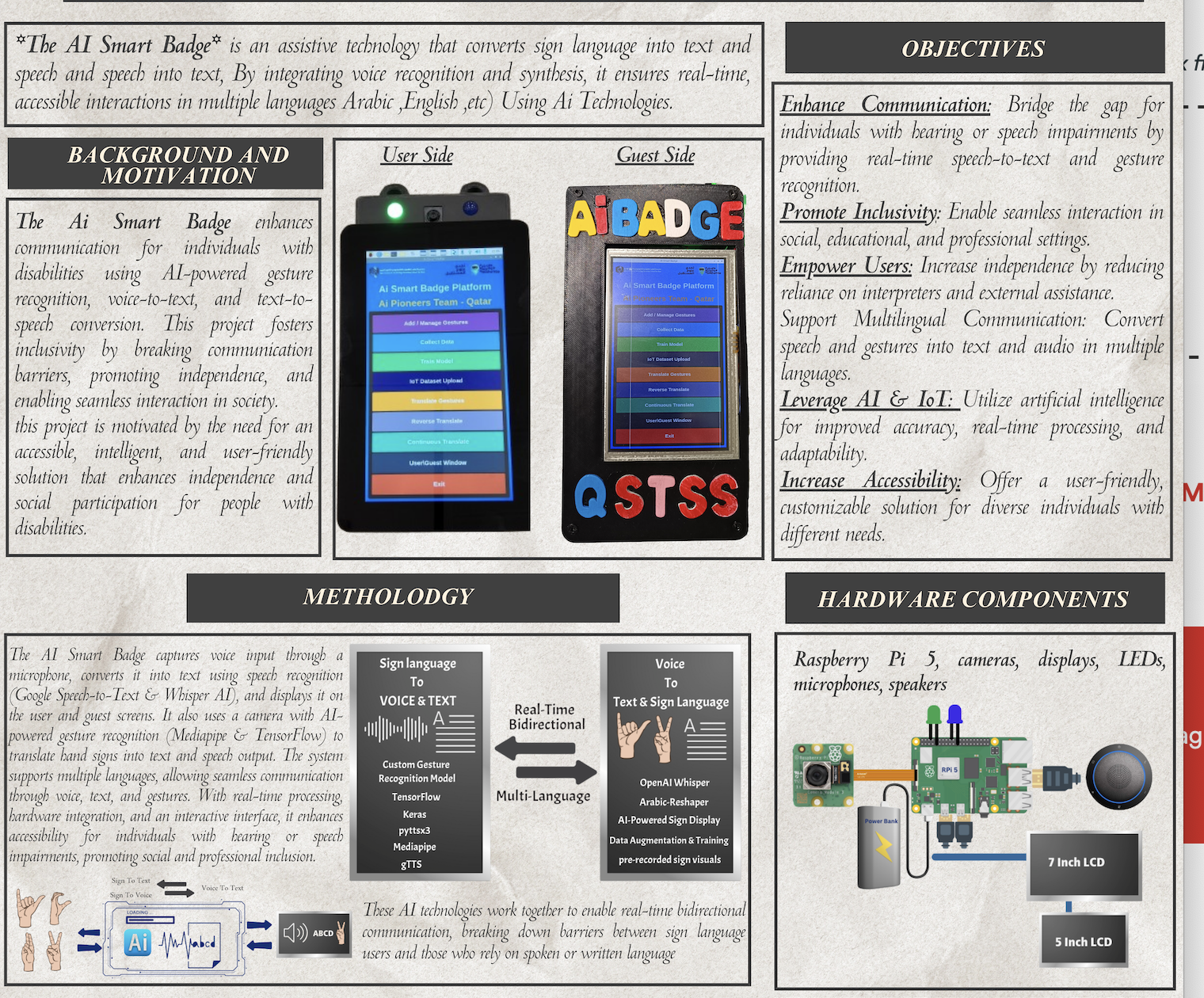
The AI Smart Badge is a portable, AI-powered wearable that bridges communication between sign language, text, and speech in real time. It empowers individuals with hearing or speech impairments to interact confidently in classrooms, workplaces, and public settings.
It recognizes sign language gestures and converts them into clear, spoken words. It listens to voice input and displays text for those who can't hear. It works both ways — like a translator between two worlds that have long been disconnected.
This badge isn't just smart — it's inclusive, gender-aware, and designed to meet the needs of people who are too often left behind by innovation.
How We Built It
We built the badge using:
- OpenCV for gesture and sign recognition
- Text-to-Speech (TTS) and Speech-to-Text (STT) engines
- A Raspberry Pi as the hardware brain
- Microphone and speaker modules for real-time interaction
- A lightweight front-end interface for display and settings
We trained the model using publicly available gesture datasets and optimized it to run on-device for mobility and speed. The design was intentionally kept minimal and wearable, so users wouldn’t feel like they were “carrying a device” — but instead, just wearing a badge like everyone else.
Challenges We Faced
- Training accurate gesture recognition across diverse hand shapes and lighting conditions
- Making the badge affordable and compact without sacrificing functionality
- Designing for gender inclusivity — considering how cultural factors affect who gets access to assistive technology
- Ensuring the voice and text output felt natural, respectful, and empowering, not robotic
The hardest part wasn’t technical. It was emotional: realizing how many people feel unseen, and how something simple could make them feel heard.
Accomplishments We’re Proud Of
- Built a fully working prototype that translates gestures and speech in real time
- Created a communication bridge that requires no app or extra setup
- Centered the needs of women and girls with disabilities, often ignored in accessibility design
- Sparked interest from teachers and disability advocates who tested early versions
What’s Next
- Expand support to other sign languages and regional dialects
- Improve hardware design for long-term use and comfort
- Launch a nonprofit toolkit version for schools and NGOs to build their own badges
- Partner with inclusive education networks to bring it to classrooms
- Translate the interface to Arabic, Portuguese, and Hindi — to reach broader communities
How It Aligns with the Theme
This project speaks directly to the heart of the GNEC Hackathon mission.
- SDG 10 – Reduced Inequalities: It removes a critical barrier — communication — that limits education, healthcare, and employment access for millions.
- SDG 5 – Gender Equality: It uplifts the voices of women and girls with disabilities, a group that is often doubly excluded. This badge is not just a tool — it is an act of recognition.
The AI Smart Badge gives people their voice back. In doing so, it gives them power, presence, and dignity.
Built With
- accessibility-design
- hardware
- integration
- numpy
- opencv
- python
- raspberry-pi
- real-time-gesture-recognition
- speech-to-text-(stt)
- speechrecognition
- text-to-speech-(tts)


Log in or sign up for Devpost to join the conversation.