Inspiration
Most "AI engineering calculators" are confident liars. Ask a chatbot for a beam deflection and it happily answers — but nothing verifies the number, and nothing checks it against the standards your field actually uses.
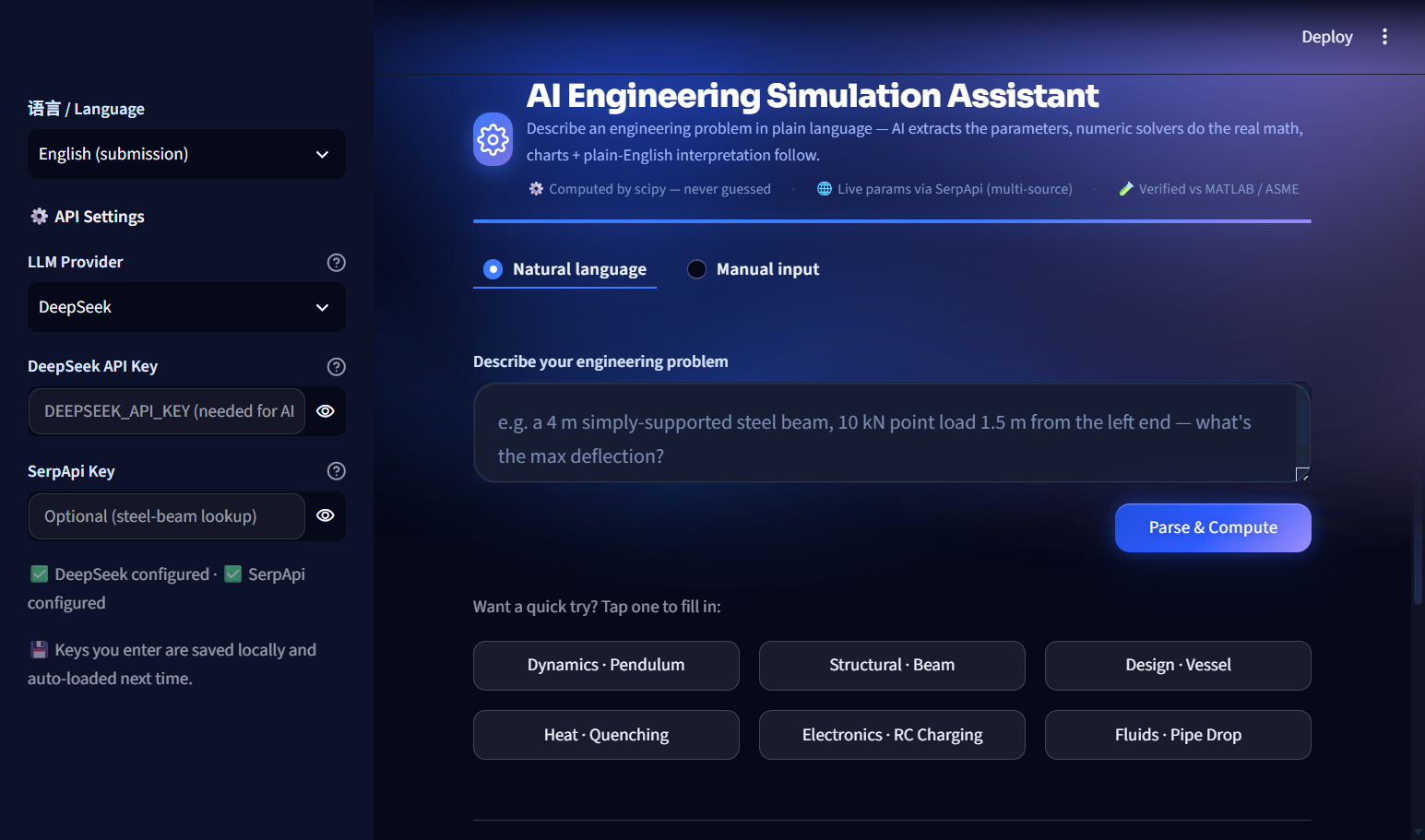
I wanted a different deal: **the AI should only organize the problem, never invent the math.*Describe an engineering problem in plain language, let the AI extract the parameters, hand them to a real numerical kernel (scipy), and then — the part nobody else does — check the answer against a benchmark the industry trusts: a MATLAB reference, an ASME formula, a physical constraint. Numbers are never guessed.
What it does
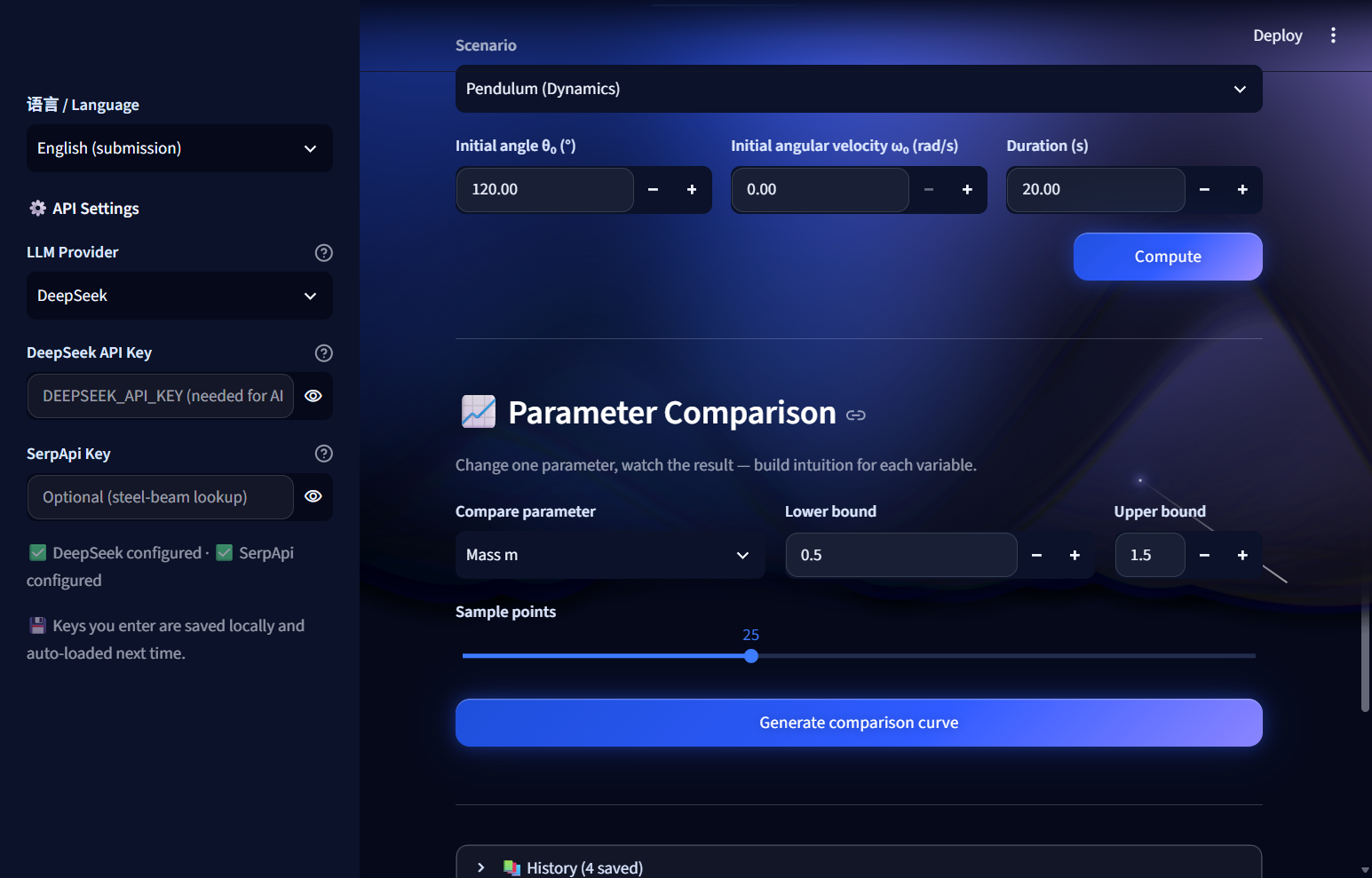
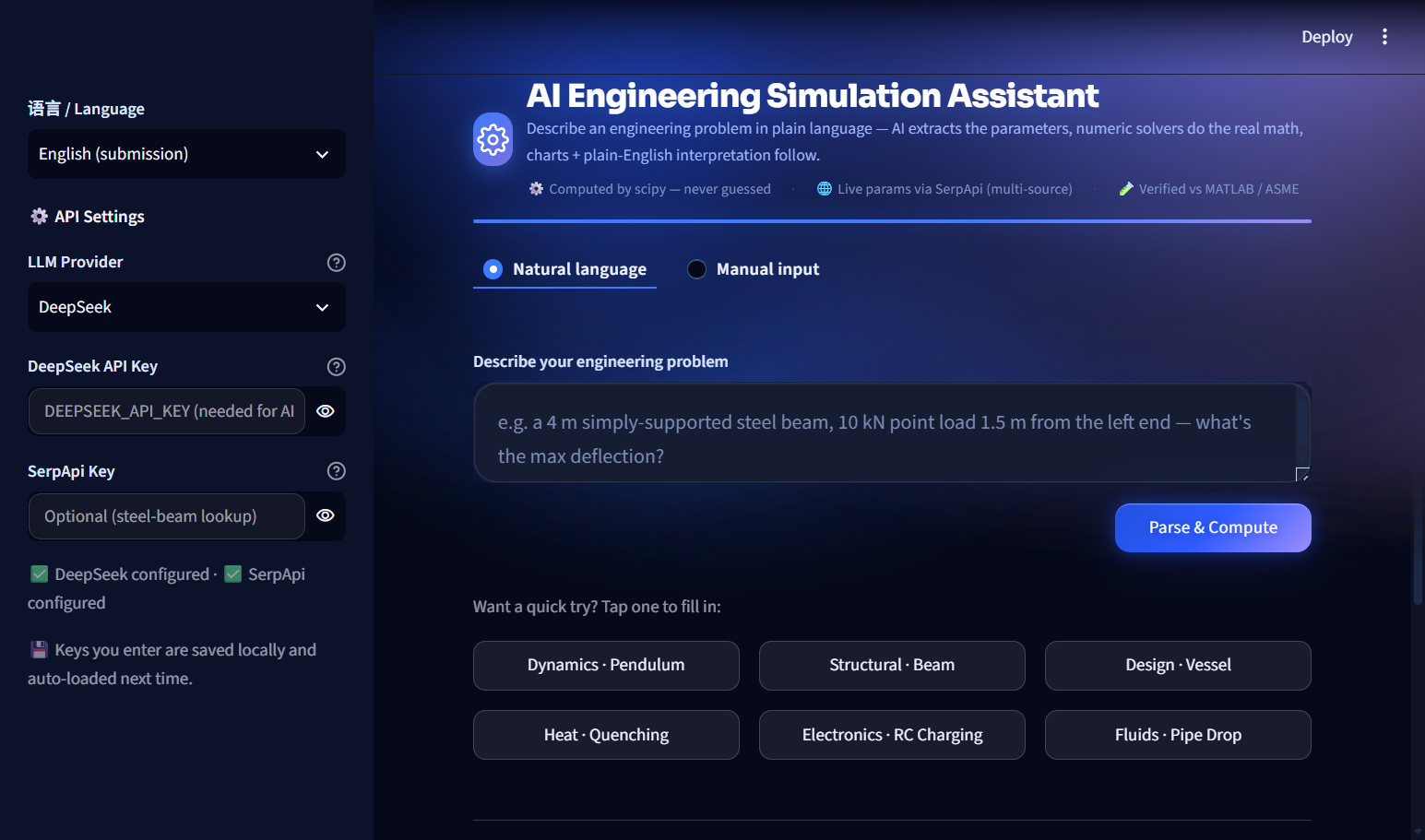
Six scenarios across four engineering domains: a pendulum (dynamics), steel quenching (heat transfer), a loaded steel beam (structures), a pressure vessel (design), an RC circuit (electrics), and pipe pressure drop (fluids).
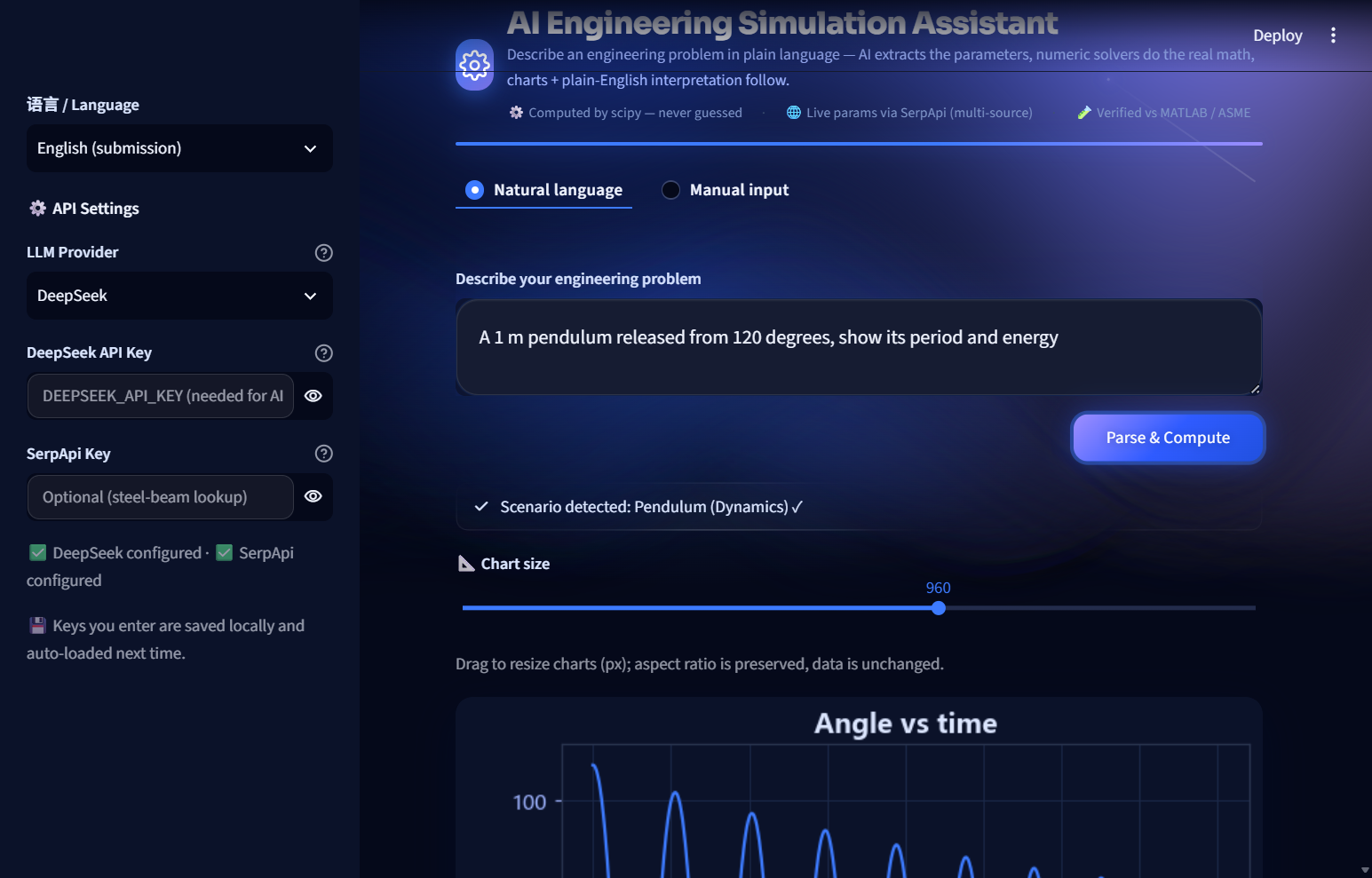
- Plain-language input** — "a 1 m pendulum released from 120°, show the period": the AI extracts the parameters via few-shot parsing.
- Real computation** — scipy integrates and solves; the LLM never touches the arithmetic.
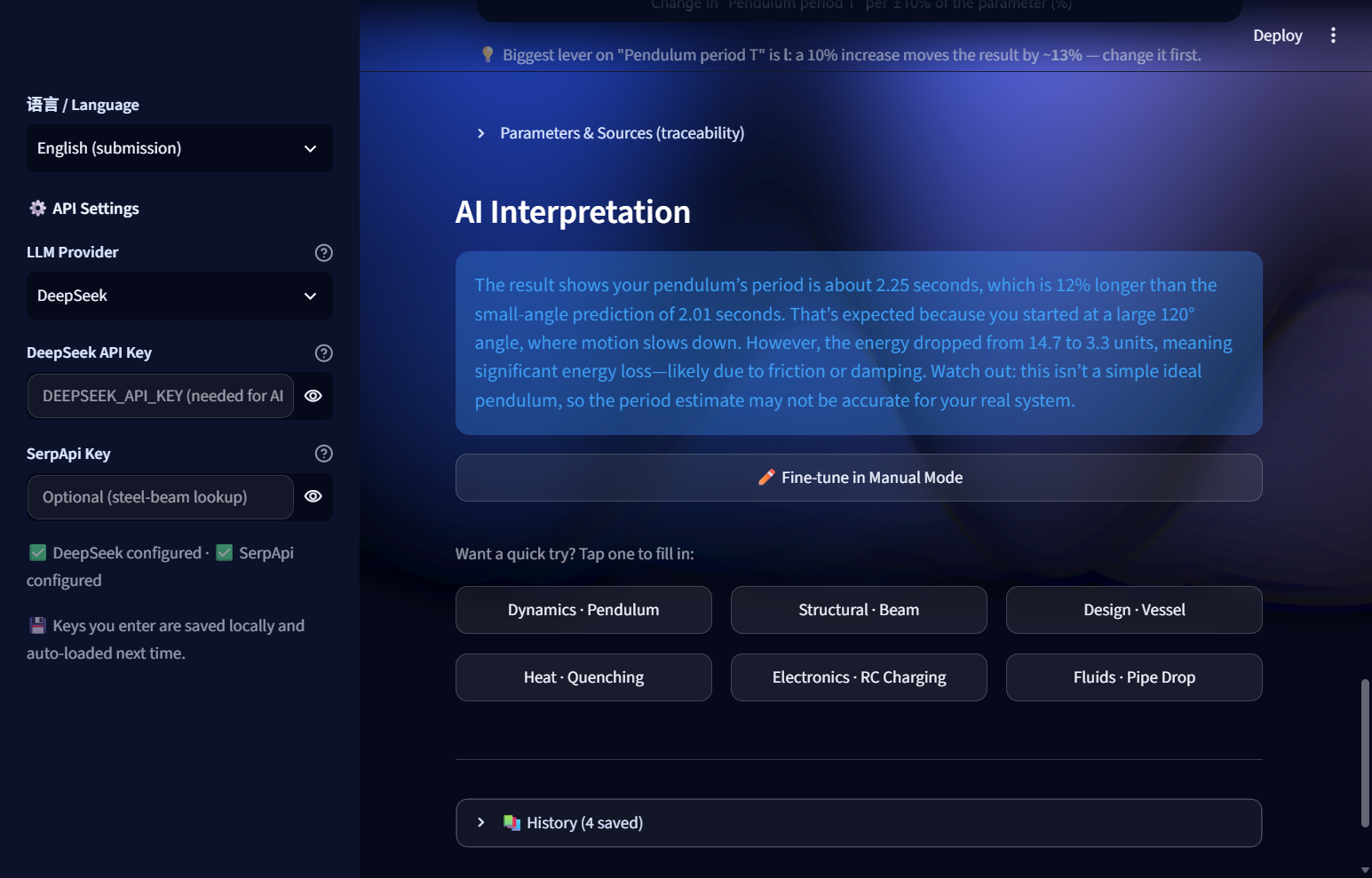
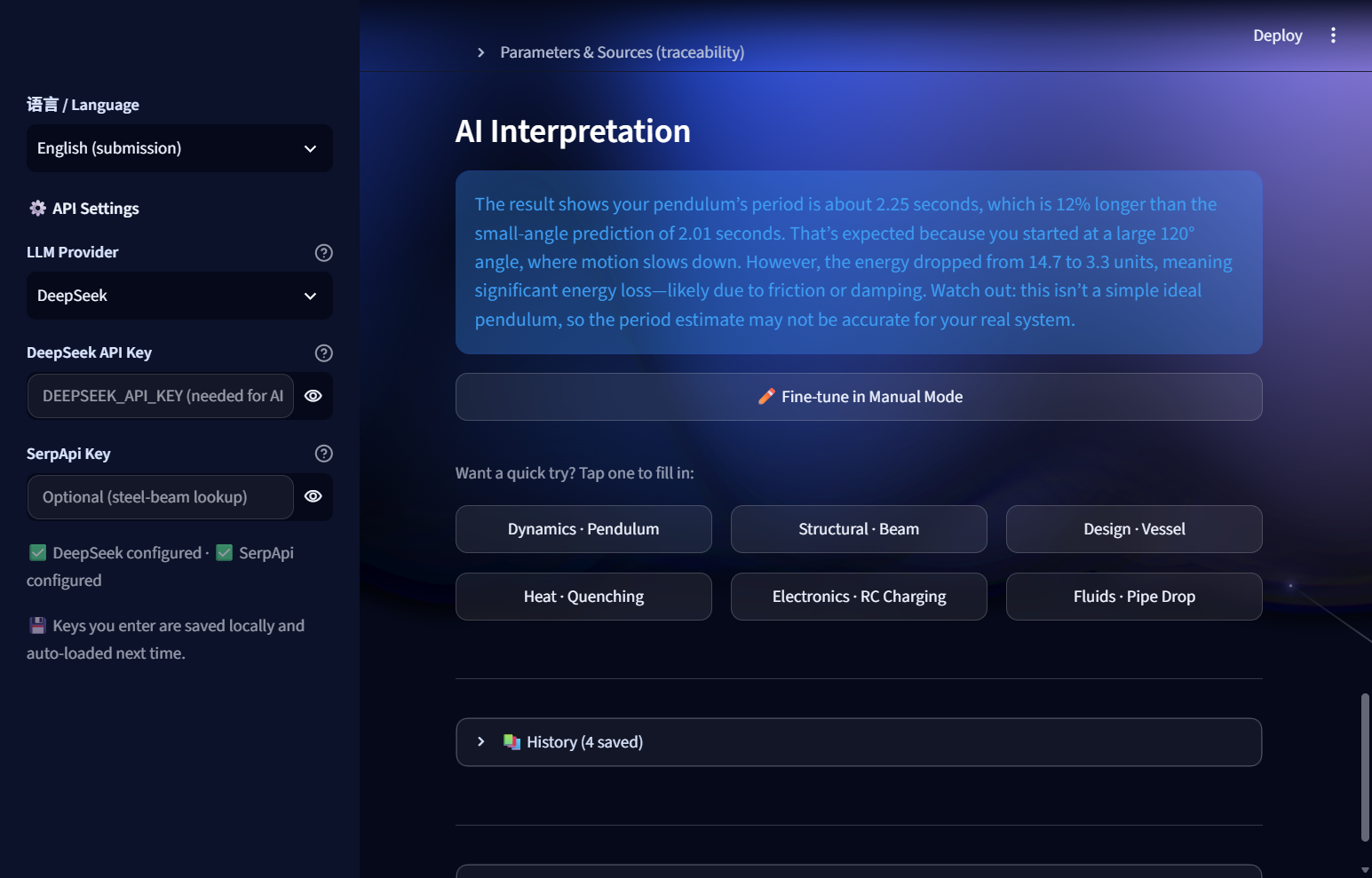
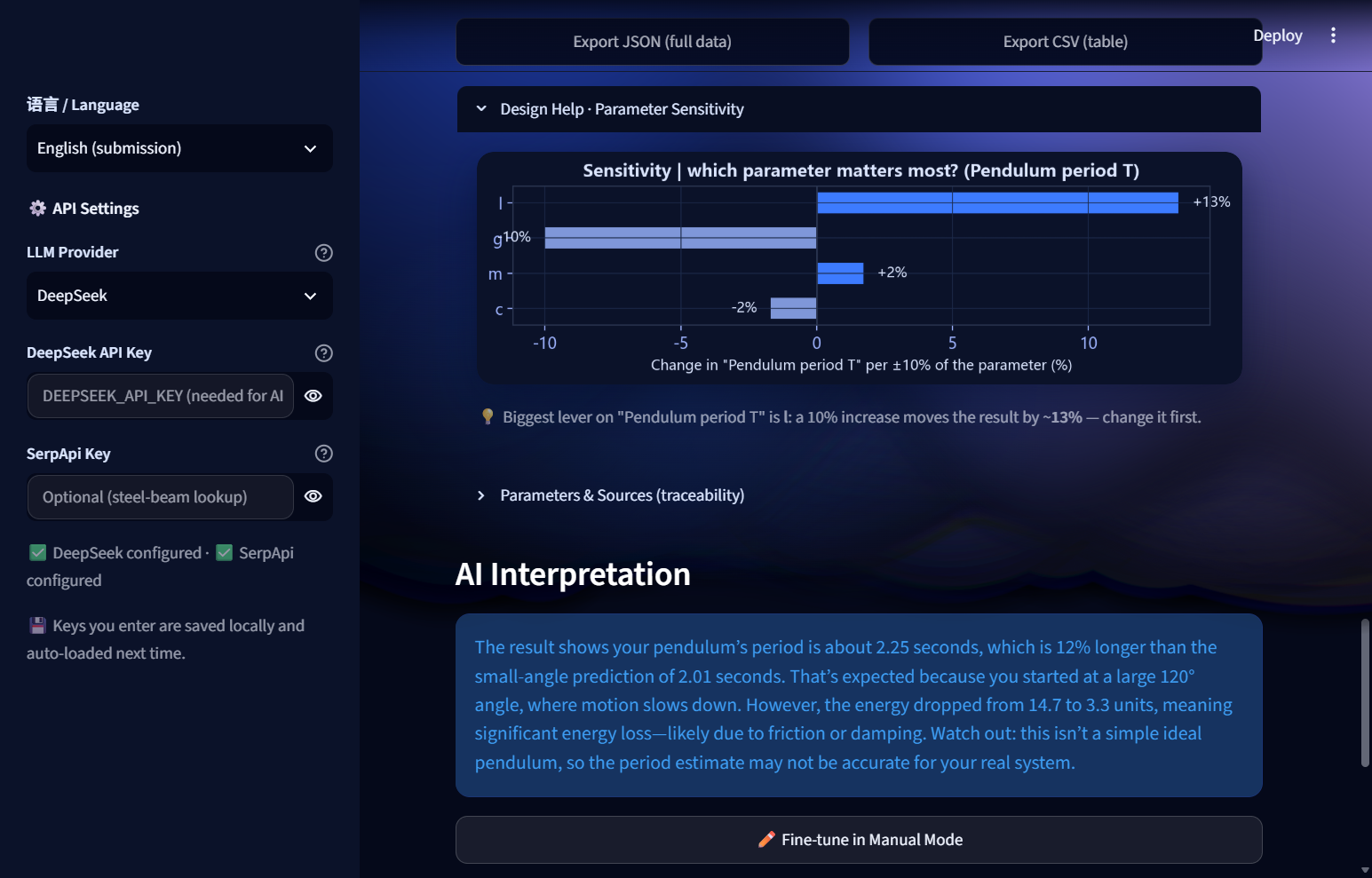
- Verification card on every result** — the large-angle pendulum shows physics check 1.123 > 1 ✓ (large-angle period is longer, as physics demands); the vessel wall is checked against the ASME thin-wall formula $t = PD/(2\sigma)$ with 0.00% deviation; the beam and quenching cases are benchmarked against MATLAB reference solutions.
- No guessing when data is missing** — omit a parameter and the AI asks for it, offering an engineering-sensible recommendation instead of inventing a number.
- Live parameter lookup** — typical material values (e.g. E = 200 GPa) are cross-checked online via SerpApi from multiple agreeing sources.
- Traceability** — every parameter is tagged "you provided / default / looked up online", and each result generates a shareable reproduction link carrying the exact scenario and parameters.
How I built it
Python + Streamlit front end; scipy ODE solvers and finite-difference kernels behind; an LLM layer (swappable: DeepSeek, OpenAI, Zhipu, Qwen, Kimi, SiliconFlow) restricted to parameter extraction; a verification layer encoding the industry baselines; SerpApi for live lookups; English/Chinese i18n. 190+ automated tests, including UI-level tests driving the one-click "apply the AI's suggestion" flow.
Challenges I faced
- Keeping the LLM out of the math** — the tempting shortcut is to let the model "compute"; I hard-restricted it to structured parameter extraction so every number has a numerical, auditable source.
- One parameter protocol, six solvers** — every scenario has different physics but shares the same parse → compute → verify pipeline.
- Streamlit state pitfalls** — applying the AI's suggested fix after a widget was already rendered threw a
StreamlitAPIException; a real red-screen bug found in a live demo, fixed by clearing the widget key and letting the form re-initialize, then locked in with a UI test. - Making verification honest** — benchmarks must come from real references (MATLAB runs, ASME standard formulas), not from the solver echoing itself.

Log in or sign up for Devpost to join the conversation.