-
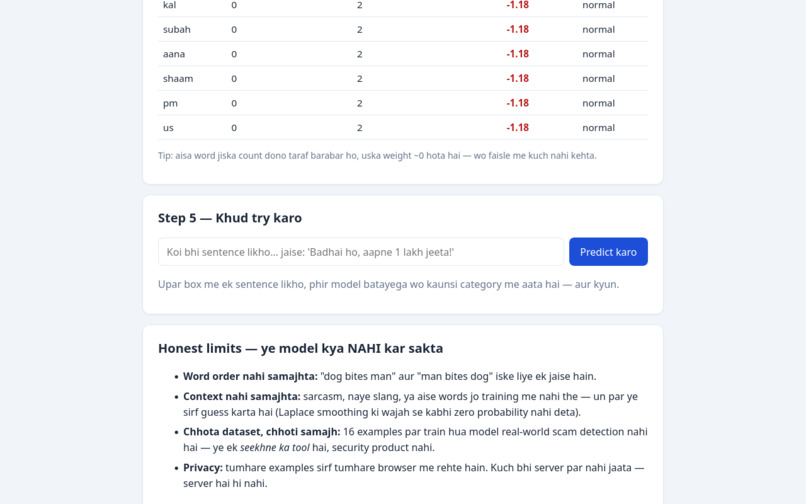
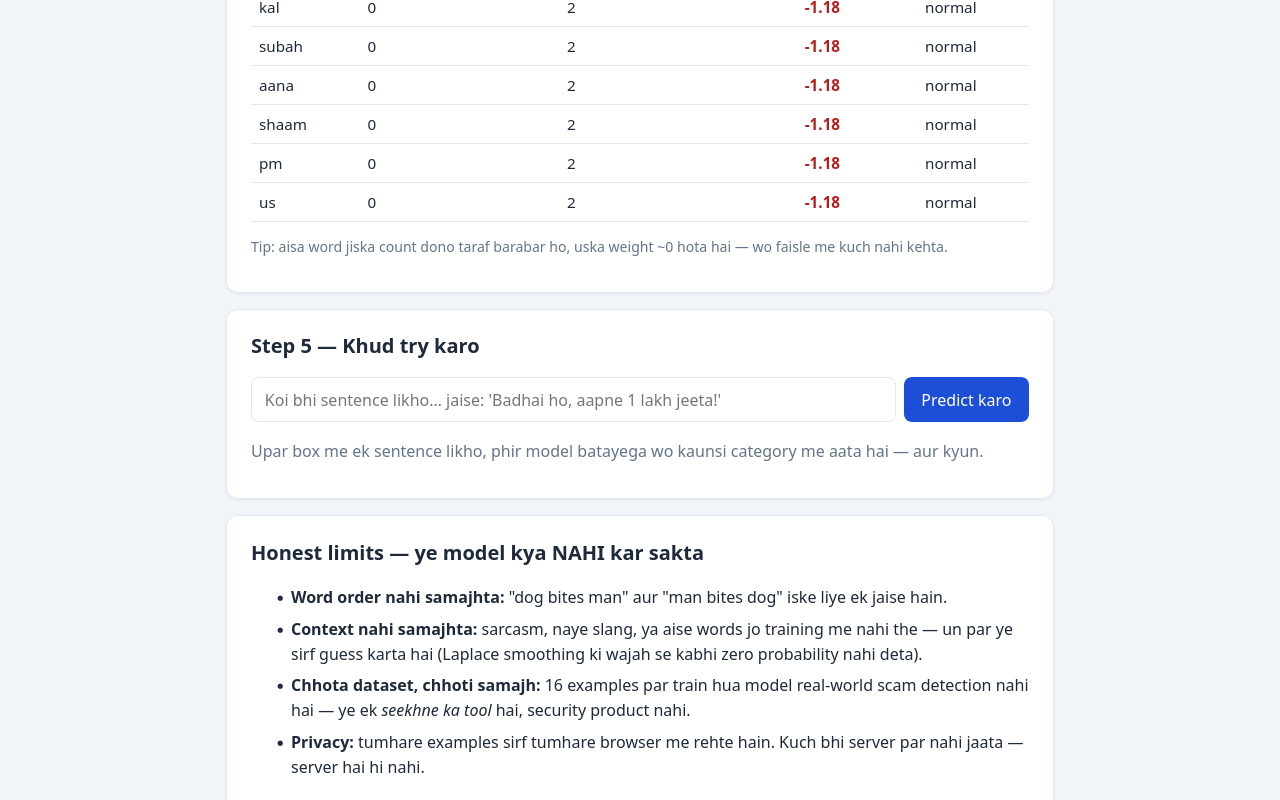
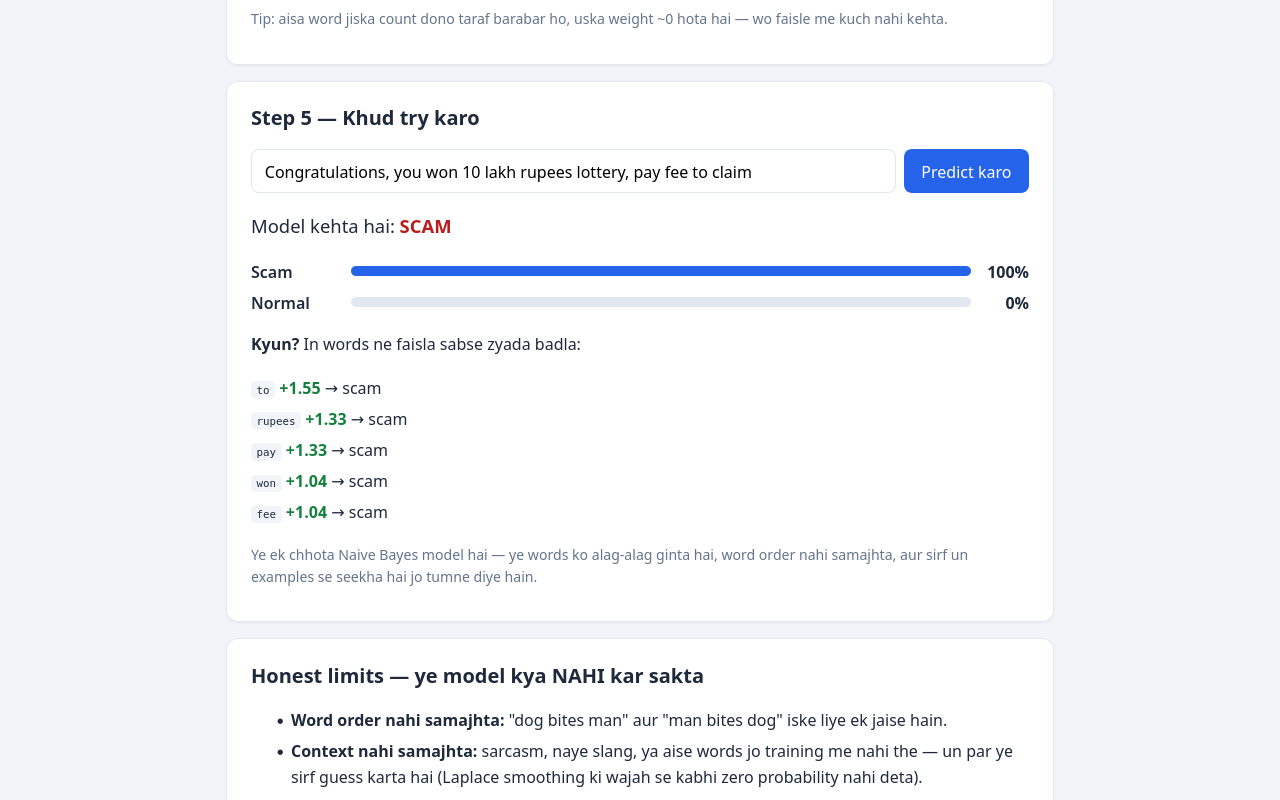
Word-weight table and prediction step
-
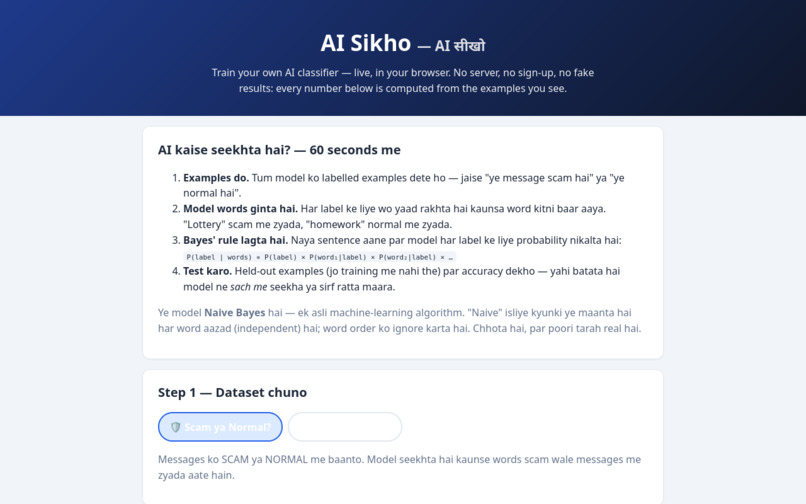
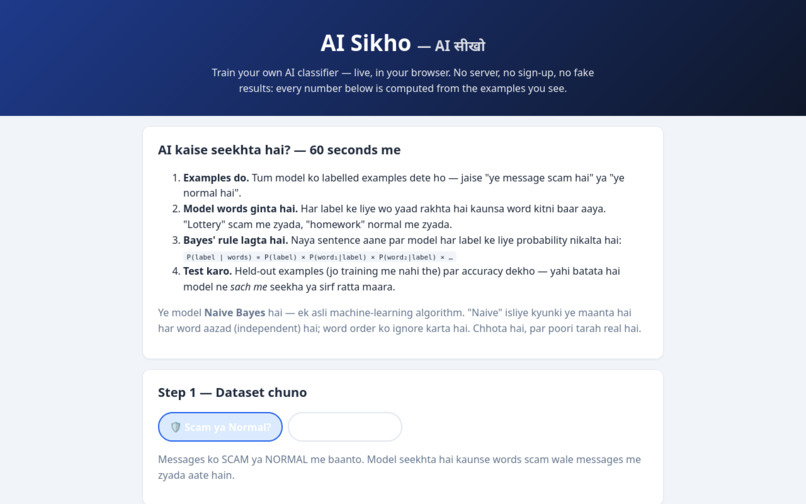
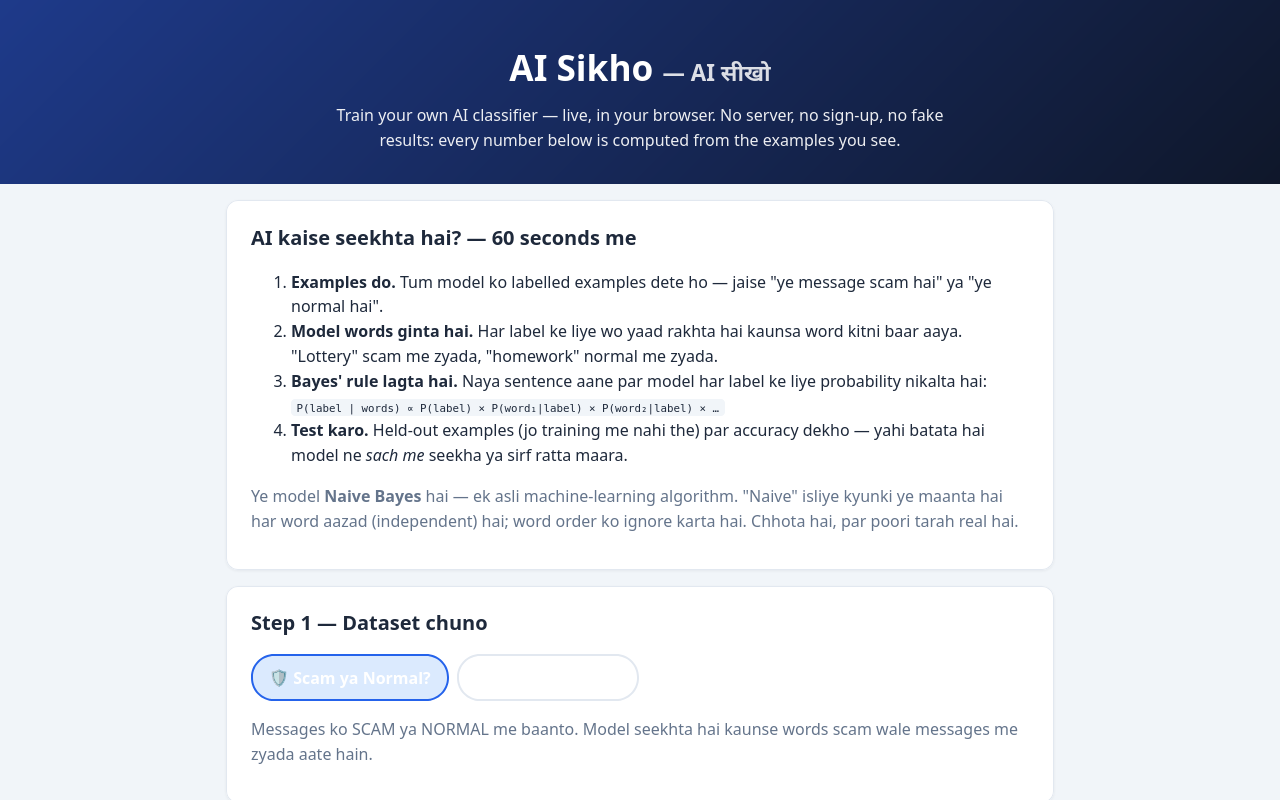
AI Sikho homepage
-
-
-
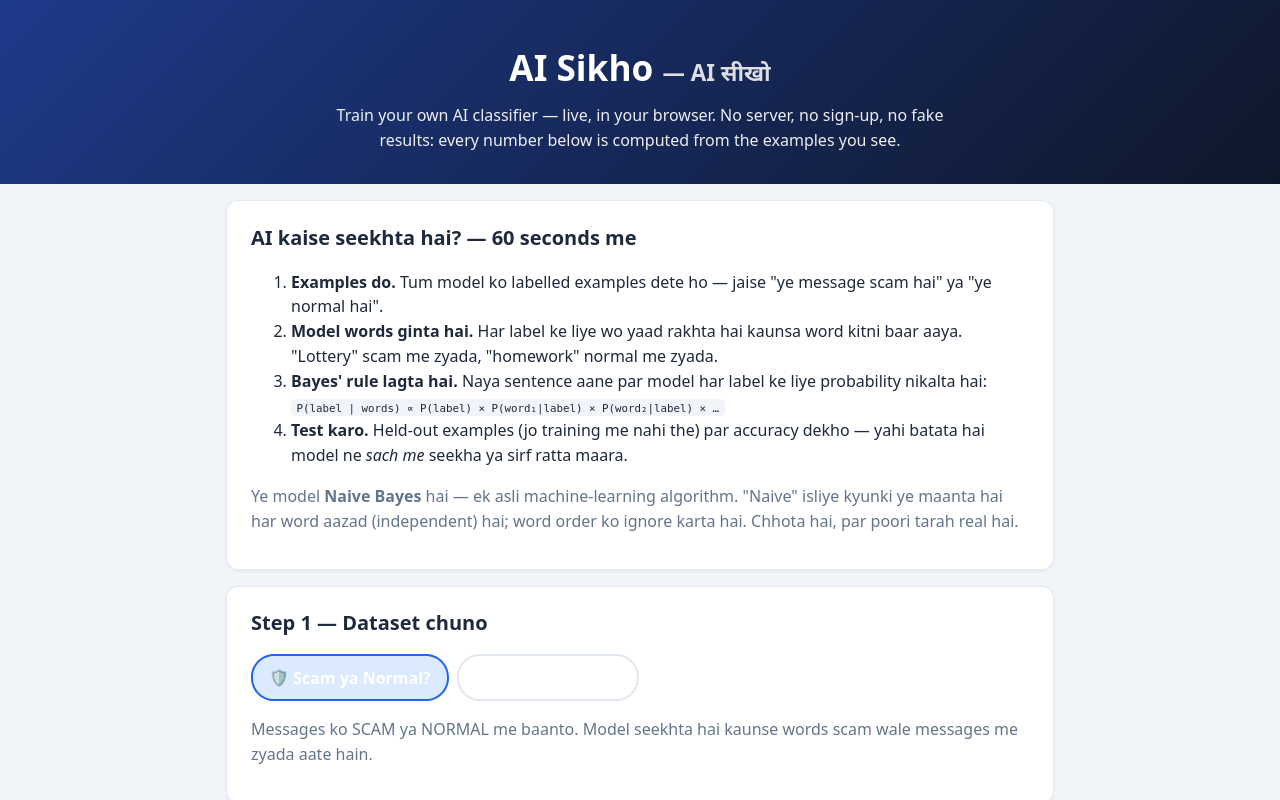
AI Sikho — Train Your Own AI Classifier
Tagline: Learn how AI really works by training a tiny classifier yourself — live in your browser, no server, no sign-up.
Try it out: Live app — https://devilking7x.github.io/ai-sikho/ · Source code — https://github.com/devilking7x/ai-sikho
Inspiration
Most "learn AI" tools either show you a black-box demo or ask you to trust a big model you can't see inside. A beginner never learns how the machine actually learns — what it counts, what it weighs, and where it goes wrong. AI Sikho (AI सीखो, "Learn AI") is the opposite: a playground where you train a real classifier yourself and watch every number move.
What it does
- Two Hindi/Hinglish/English datasets — sort messages into Scam vs Normal, or sentences into Khush (happy) vs Gussa (angry).
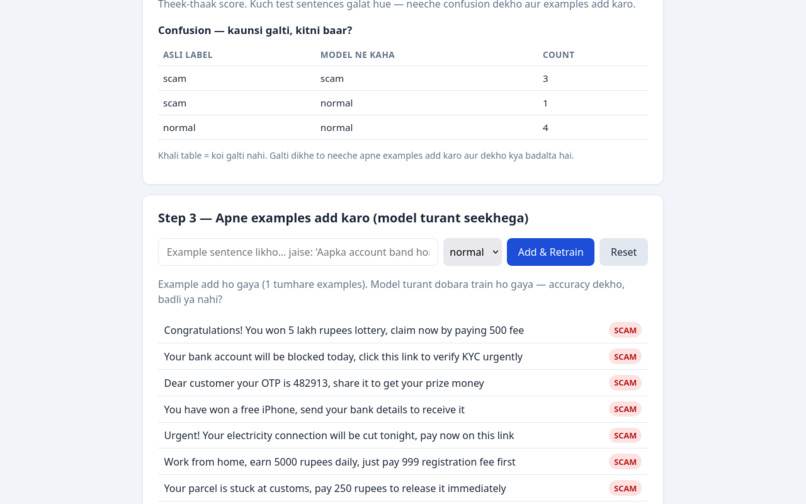
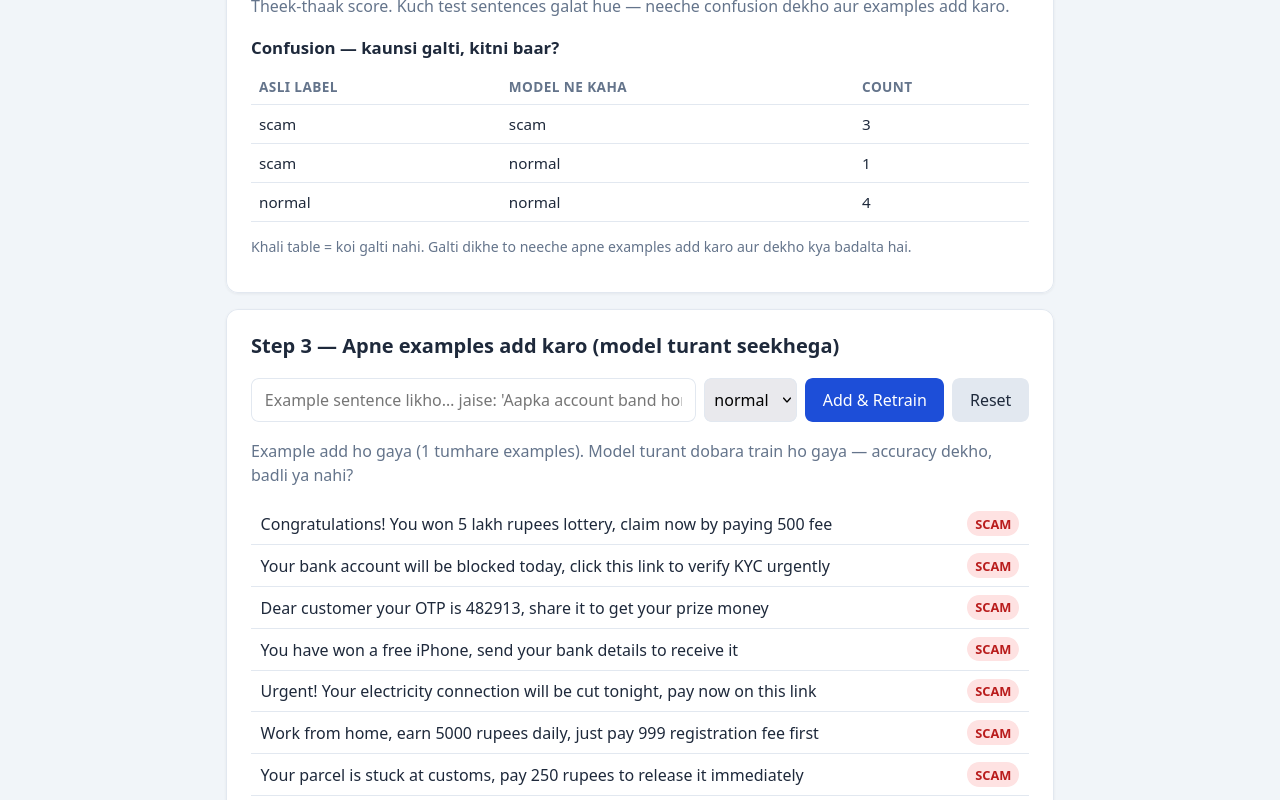
- Live scoreboard — every change retrains the model instantly. You see training size, vocabulary size, and accuracy on a held-out test set (examples the model never trained on), plus a confusion table showing exactly which mistakes it made.
- Add your own examples — type any sentence, label it, and watch accuracy move. A good example helps; a bad one hurts. That's learning, visible. A "Load sample progress" button adds 3 clearly-labelled sample examples (training count 16 → 19) so the learning loop is visible in one click, and Reset restores the starting point.
- Look inside the model — a word-weight table shows each word's log-odds weight, so you see why "lottery" screams scam and "homework" doesn't.
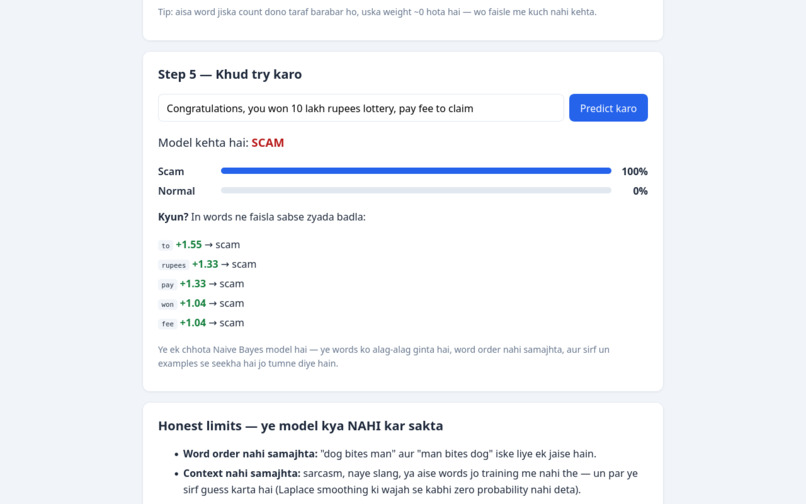
- Try any sentence — get a prediction with per-label probabilities and the top words that drove the decision, each with its individual contribution.
The AI, honestly: multinomial Naive Bayes with Laplace smoothing, implemented from scratch in ~150 lines of plain JavaScript (classifier.js). No API calls, no pre-trained black box, no fake results — every number on the page is computed from the examples you see. Seed accuracy is deliberately imperfect (scam set 7/8 = 88%, mood set 6/8 = 75%), because a tiny model trained on 16 examples genuinely is limited — and the app says so on the page, in a dedicated "Honest limits" section (bag-of-words, no word order, no sarcasm, not a real scam detector).
Who it helps: students and first-time AI learners — especially Hindi-first learners, who rarely get ML explainers in their own language mix. It runs fully offline once loaded, needs no account and no API key, and stores nothing: your examples never leave your browser.
How we built it
Plain HTML, CSS and JavaScript (ES modules). The classifier (classifier.js, ~150 lines) is a dependency-free module: tokenisation, per-class word counts with Laplace smoothing, softmax probabilities, and word log-odds weights. The UI (app.js) calls the same train/predict/evaluate functions the tests call, so the scoreboard numbers are the model's real numbers. Tests: 12 unit tests (npm test) plus a Playwright smoke test (npm run smoke).
Challenges we ran into
Devanagari tokenisation broke first. My tokenizer treated word characters as \p{L} (letters only) — but in Devanagari, combining marks like virama and nukta are \p{M} (marks), not letters, so words were being split mid-syllable and the model was learning fragments. A unit test caught it: a Hindi example tokenised into pieces that didn't match anything. The fix was to include \p{M} in the token pattern, and the test now pins Devanagari tokenisation explicitly. The second bug was quieter: some UI elements the smoke test expected had no IDs, so the test couldn't find them — the app worked, but it wasn't testable. Adding the missing IDs made the page verifiable, which is the whole point of this app.
Accomplishments that we're proud of
- A real classifier a beginner can train, break, and fix — with the accuracy moving live as they add examples.
- A word-weight table that makes Bayes' rule visible: you can literally see "lottery" pushing toward scam.
- Honest seed accuracy (88% / 75%) shown on the page instead of a flattering number — the imperfection is the lesson.
- Devanagari tokenisation done correctly (virama/nukta as combining marks), tested and pinned.
- 12/12 unit tests passing, plus a Playwright smoke test.
What we learned
- How Bayes' rule turns word counts into probabilities, why Laplace smoothing exists (so an unseen word never means zero probability), and why a held-out test set is the only honest accuracy.
- That tokenisation is where multilingual ML actually breaks — the maths was easy, the Devanagari combining marks were the real bug.
- That a learner understands "training" the moment they see one bad example hurt accuracy: the feedback loop is the teacher.
What's next for AI Sikho
- A third dataset (e.g. positive vs negative movie reviews in Hinglish) so learners see the same method on a different problem.
- A "confusion explorer" that lets you click a wrong test prediction and see exactly which words misled the model.
- A short guided lesson path (5 steps with checkmarks) that walks a first-time learner from "what is training data" to "I trained a model" — the sample-progress button is the first piece of that path.
Built With
HTML, CSS, JavaScript (ES modules), Node.js 20, Playwright
Testing instructions (for judges)
- Open the live link — no install, no sign-up. The scoreboard shows 16 training examples, 8 held-out test examples, and accuracy (scam set: 7/8 = 88%).
- Click "Load sample progress" — 3 labelled sample examples are added (training count 16 → 19) and the scoreboard retrains live. Click Reset to restore the starting point.
- Scroll to Step 5 — Khud try karo, type
Congratulations, you won 10 lakh rupees lottery, pay fee to claimand click Predict karo — it predicts SCAM with probabilities and the words that decided it. - In Step 3, add your own example (e.g.
Kal subah school ki chhutti haiasnormal) and watch the training count go up and the model retrain instantly. - Switch to the Khush ya Gussa? tab and try
I am so happy, I passed my exam— it predicts KHUSH. - Run the tests yourself:
git clone https://github.com/devilking7x/ai-sikho,npm install,npm test(12 unit tests) andnpm run smoke(Playwright browser test).
Built With
- css
- html
- javascript
- node.js
- playwright
