Inspiration
Communication between deaf or hearing-impaired people and others is difficult because many people do not understand sign language.
Millions of people rely on sign language for daily communication, but interpreters are not always available.
We wanted to use Artificial Intelligence and Computer Vision to build a tool that bridges this communication gap.
The goal was to create a simple and accessible real-time translator using only a webcam.
What it does
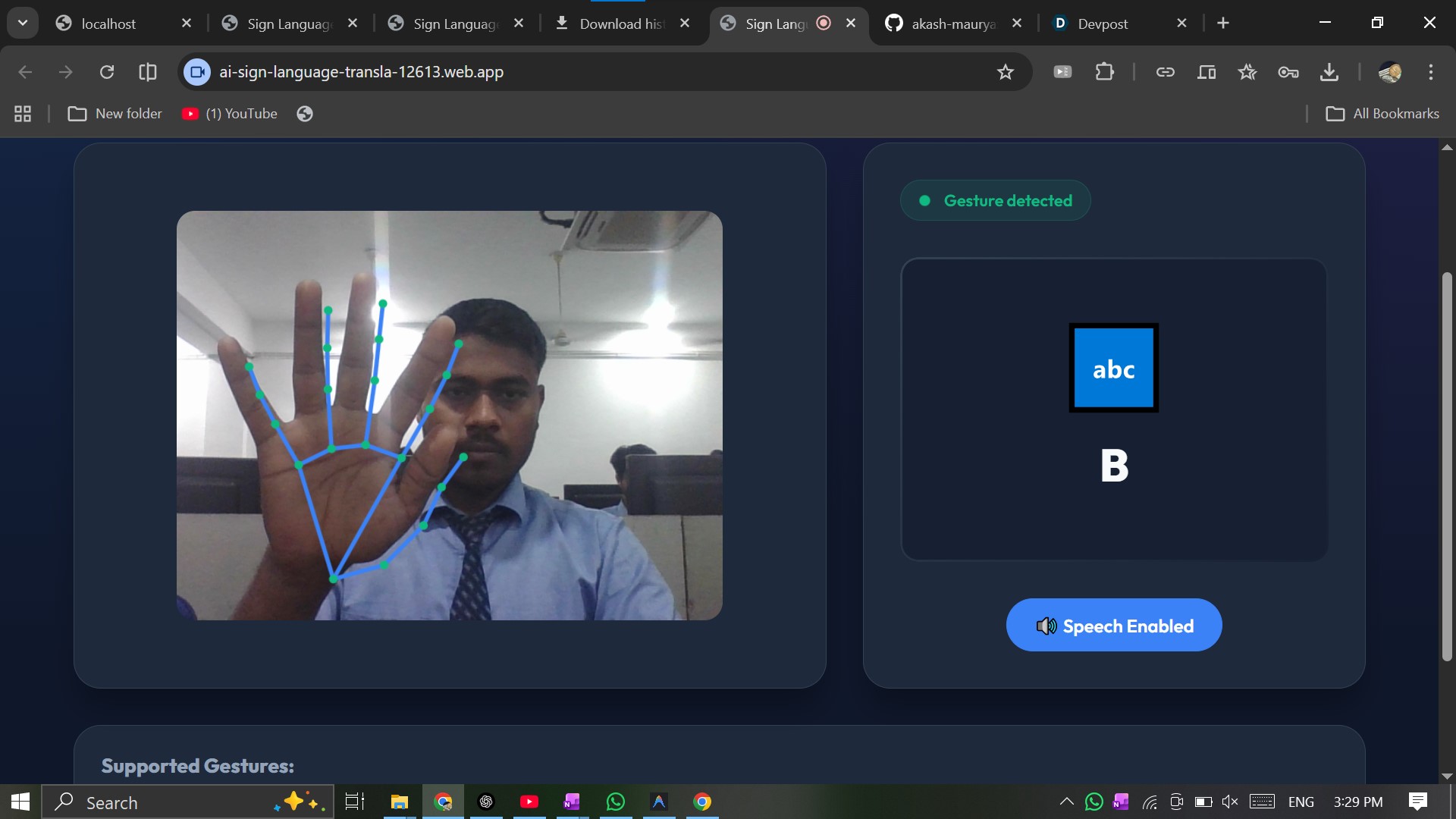
The system detects hand gestures using a webcam.
It recognizes sign language gestures using AI models.
The recognized gesture is converted into text on the screen.
The tool enables real-time communication between sign language users and non-signers.
It can also be extended to convert text into speech output.
How we built it
Used Python as the main programming language.
Used OpenCV to capture video from the webcam and process images.
Used MediaPipe to detect hand landmarks and track finger positions.
Extracted gesture features from the detected hand landmarks.
Trained a machine learning model to classify different sign gestures.
Built a simple interface that displays recognized gestures as text in real time.
Challenges we ran into
Detecting hands accurately under different lighting conditions.
Training the model with a limited dataset of gestures.
Handling different hand sizes and gesture variations between users.
Ensuring real-time performance without lag.
Reducing false predictions when gestures are unclear.
Accomplishments that we're proud of
Successfully built a real-time AI gesture recognition system.
Created a tool that can help improve accessibility for deaf individuals.
Integrated computer vision and machine learning into a practical application.
Achieved accurate gesture detection using a simple webcam setup.
Built a working prototype within a short development time.
What we learned
How computer vision works for hand tracking and gesture detection.
How MediaPipe hand landmarks can be used for gesture recognition.
Experience with training and using machine learning models.
How to optimize AI systems for real-time performance.
The importance of designing technology for social impact.
What's next for AI Sign Language Translator
Add support for full words and sentences instead of only letters.
Improve model accuracy using a larger dataset of gestures.
Add speech output so the system can talk.
Build a mobile application version.
Support multiple sign languages.
Integrate with video call platforms for real-time translation.


Log in or sign up for Devpost to join the conversation.