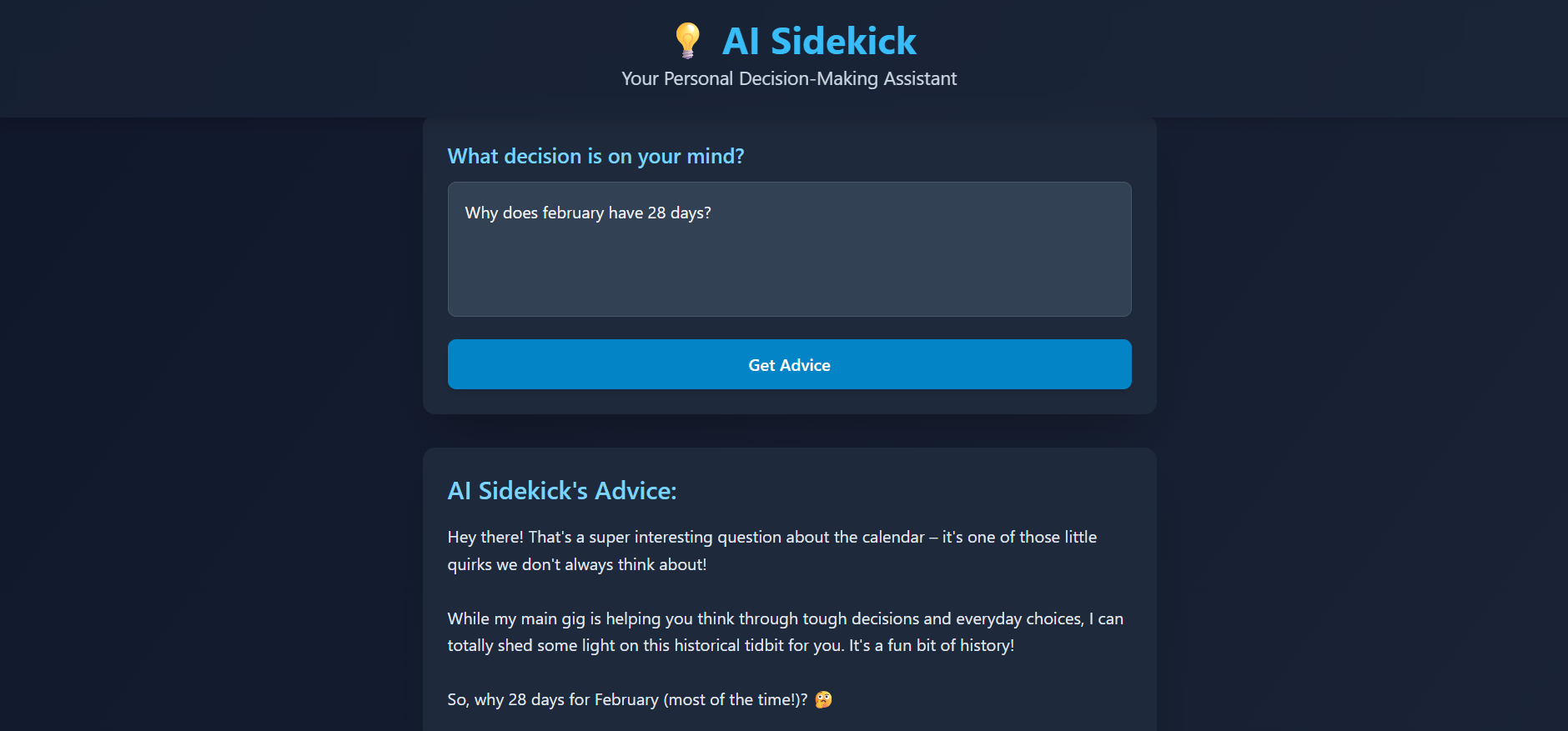
We were inspired by the idea that people make dozens of small decisions every day—what to eat, when to take breaks, how to plan their time—and these choices, while seemingly minor, collectively impact health, productivity, and happiness. We wanted to build an AI-powered sidekick that doesn't just answer questions, but understands context and gives thoughtful, personalized recommendations—almost like a real assistant, but smarter and always available.
What it does
We explored how large language models can not only answer questions but also explain decisions, which adds a layer of trust and clarity.
Integrating multiple AI modalities: We learned how to blend structured ML (for user modeling), deep learning (for NLP and computer vision), and real-time data streams to create a cohesive experience.
Balancing automation and control: We gained insights into how much autonomy to give the AI versus how much input to ask from the user to avoid overwhelming or under-informing them.
How we built it
We used Python with FastAPI as the backend and Streamlit for a lightweight, interactive frontend.
For the recommendation engine, we used a basic user preference model that adapts based on user input and context (e.g., time, simulated location, calendar events).
We used an LLM (e.g., GPT or Claude via Amazon Bedrock) to reason over context and generate user-friendly suggestions and explanations.
Optionally, we built a vision module using OpenCV and a pretrained image classifier to analyze food items from photos and provide health nudges.
Real-time data like weather and calendar were simulated or fetched using APIs to add contextual intelligence.
Challenges we ran into
Accomplishments that we're proud of
What we learned
Context handling: One major challenge was maintaining a conversation state and context across user interactions, especially when combining LLMs with real-time APIs.
Latency and LLM calls: LLMs are powerful but slow and sometimes inconsistent. We had to balance speed and quality by caching and simplifying prompts.
Scope control: It was tempting to keep adding features, but we learned to focus on solving one user problem really well—daily micro-decisions—rather than trying to be a full general assistant.
Data privacy concerns: We were conscious of handling personal data (like calendar or habits), so we focused on keeping everything local or anonymized during the hackathon.
What's next for AI Sidekick for Everyday Decisions
Built With
- api
- llm
- python

Log in or sign up for Devpost to join the conversation.