-
-
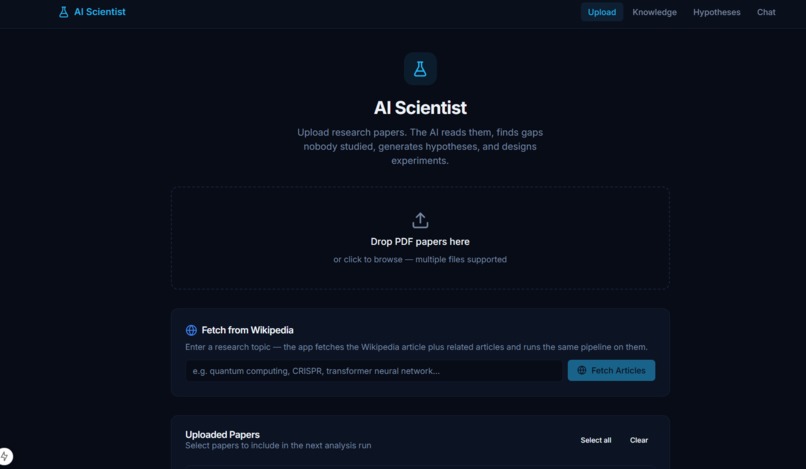
Dashboard
-
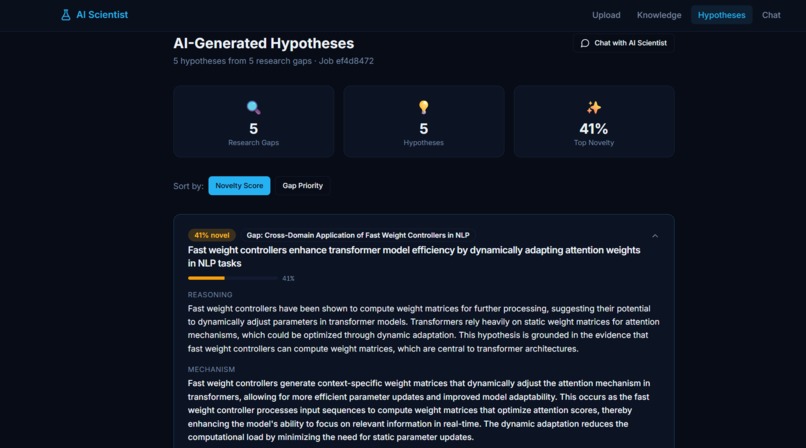
AI-Generated Hypotheses
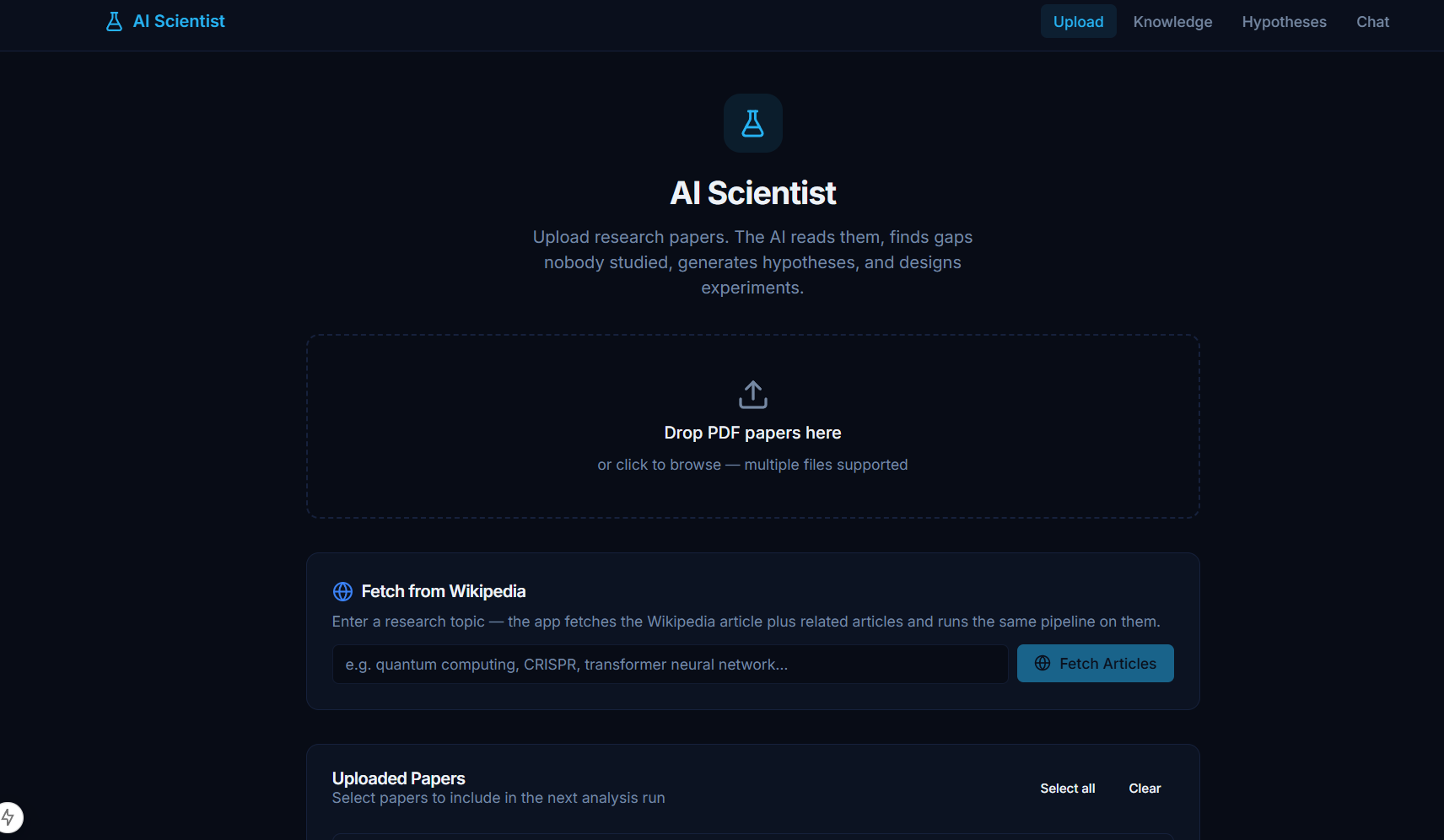
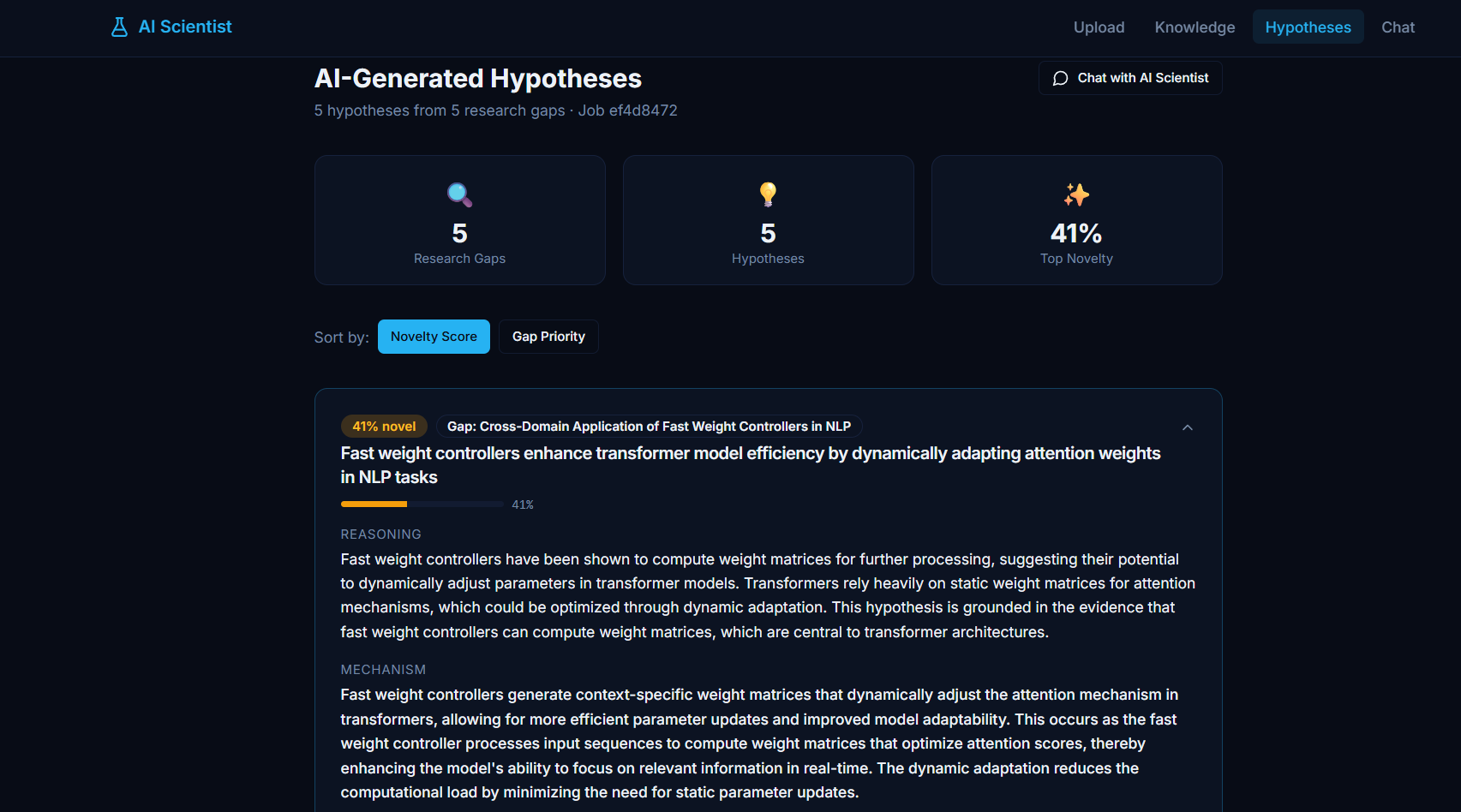
AI Scientist
Inspiration
Scientific progress is humanity's greatest engine of innovation, yet the process of discovery remains painfully slow. Every year, millions of research papers are published across medicine, physics, chemistry, biology, and engineering. No single researcher can read, connect, and reason over all this knowledge, leaving countless discoveries hidden between disciplines.
Rather than asking, "How can AI help scientists write papers faster?", we asked a much bigger question:
What if AI could become a scientist?
Our vision was to build the first prototype of an Autonomous Scientific Discovery Engine—an AI system capable of reading scientific literature, identifying unexplored research opportunities, generating novel hypotheses, and designing experiments that could accelerate humanity's pace of discovery.
Instead of creating another AI assistant, we wanted to prototype the future of scientific research.
What it does
AI Scientist transforms scientific literature into actionable discoveries through an autonomous multi-agent workflow.
The platform allows users to upload research papers or simply enter a research topic. The system automatically gathers relevant knowledge, analyzes relationships between concepts, detects unexplored research gaps, generates original scientific hypotheses, designs complete experimental procedures, and evaluates each idea using novelty, feasibility, and impact scores.
The platform includes:
- Research paper and Wikipedia knowledge ingestion
- AI-powered knowledge extraction
- Interactive scientific knowledge graphs
- Autonomous research gap detection
- Novel hypothesis generation
- AI-designed experimental methodologies
- Novelty and feasibility scoring
- Impact prediction
- Retrieval-Augmented Generation (RAG) chat interface
- Future Discovery Simulator for forecasting emerging scientific directions
Rather than answering existing scientific questions, AI Scientist attempts to generate entirely new ones.
How we built it
We designed AI Scientist as a modular multi-agent system where each component performs a specialized scientific reasoning task.
The frontend was built using Next.js, TypeScript, Tailwind CSS, shadcn/ui, and React Flow to provide an interactive research environment and visualize scientific knowledge graphs.
The backend was developed with FastAPI, exposing REST APIs for document processing, hypothesis generation, experiment design, and AI orchestration.
Scientific papers are processed using PyMuPDF for text extraction, chunked with LangChain, embedded using OpenAI Embeddings, and indexed in Qdrant to enable semantic retrieval.
Multiple AI agents orchestrated through LangGraph perform sequential reasoning tasks:
- Research Reader
- Knowledge Extractor
- Gap Detector
- Hypothesis Generator
- Experiment Designer
- Novelty Analyzer
- Impact Predictor
The application stores structured scientific information in PostgreSQL, while the RAG pipeline enables users to interact conversationally with generated discoveries using the OpenAI API.
The result is a complete end-to-end prototype demonstrating how autonomous scientific reasoning could function in the future.
Challenges we ran into
The biggest challenge wasn't building an AI chatbot—it was modeling the scientific discovery process itself.
Unlike summarization tasks, scientific discovery requires multiple layers of reasoning:
- Understanding research papers
- Extracting meaningful scientific concepts
- Building relationships between ideas
- Identifying genuine research gaps
- Generating plausible hypotheses
- Designing realistic experiments
Another major challenge was reducing hallucinations. Scientific reasoning requires evidence-backed outputs, so we incorporated Retrieval-Augmented Generation (RAG), structured prompts, and semantic search to ground the AI's reasoning in uploaded literature.
Designing an autonomous multi-agent workflow that remained coherent across multiple reasoning stages while producing consistent outputs was another significant engineering challenge.
Accomplishments that we're proud of
We successfully built a working prototype demonstrating that AI can move beyond information retrieval and participate in the earliest stages of scientific discovery.
Some of our favorite achievements include:
- Building an autonomous multi-agent scientific reasoning pipeline
- Generating research hypotheses instead of simple summaries
- Automatically designing scientific experiments
- Creating interactive scientific knowledge graphs
- Implementing novelty, feasibility, and impact scoring
- Supporting both PDF-based research and topic-based knowledge ingestion
- Delivering an end-to-end prototype that transforms raw scientific literature into potential future discoveries
More importantly, we shifted the conversation from "AI for research assistance" to "AI for scientific discovery."
What we learned
Building AI Scientist fundamentally changed how we think about artificial intelligence.
We realized that the true bottleneck in science is no longer access to information—it is our ability to synthesize knowledge across disciplines and discover entirely new ideas.
We also learned the importance of multi-agent architectures, Retrieval-Augmented Generation, semantic search, knowledge representation, and structured reasoning when solving complex research problems.
Most importantly, we learned that AI's greatest contribution to science may not be replacing researchers, but expanding humanity's collective capacity for discovery.
What's next for AI Scientist
This prototype represents only the first step toward autonomous scientific discovery.
Future versions of AI Scientist will include:
- Integration with arXiv, PubMed, Semantic Scholar, and Crossref
- Large-scale scientific knowledge graphs spanning multiple disciplines
- Autonomous literature reviews across millions of papers
- AI-to-AI collaboration between specialized scientific agents
- Physics and chemistry simulation engines for virtual experimentation
- Laboratory robotics integration for automated experiment execution
- Continuous self-improving hypothesis generation through experimental feedback
- Collaboration tools enabling researchers and AI scientists to co-discover breakthroughs
- Personalized AI research collaborators for every scientist
Our long-term vision is ambitious:
A future where millions of AI Scientists work alongside humanity, continuously reading, reasoning, hypothesizing, and experimenting—accelerating scientific progress by orders of magnitude and helping solve humanity's greatest challenges in medicine, climate, energy, and beyond.
We believe the future of science isn't just AI-assisted.
It's AI-driven discovery.
Built With
- docker
- docker-compose
- fastapi
- langchain
- langgraph
- next.js
- openai-api
- openai-embeddings
- postgresql
- pydantic
- pymupdf
- python
- qdrant
- rag
- react
- react-flow
- shadcn-ui
- tailwind-css
- tanstack-query
- typescript
- uvicorn
- zustand

Log in or sign up for Devpost to join the conversation.