AI ScamShield – Smart Fraud Detection
💡 Inspiration
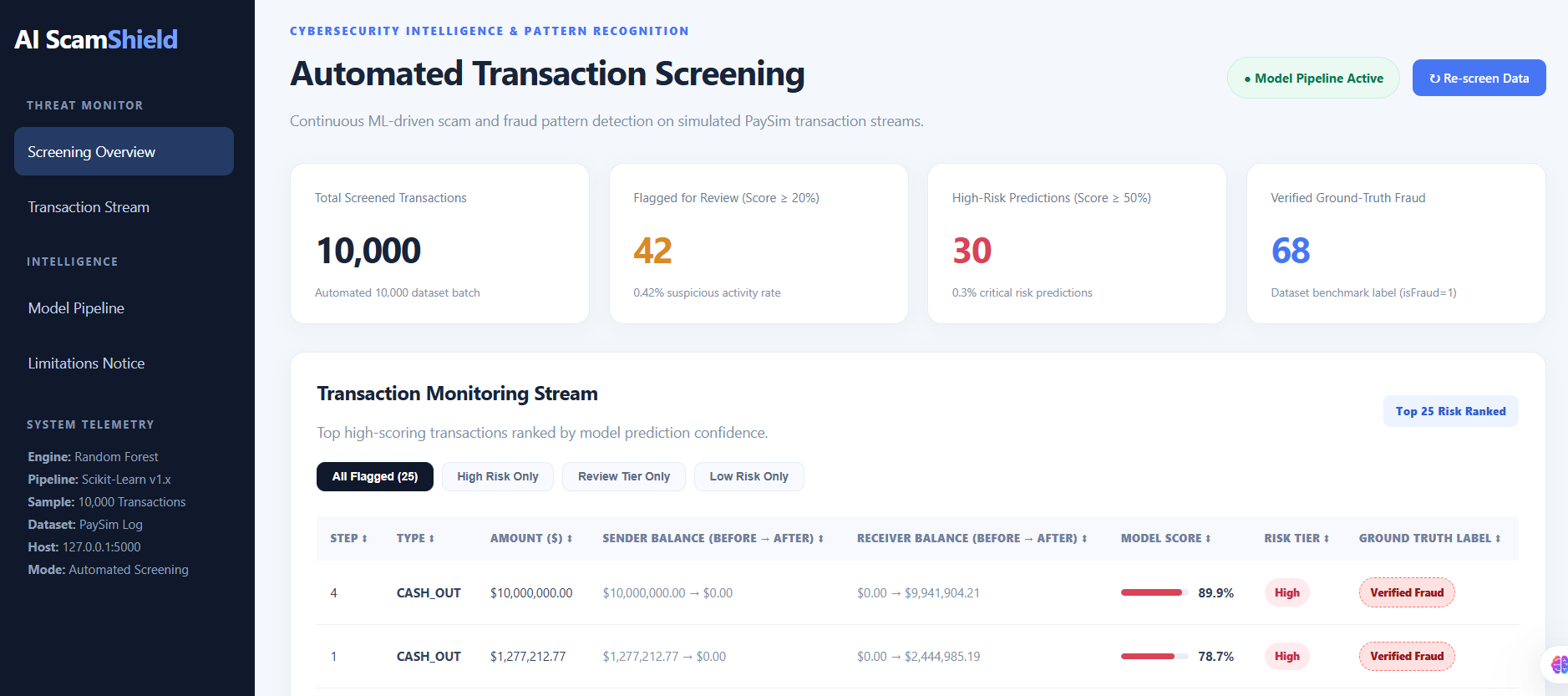
Online financial fraud is a growing concern, and suspicious transactions can be difficult to identify manually. We wanted to explore how machine learning could help detect potentially fraudulent transactions and make transaction monitoring easier. This inspired us to build AI ScamShield, a smart fraud detection dashboard that analyzes transaction data and highlights suspicious activity.
🛠️ How We Built It
We developed AI ScamShield using Python, Flask, Pandas, and Scikit-learn. We used the PaySim synthetic financial transaction dataset to train a Random Forest machine learning model.
The application processes transaction records, assigns model-based risk scores, and presents the results through a web dashboard. The dashboard is designed to make transaction analysis easier by displaying summary statistics and highlighting transactions that may require further investigation.
Our workflow included preparing the dataset, training the model, integrating it with the Flask application, developing the dashboard interface using HTML and CSS, and deploying the project online using Render. We also used GitHub to manage and publish the source code.
📚 What We Learned
Through this project, we gained practical experience in machine learning, data preprocessing, model integration, and web application development. We learned how to connect a trained machine learning model to a Flask backend, display analytical results through a dashboard, and deploy a Python application to a public URL.
We also learned that fraud detection involves challenges such as imbalanced datasets, false positives, and the importance of evaluating models carefully rather than relying only on accuracy.
🚧 Challenges We Faced
One of our main challenges was integrating the trained model with the web application and ensuring that the input transaction features matched the model's expected format. We also faced Git and deployment configuration issues while publishing the project.
We addressed these challenges by troubleshooting the code, organizing the project structure, configuring the required Python dependencies, and testing the application during deployment.
🚀 What's Next?
We aim to improve AI ScamShield by evaluating additional fraud detection techniques, improving the handling of imbalanced data, and making the dashboard more informative. Future versions could explore suspicious-message detection, explainable AI, and real-time transaction monitoring, subject to suitable data access and security safeguards.
AI ScamShield is a prototype that demonstrates how machine learning can support the identification of potentially suspicious financial transactions. Its predictions require further validation before any real-world financial use.
Built With
- artificial-intelligence
- css
- data-science
- flask
- github
- html
- machine-learning
- numpy
- pandas
- python
- random-forest
- scikit-learn

Log in or sign up for Devpost to join the conversation.