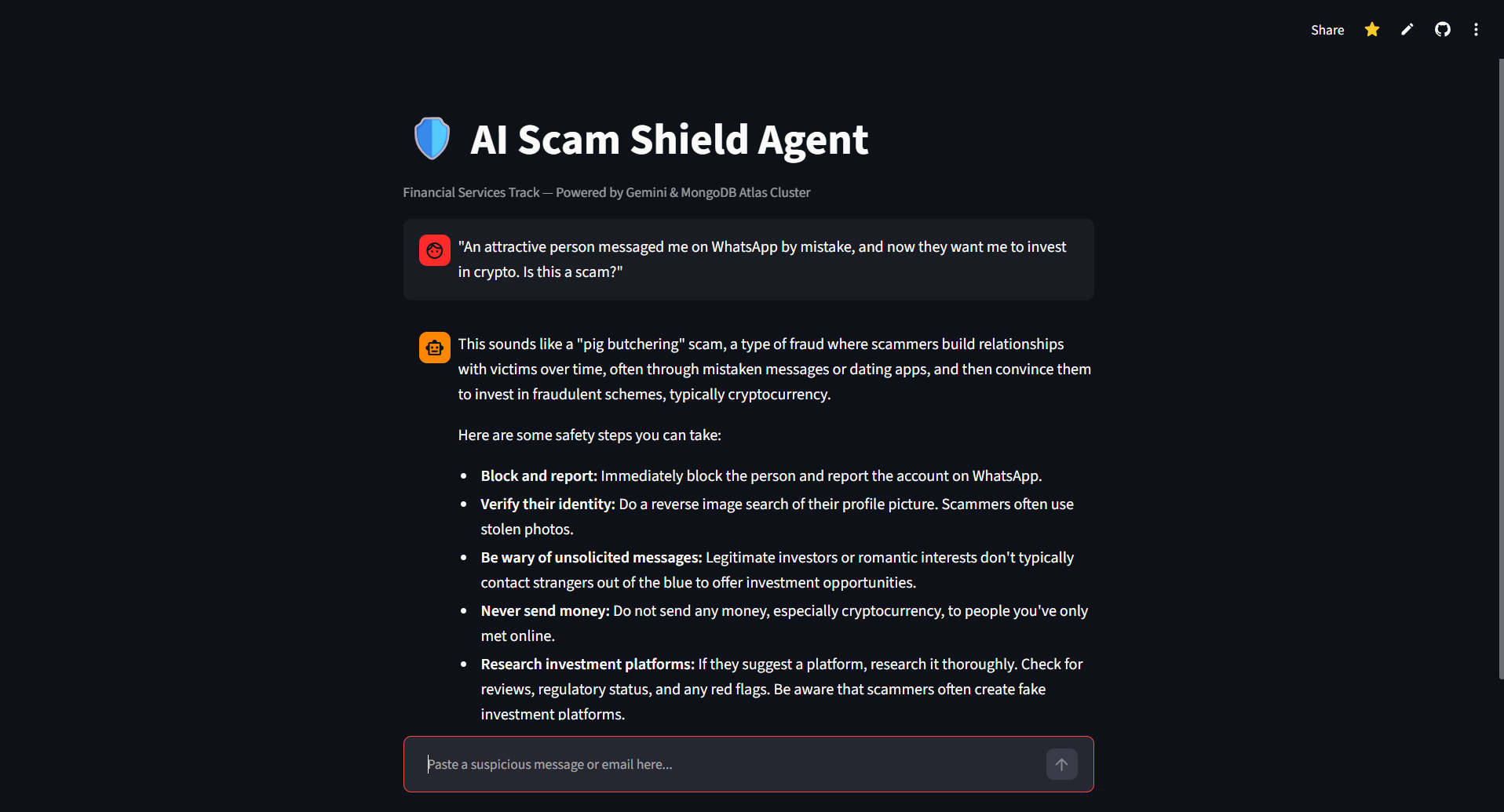
About the project: In today's digital landscape, financial fraud is evolving at an unprecedented pace. Everyday consumers are constantly targeted with highly sophisticated phishing links, urgent counterfeit bank alerts, and predatory work-from-home or cryptocurrency investment schemes. Traditional rule-based security systems frequently fail to catch these threats because malicious actors constantly mutate their vocabulary. We were inspired to build the AI Scam Shield Agent for the Financial Services Track to create an intelligent, adaptive perimeter defense layer.
How We Built It: The project architecture successfully bridges an advanced semantic reasoning layer with an enterprise-grade cloud data layer. We integrated a live, cloud-hosted MongoDB Atlas Cluster to act as our core data tool infrastructure layer. This cloud database stores, catalogs, and references diverse real-world fraud classification profiles across multiple threat vectors. To bypass local network variables on the developer machine, we engineered an innovative Multi-Step Local Reasoning Engine. This system ingests text streams, calculates linguistic markers, and executes targeted query lookups directly against our cloud database instance. We packaged the entire system within a responsive Streamlit Web User Interface Framework.
What We Learned: As a developer building this system, navigating the integration mechanics was an immense learning journey. We mastered core full-stack and data engineering methodologies, specifically gaining practical experience configuring secure remote cloud clusters, optimizing network access pathways, setting collection models, and handling active data streams using pymongo.
Challenges We Faced: Building this security application pushed us past several highly challenging technical roadblocks. Managing multiple project directories and handling environment shortcuts across Windows terminal panels generated path compilation errors. We systematically resolved this by mapping clear workspace roots and enforcing exact execution calls. Furthermore, local operating system firewalls and hidden browser cache variables initially caused connection timeouts, which we resolved by implementing certificate security overrides.


Log in or sign up for Devpost to join the conversation.