-
-
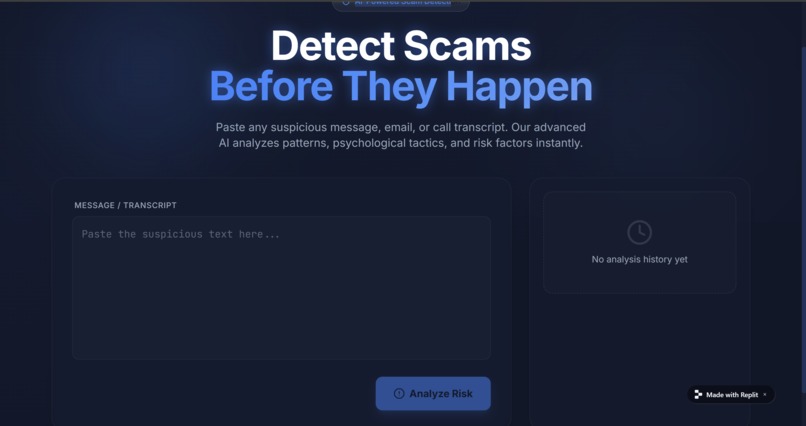
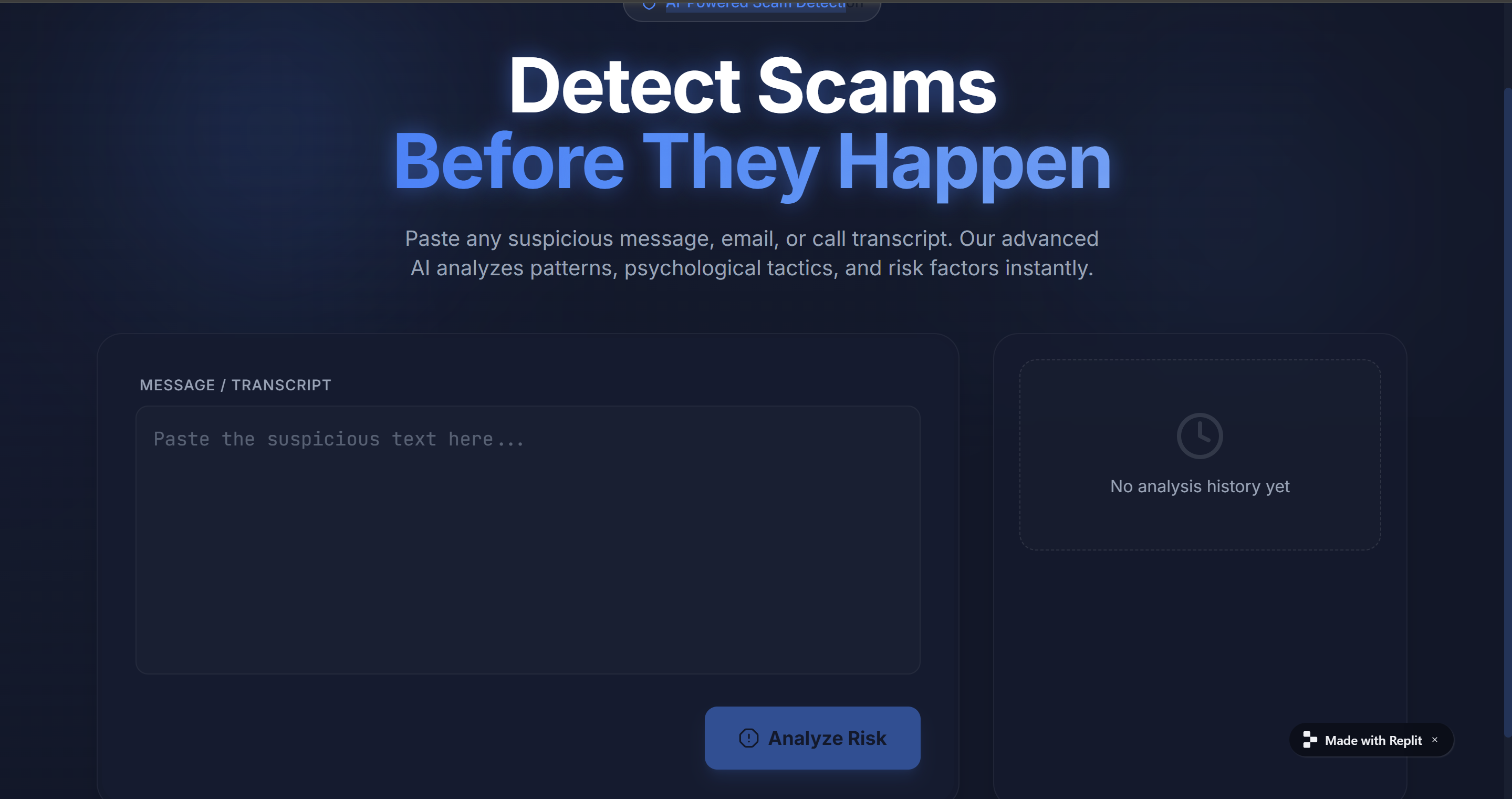
UI
Inspiration
Online scams are becoming increasingly sophisticated. Many people — especially students, working professionals, and elderly users — struggle to differentiate between legitimate communication and psychologically manipulative fraud attempts. We wanted to build a system that doesn’t just detect keywords, but analyzes intent, urgency, impersonation, and emotional pressure patterns in suspicious messages or call transcripts.
Our goal was to create an AI-powered protection layer that helps users think clearly before reacting impulsively.
What it does
AI Scam Caller Detector analyzes suspicious messages or call transcripts and performs structured threat analysis.
It provides:
- A risk score (0–100)
- Identified scam category
- Highlighted red flags
- Detected psychological manipulation tactics
- A clear recommended safe action
- A confidence level for transparency
Instead of simply filtering keywords, the system evaluates persuasion patterns, authority impersonation, urgency pressure, financial extraction attempts, and emotional triggers.
How we built it
We built a full-stack web application using:
- Node.js + Express for the backend
- Vanilla HTML, CSS, and JavaScript for the frontend
- Google Gemini API for AI-powered scam analysis
The backend securely handles API calls using environment variables to protect the API key.
We engineered a structured prompt that forces Gemini to return strict JSON output, ensuring predictable and clean data for frontend visualization.
The UI displays results in a clean, color-coded format:
- Green (Low Risk)
- Orange (Moderate Risk)
- Red (High Risk)
Challenges we ran into
- Ensuring the AI returned strictly structured JSON without extra text.
- Handling edge cases where legitimate messages contain urgent language.
- Designing prompts that focus on behavioral intent instead of simple keyword matching.
- Balancing clarity of explanation with technical depth.
Prompt engineering and response validation were the most critical technical components.
Accomplishments that we're proud of
- Successfully built a secure AI-powered backend in a short time frame.
- Designed a structured threat-analysis system rather than a basic keyword filter.
- Implemented color-coded risk visualization for intuitive user understanding.
- Created a system that explains why something is risky — not just that it is risky.
What we learned
- Prompt engineering significantly impacts AI reliability.
- Structured outputs make AI systems more production-ready.
- Security best practices (like environment variable handling) are essential even in rapid builds.
- AI can be used not just for automation, but for digital safety and behavioral intelligence.
What's next for AI SCAM DETECTOR
- Voice-to-text integration for real-time call analysis.
- Browser extension for instant scam detection in emails and web pages.
- Community reporting system to improve detection patterns.
- Multi-language support to protect a wider audience.
- Machine learning fine-tuning for higher accuracy in subtle scam cases.
Our long-term vision is to build an intelligent digital shield that detects manipulation before it causes harm.
Built With
- replit

Log in or sign up for Devpost to join the conversation.