-
-
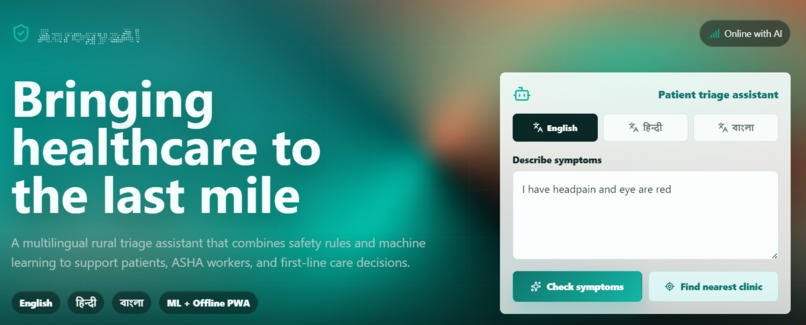
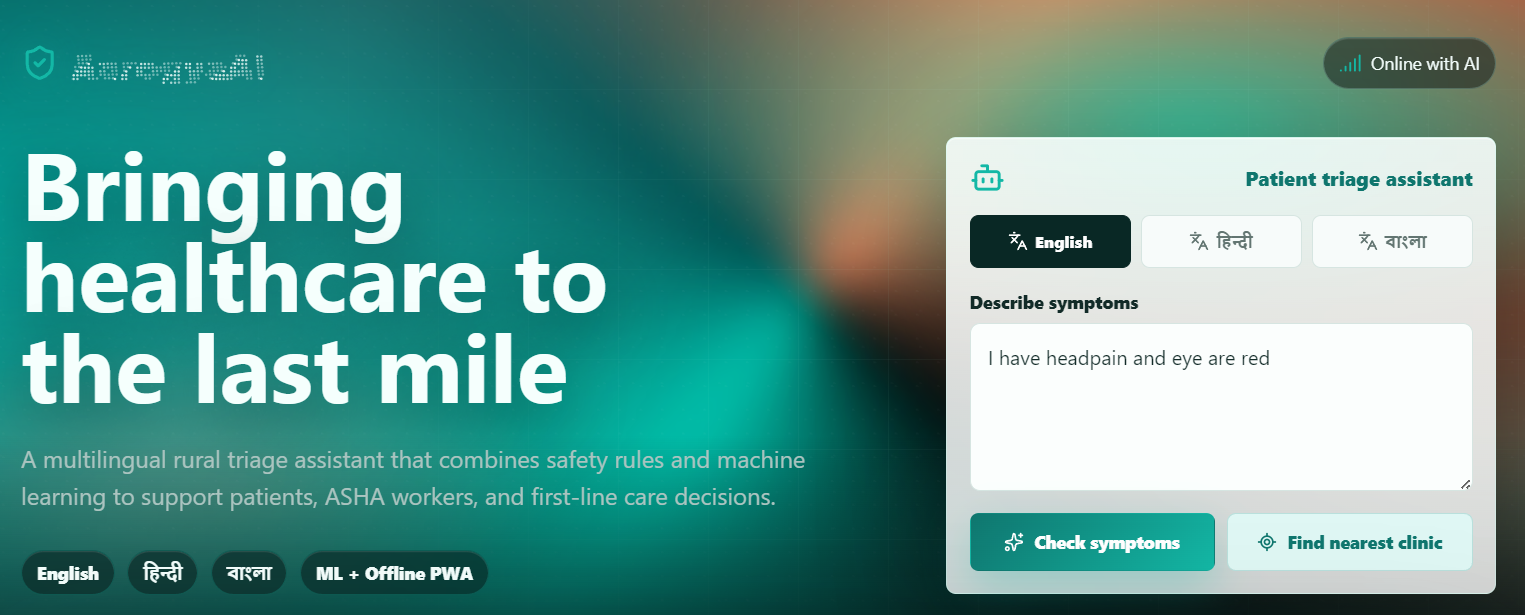
Bringing Heathcare to the last mile
Inspiration
AarogyaAI was inspired by the healthcare gap faced by rural communities, where patients may be far from doctors, internet access can be unreliable, and frontline workers often need quick support for first-line triage. We wanted to build an ML-powered tool that could help patients and ASHA/community health workers recognize danger signs early, understand what to do next, and connect with nearby care.
The goal was not to replace doctors, but to empower rural people with safer, faster, multilingual guidance.
What It Does
AarogyaAI is a multilingual rural health triage assistant. A patient or health worker enters symptoms, and the app first runs a local safety screening for emergency warning signs such as chest pain, breathing difficulty, seizures, poisoning, unconsciousness, or severe bleeding.
If no emergency rule is triggered, the app uses an AI model to generate patient-friendly guidance, including:
- urgency level: emergency, see a doctor, or home care
- summary of possible concern
- next action steps
- care window
- follow-up question
- rural support guidance
- saved local assessment history
The app supports English, Hindi, and Bengali, and includes offline-friendly PWA behavior for low-connectivity settings.
How We Built It
We built AarogyaAI using:
- React + TypeScript for the frontend
- Vite for fast development and production builds
- Vercel Serverless Functions for the secure AI API route
- Mistral AI API for ML-assisted triage guidance
- IndexedDB with
idbfor local saved assessments - Vite PWA + Workbox for offline support
- Lucide React for icons
- Custom CSS and Canvas effects for the animated shader hero and particle app name
The system follows a safety-first flow:
Patient symptoms
      ↓
Local safety-rule screening
      ↓
Emergency? → show urgent care guidance immediately
      ↓
No emergency
      ↓
Serverless AI triage request
      ↓
Patient-friendly rural care guidance
      ↓
Save assessment locally
Built With
- ai
- chat
- html
- indexeddb
- javascript
- mistral
- react
- serverless
- typescript
- vercel


Log in or sign up for Devpost to join the conversation.