-
-
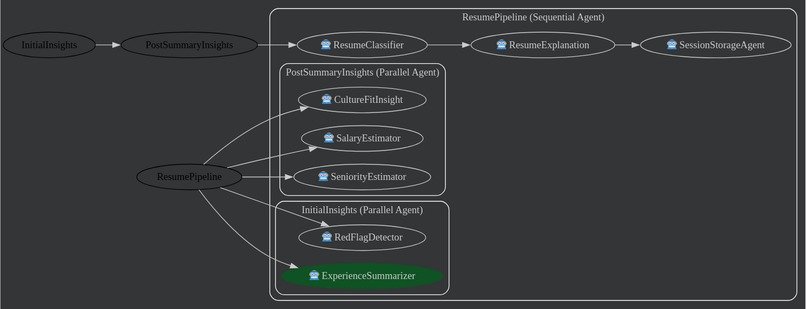
Architecture Diagram

Inspiration
We noticed that hiring teams often struggle with screening large volumes of resumes efficiently and objectively. Many resumes include vague achievements or inflated claims, making it difficult to assess candidates accurately. This inspired us to develop a system that goes beyond keyword matching by analyzing resumes for key experiences, detecting inconsistencies, and estimating culture fit and salary expectations.
What it does
The AI Resume Analyzer evaluates resumes and generates a comprehensive profile of the candidate. It includes:
- A summary of relevant work experiences
- Detection of potential red flags, such as timeline inconsistencies or vague claims
- Classification of the resume as excellent, normal, bad, or fake
- Estimation of the candidate’s seniority level
- Cultural fit analysis across different work environments
- A salary range estimate based on qualifications and experience
- An explanation of the classification decision
All of this is automated using a structured pipeline of large language model (LLM) agents.
How we built it
We used Google’s Agent Development Kit (ADK) to build a modular system consisting of several LLM-based agents. The pipeline includes both sequential and parallel components for efficiency:
- The initial stage summarizes the resume and detects red flags
- A central classifier evaluates the overall quality and provides reasoning
- Post-processing agents estimate salary, seniority, and culture fit in parallel
- A session storage agent saves the final output for further use
We used PyPDF2 for resume text extraction and exposed the system via a simple web interface for testing and demonstration.
Challenges we ran into
Some of the challenges included aligning the outputs of multiple agents, especially when they run in parallel. We also had to balance accuracy with generalizability when evaluating resumes with limited information. Ensuring that explanations provided by the system were both clear and fact-based was another important consideration. Additionally, parsing resume PDFs reliably across different formats required extra validation.
Accomplishments that we're proud of
We successfully developed an automated resume screening tool that produces structured and explainable evaluations. The system was able to identify real inconsistencies in a sample resume, including overlapping timelines and vague achievements. We also built the pipeline in a way that can be deployed and scaled easily, making it ready for integration into larger hiring systems.
What we learned
This project gave us practical experience in building agent-based systems using Google ADK. We learned how to structure LLM workflows for both performance and clarity, and how to extract and validate real-world text from resumes. Most importantly, we saw the importance of contextual reasoning in hiring scenarios, and how automation can support better decision-making.
What's next for AI Resume Analyzer
In the next phase, we plan to add automatic timeline validation to detect overlapping or unrealistic dates. We’re also exploring ways to request missing information from candidates to improve evaluation accuracy. Another goal is to improve our salary estimator by integrating data from job market APIs. Eventually, we aim to support multilingual resumes and make the system more inclusive for a wider range of applicants.
Built With
- cloudrun
- gemini

Log in or sign up for Devpost to join the conversation.