-
-
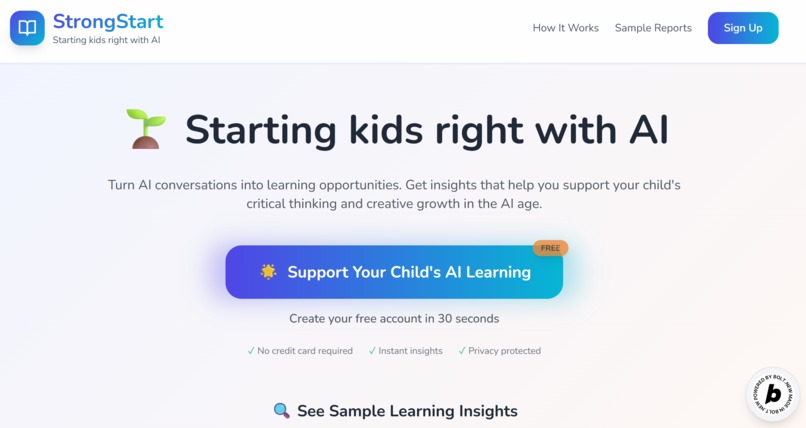
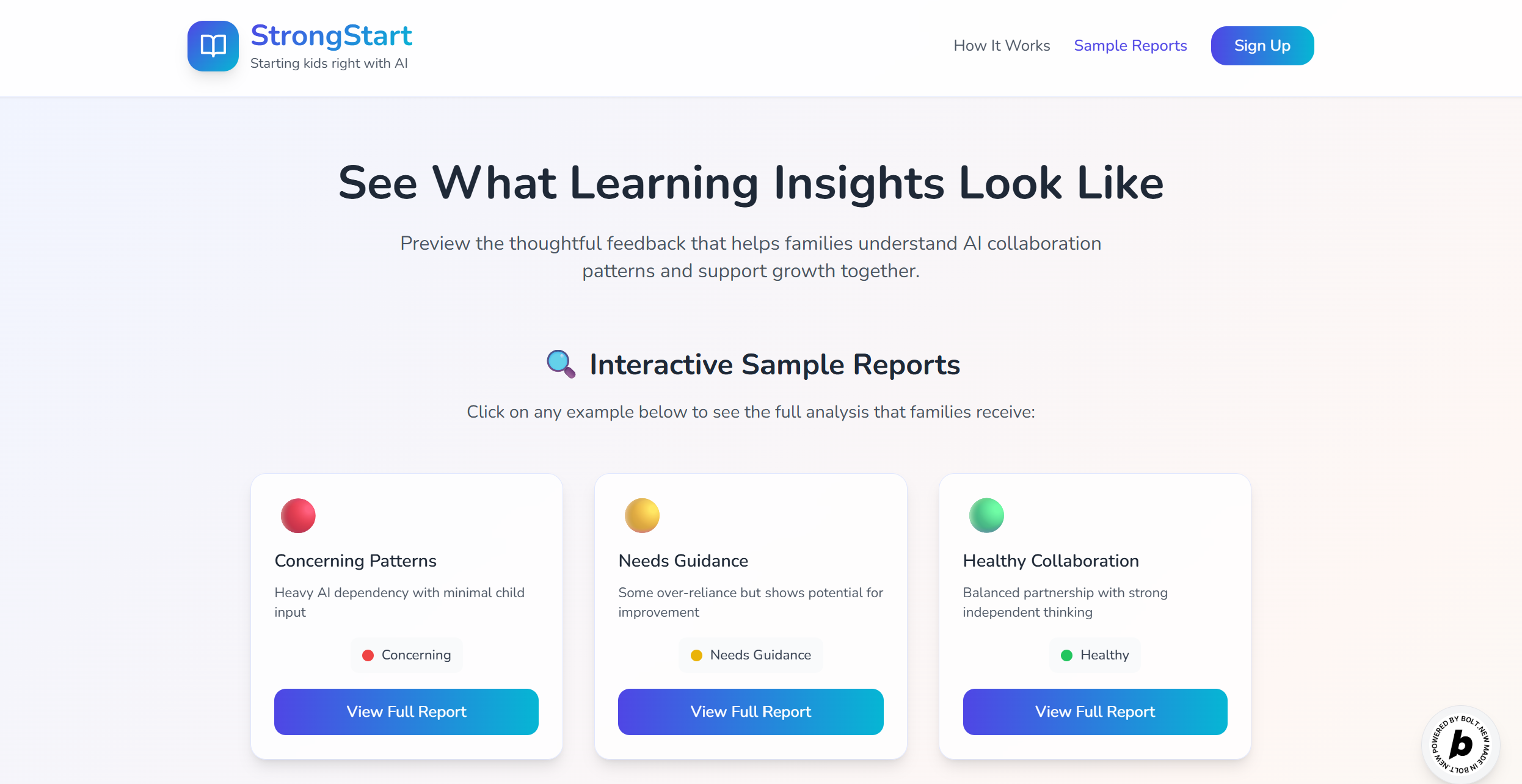
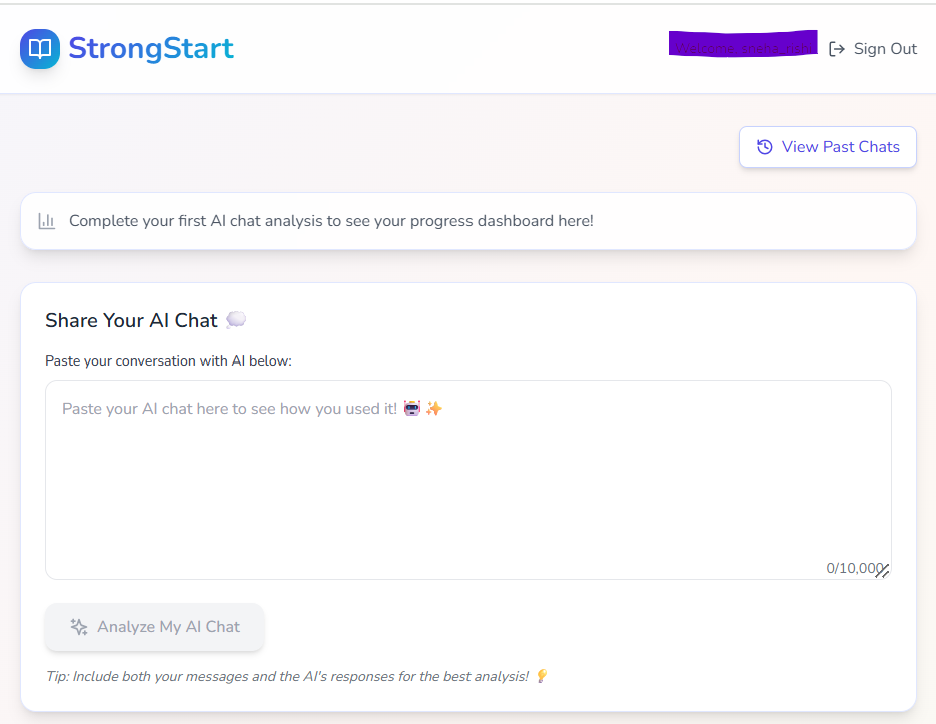
Landing Page
-
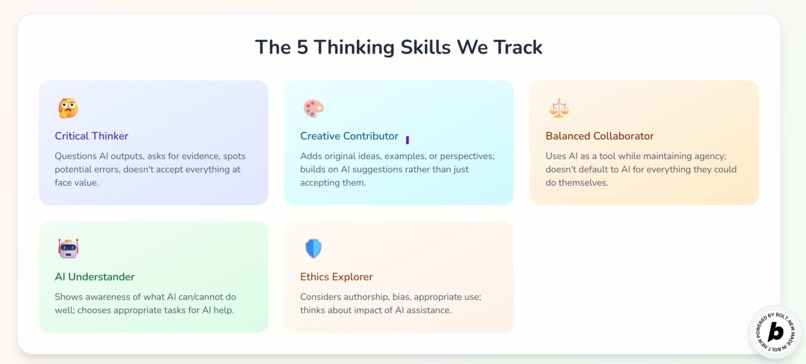
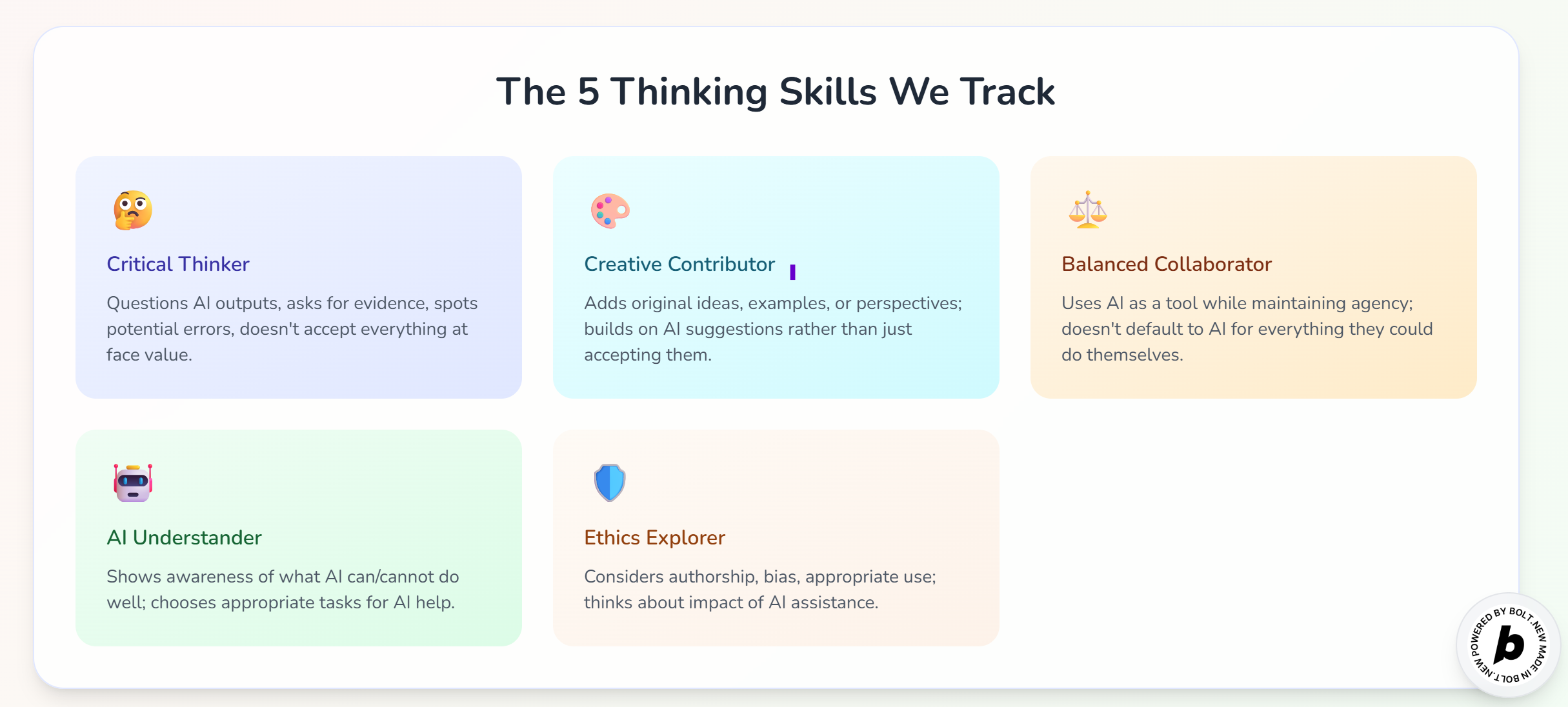
Healthy AI Collaboration - Key Dimensions
-
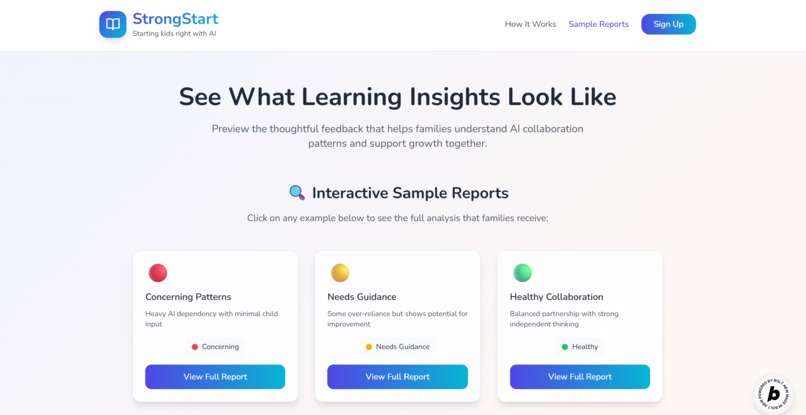
Sample Reports
-
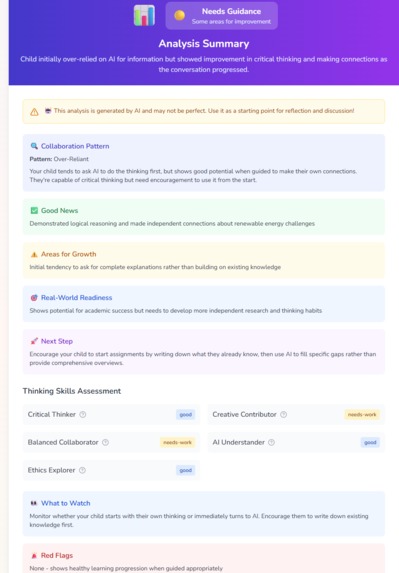
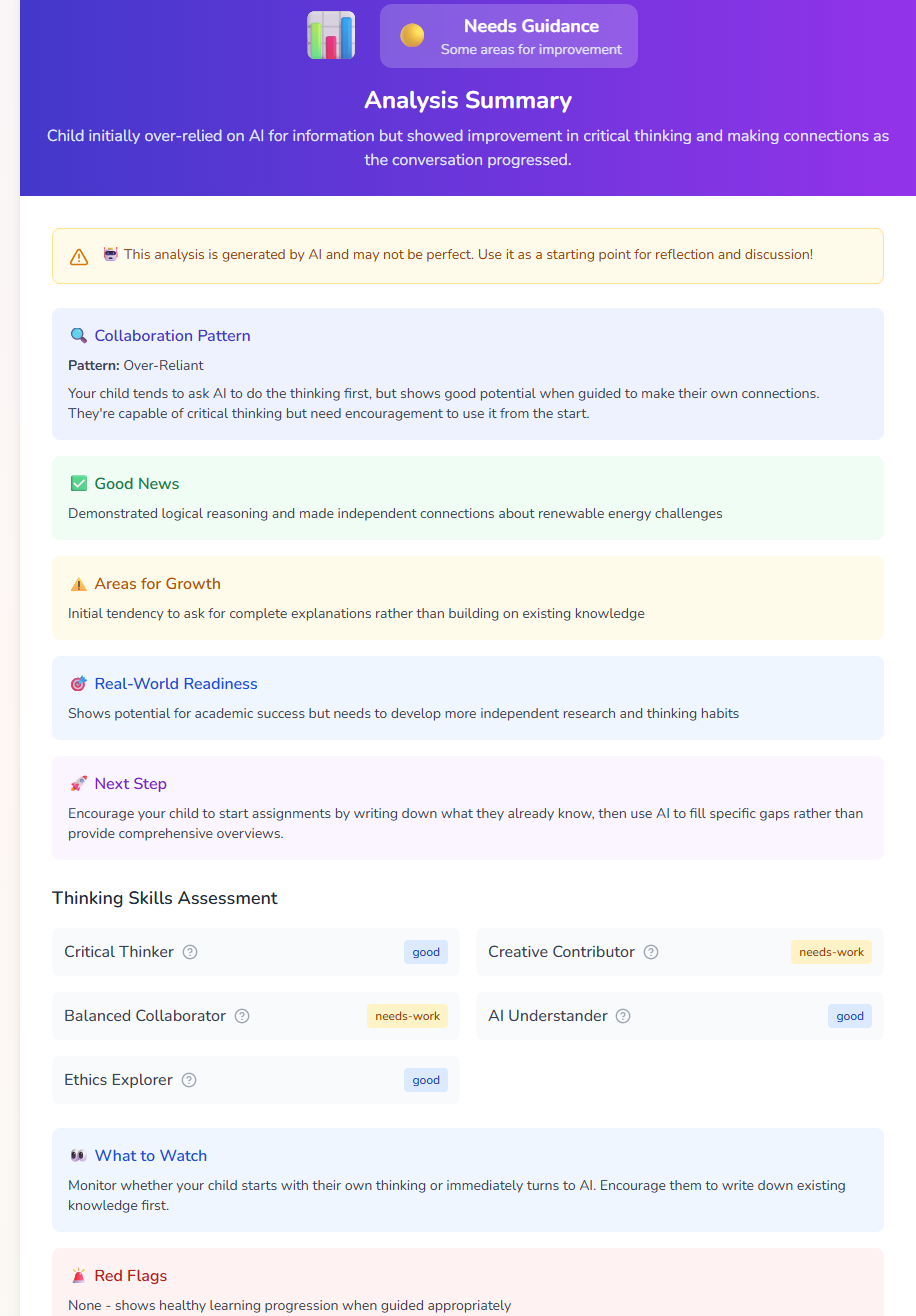
Yellow Report Example
-
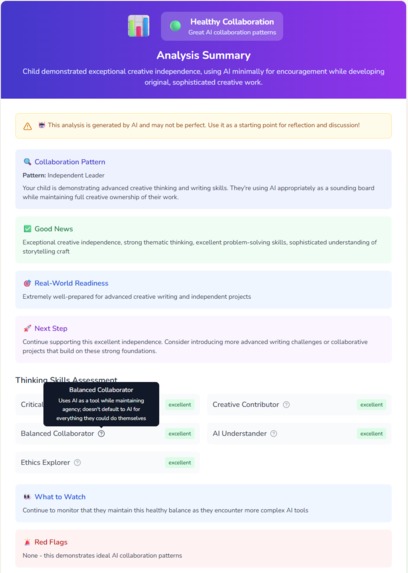
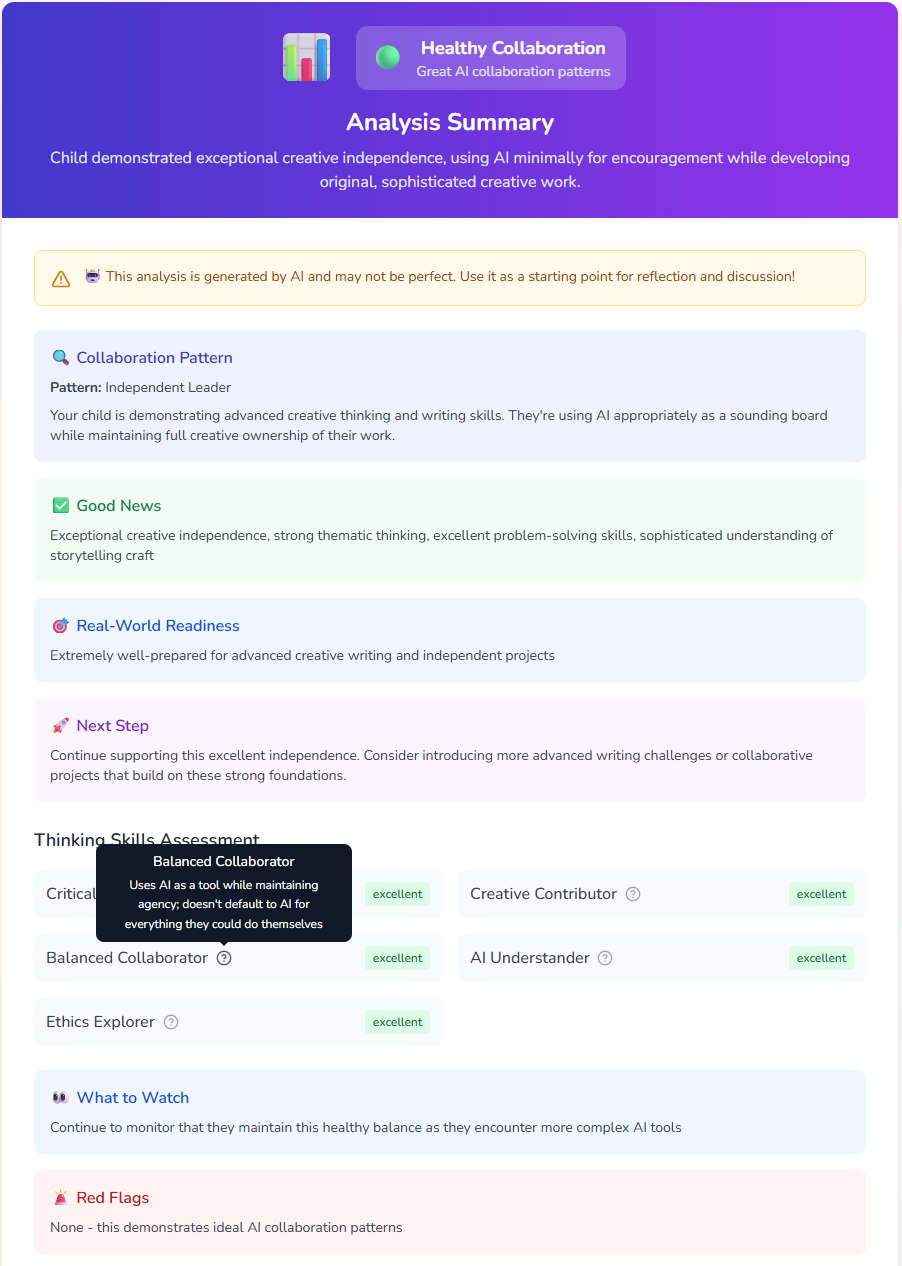
Green Report Example
-
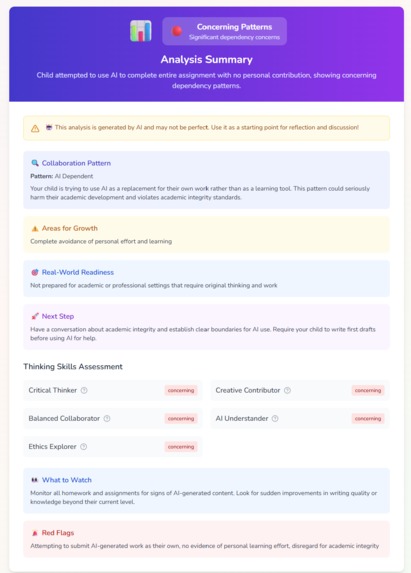
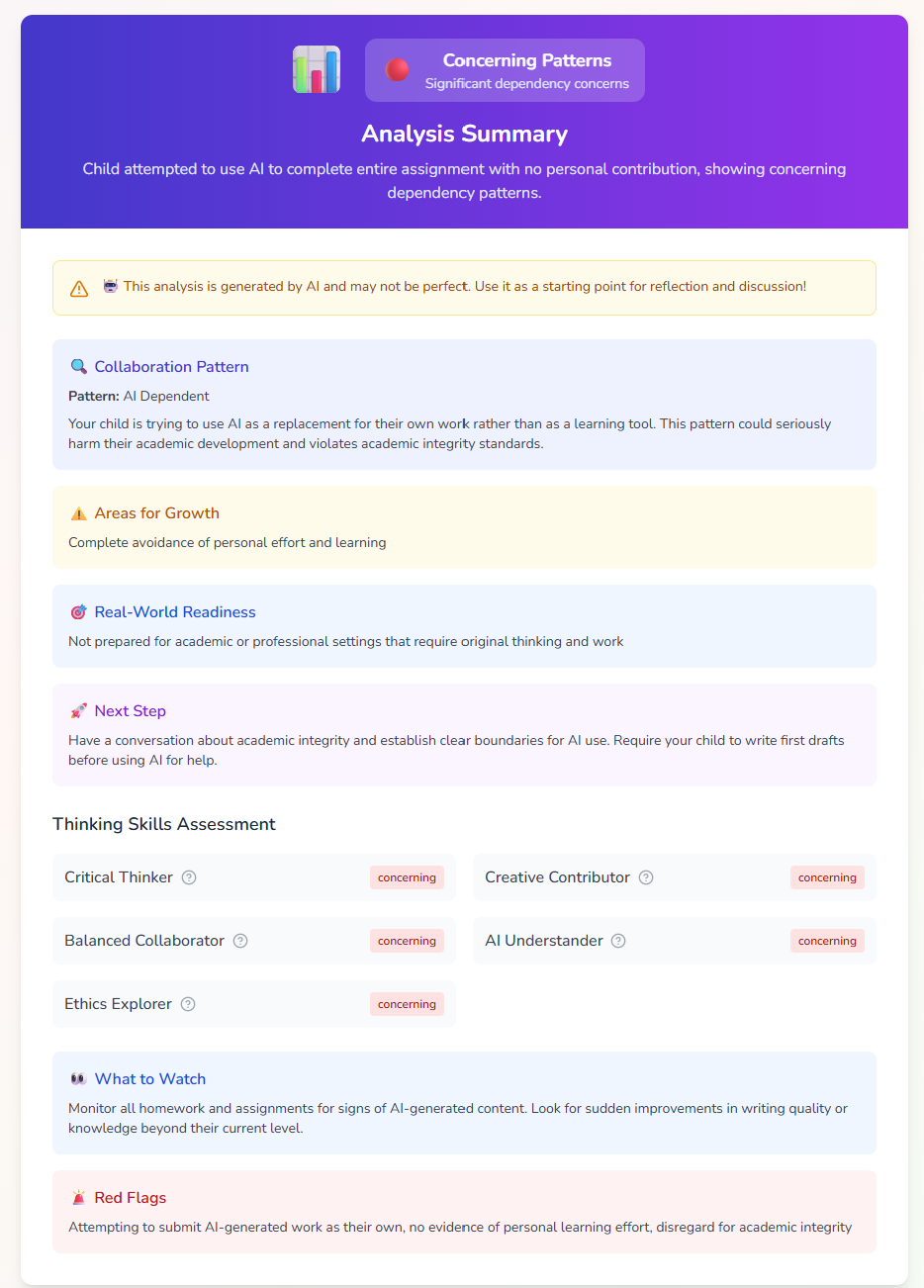
Red Report Example
-
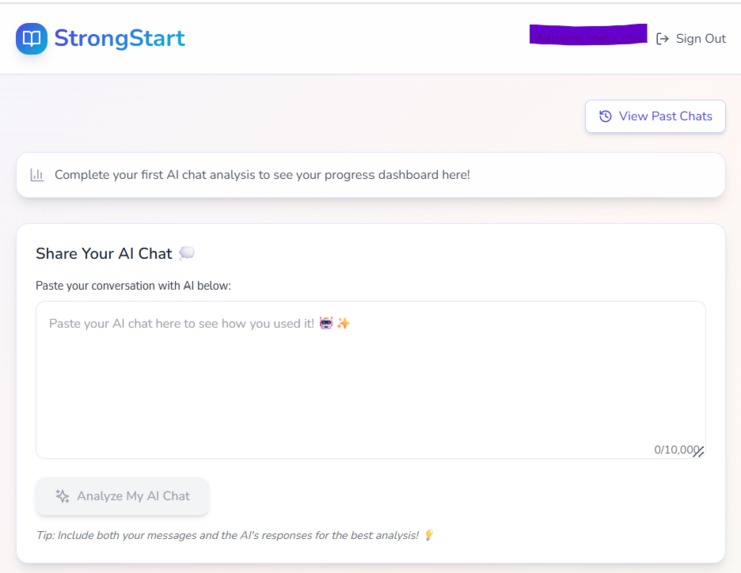
How it works
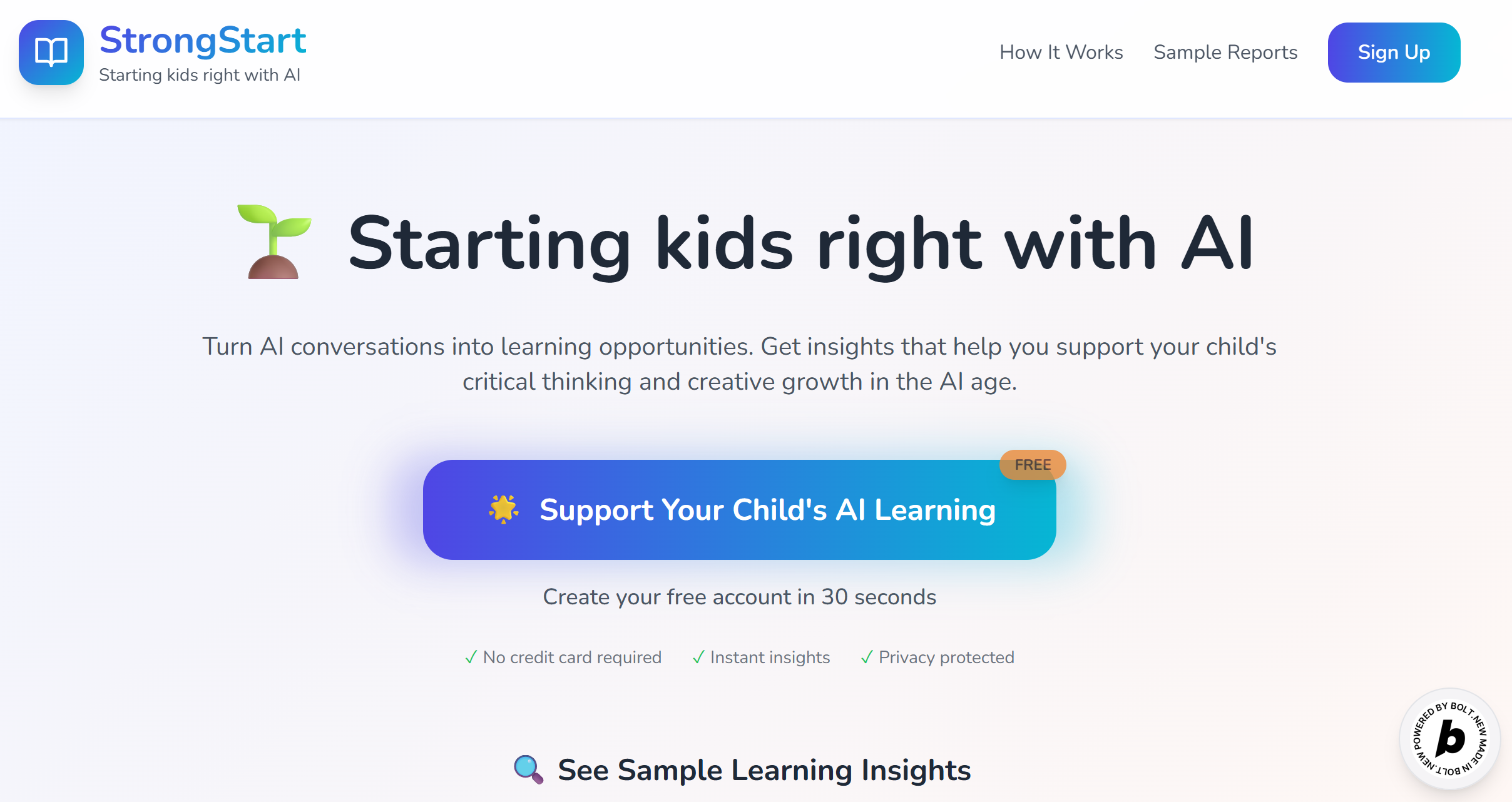
Strong Start: The First Framework for Healthy AI Collaboration in Kids
Inspiration
Parents in my circle are grappling with a dilemma: their kids are using AI tools, but there’s no clear guidance on how to use them responsibly. Schools offer little beyond bans or detection tools. Parent forums are full of confusion and concern.
Recent MIT research validates these fears ChatGPT users showed lower brain activity, poorer memory, and less originality. Kids are especially at risk of "shallow encoding" and cognitive offloading, impacting how they learn and think.https://onlinelibrary.wiley.com/doi/full/10.1002/brx2.30
On April 23rd, a U.S. executive order mandated AI literacy in schools. The need for guidance is urgent. We don’t need more tools that ban AI we need tools that teach kids how to use it well. Families worldwide are facing the same challenge: kids are using powerful AI tools, but there’s no shared understanding of what healthy use actually looks like.
What it does
Strong Start is the first framework designed to help families understand and guide healthy AI collaboration in children.
It analyzes chat transcripts between kids and AI tools, detecting collaboration patterns across five essential dimensions:
- Critical Thinker: Questions and verifies AI responses
- Creative Contributor: Adds original ideas to the AI’s outputs
- Balanced Collaborator: Maintains agency, doesn’t just copy/paste
- AI Understander: Grasps AI’s strengths and limitations
- Ethics Explorer: Considers implications of how AI is used
The result? Parents get an instant, jargon-free report showing how their child used AI plus coaching tips to guide better habits.
There’s no existing tool or framework that helps families see how their kids are actually using AIand coach them toward better habits. This isn’t just about literacy its about shaping lifelong thinking skills.
How we built it
I started with user research surveying 12 parents and interviewing 4 kids and 4 parents. After identifying key concerns, I drafted a Product Requirements Document (PRD) and used it to guide the build.
This was my first time using Bolt.new, and it turned out to be the perfect platform for fast iteration. I built feature by feature:
- Chat upload and analysis UI
- Modular React frontend with a clean UX
- Supabase backend for auth and history
- OpenAI API for transcript analysis
- Custom logic for scoring AI-human collaboration
Breaking the build into small steps let me experiment, test, and roll back if needed exactly the kind of vibe-based development Bolt enables.
Bolt.new's visual iteration flow made it easy to prototype and debug LLM behavior something hard to achieve with traditional dev stacks.
Challenges we ran into
The hardest part? Defining what “healthy” AI use looks like. No standards exist, so I built a framework from scratch based on cognitive psychology, AI ethics, and educational research.
The MIT study was a turning point it validated the risks of overreliance on AI and helped shape a more focused assessment framework.
Prompt engineering was another challenge. Getting the LLM to evaluate nuanced behavior (e.g., "Did the kid think critically here?") required dozens of iterations with sample chats.
Designing the tone was just as hard. Reports had to feel supportive, not punitive parents want insight, not surveillance.
Accomplishments that we're proud of
- Created the first child-AI collaboration framework grounded in research
- Developed a working MVP with real-time transcript analysis and score breakdown
- Turned vague concerns into a concrete, supportive tool for families
- Aligned the solution with national policy priorities and everyday parent needs
Most tools focus on catching AI use. Ours focuses on developing AI thinking skills that’s what makes it different, and urgently needed.
What we learned
We don’t need to stop kids from using AI we need to help them use it better.
That mindset shift from control to coaching changes everything. Kids don’t need bans. They need feedback, structure, and support to grow as thoughtful AI collaborators.
I also learned that micro-iterations using Bolt.new made this kind of thoughtful, research-backed build possible within a tight timeline.
Designing reports that were actionable but non-judgmental was key to making parents feel supported instead of surveilled.
What's next for Strong Start
Short-term:
- Collect feedback from real parents and kids
- Polish the user experience for clarity and delight
- Make it easy to import chats from different platforms - maybe through browser extensions or integrations.
Long-term vision:
- As AI tools become globally accessible, StrongStart can adapt to cultural and regional needs making it possible to support families everywhere in raising thoughtful, responsible AI users.
- Build an AI chatbot that nudges kids with thought-provoking challenges
- Expand to schools with AI usage reports that show how AI was used not just if it was
- Scale to analyze AI usage from multiple platforms and formats
Every parent with a ChatGPT-using kid could benefit. The opportunity to spark better habits early and across households, schools, and communities is massive.
Built With
- api
- openai
- promptengineering
- react
- supabase
- typescript


Log in or sign up for Devpost to join the conversation.