-
-
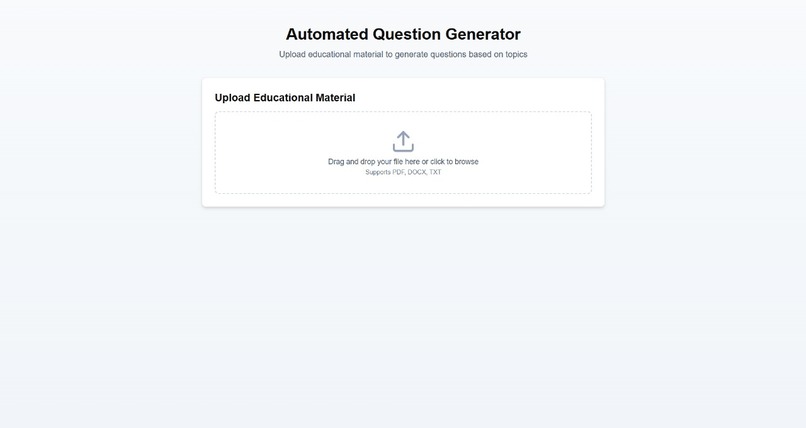
First Page
-
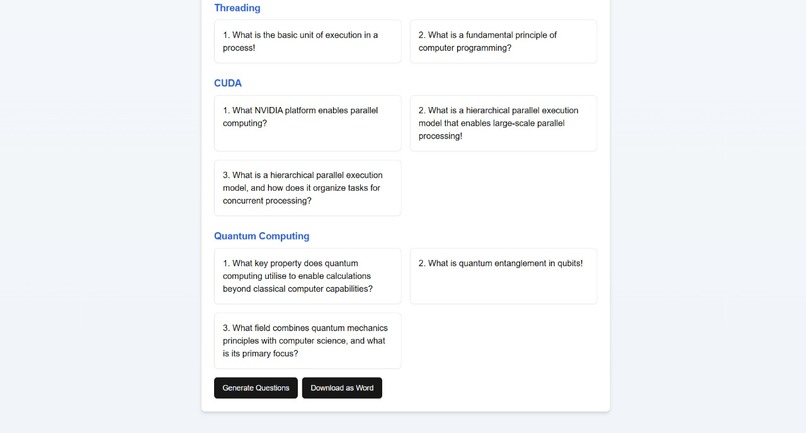
Response Page
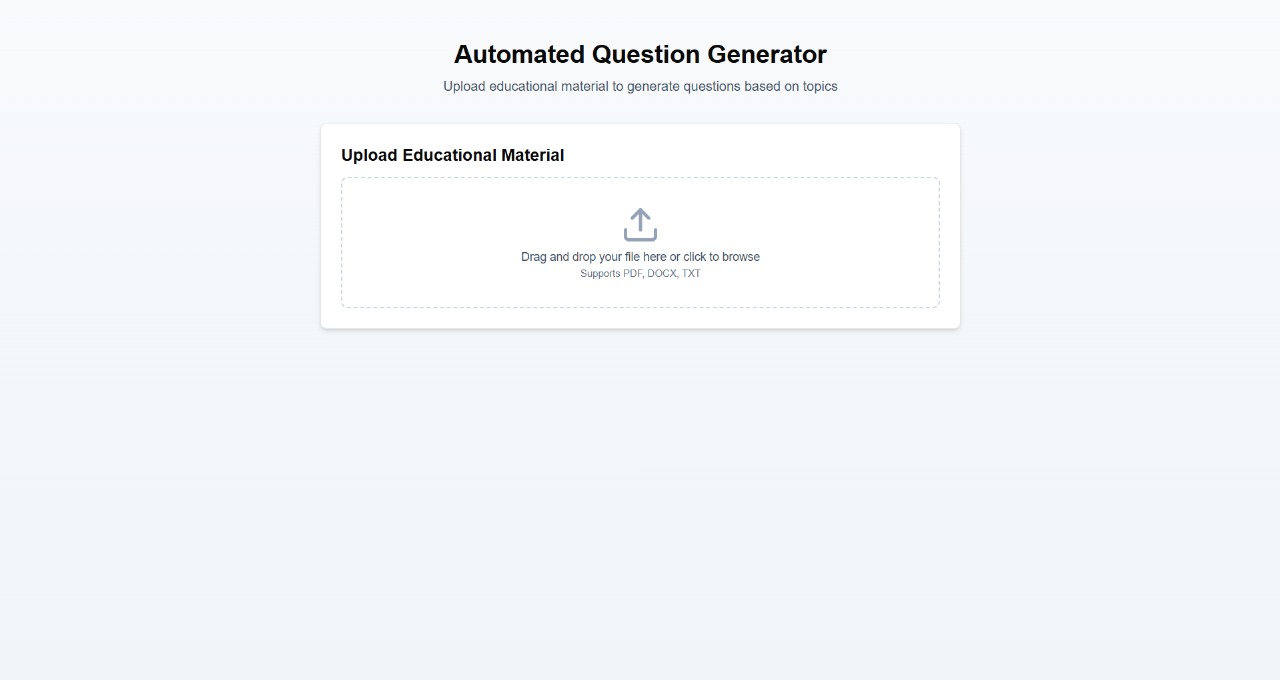
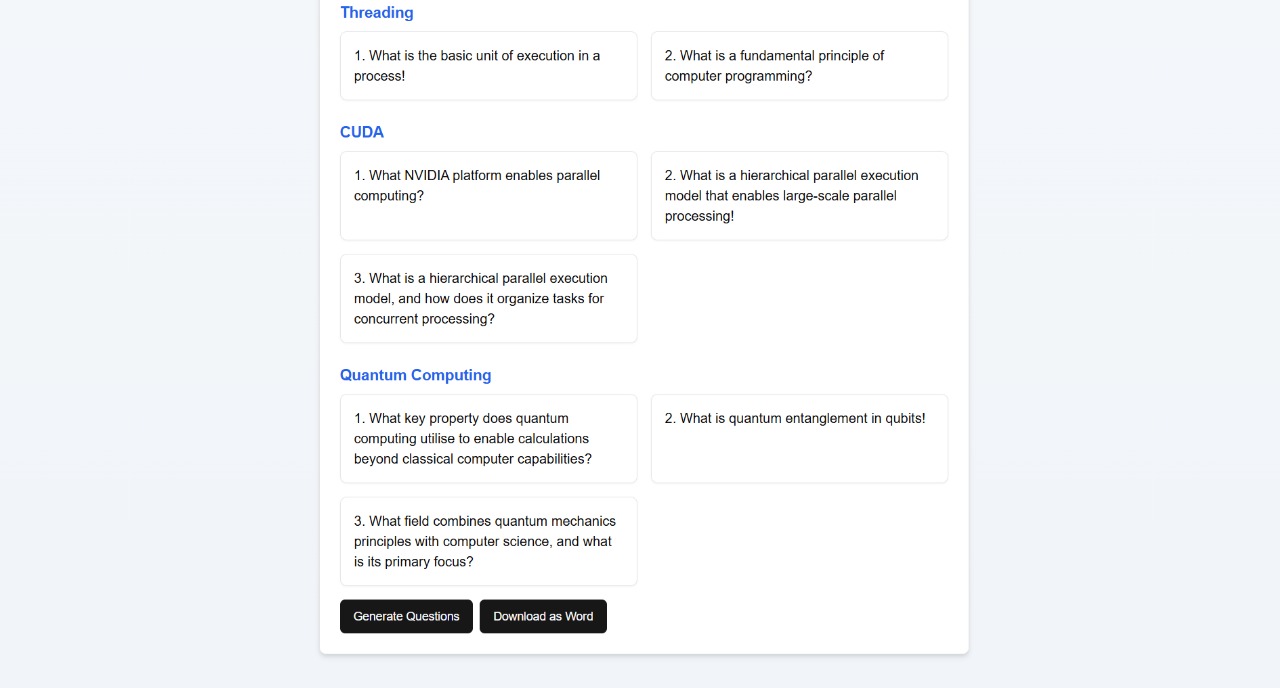
AI Question Paper Generation
Inspiration
The manual process of creating question papers is time-consuming, repetitive, and prone to human error. As students and developers, we recognized the need for a smarter, more efficient solution that could assist educators in generating quality questions based on specific topics and difficulty levels. Our passion for AI and education inspired us to create a system that automates question paper generation while maintaining accuracy, variety, and relevance.
What it does
Our AI-powered system generates question papers automatically based on:
- User-provided keywords or topics
- Desired difficulty levels
- Number and types of questions (MCQs, short answer, long answer)
The system uses natural language processing (NLP) to understand the context and produce meaningful and diverse questions. It also formats them into a structured question paper, ready to be reviewed or printed.
How we built it
We used the following technologies and methods:
- Frontend: React.js for the user interface to input topics, difficulty, and generate papers.
- Backend: Node.js and Express for handling API requests.
- AI/NLP: We integrated a transformer-based language model (like GPT) for question generation using prompt engineering techniques.
- Database: MongoDB to store past questions and topic data.
- Deployment: The project was hosted using [insert deployment platform like Vercel/Heroku].
Challenges we ran into
- Ensuring the questions were grammatically correct and contextually relevant.
- Maintaining a balance between randomness and topic relevance in question generation.
- Handling vague or ambiguous input topics.
- Structuring questions into a formal exam pattern.
- Limited model accuracy when generating domain-specific or technical questions.
Accomplishments that we're proud of
- Built a functional prototype that can generate question papers in seconds.
- Created a user-friendly UI with customizable inputs.
- Achieved consistent and meaningful question generation across various topics.
- Learned and successfully applied prompt engineering and AI model tuning.
What we learned
- How to integrate AI models into real-world applications.
- Techniques for improving output quality using prompt engineering.
- The importance of user experience in education tech tools.
- Backend/frontend collaboration and state management in React.
- Working with unstructured data and converting it into a usable format.
What's next for AI Question Paper Generation
- Improve question filtering and quality scoring.
- Add plagiarism checks and originality detection.
- Support for multiple languages and subjects.
- Enable export to PDF and Word formats.
- Incorporate a feedback loop from teachers to improve generation accuracy.
Built With
- fastapi
- python
- react
- typescript


Log in or sign up for Devpost to join the conversation.