-
-
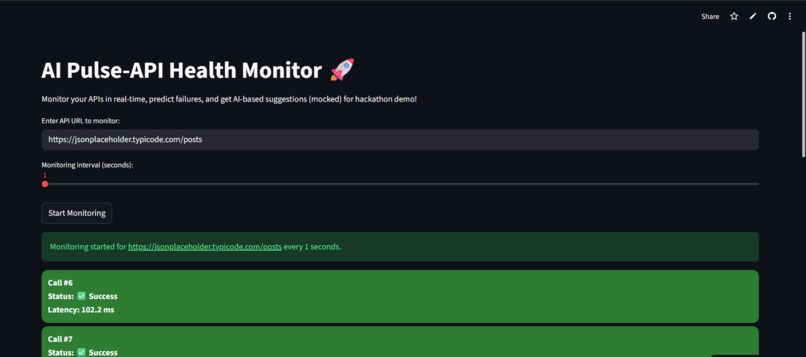
User interface with fiels and cards
-
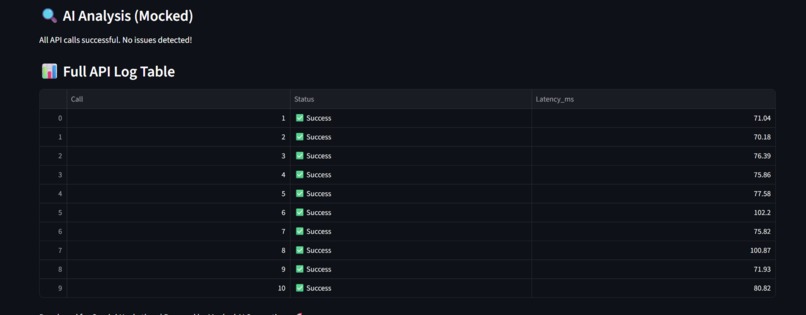
Mock result and log table
Inspiration
Modern applications depend heavily on APIs, but when APIs fail, developers usually see only error codes and logs without clear explanations. During my previous work on API monitoring, I realized that while systems can detect failures, they cannot reason about them or predict what might happen next. This inspired me to build AI Pulse, a tool that not only monitors API health but also explains failures and predicts incidents using AI.
What it does
AI Pulse continuously monitors a given API by sending periodic health checks. It records response status codes and response times in real time. When abnormal patterns such as repeated errors or increasing latency are detected, the system uses Gemini to analyze recent API behavior, explain the likely cause of the issue, predict whether a major failure is imminent, and suggest preventive actions.
How I built it
The project is built as a lightweight Python-based monitoring agent. The core logic performs continuous API polling and anomaly detection using simple rules. When an anomaly is detected, recent API metrics are sent to the Gemini API, which reasons over the data and generates human-readable explanations, predictions, and recommendations.
Challenges I ran into
One of the main challenges was designing a clear boundary between traditional monitoring logic and AI-based reasoning. Ensuring that Gemini received structured, meaningful data rather than raw logs was critical for useful analysis. Another challenge was keeping the system simple and reliable while still demonstrating real-world applicability.
What I learned
Through this project, I learned how AI models like Gemini can enhance traditional monitoring systems by adding reasoning and predictive capabilities. I also gained hands-on experience integrating AI APIs into developer-focused tools and designing systems that assist humans rather than replace existing logic.

Log in or sign up for Devpost to join the conversation.