-
-
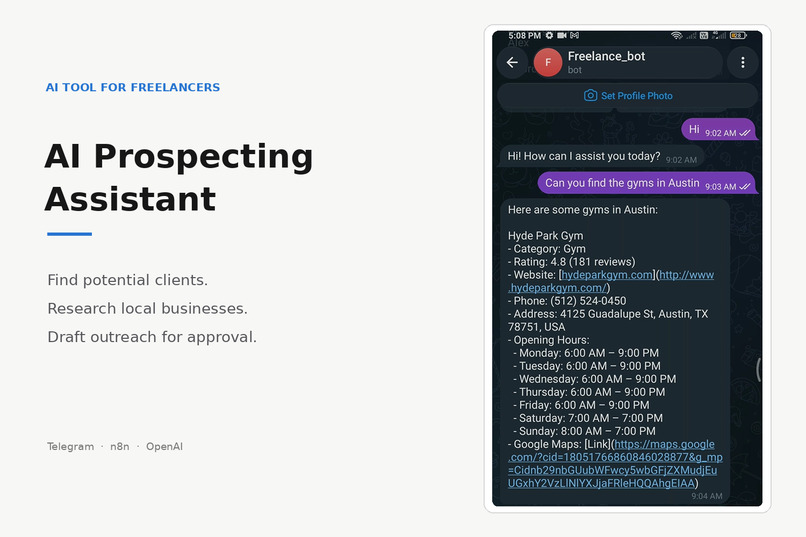
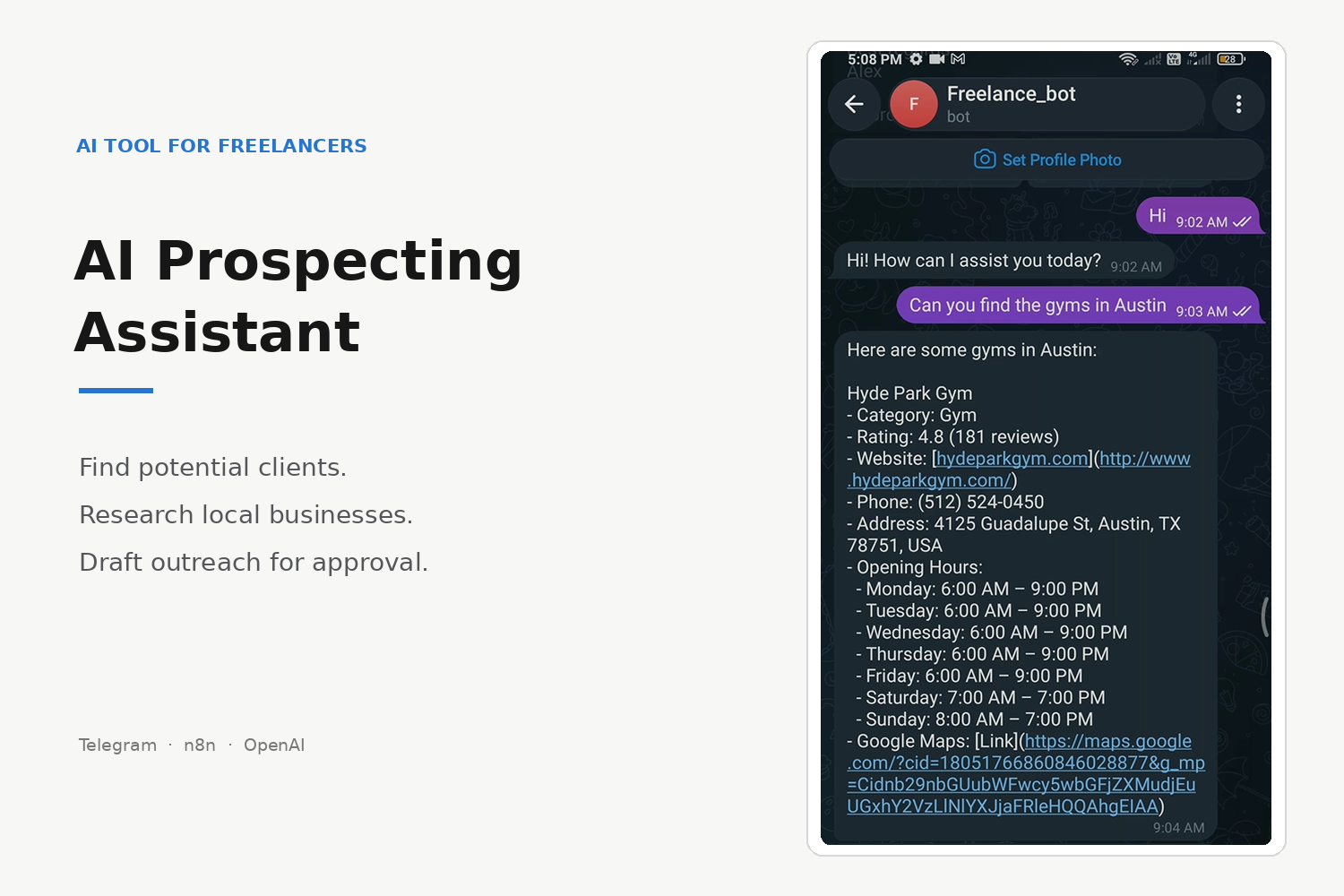
Telegram lead discovery
What inspired the project?
Finding potential clients is a time-consuming part of freelancing. Freelancers often have to search for businesses, visit their websites, find contact information, write personalised messages and keep track of follow-ups.
I wanted to explore whether AI and workflow automation could bring these tasks together into one practical assistant.
What does it do?
AI Prospecting Assistant is a Telegram-based lead research and outreach automation system built primarily for freelancers.
It helps users:
- Find potential leads: Search Google Places by business niche and location.
- Research businesses: Visit business websites and collect publicly available contact information, including emails, phone numbers and social links.
- Draft personalised outreach: Use AI to generate outreach messages based on the researched business and the user's preferred writing style.
- Keep humans in control: Review and approve outreach messages through Telegram before they are sent.
- Manage leads: Save business information, outreach status and other details in Google Sheets.
- Manage follow-ups: Create follow-up reminders and prepare for discovery calls.
How I built it
I built the project using n8n, organising the system into nine workflows that handle different parts of the prospecting process.
The workflows connect external services and APIs, including Google Places, website research and scraping, OpenAI, Telegram and Google Sheets.
Instead of having AI send messages automatically, I included a human approval step through Telegram. The user reviews the generated message and decides whether it should be sent.
What I learned
Building this project helped me understand how different services can work together in a larger automation system.
I explored workflow design, API integrations, structured data handling, AI-generated content, Telegram bot interactions and human-in-the-loop automation.
It also taught me that building an AI application involves more than generating text. The surrounding workflows, integrations, data handling and approval mechanisms are equally important.
Challenges
One of the main challenges was connecting multiple services and making sure information moved correctly between workflows.
I also had to consider practical setup requirements, API usage limits, user configuration and how to keep the user involved in decisions involving outreach.
Current status
The project is available as an open-source implementation. It requires users to configure their own API credentials and connected services before running it.
Built With
- data
- gmail
- google-places
- google-sheets
- jina-ai-reader
- n8n
- openai
- scrapingbee
- telegram-bot-api
