InspirationHere is a polished, hackathon-ready write-up for your AI Prediction Route Analyzer project.
You can use this for Devfolio, GitHub, submission forms, or presentation slides.
🌟 AI Prediction Route Analyzer — Project Overview
🚀 Inspiration
During daily travel, we often face unpredictable route conditions—traffic jams, roadblocks, delays, or inefficient paths. Traditional navigation apps only show the current state, not future possibilities.
We wanted to build a solution that doesn’t just map routes but predicts what might happen next. The goal was to empower users with smarter decision-making, reduce travel time, and avoid unexpected delays. This inspired us to create an AI-powered system capable of forecasting the best possible route ahead of time.
🔍 What It Does
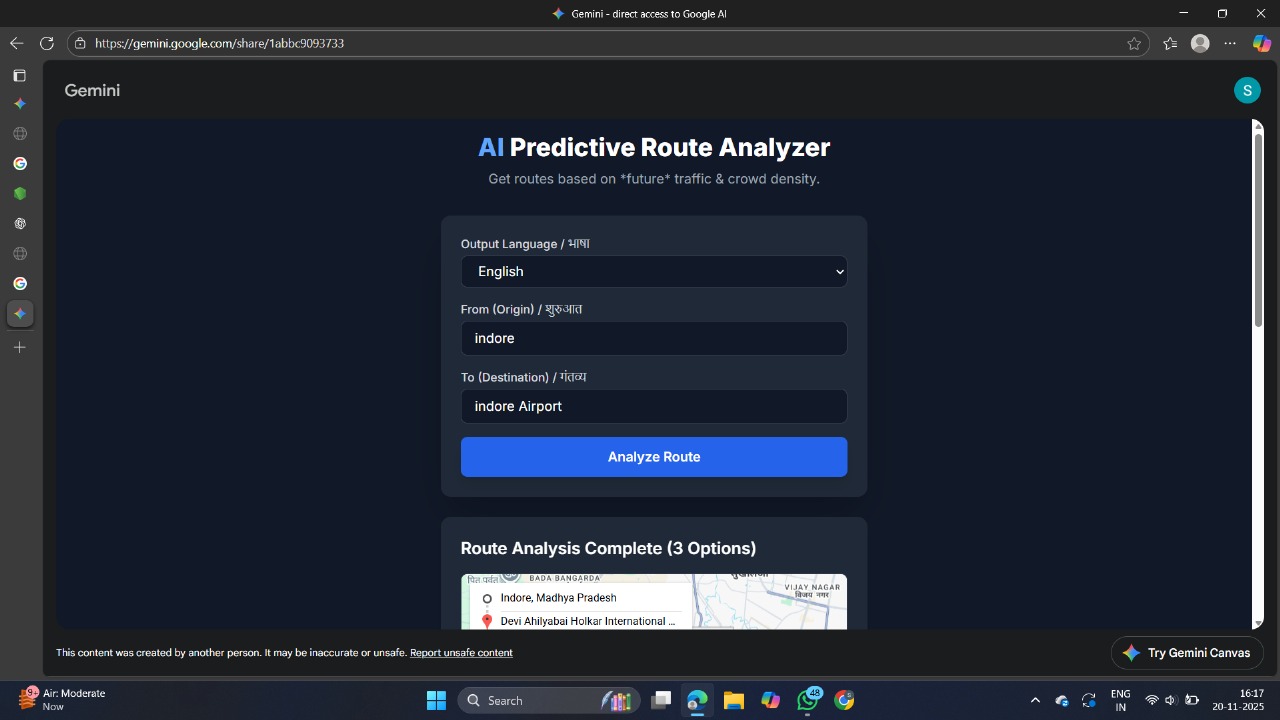
AI Prediction Route Analyzer analyzes multiple routes between two locations and uses AI-powered predictions to determine which route is likely to perform better in the near future.
✔️ Key Features:
Predicts the optimal route using AI
Calculates route reliability based on patterns
Detects possible delays or bottlenecks
Compares multiple paths in real time
Gives a smart recommendation with confidence levels
Provides a simplified visual summary
It converts raw route data into clear and smart insights.
🛠️ How I Built It
We developed the system in a few clear stages:
1️⃣ Frontend (User Interface)
A simple input interface to enter source and destination
Results displayed with predicted route rating, estimated time, and insights
Built using: HTML, CSS, JavaScript / React (if used)
2️⃣ Backend Logic
Route information collected from mock data or API
AI model processes:
distance
traffic patterns
delay probability
historical route behavior
The Gemini / AI model predicts which route is more efficient
3️⃣ AI Prediction Engine
Using Gemini API, we created a prompt-based logic engine:
Sends route data to the model
Model returns a prediction for the best route
Converts prediction into human-friendly output
4️⃣ Integration
Frontend sends request → Backend processes → Gemini predicts → Result sent back
Lightweight, fast, and hackathon-friendly
⚠️ Challenges I Ran Into
Building the project wasn’t always smooth—here are the main challenges:
🔧 1. Getting Accurate Route Data
Real-time route APIs can be complex or paid, so we had to:
Use sample data
Clean and format it
Convert it into a structure AI could understand
🤖 2. Tuning AI Prompts
At first, the AI would produce vague or inconsistent predictions. We refined prompts to ensure:
Clear outputs
More structured results
Better prediction accuracy
🔗 3. Integrating Gemini With Backend
Connecting API calls, managing keys, and handling responses required careful debugging.
🎨 4. Designing a Simple UX
The challenge was to make the UI:
Minimal
Clean
Easy to understand
Fast to operate in a hackathon setting
🕒 5. Time Constraints
Predictive logic + UI + API integration within hours was the toughest part.
Built With
- htdp
- javascript


Log in or sign up for Devpost to join the conversation.