-
-
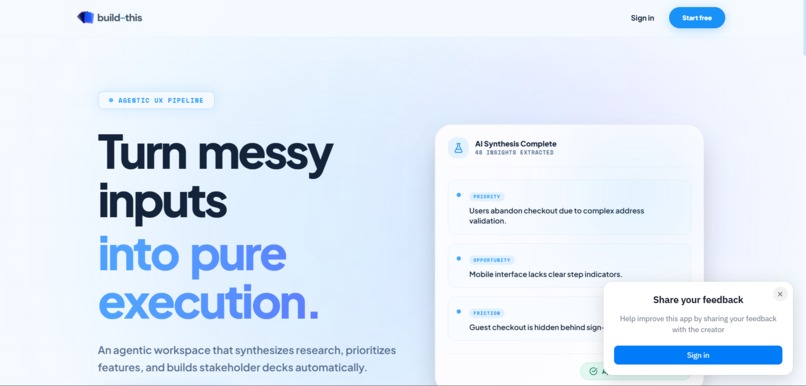
Screenshot
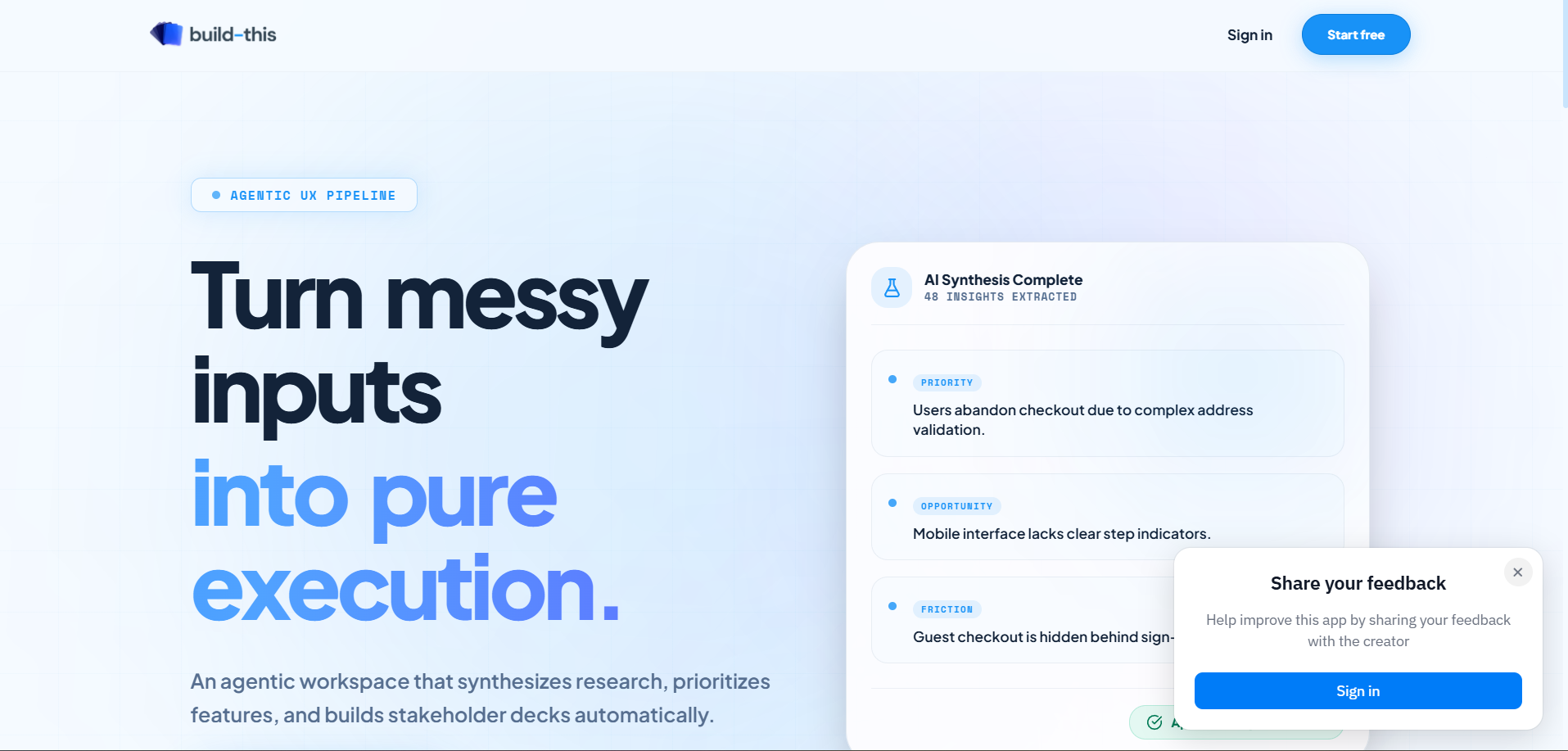
Inspiration
Product teams often lose momentum between research, design decisions, and implementation. User findings live in documents, UX recommendations live elsewhere, and developer tasks are frequently created manually after the design work is already complete. That fragmentation creates handoff friction and makes it harder to maintain a clear line from user evidence to what gets built.
AI-Powered UX Workflow Automation explores a more connected approach: use agentic AI to turn raw product inputs into structured, execution-ready UX outputs while keeping human judgment in control.
What it does
The product acts as an AI-powered UX workflow assistant that helps transform research and business context into practical product-design outputs. It can:
- Summarize key user problems and product needs from project inputs.
- Generate structured UX recommendations and user-flow direction.
- Prioritize features around business goals and user value.
- Translate design decisions into clearer, developer-ready tasks.
- Reduce repetitive manual work between research, UX planning, and implementation.
The goal is not to replace designers. It is to remove repetitive workflow friction so product teams can spend more time evaluating evidence, making decisions, and improving the experience.
How we built it
The workflow was designed by mapping common UX and product-design activities into a sequence of AI-assisted steps. Instead of asking an AI model for one generic answer, the experience structures the work around specific product inputs and outputs: research synthesis, UX recommendations, prioritization, flow thinking, and implementation tasks.
The application is delivered as an interactive web experience and deployed on Replit. The product logic uses agentic prompting and structured AI workflows to keep outputs focused on product context rather than generic design advice.
Challenges we ran into
Keeping AI output specific
Generic AI suggestions are rarely useful to experienced product teams. The workflow needed prompts and structure that consistently tied recommendations back to the user problem and business objective.
Bridging design and development
A useful UX assistant cannot stop at ideas. The workflow needed to convert design reasoning into outputs that are easier for developers and cross-functional teams to act on.
Preserving human judgment
UX decisions are contextual. The product was designed as an assistant that accelerates analysis and execution rather than an autonomous replacement for product judgment.
Accomplishments that we're proud of
- Created a working AI-powered UX workflow instead of a static design concept.
- Connected research synthesis, UX recommendations, prioritization, and implementation planning in one product flow.
- Focused the AI experience on actionable product decisions rather than generic design generation.
- Built a reusable concept that can support product designers, UX leads, founders, and cross-functional teams.
What we learned
Agentic AI becomes more valuable in UX when it is structured around a real workflow rather than treated as a general-purpose chatbot. Clear task boundaries, strong context, and human review produce outputs that are more useful for actual product work.
We also learned that the strongest opportunity is not simply generating interfaces faster; it is maintaining continuity from research and strategy through design and implementation.
What's next
- Deeper integrations with Figma and project-management tools.
- Automated UX audits for SaaS, e-commerce, and product dashboards.
- More advanced user-journey and information-architecture generation.
- Collaboration features for designers, developers, and product stakeholders.
- Stronger traceability from research evidence to recommendations and implementation tasks.
Built With
- agentic-ai
- prompt-engineering
- replit
- ux-automation