-
-
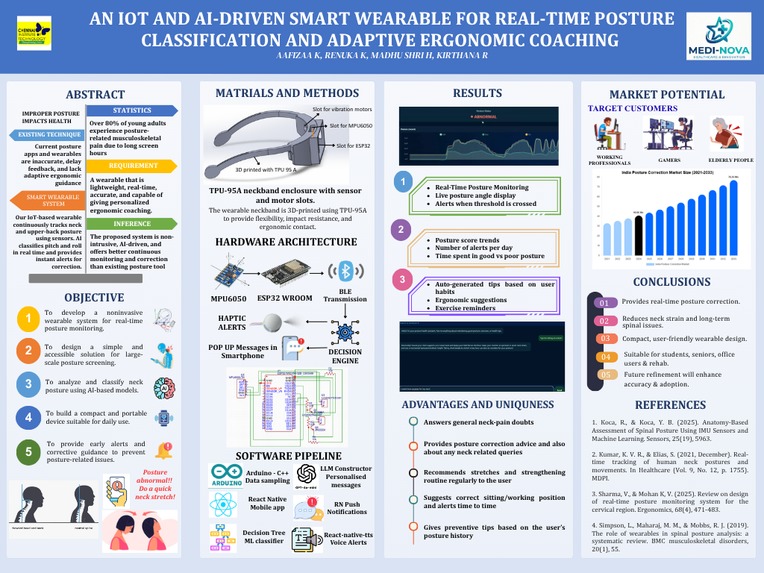
Postura-AI-scientific poster
-
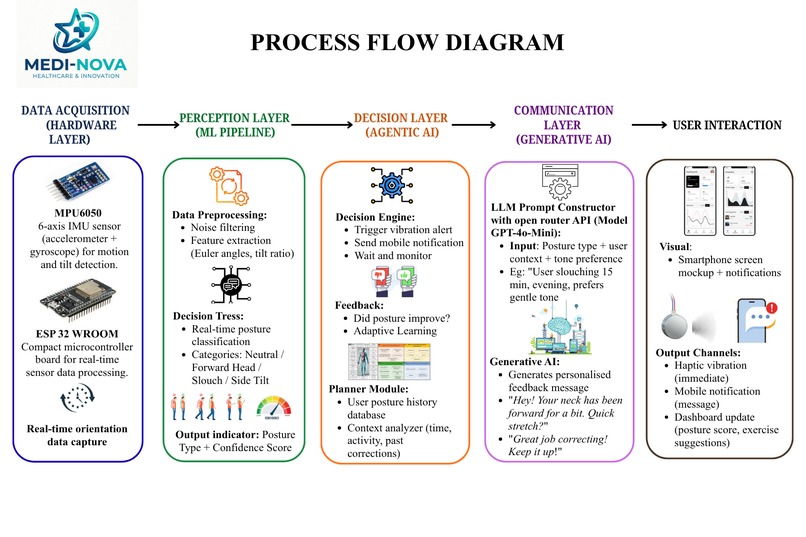
Process flow diagram
-
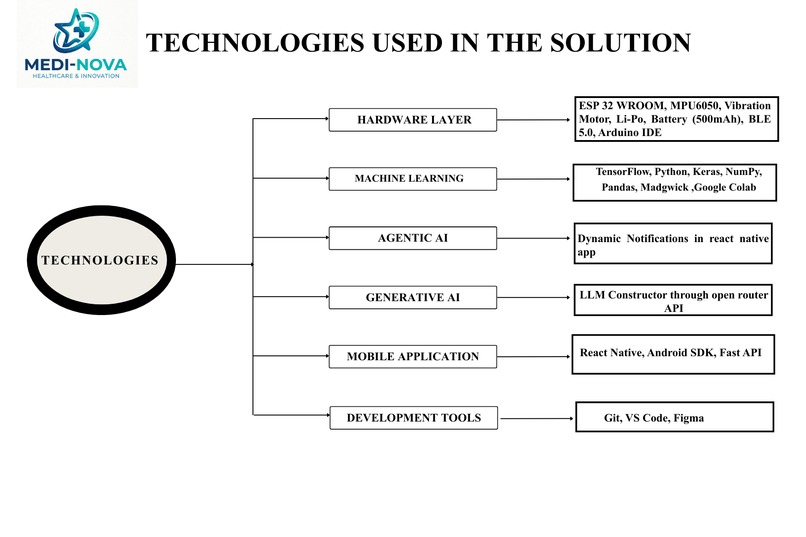
Software and hardware TECHSTACK
-
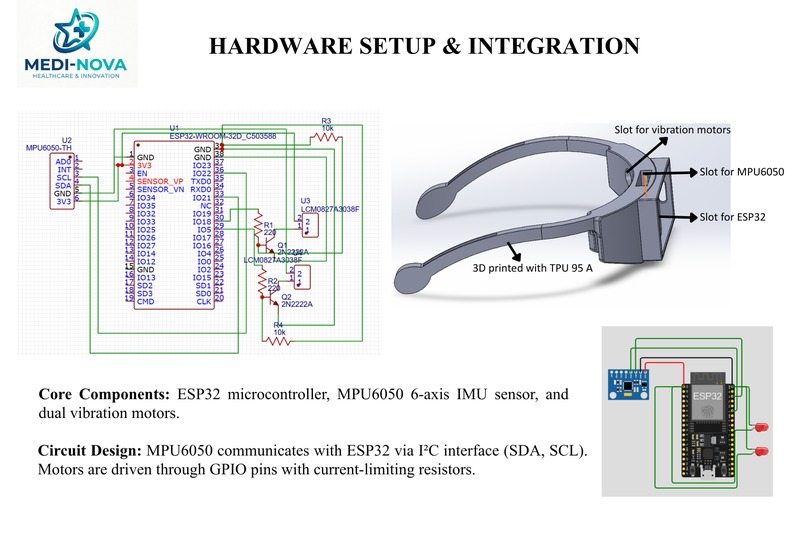
hardware setup and integration
-
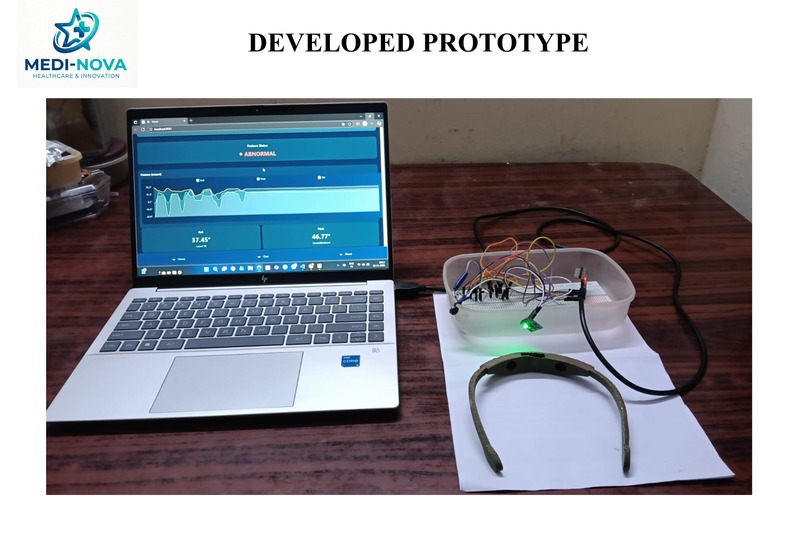
Developed protoype
Inspiration
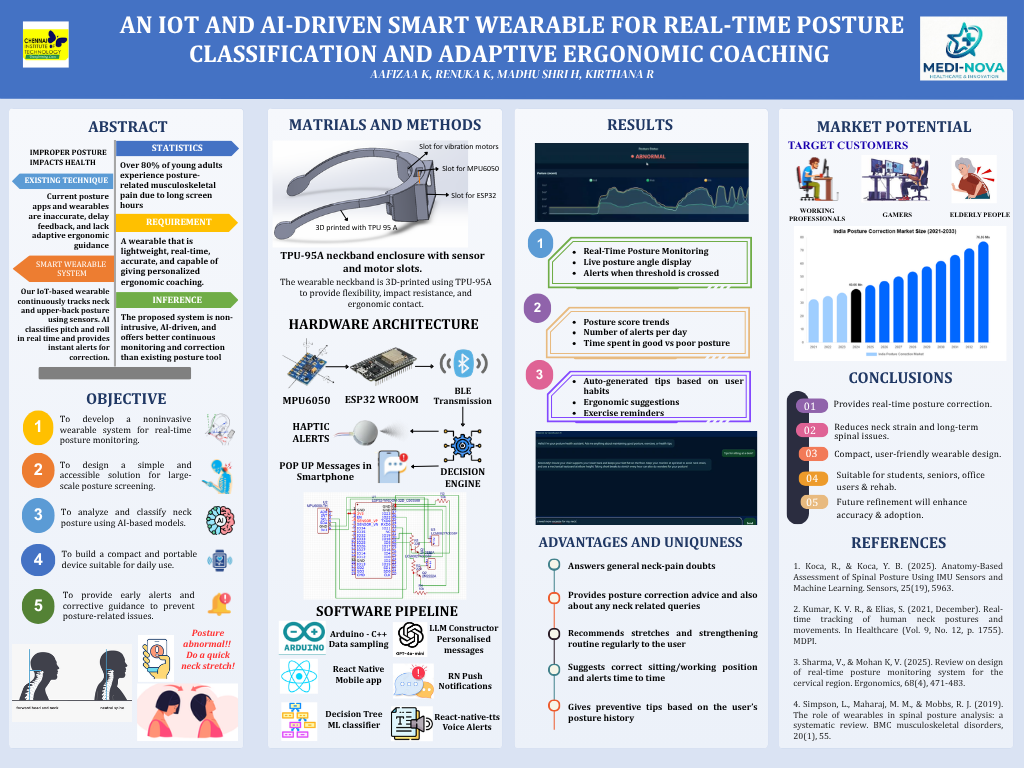
In a world where screens dominate our daily lives, posture has silently become a public health concern. The proposed solution, an AI-powered smart neckband detects, analyses, and corrects neck and spinal posture in real-time using embedded IMU sensors and a self-learning AI engine. Unlike static wearables, this system adapts to the user’s body dynamics, providing subtle haptic alerts and personalized exercises through a mobile dashboard. It’s not just a tracker, it’s a digital posture companion that learns, predicts, and coaches for lasting musculoskeletal wellness.
What it does
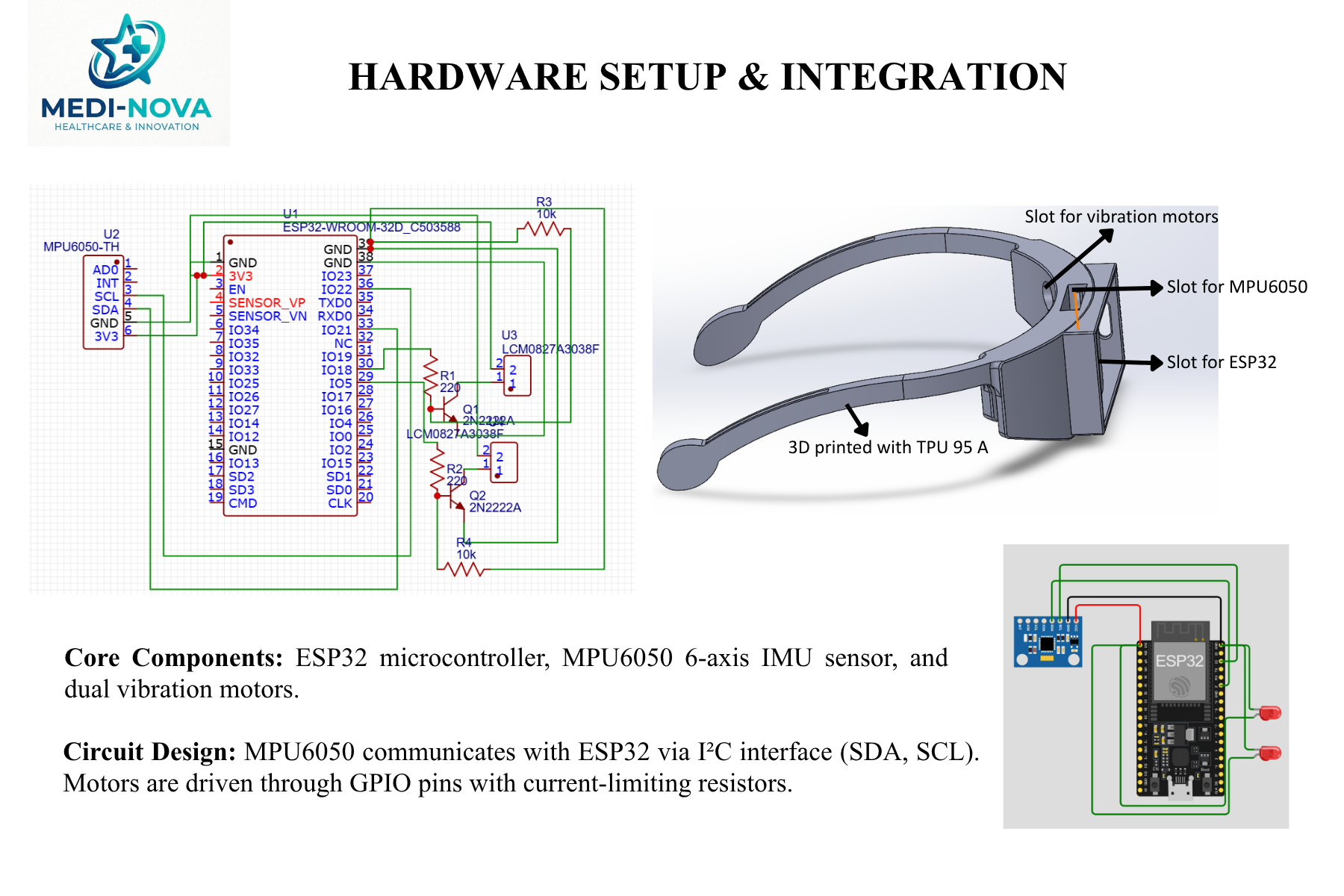
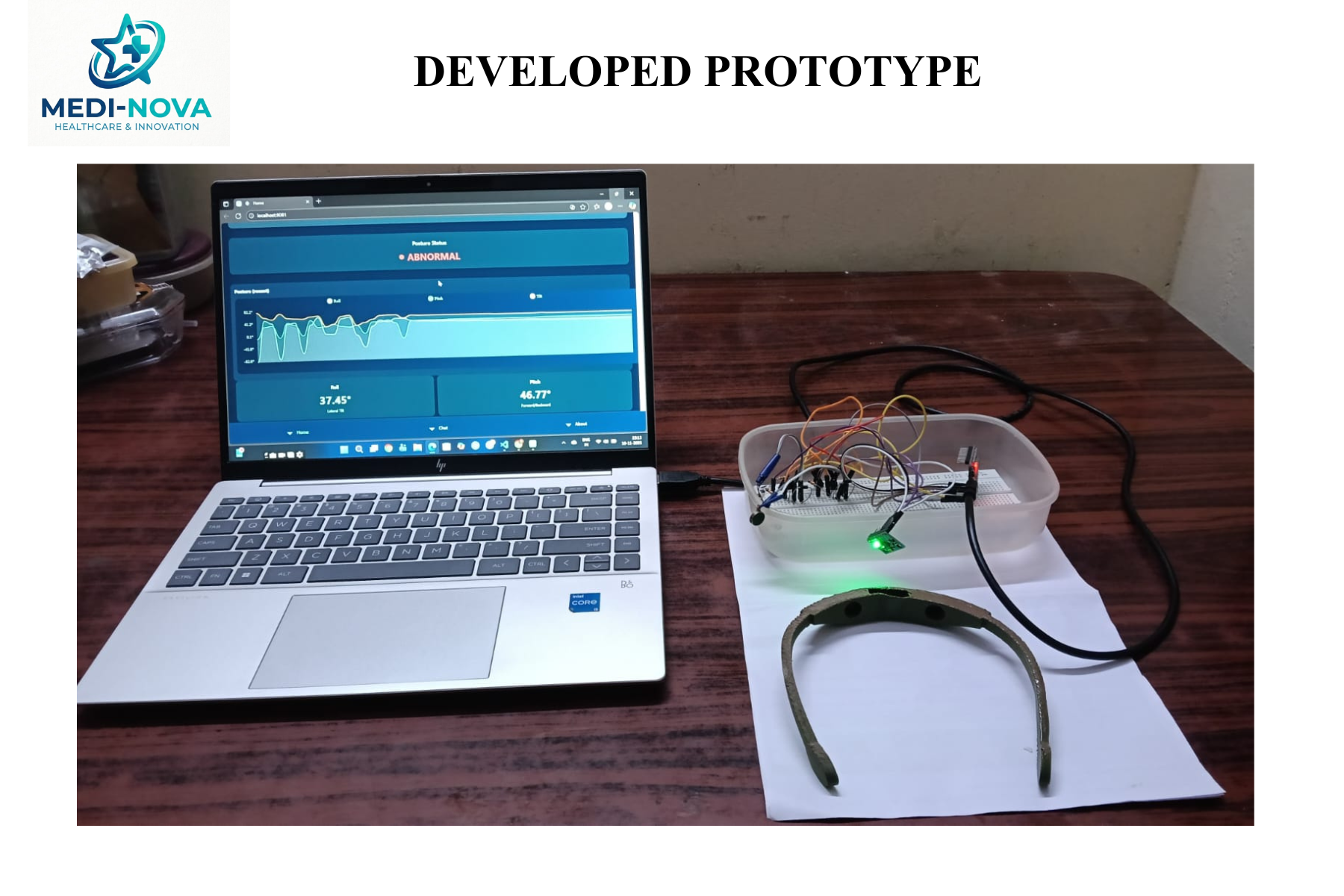
The PostureMonitor system is a smart, AI-assisted posture detection device designed to identify improper body alignment and promote ergonomic health. It employs an ESP32-WROOM microcontroller integrated with an MPU6050 accelerometer and gyroscope sensor to acquire real-time body orientation data. Using trigonometric computations, the device determines pitch and roll angles, classifying posture as normal or abnormal. When incorrect posture is detected, dual vibration motors are triggered to alert the user through haptic feedback. The device establishes wireless communication via Bluetooth Low Energy (BLE) to a React Native mobile application, which visualizes posture data and provides AI-generated health recommendations. This combination of IoT and AI technologies ensures an efficient, affordable, and user-friendly system for continuous posture monitoring and wellness improvement.
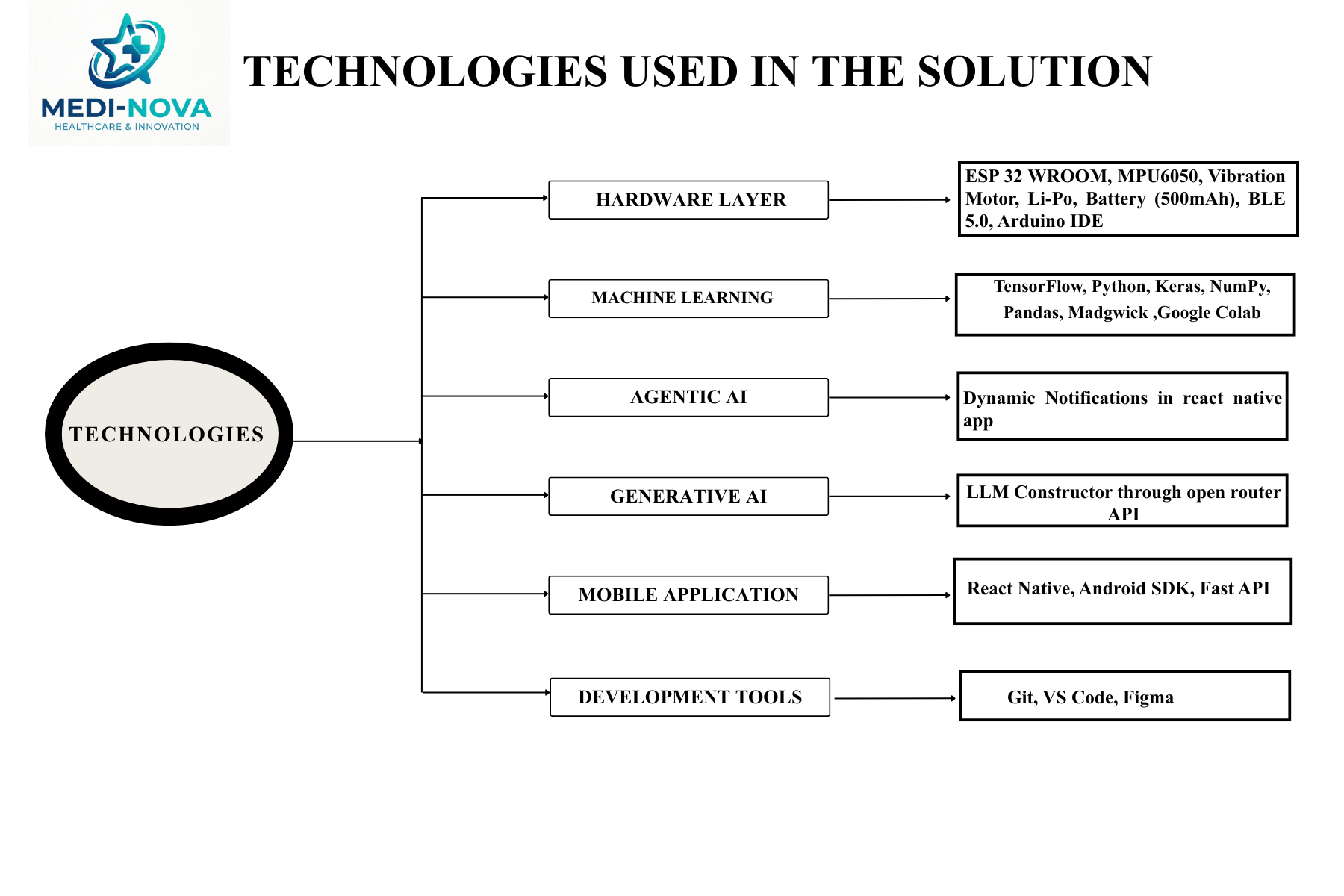
Built for AI-centric software innovation, it combines:
- Embedded sensing (ESP32 + MPU6050)
- Real-time BLE data transmission
- On-device AI classification (Decision Tree)
- Generative AI voice advisory (GPT-4o mini)
How we built it
We designed POSTURA AI as a tightly integrated edge-AI + IoT wearable system that operates in real time with minimal latency.
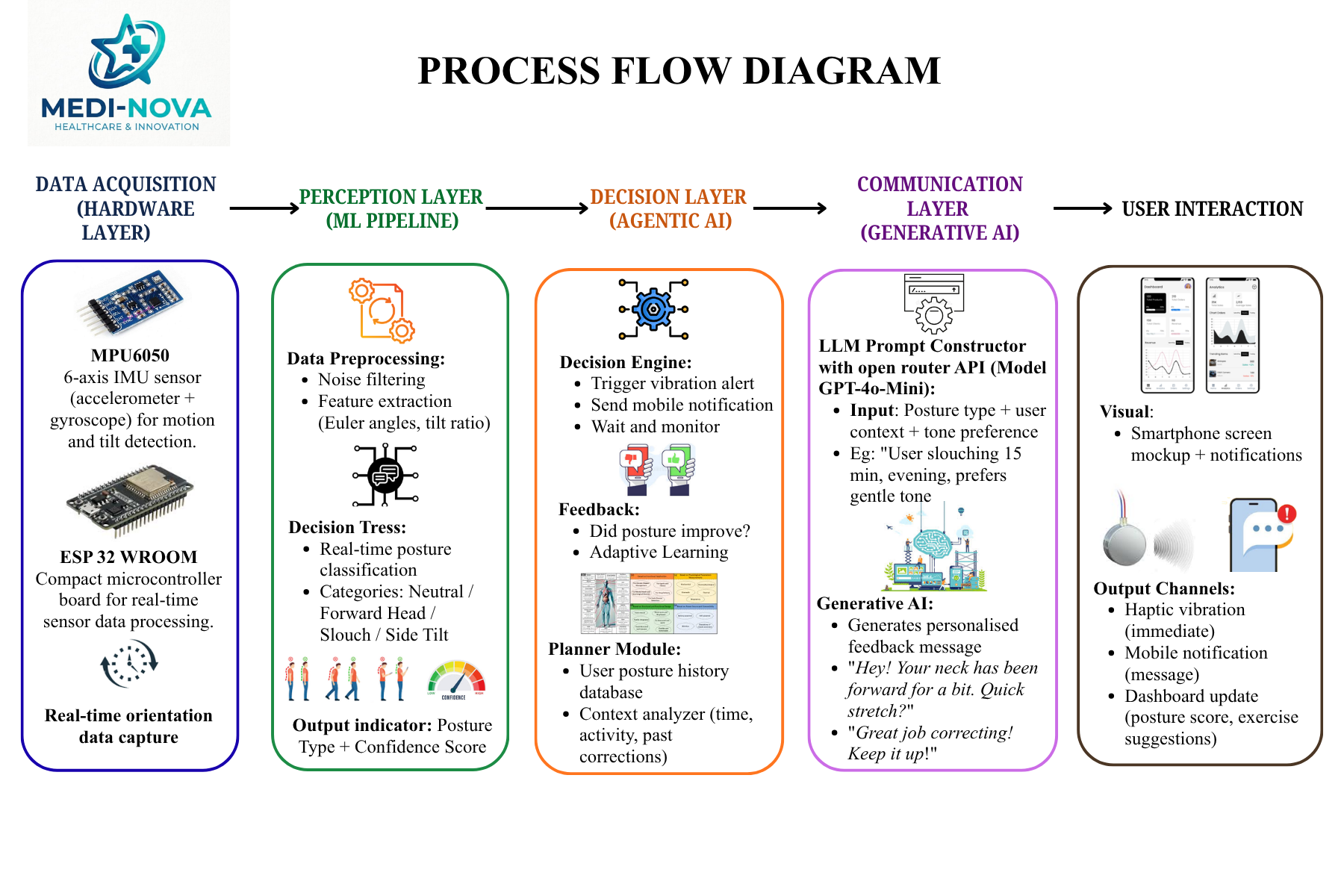
At the hardware level, we developed a lightweight smart neckband using an ESP32-WROOM microcontroller interfaced with an MPU6050 6-axis IMU sensor to continuously capture neck orientation data (pitch, roll, yaw). The raw sensor data is preprocessed on-device using noise filtering and trigonometric transformations to extract meaningful posture features.
On the intelligence layer, we implemented a Decision Tree-based edge ML model trained using scikit-learn to classify posture into Neutral, Forward Head Tilt, and Slouching with high accuracy. This model is embedded for real-time inference without cloud dependency.
For communication, we built a BLE-based pipeline to transmit posture data to a React Native mobile application, where users can visualize posture trends and receive alerts.
To elevate the system beyond detection, we integrated GPT-4o mini as a generative AI layer that converts posture data into personalized, context-aware coaching messages, transforming the device into an interactive digital posture assistant.
The complete pipeline follows: IMU → ESP32 → Edge ML Classification → BLE → Mobile App → AI Advisory → Haptic + Voice Feedback
Challenges we ran into
Building a real-time wearable AI system exposed several non-trivial challenges:
- Sensor noise & drift: IMU data is inherently noisy, and small errors in angle estimation led to misclassification. We had to carefully tune filtering and feature extraction (Euler angles, tilt ratios) to stabilize predictions.
- Edge vs. accuracy trade-off: Running ML on-device required balancing model complexity with latency and power consumption. We optimized the Decision Tree to maintain >90% accuracy while ensuring real-time performance.
- Ergonomic hardware design: Designing a comfortable yet stable neckband using TPU 95A was challenging, as sensor placement and vibration isolation directly affected signal quality.
- Meaningful AI feedback (not annoying alerts): Raw alerts quickly become irritating. Integrating generative AI required designing prompts that produce empathetic, non-intrusive coaching instead of robotic warnings.
- Seamless BLE communication: Ensuring low-latency, stable data transfer between ESP32 and the mobile app under continuous streaming conditions required careful handling of BLE characteristics and packet flow.
Accomplishments that we're proud of
- Built a fully functional end-to-end wearable prototype — not just a concept.
- Achieved real-time posture classification with >90% accuracy on edge devices.
- Successfully combined Edge ML + Generative AI, which is still rare in wearable healthcare systems.
- Developed a system that provides multi-modal feedback: Instant haptic correction, Mobile notifications, AI-generated coaching.
- Designed a user-adaptive system that evolves from a tracker into a behavior-changing digital wellness companion.
- Created a solution that is affordable, non-invasive, scalable to real-world users (students, professionals, elderly).
What we learned
This project pushed us beyond textbook knowledge into real-world system design:
- AI is only valuable when paired with good sensing — poor input data limits even the best models
- Edge AI is the future of healthcare wearables, especially for privacy, latency, and reliability User experience matters as much as accuracy how feedback is delivered determines adoption
- Interdisciplinary integration is key — success required combining Embedded systems, Signal - processing, Machine learning, Mobile development and Human-centered design.
- We also learned that Generative AI can act as a behavioral coach, not just a text generator, when grounded in real sensor data
What's next for AI-Powered Smart Posture Detection and Advisory System
We envision POSTURA AI evolving into a complete musculoskeletal health platform:
- Advanced AI models: Upgrade to deep learning for more accurate posture and movement analysis
- Personalized learning: Adaptive system that predicts and corrects posture proactively
- Computer vision integration: Hybrid validation using wearable + camera-based tracking
- Clinical validation: Collaboration with physiotherapists for real-world healthcare use
- Product scalability: Sleeker, more ergonomic, and commercially viable wearable design
- Ecosystem expansion: Integration with fitness, workplace wellness, and telehealth platforms
Goal: Shift from reactive correction → proactive, AI-driven posture prevention
Built With
- android-studio
- arduino
- ble-plx
- decisiontree
- fastapi
- gpt-4o
- numpy
- openrouter
- pandas
- push-notifications
- python
- reactnative
- scikit-learn
- text-to-speech


Log in or sign up for Devpost to join the conversation.