-
-
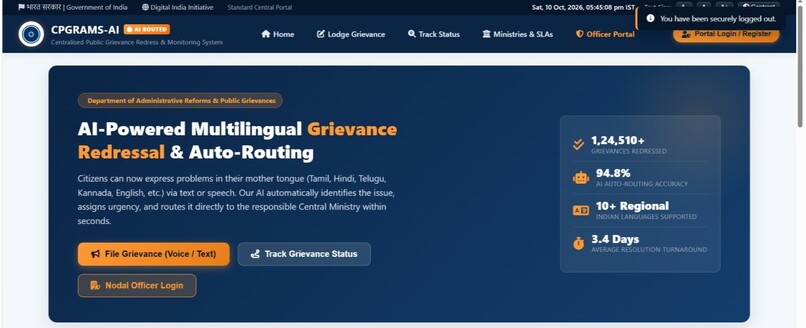
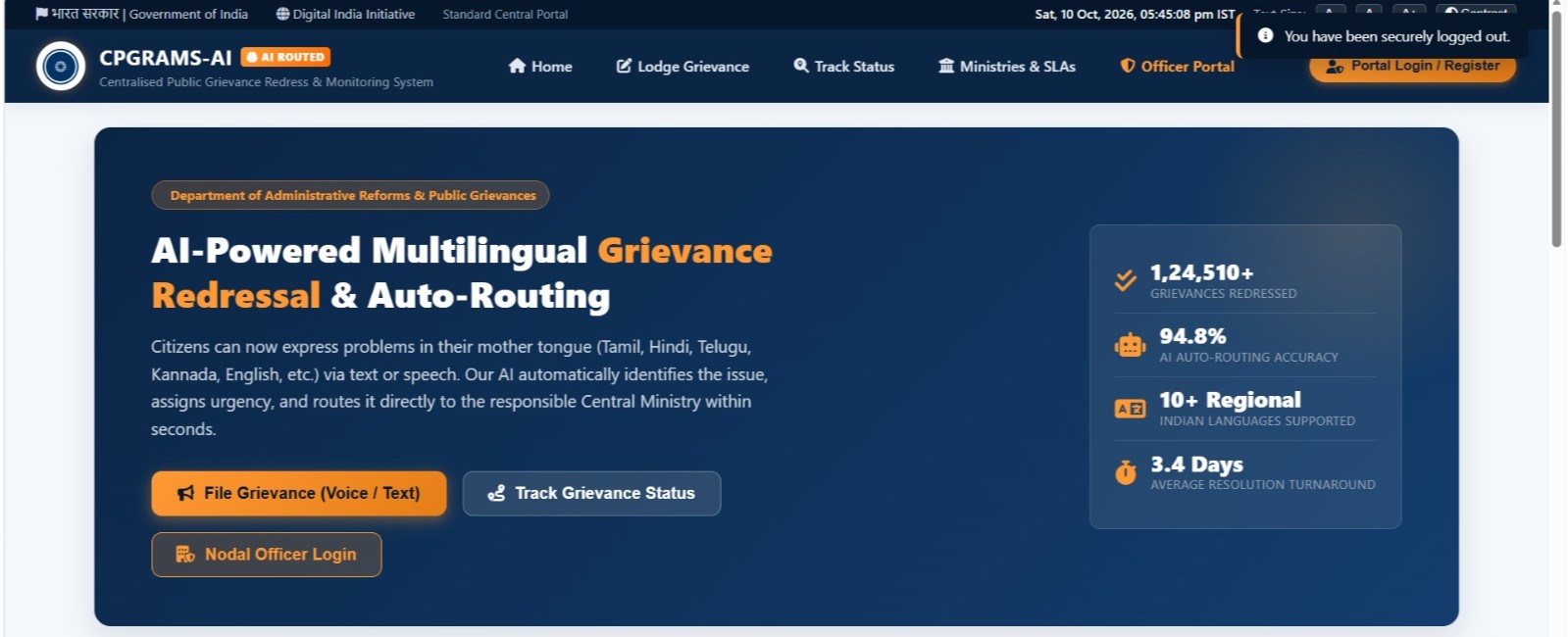
Home Page
-
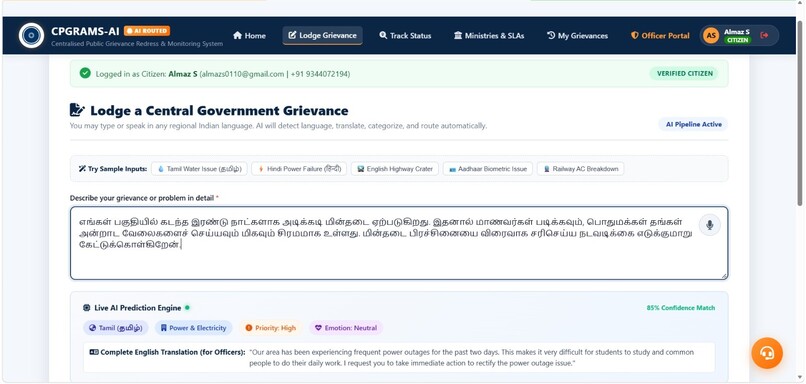
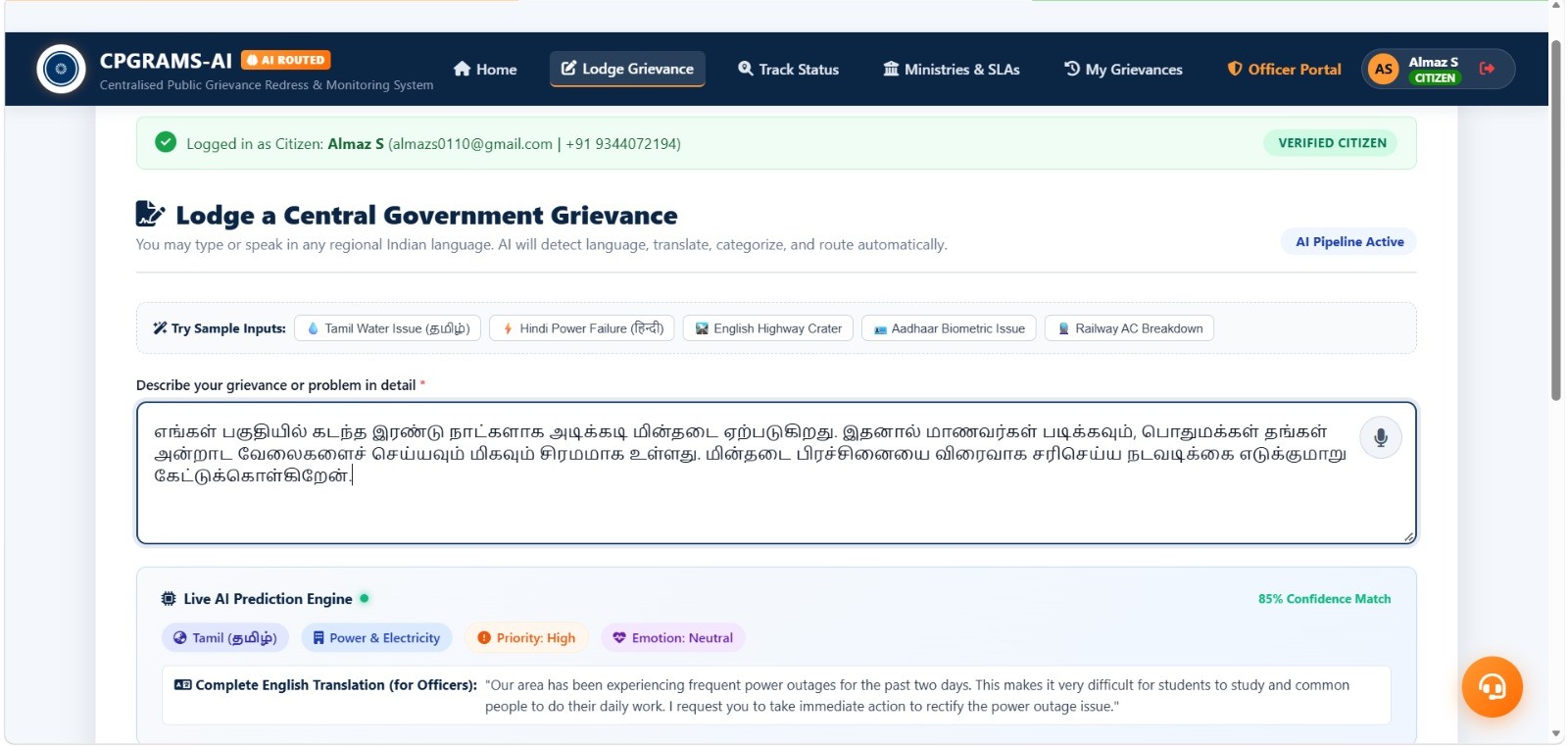
Multilingual Grievance Submission
-
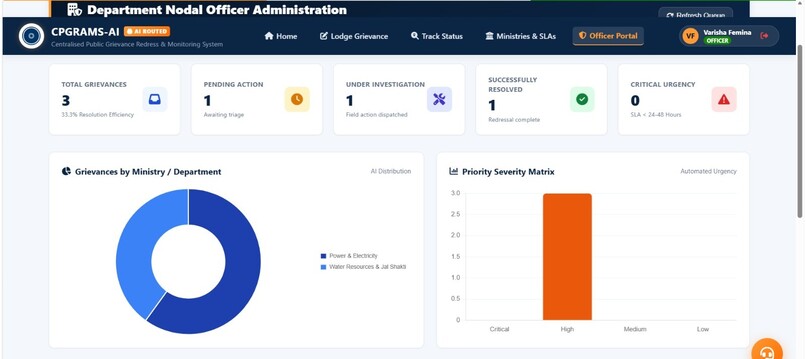
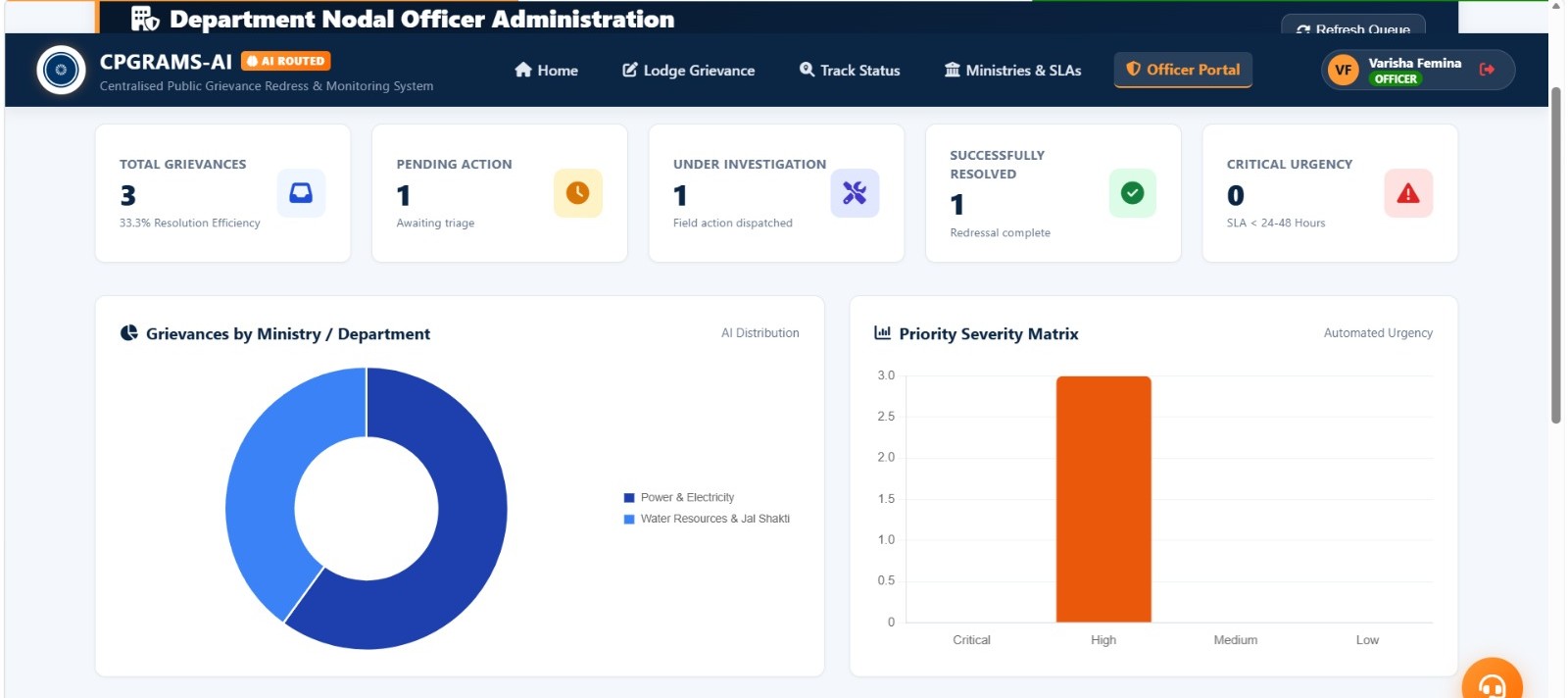
Officer Analytics Dashboard
-
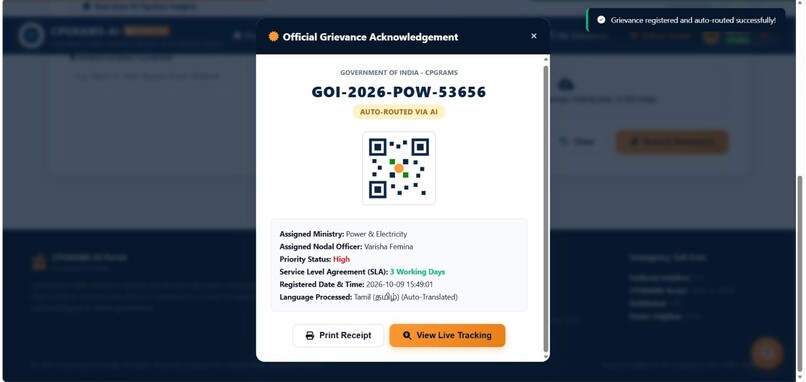
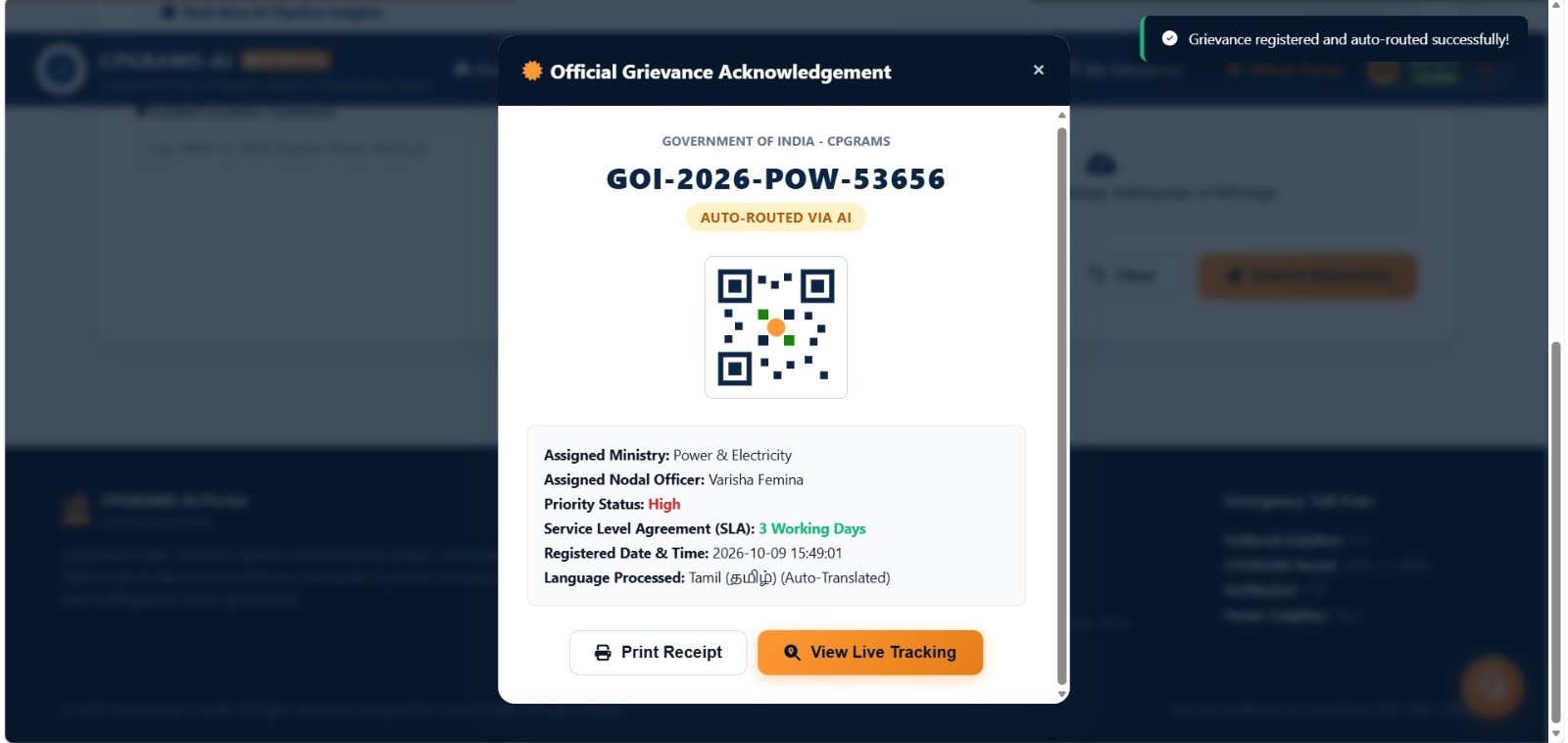
AI Routing and Acknowledgement
-
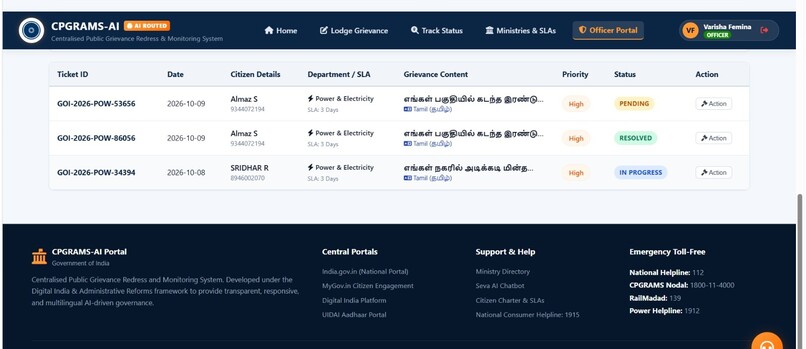
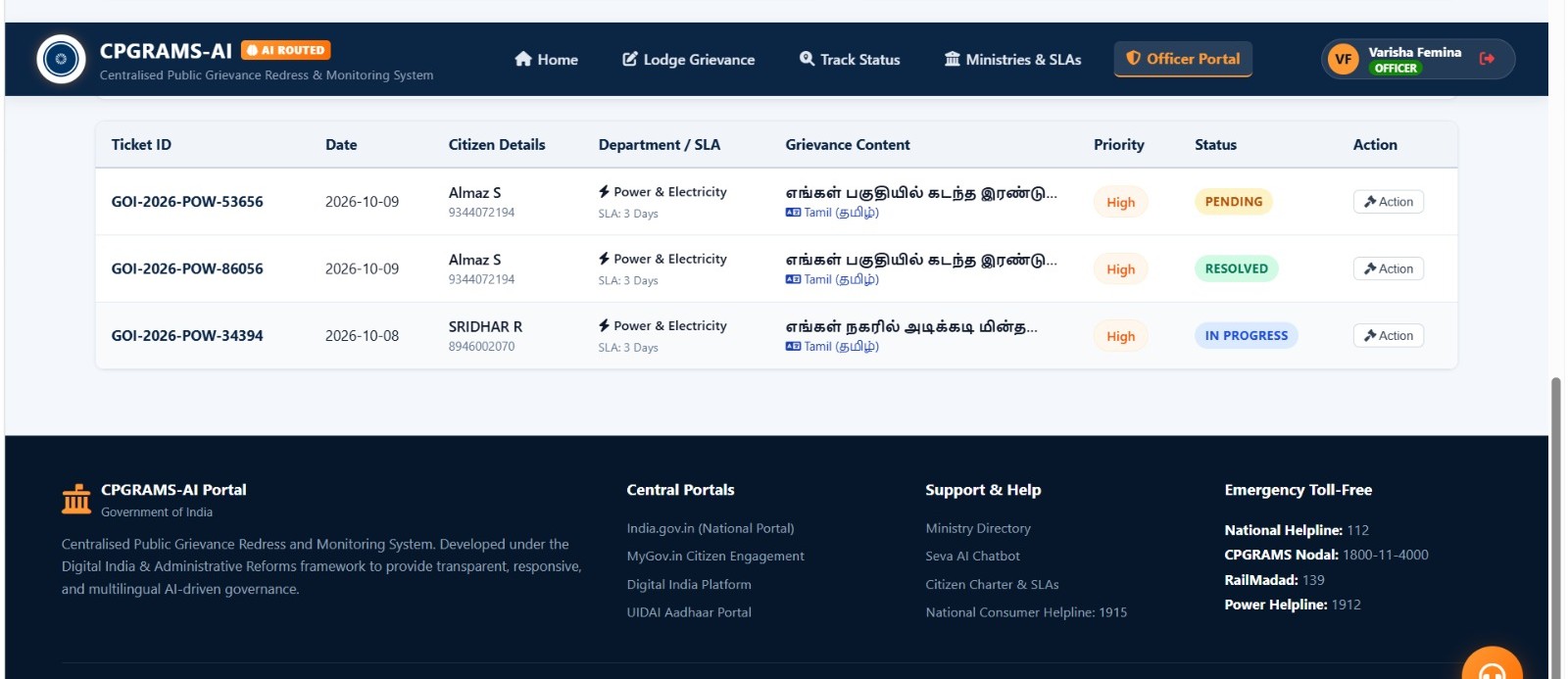
Grievance Management
-
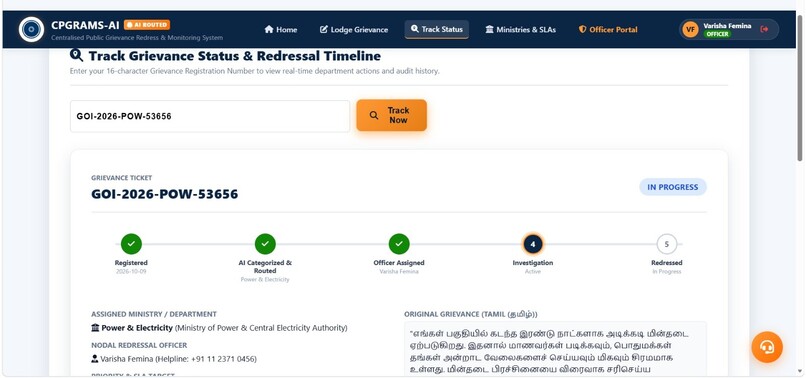
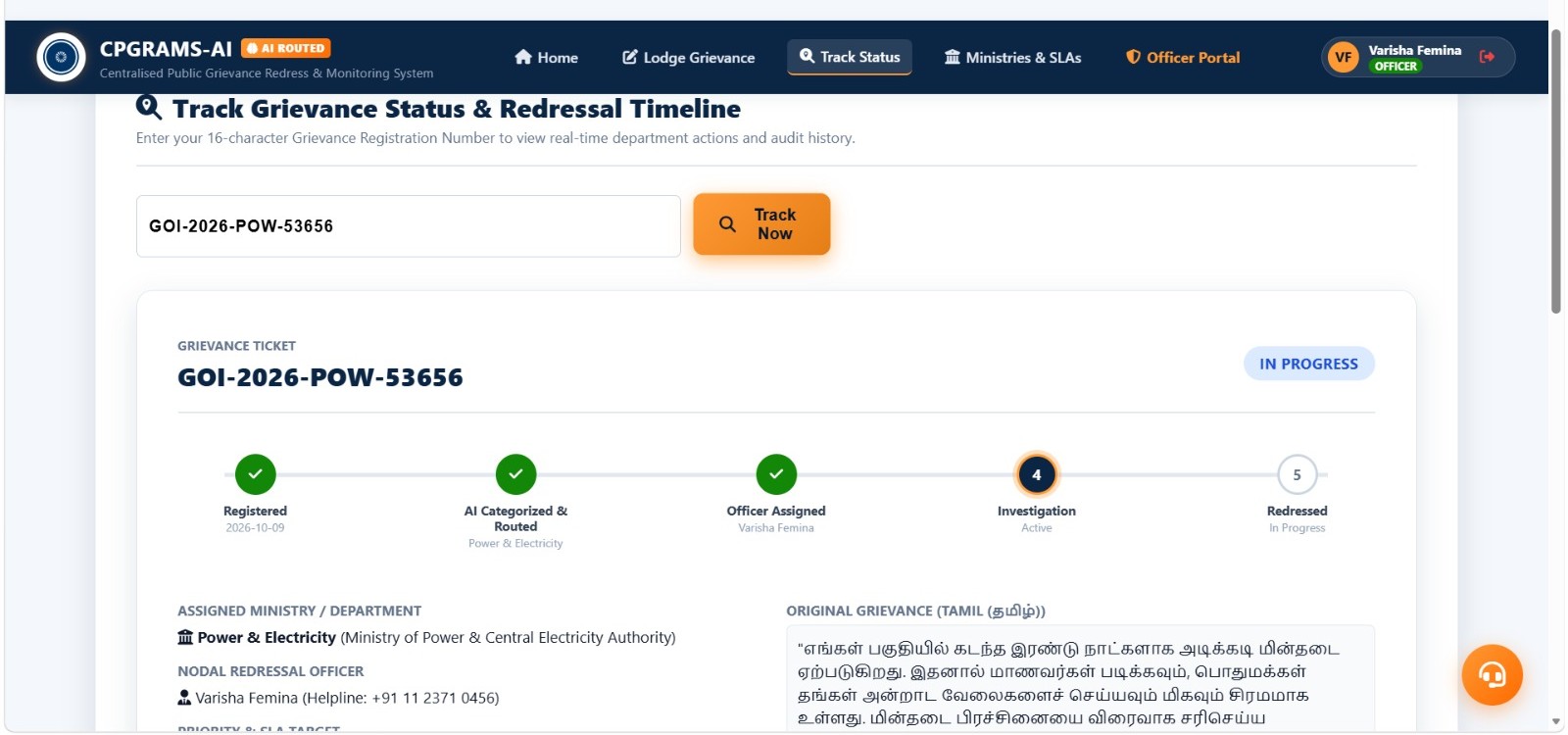
Complaint Tracking Timeline
Inspiration
Citizens often face difficulties when submitting grievances to government departments. Complaints may be written in different languages, forwarded to the wrong department, or delayed due to manual classification and routing. These issues can make public-service grievance handling less efficient and leave citizens uncertain about the progress of their complaints.
We were inspired to build an AI-powered solution that simplifies grievance management by understanding citizens' complaints, identifying the appropriate category, and routing them to the relevant department. Our goal is to make the process more accessible, efficient, and transparent, especially for citizens who prefer regional languages.
What it does
AI-Powered Smart Grievance Routing System is an intelligent grievance management platform that helps automate the complaint-handling process.
Multilingual Input: Accepts grievances in supported languages, including Tamil and English, with Hindi support where configured.
Language Detection and Translation: Identifies the complaint language and translates the text when required.
AI-Based Classification: Analyzes complaint text and predicts a relevant category, such as water supply, electricity, roads, healthcare, or education.
Priority Assignment: Assigns a priority level to help identify complaints that may require faster attention.
Automatic Department Routing: Maps the predicted category to the appropriate department.
Complaint Tracking: Generates a unique complaint ID and allows users to check complaint status.
Admin Dashboard: Helps administrators view grievances and manage status updates.
The system aims to reduce manual effort and make grievance handling more organized and transparent.
How we built it
We developed a working prototype using a modular architecture consisting of a frontend, backend, AI processing pipeline, and database.
Python and scikit-learn are used for the machine learning component. TF-IDF converts processed complaint text into numerical features, and a Logistic Regression classifier predicts the complaint category. Language detection and translation help prepare multilingual complaints for classification.
The backend handles complaint submission, AI predictions, department mapping, and status management. The frontend provides interfaces for citizens to submit and track grievances, while the administrative interface supports complaint monitoring. The database stores complaint details and status updates.
The main workflow is:
Complaint Submission → Language Processing → AI Classification → Priority Assignment → Department Routing → Complaint Tracking
Challenges we ran into
One major challenge was designing a workflow that can handle complaints written in different languages while preserving their meaning. Another challenge was distinguishing between similar complaint categories, such as water supply issues and general sanitation problems.
We also considered the impact of limited or imbalanced training data on classification quality. Incorrect department mapping and unsuitable priority assignment could delay the resolution of important grievances. We addressed these design challenges through text preprocessing, machine learning-based classification, category-to-department mapping, and a structured complaint workflow.
Further testing with more diverse, real-world grievance data is necessary to improve reliability across languages and complaint types.
Accomplishments that we're proud of
We are proud to develop a working prototype that demonstrates how AI can support the grievance management process from complaint submission to department routing and status tracking.
Our key accomplishments include:
Integrating a machine learning model into a grievance-handling workflow.
Using TF-IDF and Logistic Regression for complaint category prediction.
Designing a multilingual processing approach for greater accessibility.
Connecting predicted categories with department-routing logic.
Bringing complaint management and status tracking into a unified workflow.
The most important accomplishment is demonstrating how AI-based classification can turn unstructured complaint text into a more organized and actionable grievance record.
What we learned
Through this project, we learned how Natural Language Processing and machine learning can be applied to a practical public-service problem. We understood the role of text preprocessing, TF-IDF feature extraction, and supervised classification in converting complaint text into meaningful predictions.
We also learned that an AI prediction alone is not enough to complete a real-world workflow. It must be connected to reliable department mapping, priority handling, database storage, and status tracking. We gained a better understanding of how frontend, backend, AI, and database components work together in an end-to-end application.
Most importantly, we learned to consider accessibility, prediction errors, data quality, and user trust when designing AI-powered systems.
What's next for AI-Powered Smart Grievance Routing System
Our next goal is to improve the system's accuracy, usability, and scalability.
Improved Multilingual Support: Expand support for additional Indian languages and evaluate translation quality.
Better Model Evaluation: Compare classification algorithms using precision, recall, F1-score, and a confusion matrix.
Smarter Priority Assessment: Improve priority assignment using complaint severity, duration, and potential public impact.
Duplicate Complaint Detection: Identify similar grievances to help administrators recognize recurring issues.
Notifications: Add email or SMS updates when complaint status changes.
Analytics Dashboard: Visualize complaint categories, priority levels, resolution times, and recurring public-service issues.
Voice-Based Submission: Explore speech-to-text for citizens who find typing difficult.
Our long-term vision is to build a reliable, accessible, and scalable AI-assisted grievance platform that helps citizens communicate their problems more easily and helps public-service teams manage complaints more efficiently.
Built With
- chart.js
- css3
- fastapi
- html5
- javascript
- logistic
- python
- regression
- scikit-learn
- sqlite
- tf-idf
- uvicorn

Log in or sign up for Devpost to join the conversation.