-
-
AI-Powered Smart Attendance & Identity Management System
Inspiration
The inspiration behind this project came from the challenges faced in managing attendance and identity verification in classrooms, workplaces, and public events. Traditional attendance methods such as manual registers or ID-based systems are time-consuming, error-prone, and vulnerable to proxy attendance or unauthorized access. During exams and secure events, verifying identities quickly and accurately becomes even more critical. We wanted to design a smart, automated system that uses artificial intelligence to make attendance seamless, secure, and efficient. The idea was to build a unified platform that not only records attendance but also provides analytics, alerts for unknown individuals, and intelligent interaction through natural language queries.
What it does
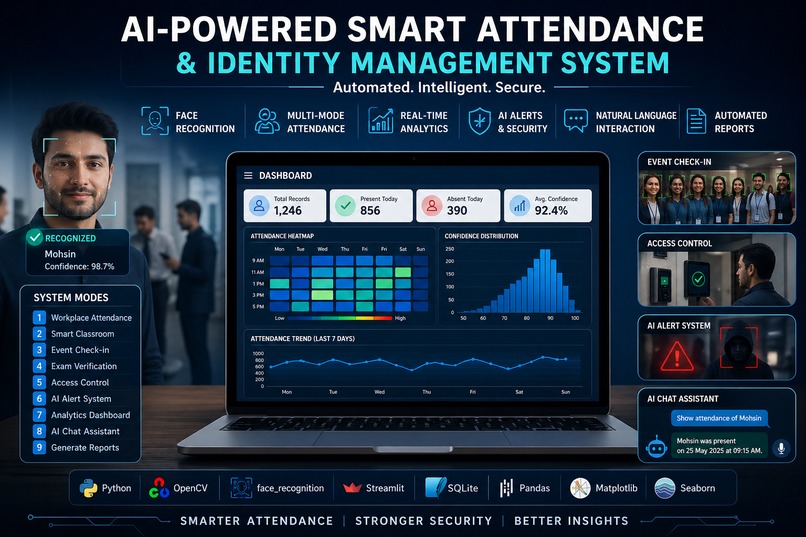
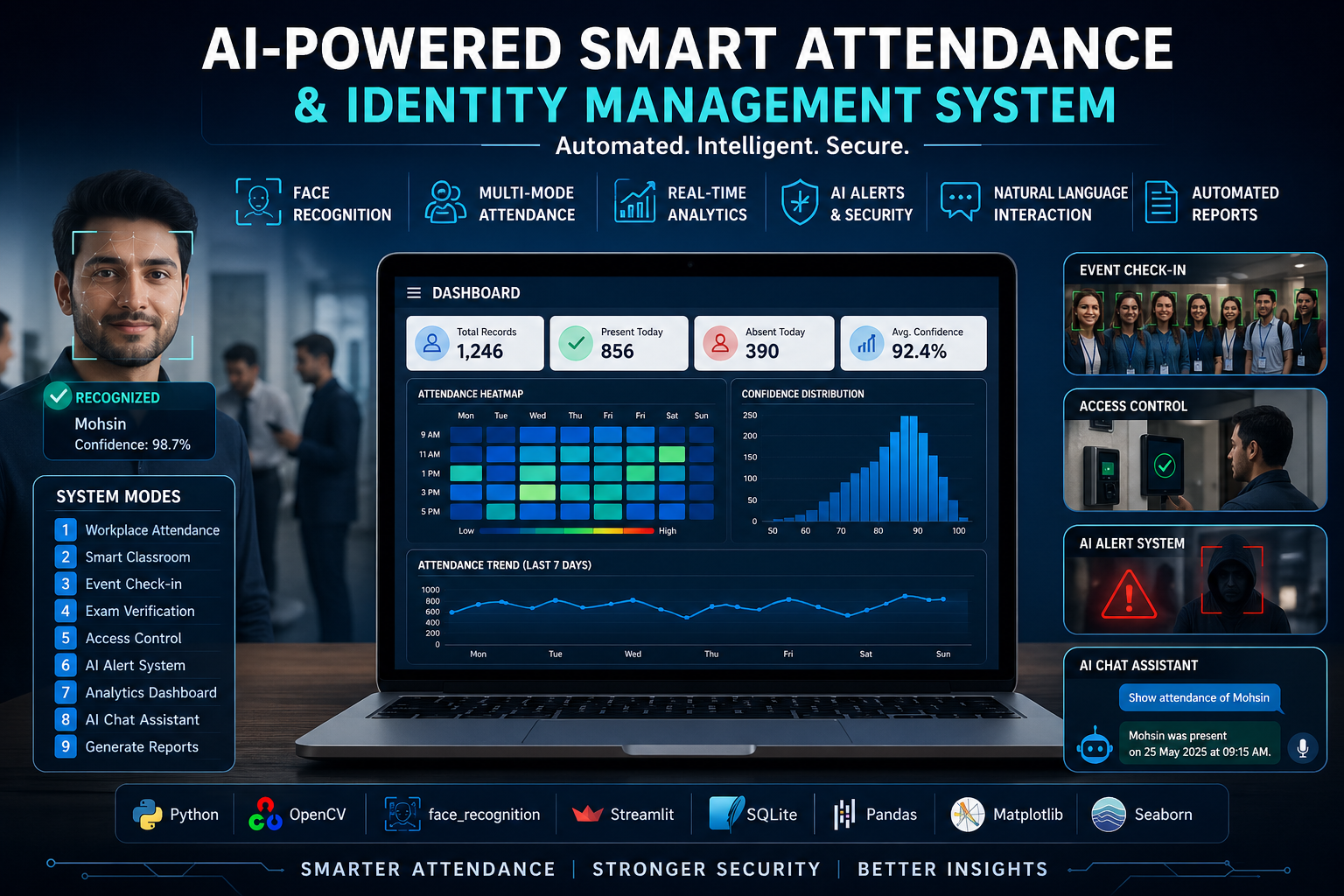
This project is an AI-powered smart attendance and identity management system that automates attendance tracking using real-time facial recognition. The system detects faces through a camera, identifies individuals using trained face recognition models, and records their attendance along with timestamps and confidence scores.
The platform supports multiple real-world scenarios through different operational modes. In Workplace Attendance mode, employees are automatically marked present when their faces are recognized. In Smart Classroom mode, student attendance is recorded without manual input. Event Check-in mode allows participants to register automatically during seminars or hackathons. Exam Verification mode ensures that only authorized students appear for examinations, while Access Control mode grants or denies entry based on identity verification.
The system also includes an AI Alert module that detects unknown individuals and logs them for security monitoring. An interactive analytics dashboard built with Streamlit provides visual insights such as attendance trends, heatmaps, confidence analysis, and performance metrics. Additionally, users can query attendance data using natural language through an AI chat assistant, and generate automated attendance reports for administrative use.
Overall, the system transforms traditional attendance methods into a fast, secure, and intelligent automated process powered by artificial intelligence.
How I built it
The system was built using Python as the core programming language, with OpenCV and the face-recognition library (powered by dlib) for real-time facial detection and identity matching. Initially, face datasets were collected by capturing multiple images of each individual using a webcam or mobile camera. These images were processed to generate facial encodings, which were stored as trained models for fast recognition during runtime.
SQLite was used as the database to store attendance records, timestamps, recognition confidence values, and logs of unknown individuals. Multiple operational modules were developed, including workplace attendance, classroom monitoring, event check-in, exam verification, and secure access control. Each module was designed to reuse the same trained face recognition model while handling different real-world scenarios.
For data visualization and analytics, an interactive dashboard was developed using Streamlit. The dashboard displays attendance tables, confidence metrics, heatmaps, daily trends, and graphical summaries using Pandas, Matplotlib, and Seaborn. This allowed real-time analysis of attendance behavior and recognition performance.
An AI-based query assistant was implemented using natural language processing logic to allow users to ask questions such as "Show attendance of student name" or "Show late employees." Additionally, automated reporting functionality was added to generate CSV-based attendance summaries for administrative use.
The system was developed modularly, allowing each feature to function independently while being controlled through a centralized main menu interface. GitHub was used for version control and project management throughout development.
Challenges I ran into
One of the main challenges was stabilizing the camera across multiple system modes, as switching between modules sometimes caused crashes or resource conflicts. Another challenge was managing database updates when adding new features like confidence scoring and alert logging. We also faced compatibility issues between libraries such as OpenCV, NumPy, and dlib, which required careful version management. Optimizing face recognition speed and ensuring accurate detection under different lighting conditions was another key technical challenge.
Accomplishments that I'm proud of
I am proud of successfully building a fully functional multi-mode AI attendance system that works across different real-world scenarios such as workplaces, classrooms, events, and secure access systems. Integrating face recognition, analytics dashboards, and natural language queries into a single unified platform was a major achievement. I am also proud of stabilizing the system to handle camera operations, database logging, and visualization features without crashes, and creating an interactive dashboard that presents attendance insights through heatmaps, confidence analysis, and trend graphs.