-
-
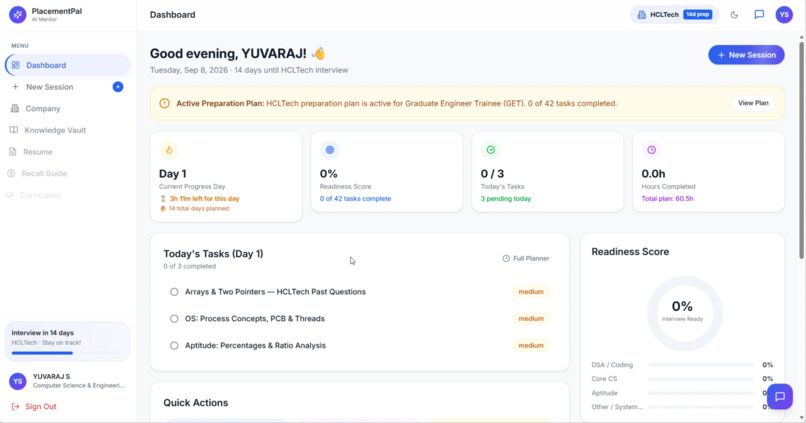
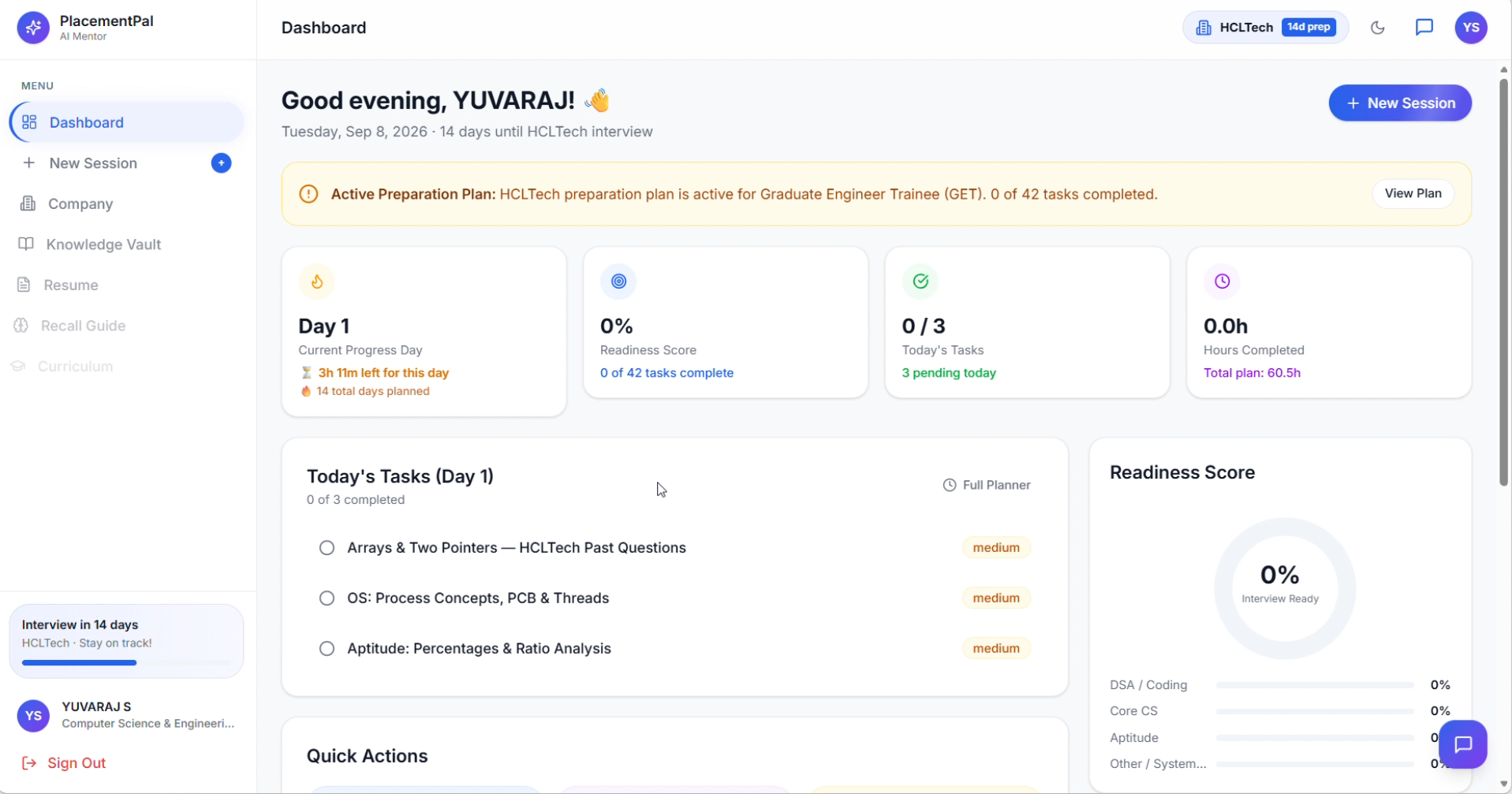
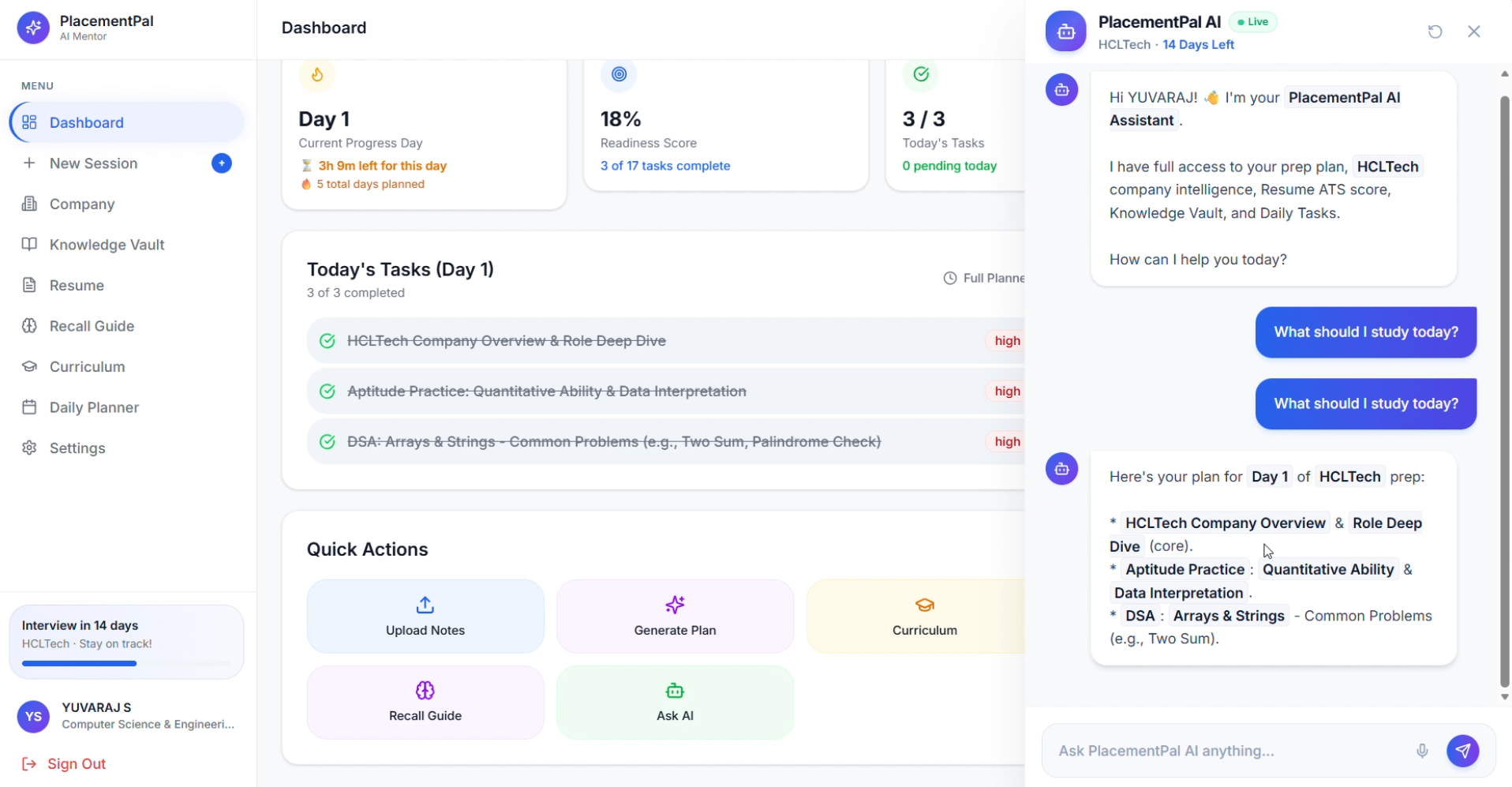
Dashboard
-
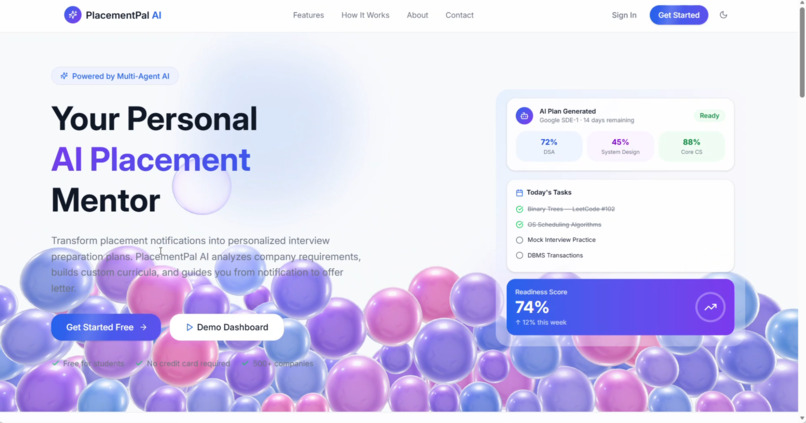
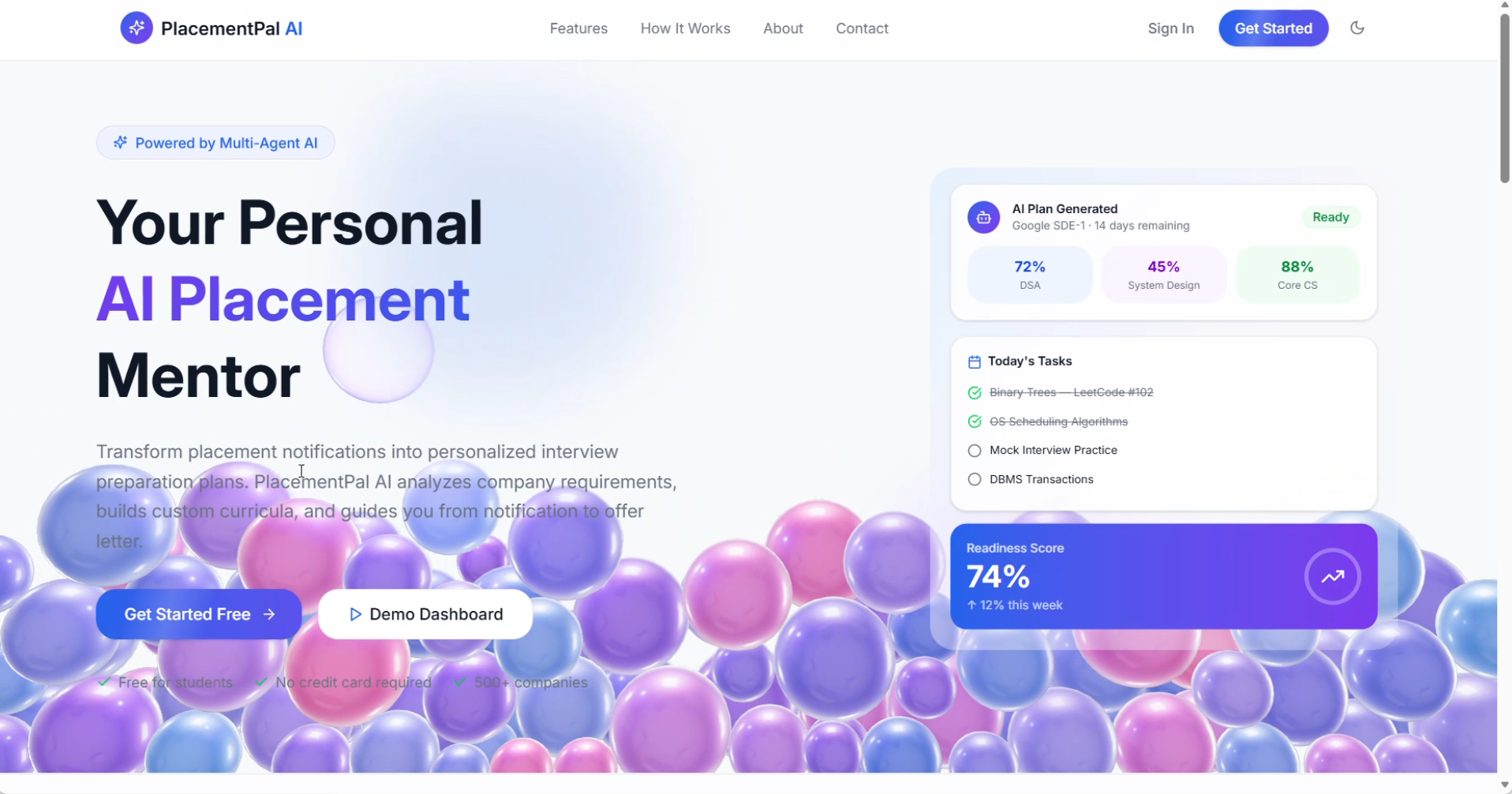
Landing Page
-
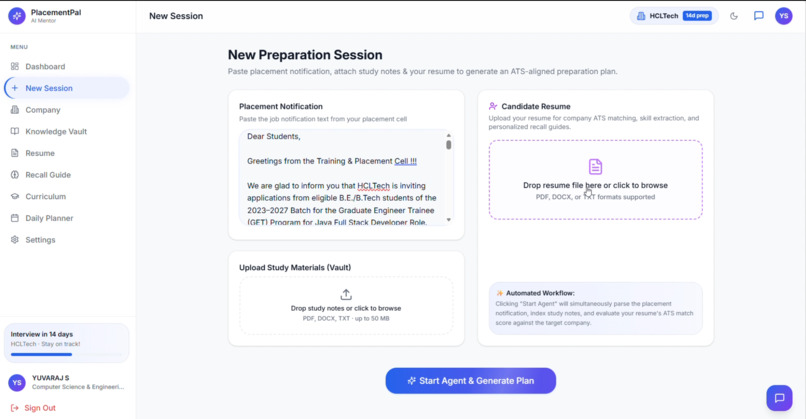
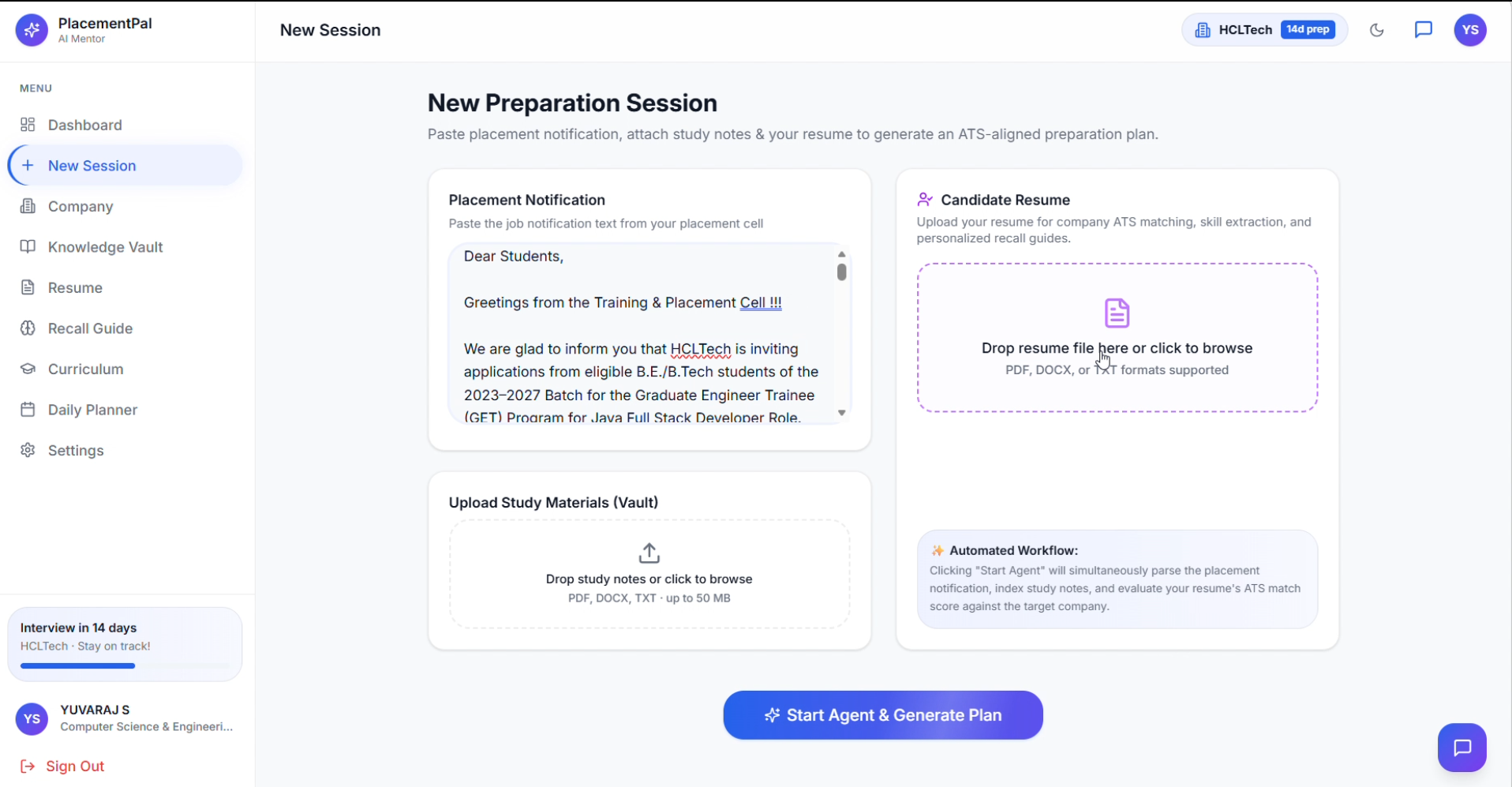
Company Profile & Requirements Intake
-
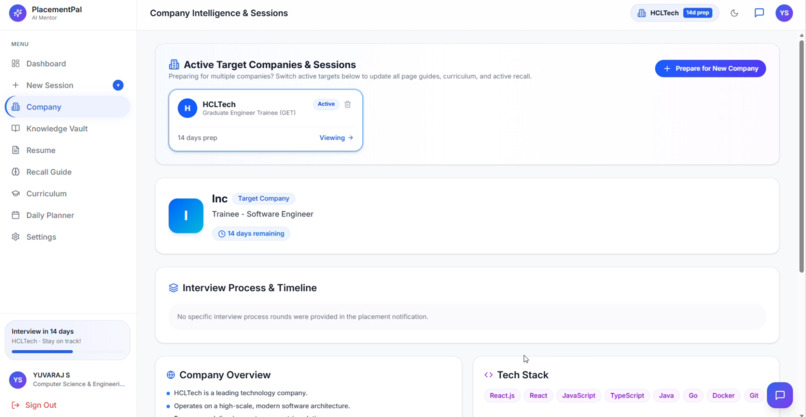
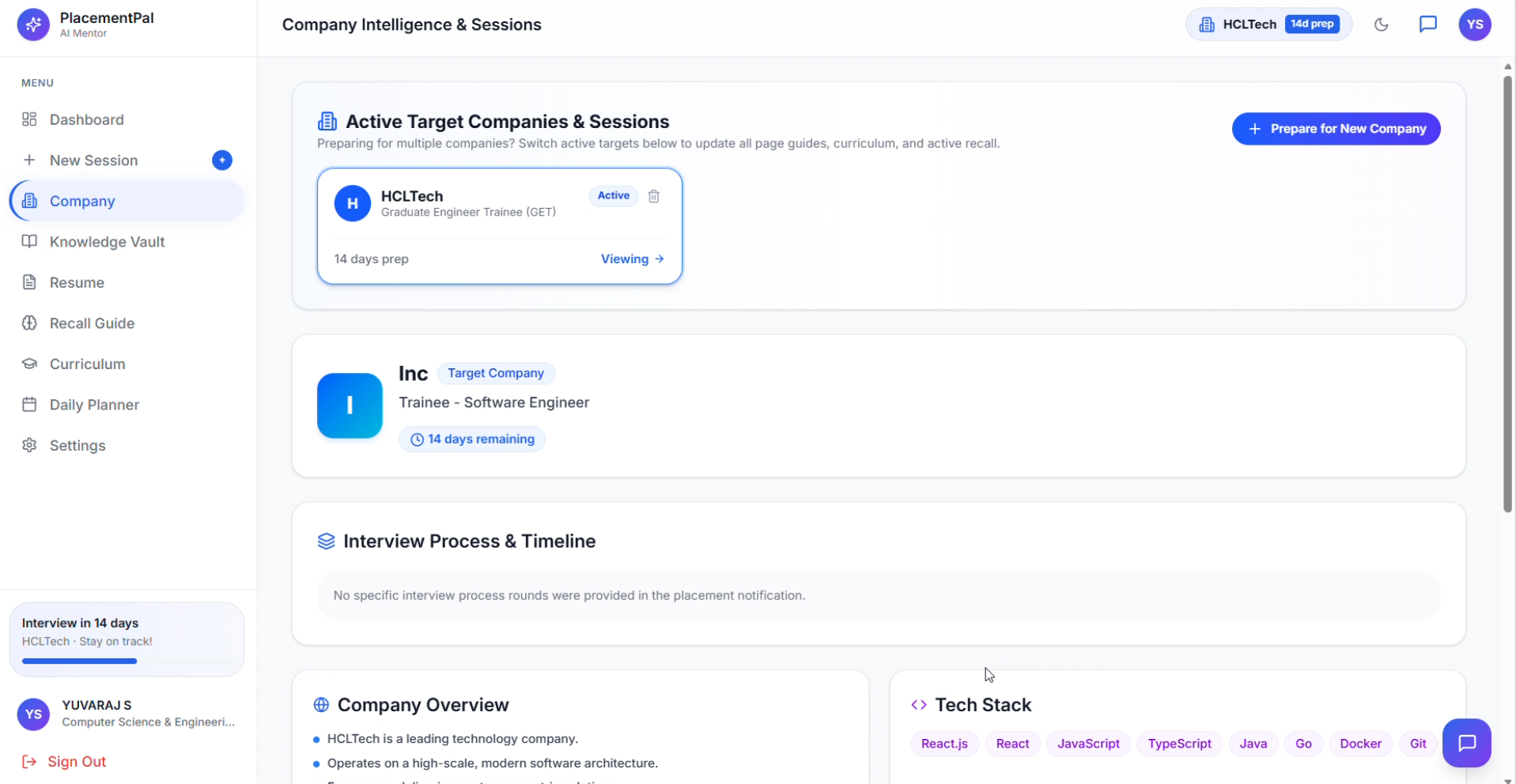
Company details
-
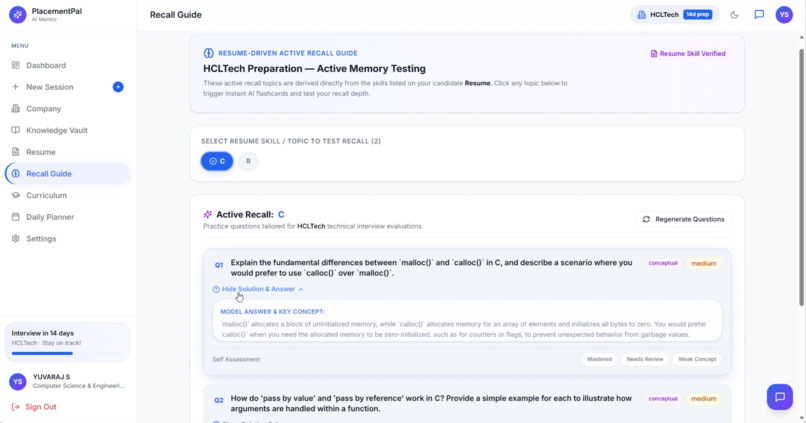
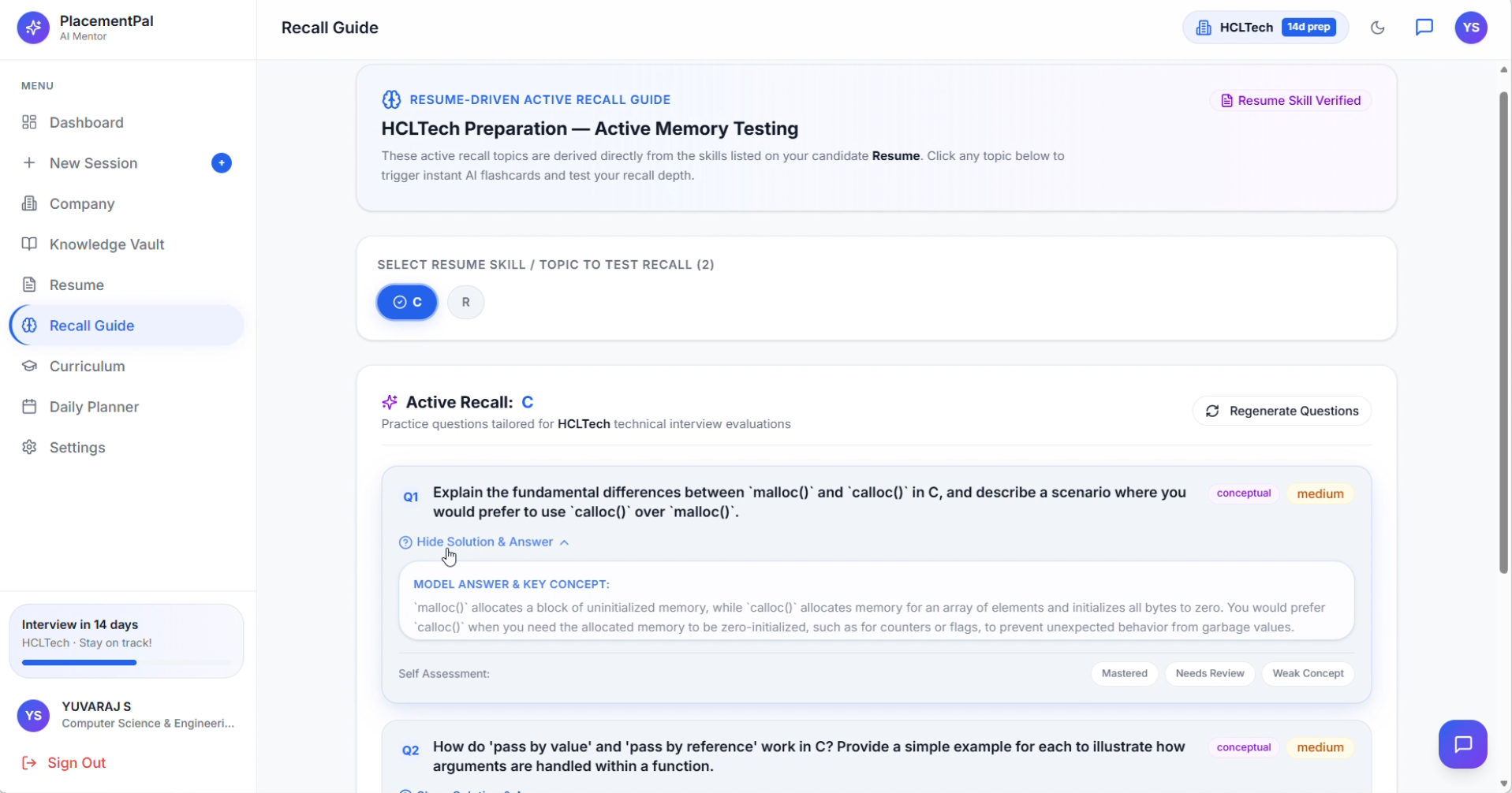
Recall Guide
-
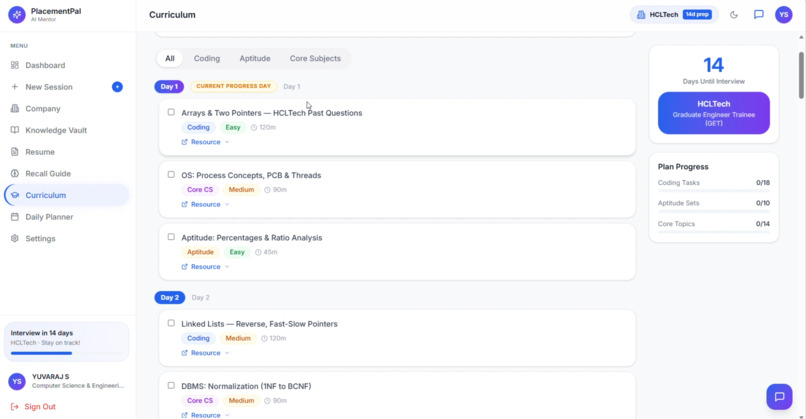
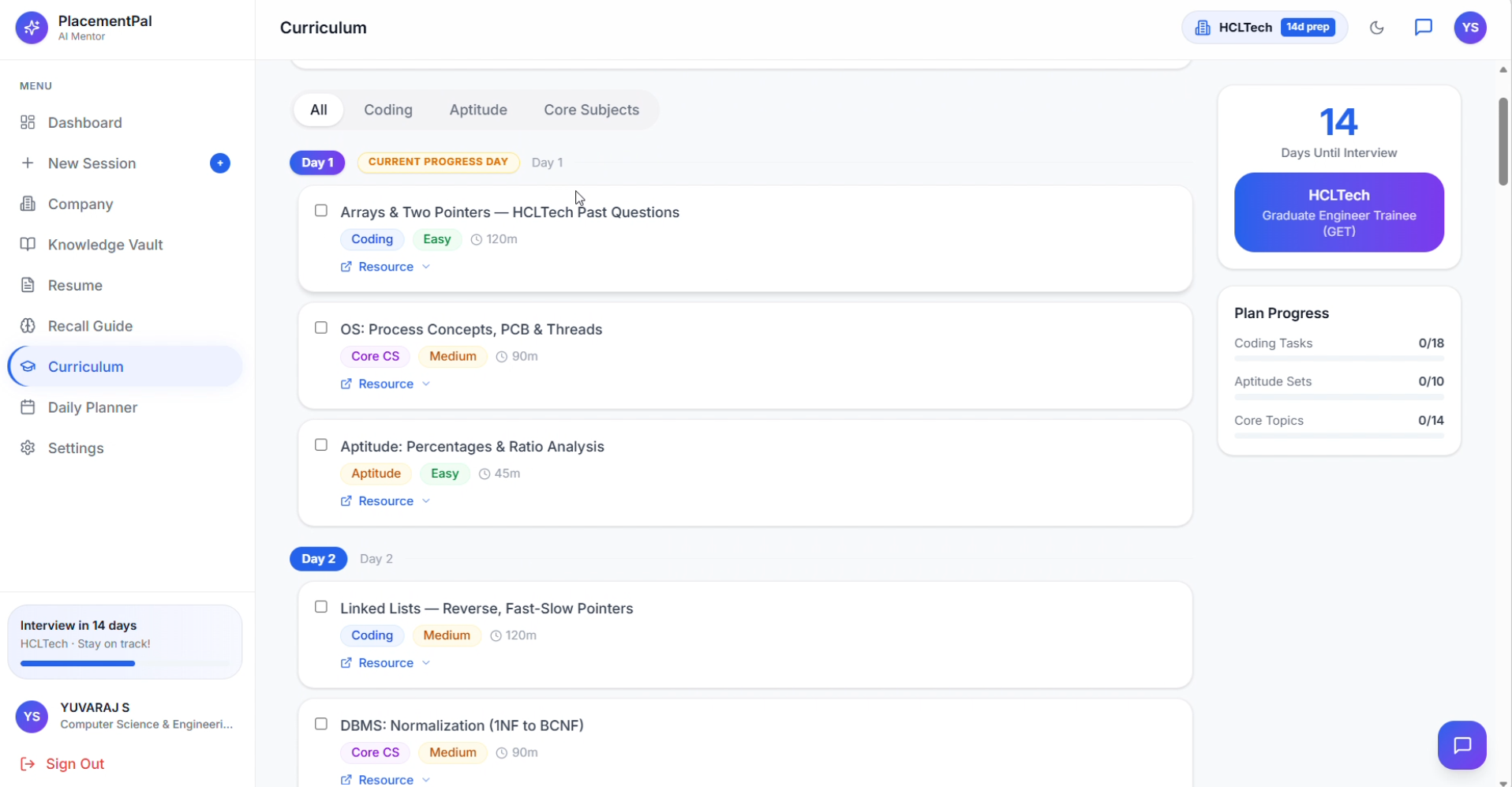
Curriculum
-
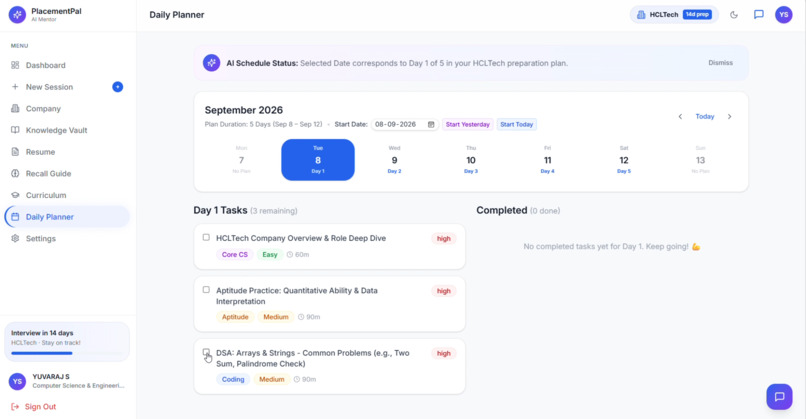
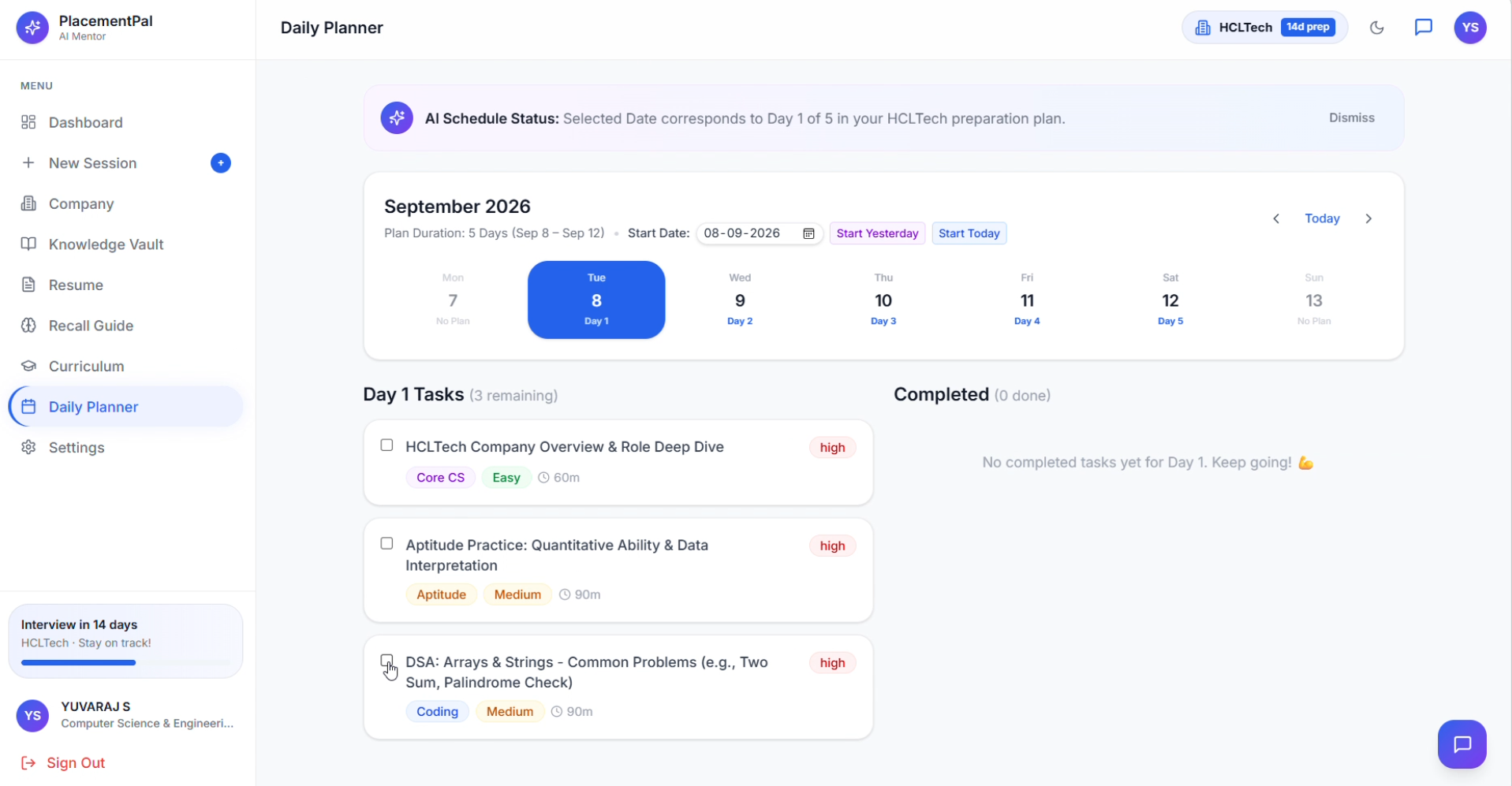
Daily Planner
-
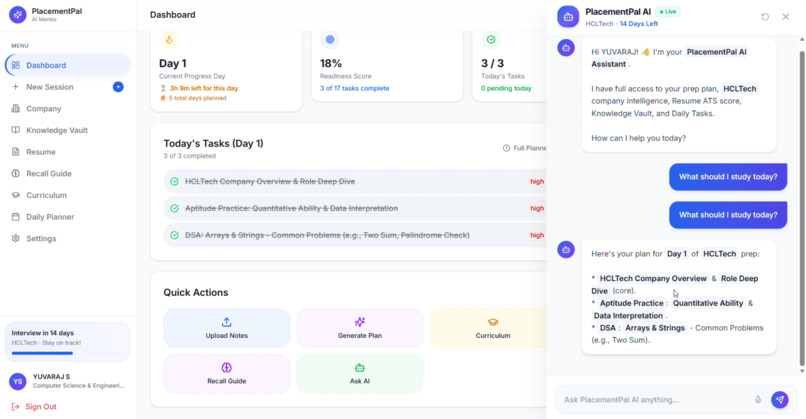
Assistant
PlacementPal – AI-Powered Placement Preparation Platform
Inspiration
Placement preparation can be overwhelming for students. Students often spend hours searching for company-specific interview patterns, deciding what topics to study, finding practice questions, and creating a realistic study schedule.
We were inspired to build PlacementPal to solve this problem using AI. Instead of providing generic preparation advice, we wanted to create an intelligent platform that understands a student's target company, preparation needs, available resources, and progress, and converts them into a personalized preparation journey.
What We Built
PlacementPal is an AI-powered placement preparation platform designed to help students prepare for technical interviews through personalized and company-specific preparation.
The platform can:
- Extract the student's placement requirements and goals.
- Gather real-time company hiring intelligence using web search.
- Retrieve relevant study materials using RAG with ChromaDB.
- Generate active-recall questions for practice.
- Create personalized day-by-day preparation plans.
- Track preparation progress and completed tasks.
- Provide relevant coding and aptitude practice resources.
The main goal is to reduce the time students spend planning their preparation and increase the time they spend actually preparing.
How We Built It
The backend was developed using Python and FastAPI, while the frontend uses React and Vite. MongoDB stores application and session data, and ChromaDB acts as the local vector database for the Knowledge Vault.
The AI architecture combines:
- LangGraph for stateful, multi-phase execution workflows.
- CrewAI for coordinating specialized AI agents.
- LangChain for LLM chains and RAG workflows.
- ChromaDB for semantic retrieval from uploaded study materials.
- Tavily Search for real-time company and hiring information.
- MongoDB for storing sessions, plans, topics, and progress.
The core AI workflow is divided into two phases.
Phase 1: Intent and Intelligence
The student's message is first analyzed to understand their goals and preparation requirements.
The system then:
- Extracts the student's intent.
- Collects company-specific hiring information.
- Searches the student's Knowledge Vault for relevant resources.
- Combines the retrieved information into structured context.
Phase 2: Recall and Curriculum
The collected context is passed to the second phase.
The system then:
- Generates active-recall questions.
- Identifies important preparation topics.
- Creates a personalized day-by-day curriculum.
- Provides coding and aptitude resources.
- Stores the generated plan and tracks progress.
This stateful workflow allows different AI components to work together instead of relying on a single generic chatbot response.
AI Agents
PlacementPal uses five specialized AI agents.
Message Interpreter
This agent understands the student's message and extracts important information such as the target company, preparation goals, timeline, and requirements.
Company Intelligence Agent
This agent uses real-time web search to gather relevant company information, including hiring trends, interview patterns, and preparation requirements.
Knowledge Vault Agent
This agent retrieves relevant information from the student's uploaded study materials using RAG and ChromaDB.
Recall Agent
This agent generates active-recall questions based on the student's preparation topics and retrieved knowledge.
Curriculum Architect
This agent uses the available context to create a personalized day-by-day preparation plan.
This specialization makes the system modular, scalable, and easier to extend.
What We Learned
Building PlacementPal helped us understand how modern AI applications are designed beyond simply calling an LLM API.
We learned how to:
- Build RAG pipelines for document-based question answering.
- Use vector databases and semantic similarity search.
- Design multi-agent AI systems using CrewAI.
- Build stateful workflows using LangGraph.
- Combine multiple AI components using LangChain.
- Integrate real-time web search into AI workflows.
- Design APIs using FastAPI.
- Connect AI workflows with databases and frontend applications.
- Manage structured state across multiple stages of an AI pipeline.
One of the biggest lessons was that building a good AI application is not only about choosing a powerful model. It is also about how data, tools, agents, retrieval, state, and workflows are orchestrated together.
Challenges We Faced
1. Coordinating Multiple AI Components
Using LangGraph, CrewAI, LangChain, RAG, and external tools introduced additional complexity. Each component had different responsibilities and data requirements.
We addressed this by separating the workflow into clearly defined agents, chains, services, and graph nodes.
2. Maintaining Consistent State
The preparation process contains multiple stages, where the output of one stage becomes the input for another.
LangGraph helped us maintain structured state throughout the workflow and pass information between different phases reliably.
3. Improving Retrieval Quality
Simply storing documents in a vector database does not guarantee useful results.
We designed the document ingestion, chunking, embedding, and semantic retrieval process to improve the relevance of information retrieved from the Knowledge Vault.
4. Creating Personalized Plans
A generic study plan is not effective because students have different skill levels, target companies, and preparation timelines.
We designed the curriculum generation process to consider the student's goals, company requirements, retrieved learning materials, and preparation context.
5. Integrating Real-Time Information
Company hiring patterns and interview requirements can change over time. Static information can quickly become outdated.
To address this, we integrated Tavily Search to retrieve current web information and incorporate it into company intelligence.
What Makes PlacementPal Different
PlacementPal is designed to be more than a traditional AI chatbot.
It combines:
Student Intent + Company Intelligence + Personal Knowledge + RAG + Active Recall + AI Agents + Personalized Curriculum + Progress Tracking
into a single placement preparation workflow.
Instead of simply asking students:
"What should I study?"
PlacementPal aims to answer:
"What should I study today, why should I study it, and how does it help me get closer to my target company?"
Future Improvements
We plan to extend PlacementPal with:
- AI-powered mock technical interviews.
- Resume-based preparation recommendations.
- Voice-based interview practice.
- Automated coding evaluation.
- Spaced-repetition scheduling.
- More detailed company-specific interview intelligence.
- Performance analytics and weak-topic detection.
- Support for multiple students and institutional placement cells.
Conclusion
PlacementPal started with a simple idea: placement preparation should be personalized instead of overwhelming.
By combining RAG, multi-agent systems, stateful AI workflows, real-time search, and personalized curriculum generation, we built a platform that transforms scattered placement resources into a structured preparation journey.
PlacementPal helps students prepare smarter, practice consistently, and move one step closer to their dream job.

Log in or sign up for Devpost to join the conversation.