Inspiration
Traditional learning materials such as textbooks, lecture notes, and PDFs contain valuable knowledge, but students often struggle to organize that information into a structured learning path.
We wanted to address this problem by building something beyond a traditional document summarizer.
Our idea was to create an AI-powered learning platform that transforms static educational materials into structured knowledge trees and eventually evolves into a personalized AI teacher.
We believe learning should not be limited to reading information. Students should be able to understand concepts, interact with an AI tutor, test their knowledge, and track their progress.
That vision led to Infinite Knowledge.
What It Does
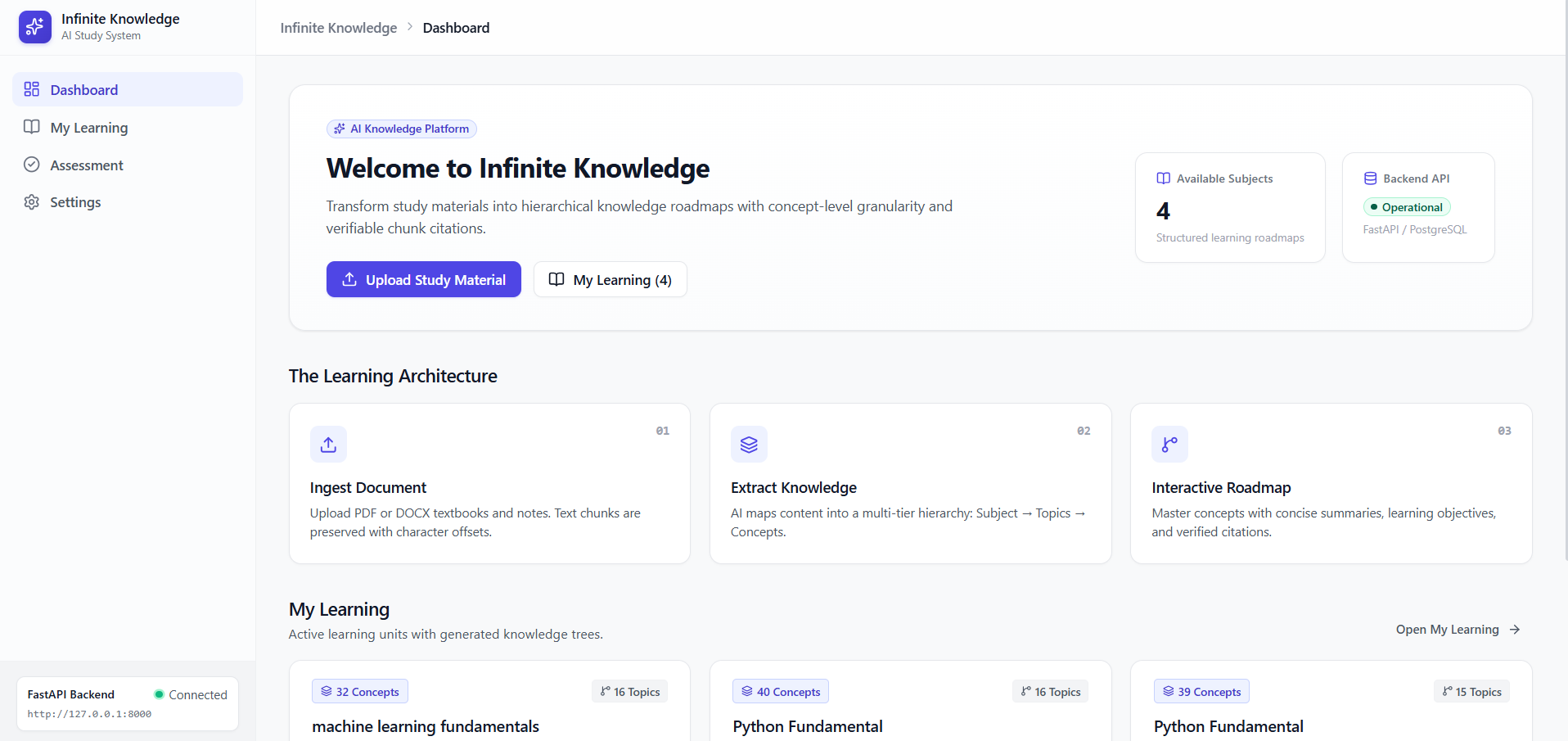
Infinite Knowledge is an AI-powered personalized study system that converts uploaded educational materials into structured, searchable knowledge.
The platform currently allows students to:
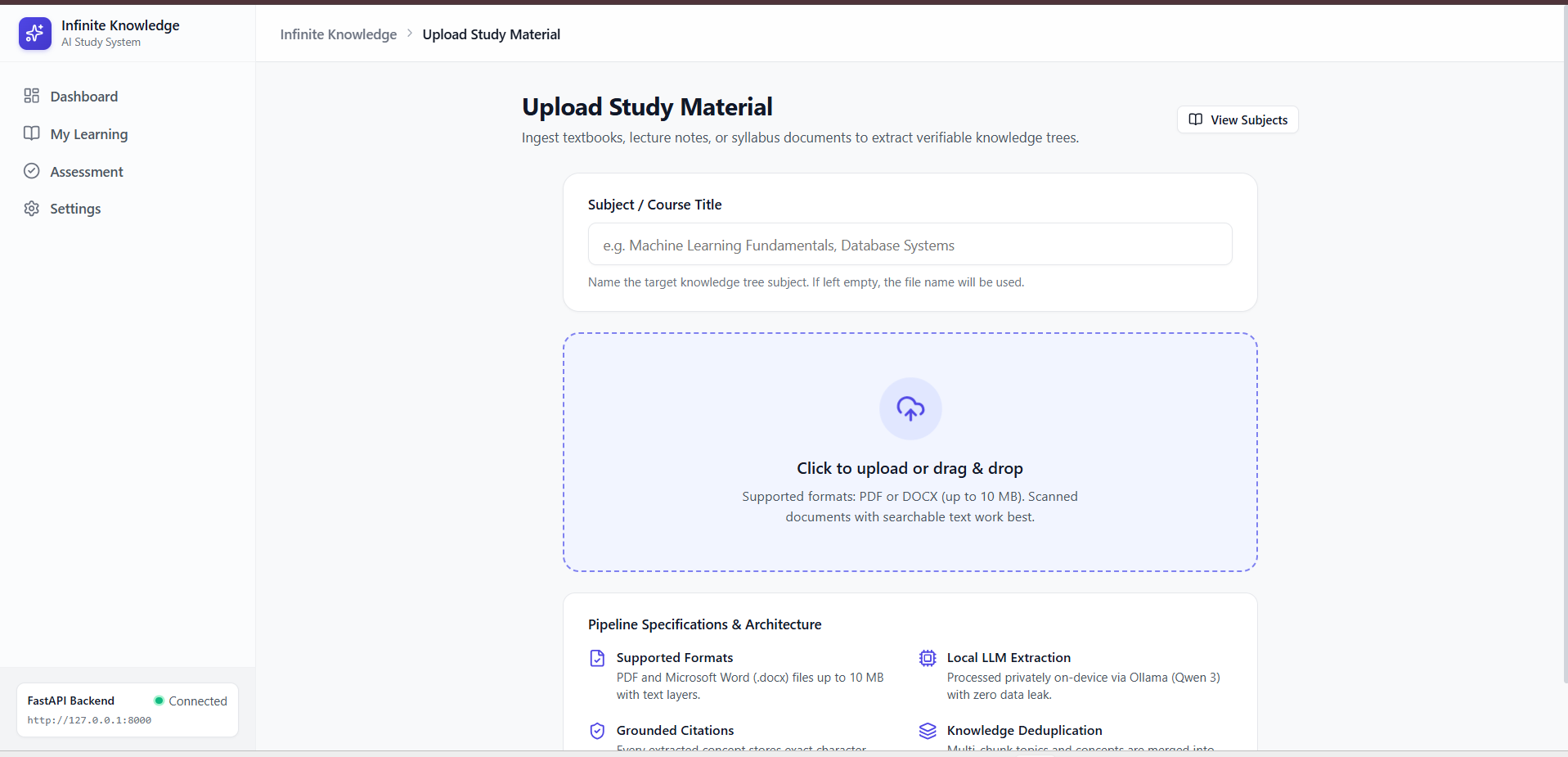
- Upload Study Materials: Upload PDF and DOCX documents.
- Extract Knowledge: Use a Large Language Model to identify important topics and concepts.
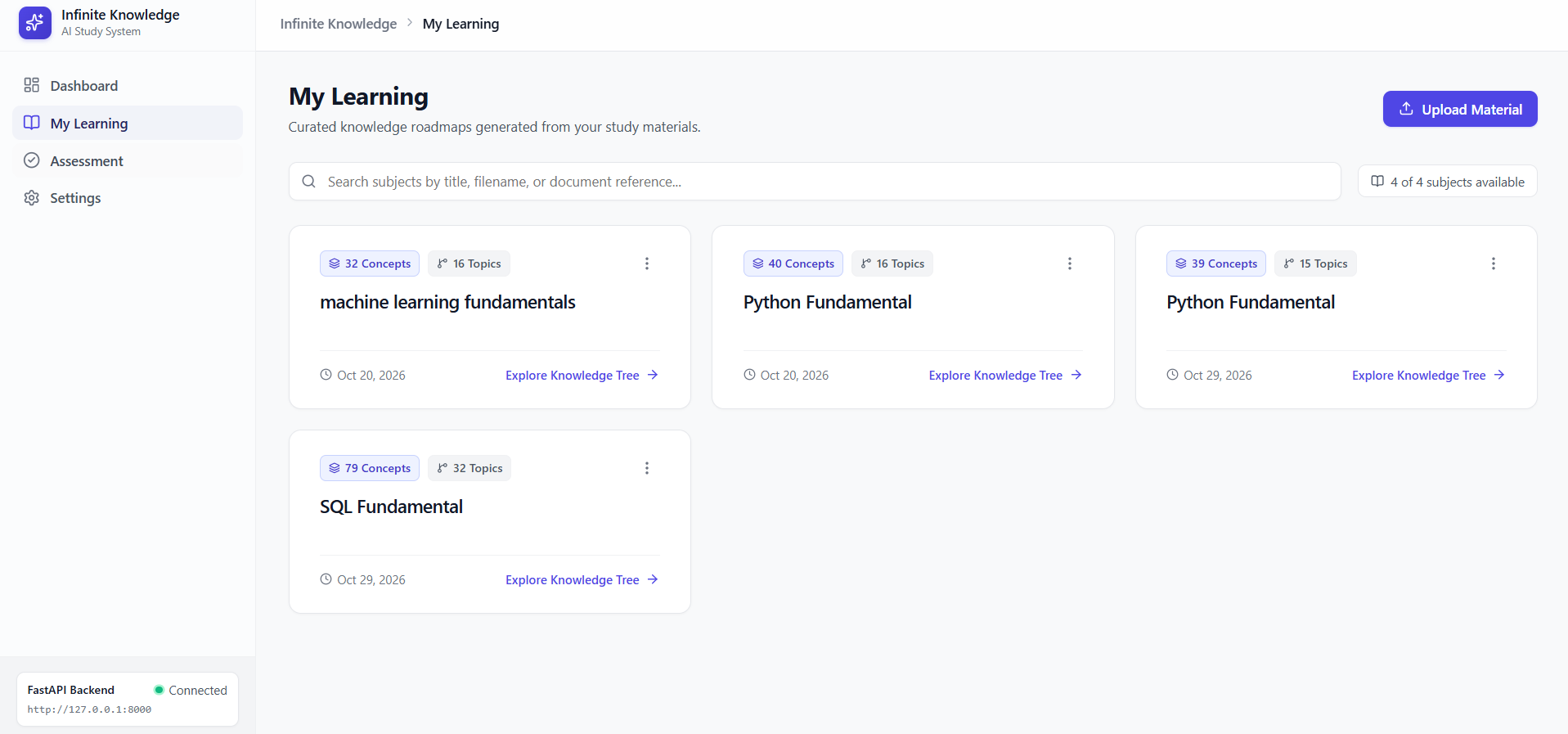
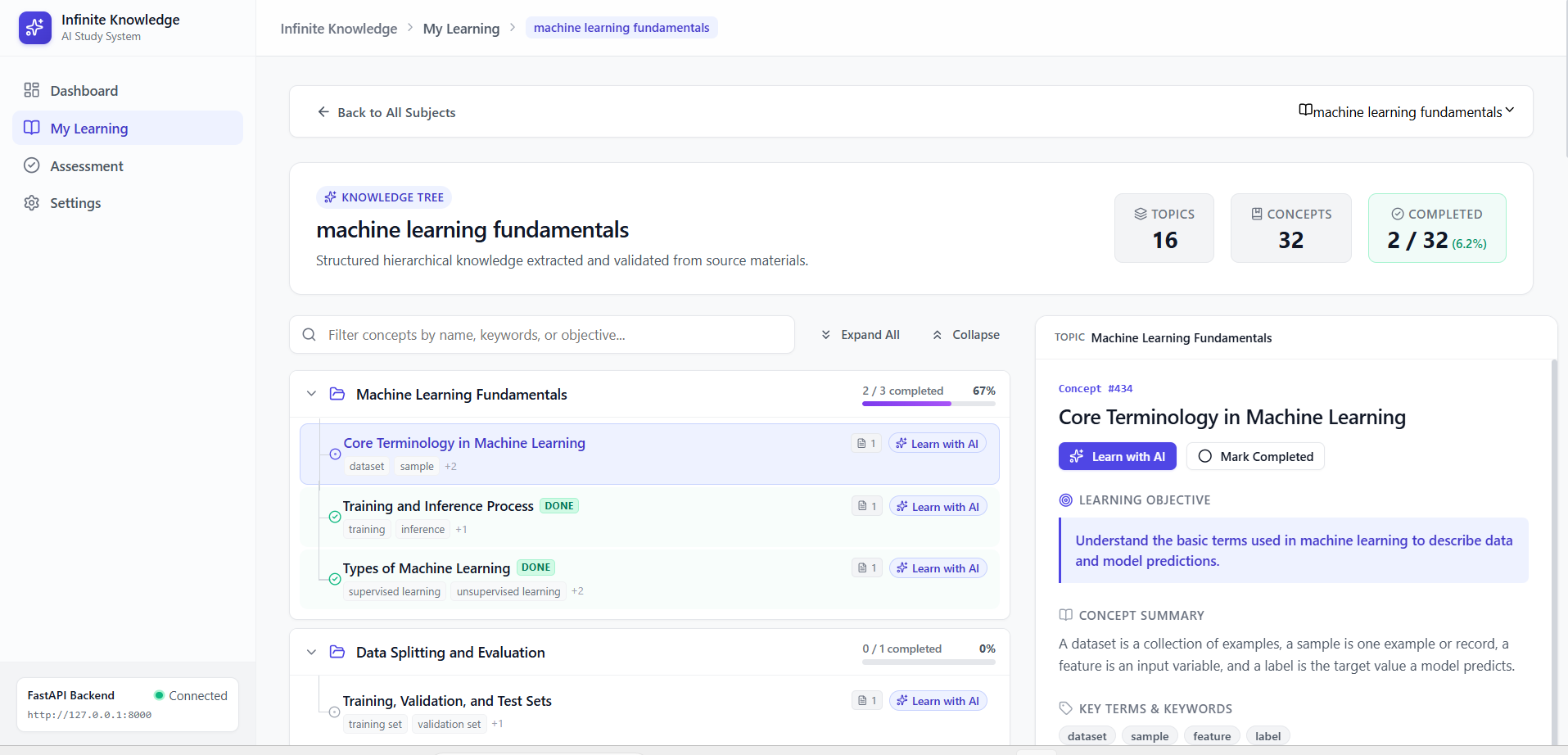
- Build Knowledge Trees: Organize extracted information into a hierarchy of Subjects → Topics → Concepts.
- Explore Concepts: View individual concept summaries, learning objectives, and keywords.
- Verify Information: Access source references that connect extracted concepts to their original document sections.
- Manage Learning Materials: View, organize, rename, and manage generated subjects.
Our vision is to turn every uploaded document into an interactive learning experience where students can learn at their own pace.
🛠️ How We Built It
We developed Infinite Knowledge using a modular architecture that separates the frontend, backend, database, and AI-processing pipeline.
Frontend
- React
- TypeScript
- Vite
- Custom CSS
Backend
- Python
- FastAPI
- SQLAlchemy
- REST APIs
Database
- PostgreSQL
- Relational data models for documents, subjects, topics, concepts, and source references.
AI and Knowledge Processing
- Ollama
- Qwen3:4B
- Prompt-based structured extraction
- Text chunking and processing
- Duplicate topic and concept merging
- Schema and source-reference validation
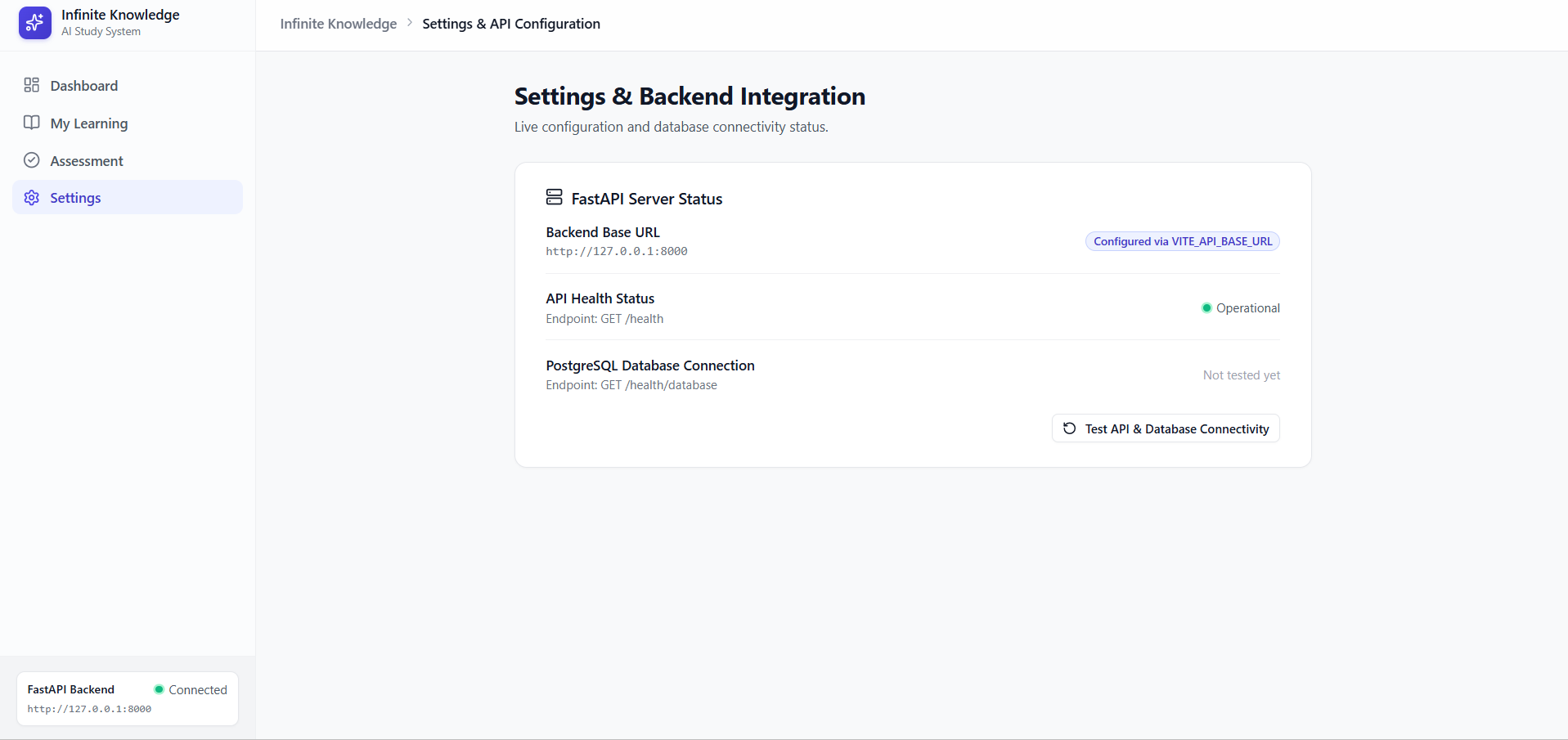
The knowledge extraction pipeline processes documents in manageable chunks, extracts structured information using an LLM, merges duplicate concepts, validates the generated data, and stores the resulting knowledge hierarchy in PostgreSQL.
We also designed the architecture to support different LLM providers, allowing us to expand beyond local models as the project evolves.
Challenges We Ran Into
Building an AI-powered learning platform came with several technical challenges.
- Document Processing: Extracting meaningful text from different educational document formats.
- LLM Reliability: Handling malformed JSON, repeated concepts, and incomplete model responses.
- Chunking Strategy: Splitting large documents while preserving enough context for accurate knowledge extraction.
- Duplicate Detection: Merging repeated topics and concepts generated across multiple chunks.
- Source Traceability: Maintaining references to the original document so students can verify extracted information.
- Database Architecture: Designing relational models to represent a flexible Subject → Topic → Concept hierarchy.
- Hardware Limitations: Running local LLMs efficiently on a machine with limited RAM and GPU memory.
These challenges taught us that a reliable AI application requires more than connecting an LLM to an interface. Proper architecture, validation, data integrity, and resource optimization are equally important.
Accomplishments That We're Proud Of
- Successfully developed a working document-upload and text-extraction workflow.
- Built an LLM-powered knowledge extraction pipeline.
- Converted educational documents into structured knowledge trees.
- Implemented topic and concept organization with duplicate merging.
- Added source references for knowledge traceability.
- Integrated PostgreSQL for persistent knowledge storage.
- Developed a modular FastAPI backend and React frontend.
- Created a professional interface for exploring extracted knowledge.
Our biggest accomplishment is building the foundation for transforming ordinary study materials into structured, accessible, and verifiable knowledge.
What We Learned
This project gave us practical experience in building real-world AI applications.
We learned:
- How to integrate Large Language Models into software applications.
- How to design document-processing and knowledge-extraction pipelines.
- How to work with structured LLM outputs and validation.
- How to build REST APIs using FastAPI.
- How to design relational databases using PostgreSQL and SQLAlchemy.
- How to build modular and maintainable software architectures.
- How to optimize local LLM inference under hardware constraints.
- Why source traceability and data reliability are important in AI systems.
Most importantly, we learned that AI should not simply generate information. It should help people understand information and make it useful.
What's Next for Infinite Knowledge – AI-Powered Personalized Tutor?
Infinite Knowledge is only the beginning of our vision.
We plan to evolve the platform into a complete personalized AI learning environment.
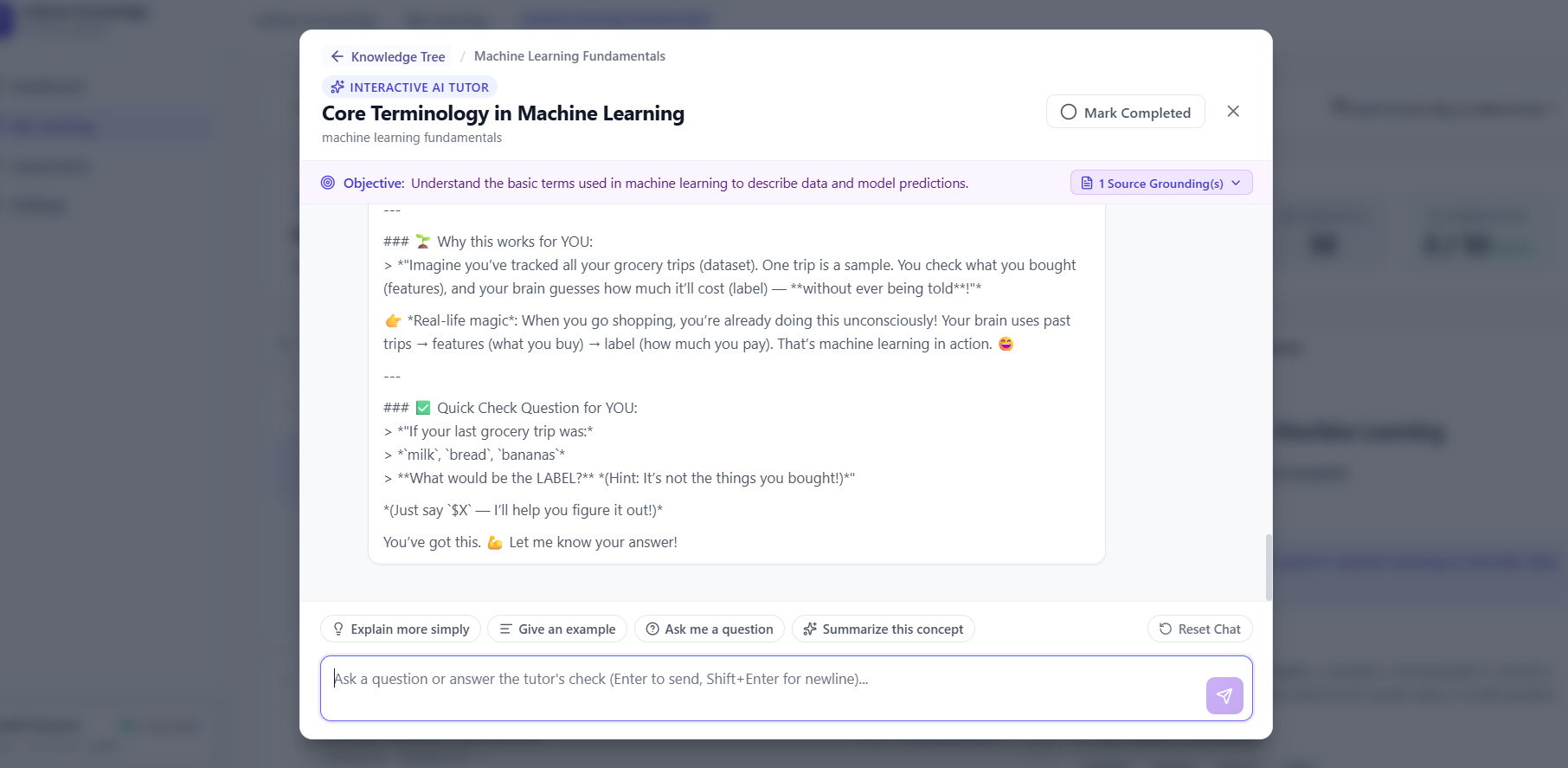
1. Interactive AI Tutor
Every concept will have an interactive learning mode where students can communicate with an AI tutor, receive explanations, explore examples, and ask follow-up questions.
2. Personalized Learning Paths
Generate structured learning sequences based on topics, concepts, and prerequisite relationships.
3. Learning Progress Tracking
Introduce concept-level completion tracking, topic progress bars, and subject-level learning analytics.
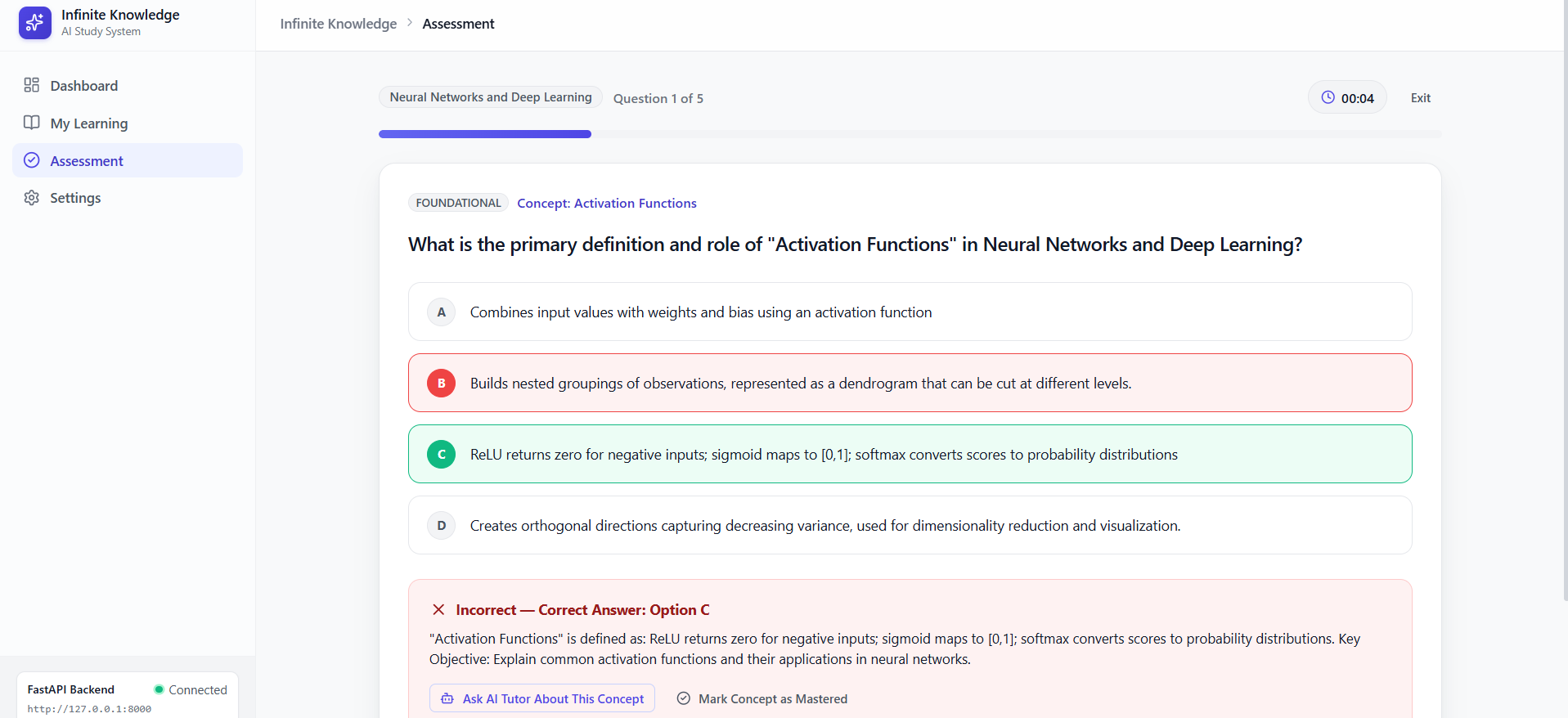
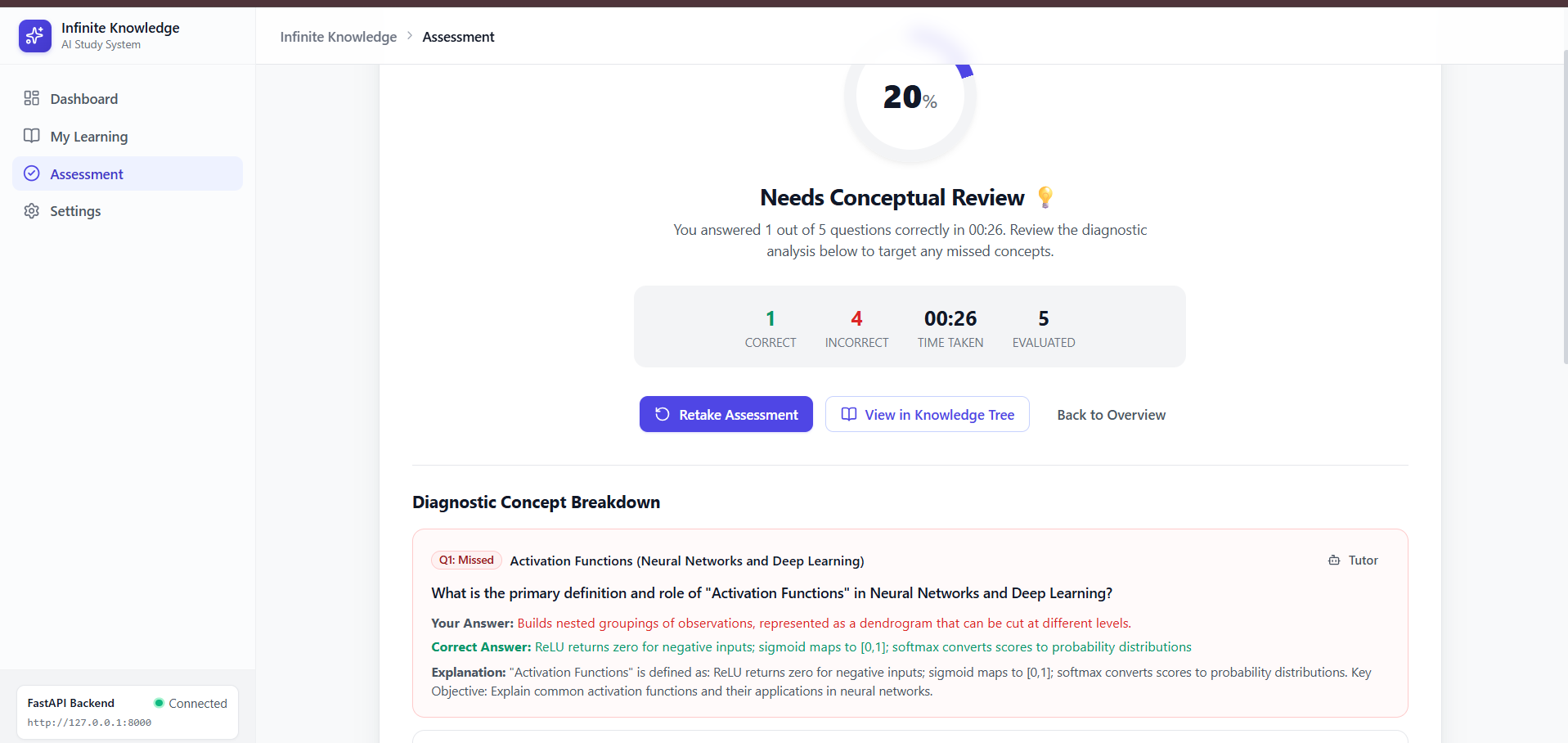
4. AI-Powered Assessments
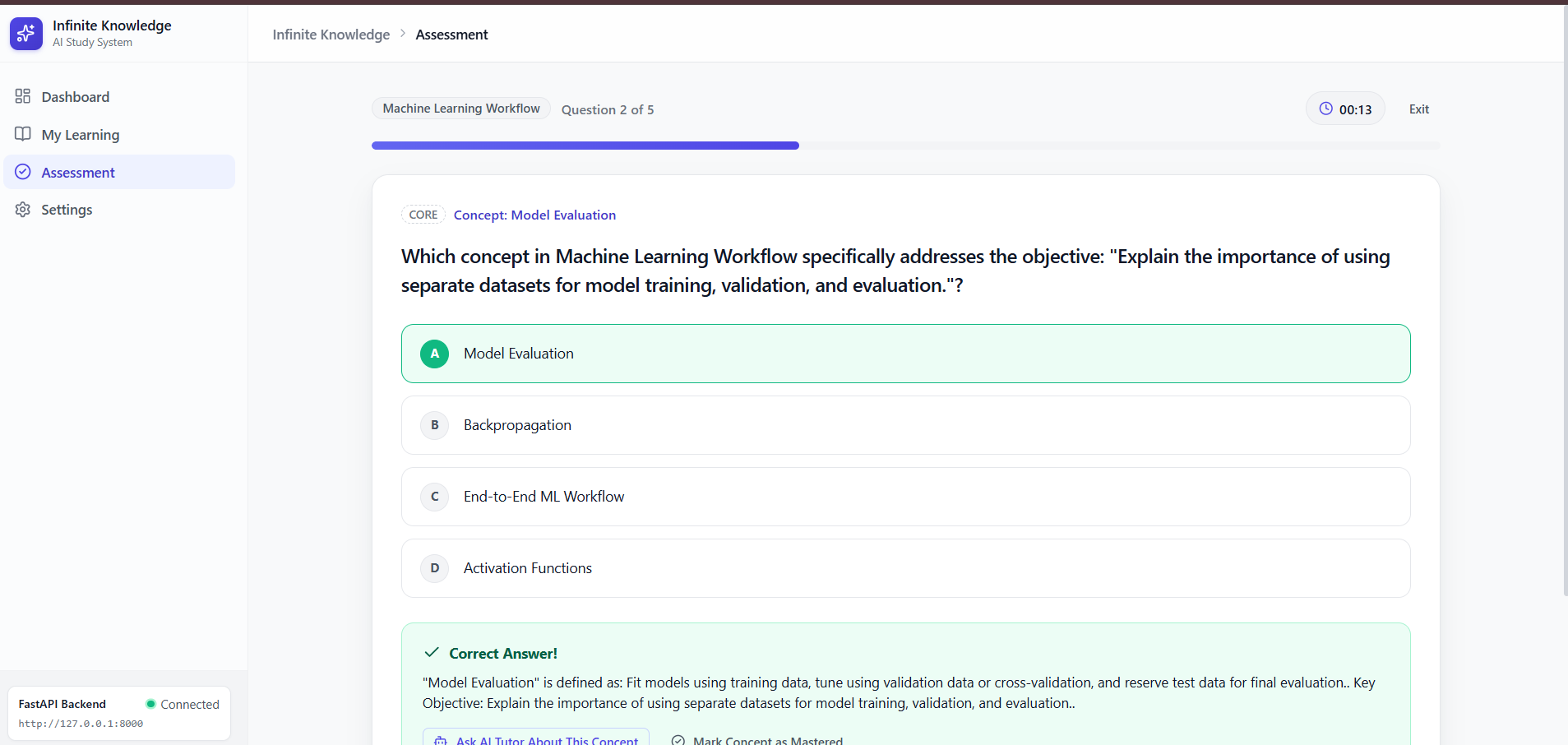
Generate quizzes and evaluate student understanding to identify knowledge gaps.
5. Adaptive Learning
Personalize explanations, practice questions, and revision activities according to individual student performance.
6. Advanced Document Understanding
Expand document processing capabilities to support complex tables, scanned documents, and additional educational formats.
7. Scalable AI Infrastructure
Expand our provider-agnostic architecture and integrate additional AI infrastructure and models, including NVIDIA and Nebius technologies.
Our ultimate goal is to build a personal AI teacher that understands what students need to learn, organizes their study materials, teaches them interactively, and helps them continuously improve.
Infinite Knowledge — Transforming Study Materials into Knowledge, and Knowledge into Understanding.
Built With
- artificial-intelligence
- css3
- fastapi
- generative-ai
- html
- large-language-models
- natural-language-processing
- ollama
- postgresql
- python
- qwen
- react
- rest-api
- sqlalchemy
- typescript
- vite

Log in or sign up for Devpost to join the conversation.