-
-
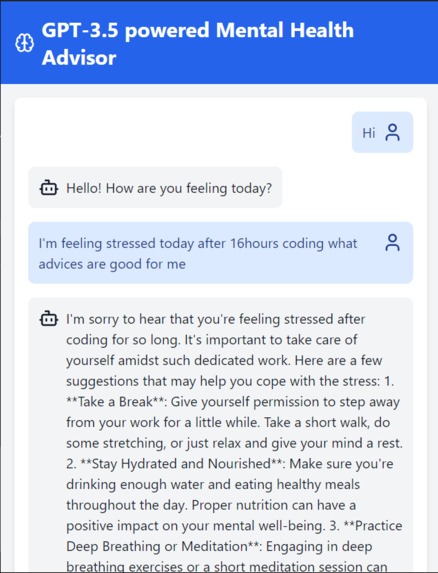
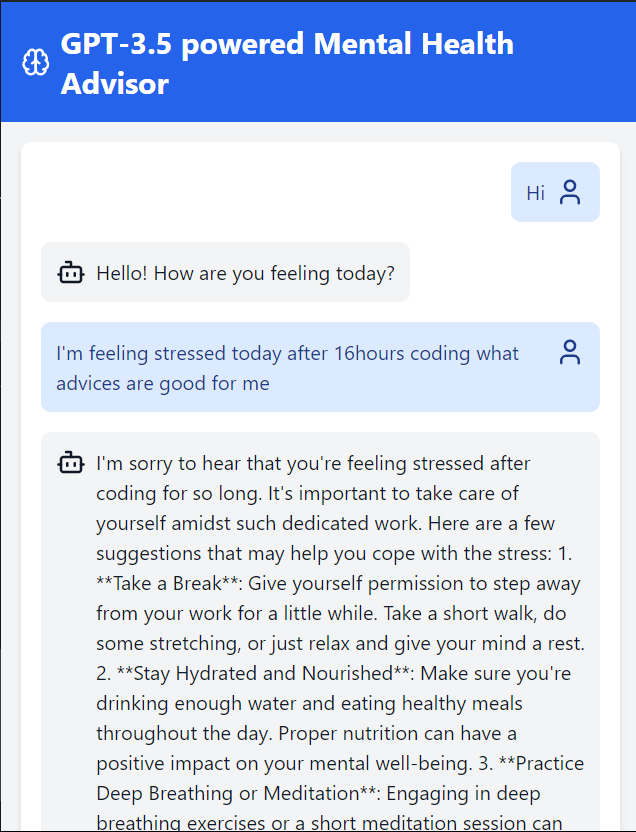
GPT-3.5 powered Mental Health advisor
Inspiration
Recognizing the increasing demand for mental health services as well as very few therapists available, we established an initiative that is readily accessible so that people can reach out anywhere at any time. We wanted a solution that could give instant response but be empathetic and founded on principles of therapeutic thought like CBT at the same time. We are using the AI to make mental health advice more accessible.
What it does
The AI-Powered Mental Health Advisor is an online chatbot that offers appropriate mental health counseling to users. It enables individuals to interact with the AI in real-time as they share their stress, anxiety, and depression, and ultimately derive CBT-based advice and mindfulness exercises. In addition, the portal offers a set of handpicked mental health resources to promote self-care and walk people through common emotional issues. Furthermore, it allows the user anonymity so that while discussing personal issues, they feel safe.
How we built it
We implemented the project with TypeScript, JavaScript, and Vite for an adaptive, interactive frontend. The chatbot is integrated with large language models, which we use with ChatGPT for empathetic and meaningful conversations. It helps streamline the development process thanks to fast builds and a better development experience. The frontend was intuitive and accessible so as to support simplicity and ease of use.
Challenges we ran into
Of course, aside from these, we also fine-tuned the responses of the chatbot for emotional support but within the therapeutic principles of CBT. Of course, striking a delicate balance between users' privacy requirements and recommendation has been challenging, particularly where sensitive topics such as mental health are concerned. Further iterations were necessary in order to integrate the AI in understanding nuanced emotions and responding in a non-intrusive manner for added support.
Accomplishments that we're proud of
We are proud to have built a functional prototype that brings modern web development and AI to this crucial issue, mental health. The culmination of how seamlessly the AI works with CBT principles and what characterizes a compassionate and responsive user experience is a great milestone in the success of the project. I'm most proud about how we came at it from a privacy-first standpoint and the accessible tools that can be brought forward to help people when they need it most.
What we learned
We learned how to better combine AI with human-centered design for meaningful mental health support throughout the process of working on the project. It was challenging to understand the gaps and pros in using language models like ChatGPT in providing therapeutic answers. We also gained practical experience in developing real-time applications with TypeScript and Vite, thereby enhancing our development workflow and frontend architecture.
What's next for AI-Powered Mental Health Advisor
Future plans would start with better comprehension of complex emotional scenarios on the part of AI and expanded capabilities to offer more advanced therapeutic tools. In the near future, multilingual support will be updated, a broader range of mental health conditions will become accessible for treatment with the help of the AI, and integration with telehealth platforms for professional mental health consultations will also be included. Along these lines, further improvements in privacy and security aspects would be made to engender even greater trust with our users.
Links:
As I don't have the credit balance for OpenAI API key right now I'm uploading the project without OpenAI and here is the overview:link
If you want to see the repository with the configuration for OpenAI API key (for GPT-3.5): link
Built With
- html
- javascript
- ts
- vite

Log in or sign up for Devpost to join the conversation.