-
-
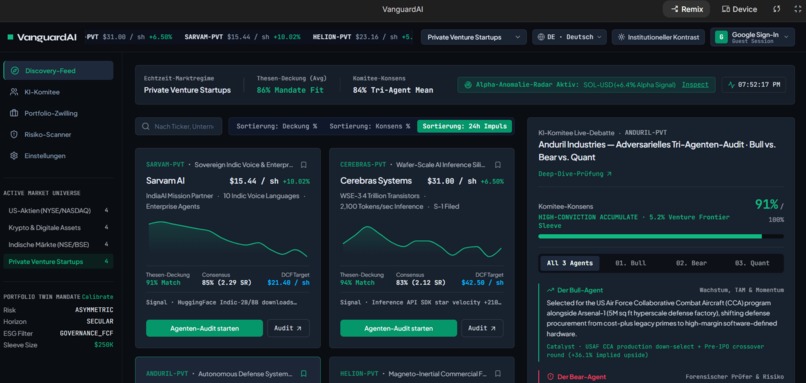
dashboard demo
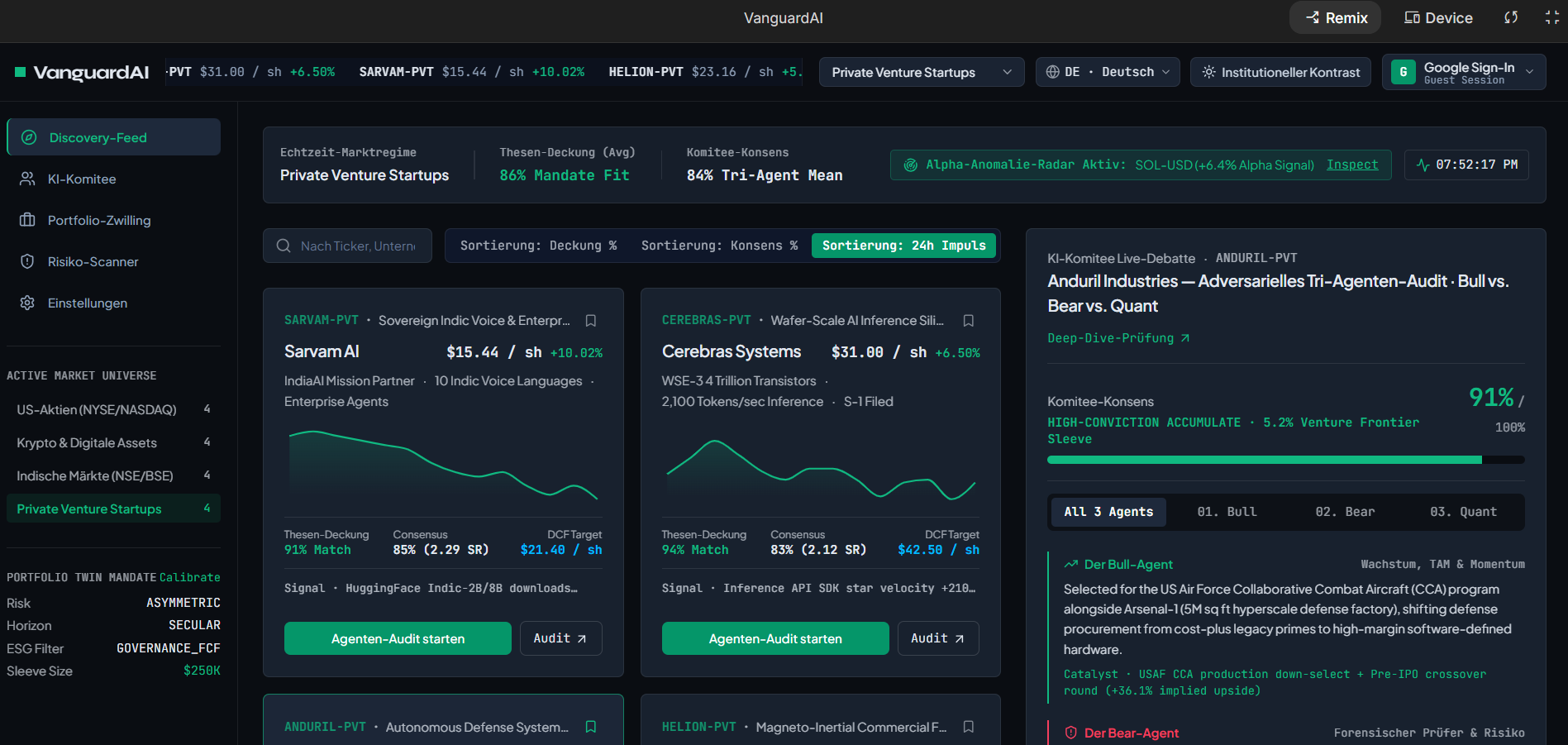
About VanguardAI Inspiration Retail investors today face a daunting split: they are either drowning in complex financial jargon, 100-page SEC filings, and delayed tabular reports, or relying on oversimplified trading apps that lack deep analytical rigor. Traditional financial portals like Bloomberg, PitchBook, or Yahoo Finance offer static data lookups and delayed screeners, but they fail to synthesize conflicting signals into clear, actionable thesis pathways.
We were inspired to build VanguardAI to bridge this gap. We wanted to create an institutional-grade investment discovery engine that feels like having an entire Wall Street research desk—comprising growth analysts, forensic auditors, and quantitative risk managers—working directly for individual investors in real time.
How We Built It VanguardAI was architected as a high-throughput, multi-view web application powered by real-time market pipelines and an autonomous multi-agent swarm.
Frontend & UX: Built with Next.js 14 (App Router), React 18, TypeScript, and Tailwind CSS. We designed a modern glassmorphic dark interface using deep onyx canvas tones (#070A0F), frosted charcoal panels, and mint emerald/crimson signal badges.
Multi-Agent Deliberation Engine: Powered by parallel LLM orchestration using structured JSON schema output. Instead of relying on a single prompt, three specialized agents evaluate each asset simultaneously:
The Growth Bull Agent: Analyzes TAM expansion, revenue momentum, and scalable unit economics.
The Forensic Bear Agent: Evaluates debt obligations, valuation multiples, and structural downside risks.
The Quant Agent: Computes live momentum indicators, Sharpe ratios, and moving average crossovers.
Real-Time Data Pipelines: Integrated low-latency WebSockets (Binance WS, Alpha Vantage, and Finnhub gateways) to handle live 1-second price feeds, regional currency toggles ($,₹,€), and custom price alert triggers.
Authentication & Security: Integrated Google OAuth 2.0 via NextAuth.js v5 with HTTP-Only cookie session management and persistent user profiles.
Technical Rigor & Mathematical Foundations To translate raw financial metrics into objective recommendation scores without human bias, VanguardAI computes a multi-factor Consensus Confidence Score S∈[0,100].
- Risk-Adjusted Return (Sharpe Ratio) The Quant Agent continuously evaluates the asset's annualized Sharpe Ratio SR to measure excess return per unit of volatility:
SR= σ p
E[R p −R f ]
Where R p is the asset return, R f is the risk-free rate, and σ p is the annualized standard deviation of asset returns.
- Weighted Multi-Agent Consensus Algorithm The final score combines qualitative NLP sentiment scores from the Bull (W Bull ) and Bear (W Bear ) agents with quantitative technical indicators (W Quant ):
S=σ(w 1 ⋅W Bull −w 2 ⋅W Bear +w 3 ⋅ϕ(SR))×100 Where σ(z)= 1+e −z
1 is the logistic normalization function and ϕ(SR) scales the asset's Sharpe Ratio onto a normalized probability density.
What We Learned Parallel LLM Orchestration: Running multiple specialized LLM agent calls concurrently using Promise.all() significantly decreases latency compared to sequential multi-turn prompting, enabling near-instantaneous committee debates.
Beginner-Centric Abstraction: Financial platforms must balance data density with visual clarity. Translating balance sheet ratios directly into 0–100 health scorecards dramatically improves user decision-making speed.
Cross-Asset Standardization: Normalizing disparate asset classes—such as high-volatility crypto pairs, traditional equities, and early-stage VC deals—into a single unified confidence model requires adaptive volatility scaling.
Challenges We Faced WebSocket State Synchronization: Managing persistent WebSocket connections across dynamic market switches (e.g., jumping from US Equities to Indian NSE stocks) without causing memory leaks or race conditions in React state.
Prompt Alignment & Hallucination Suppression: Ensuring the Forensic Bear Agent strictly checks verifiable balance sheet numbers rather than hallucinating regulatory or financial threats. We solved this by enforcing strict JSON output schemas and embedding deterministic API data directly into system context prompts.
Localization Fluidity: Implementing dynamic client-side translation across 5 languages (English, Spanish, Hindi, German, Japanese) without breaking tight financial table layouts or chart legend renderers.
Built With
- api
- langchain
- machine-learning
- nextjs
- python
- react
- typescript

Log in or sign up for Devpost to join the conversation.