Inspiration
Working in healthcare operations at Firstsource, we see the pain every day. A single claim payment discrepancy — an overpayment, an underpayment, a duplicate — can take 2 to 5 days to investigate. Analysts spend nearly $70\%$ of their time just collecting data across multiple systems, not actually solving the problem.
The math is sobering:
$$\text{Wasted Effort} = 0.70 \times \text{Analyst Hours} \times \frac{1}{8} \text{ claims flagged}$$
That's a staggering amount of human effort going into data gathering rather than decision-making. We knew AI and automation could flip this ratio — and the UiPath Hackathon gave us the perfect platform to prove it.
What it does
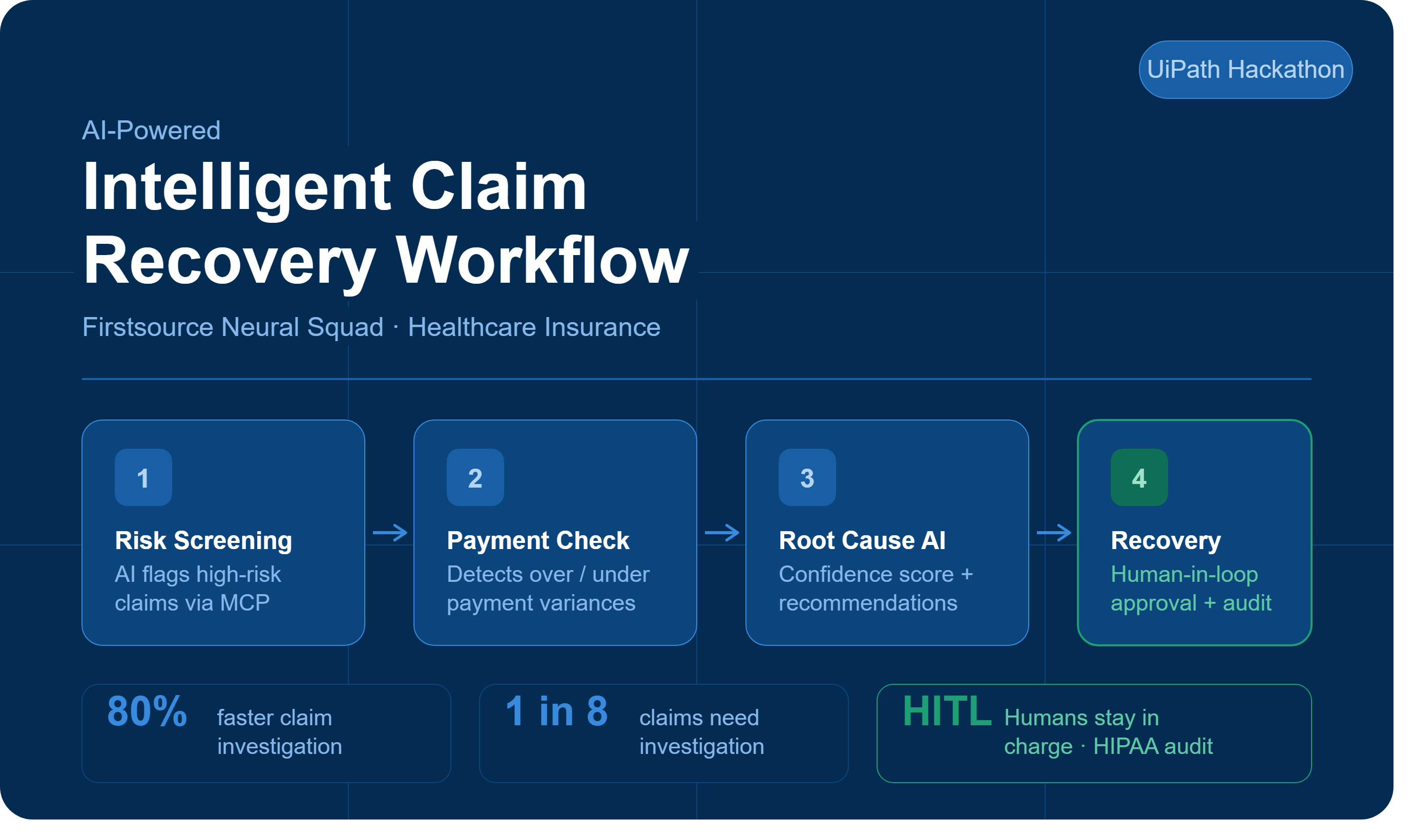
AI-Powered Intelligent Claim Recovery Workflow is an end-to-end automation solution built on UiPath Maestro that transforms how healthcare claims are investigated and recovered — from intake to resolution.
It runs a four-stage intelligent pipeline:
- Risk Screening — An AI Screening Agent retrieves claim details via MCP tools and flags only high-risk claims for investigation, filtering out noise automatically.
- Payment Validation — A Detection & Validation Agent computes the payment variance:
$$\Delta P = P_{\text{expected}} - P_{\text{paid}}$$
Where $\Delta P > 0$ is an overpayment, $\Delta P < 0$ is an underpayment, and $\Delta P = 0$ auto-closes the case.
- Root Cause Investigation — A Recovery Intelligence Agent (LLM-powered) analyzes the claim, identifies the most probable root cause, and generates a recommendation with a confidence score $C \in [0, 1]$:
$$\text{Auto-approve if } C \geq \theta, \quad \text{else escalate to Human Review}$$
- Recovery Execution — Approved actions are executed by an RPA bot — updating the Claims Application, triggering payments, and generating a full audit trail for HIPAA and SOC2 compliance.
Humans stay in charge throughout. UiPath Action Center surfaces AI recommendations to analysts, who can approve, reject, or request further investigation before any recovery action is taken.
How we built it
We designed the entire solution around UiPath Maestro (BPMN) as the orchestration backbone, with three specialized AI Agents working in sequence:
- Screening Agent — uses MCP tools to retrieve claim data and evaluate high-risk conditions
- Detection & Validation Agent — calculates expected amounts, detects variances, and classifies recovery type
- Recovery Intelligence Agent — performs root cause analysis and generates confidence-scored recommendations
UiPath Storage Buckets and Assets serve as the shared memory layer between agents, ensuring clean handoffs across the pipeline. UiPath Action Center handles all Human-in-the-Loop routing and SLA management.
Tech Stack
| Layer | Technologies |
|---|---|
| Orchestration | UiPath Maestro, Orchestrator, Action Center |
| AI & Agents | AI Agents, MCP Server, Data Fabric |
| RPA | UiPath Robots, Storage Buckets, Assets |
| Frontend | UiPath Apps, Integration Service |
| Backend | FastAPI, REST APIs, JavaScript, HTML/CSS |
| DevOps | GitHub |
Challenges we ran into
Multi-Agent Coordination — Getting three specialized agents to hand off state cleanly within Maestro required careful design. We used Storage Buckets and Assets as a shared context layer to prevent data loss between stages.
Configurable Business Rules — Healthcare payers have complex, ever-changing payment rules. We built a Rules Engine layer so thresholds, screening conditions, and risk parameters can be updated by operations teams without touching workflow code.
Balancing Automation with Human Trust — The hardest challenge wasn't technical — it was organizational. Claim analysts needed to trust AI recommendations before approving recoveries involving real money. We addressed this by surfacing root cause explanations and confidence scores alongside every recommendation, making the AI's reasoning fully transparent.
HIPAA Compliance Under Time Pressure — Building an audit-compliant system in hackathon time was intense. We scoped it tightly: immutable logs, role-based access control (RBAC), and no PII leaving the secure pipeline.
Accomplishments that we're proud of
- Built a fully functional multi-agent pipeline inside UiPath Maestro that handles real-world claim recovery logic end-to-end
- Designed a confidence-score-based HITL escalation model that keeps humans in charge without slowing down automation
- Achieved $100\%$ audit trail coverage — every AI decision, analyst action, and recovery execution is logged automatically
- Reduced a process that takes 2–5 days manually down to a matter of hours, with $80\%$ less manual effort
- Delivered a solution that is HIPAA and SOC2 ready from day one — not bolted on after
What we learned
Maestro is a game-changer for healthcare workflows. The BPMN-based orchestration made it natural to model our multi-agent pipeline visually before writing a single line of code.
MCP tools dramatically reduce agent latency. By letting AI agents call structured MCP endpoints instead of scraping UIs, claim data retrieval became deterministic and fast.
Confidence scoring is critical for HITL design. Not all claims are equal — a threshold-based escalation model means analysts only touch cases where human judgment genuinely adds value.
Audit trails can't be an afterthought. In healthcare, every AI recommendation and human override must be traceable. We built logging into every stage from day one.
Trust is a feature. The most important design decision we made was making the AI's reasoning visible to analysts — not just showing a result, but explaining why.
What's next for AI-Powered Intelligent Claim Recovery Workflow
- Predictive Risk Scoring — Train a model on historical claim data to predict payment discrepancies before they occur, shifting from reactive recovery to proactive prevention
- Multi-Payer Expansion — Extend MCP integrations to support multiple insurance carriers and payer portals simultaneously
- Real-Time Eligibility Verification — Add a pre-screening layer that checks member eligibility and benefits in real time before claim submission
- Provider Intelligence Layer — Build a provider scoring model that tracks patterns of billing anomalies over time, enabling smarter risk routing
- Analytics Dashboard — Surface KPIs like recovery rate, variance trends, and agent confidence distributions to operations leaders via UiPath Apps
- Broader Healthcare Use Cases — Adapt the pipeline for prior authorization, denial management, and coordination of benefits workflows



Log in or sign up for Devpost to join the conversation.