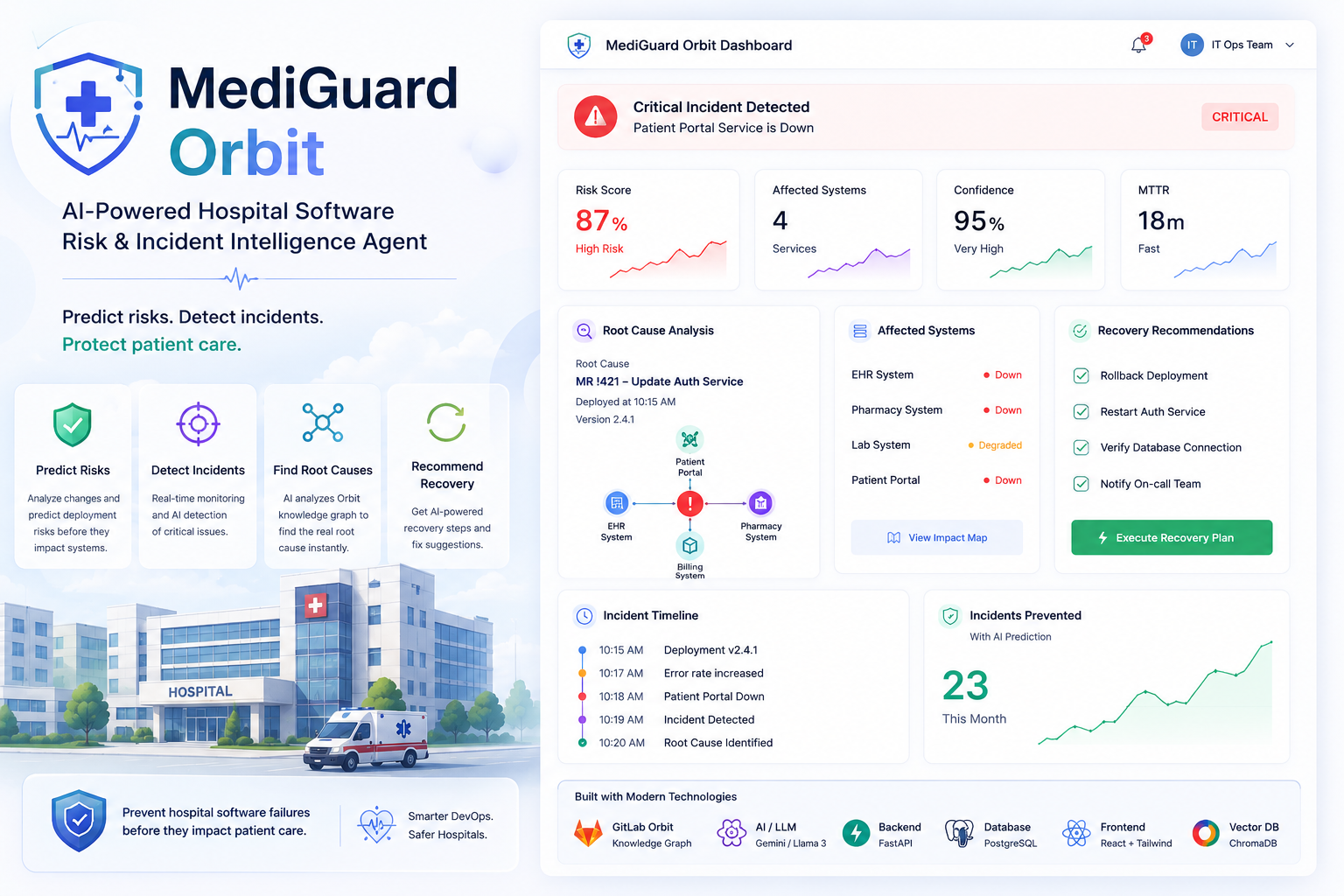
MediGuard Orbit – AI-Powered Hospital Software Risk & Incident Intelligence Agent
Inspiration
Modern hospitals rely heavily on software systems such as Electronic Health Records (EHR), Pharmacy Systems, Laboratory Systems, Patient Portals, and ICU Monitoring Systems. A single faulty deployment or software failure can disrupt critical healthcare operations and directly impact patient care.
We were inspired by the challenge of ensuring software reliability in healthcare environments. While hospitals invest heavily in medical equipment and infrastructure, software incidents are often detected only after they affect operations. We wanted to build a solution that helps healthcare software teams predict risks before deployment and quickly identify root causes when incidents occur.
What It Does
MediGuard Orbit is an AI-powered incident intelligence agent that helps healthcare software teams prevent, detect, and resolve software failures.
The platform:
- Predicts deployment risks before code changes are released.
- Analyzes dependencies between healthcare systems.
- Detects incidents and identifies their root causes.
- Estimates the impact of failures across hospital services.
- Recommends recovery actions and mitigation strategies.
- Uses GitLab Orbit's knowledge graph to understand relationships between code, merge requests, deployments, pipelines, and services.
By providing actionable insights, MediGuard Orbit helps reduce downtime and improve patient safety.
How We Built It
Our solution combines modern AI technologies with GitLab Orbit's knowledge graph capabilities.
Frontend
- React
- Tailwind CSS
- Recharts
Backend
- FastAPI
Database
- PostgreSQL
AI Layer
- Gemini / Llama 3
Vector Database
- ChromaDB
Knowledge Graph
- GitLab Orbit
The system collects deployment events, merge requests, incident reports, and dependency information. GitLab Orbit provides a structured understanding of relationships within the software ecosystem, while the AI engine analyzes this information to generate risk assessments, root-cause explanations, and recovery recommendations.
Challenges We Ran Into
One of the biggest challenges was designing a workflow where GitLab Orbit was not simply an add-on but the core intelligence layer of the project.
We also faced challenges in:
- Modeling complex healthcare software dependencies.
- Simulating realistic hospital incident scenarios.
- Creating meaningful deployment risk predictions.
- Connecting AI-generated explanations with knowledge graph data.
- Presenting technical information in a simple and intuitive dashboard.
Balancing technical depth with usability required multiple iterations of both the architecture and user interface.
What We Learned
Through this project, we gained experience in:
- Knowledge Graphs and dependency mapping.
- AI-powered root cause analysis.
- Healthcare software reliability challenges.
- Incident management workflows.
- Retrieval-Augmented Generation (RAG).
- Building scalable AI systems using FastAPI and React.
- Integrating GitLab Orbit into real-world software engineering use cases.
Most importantly, we learned how AI can be used not only to react to incidents but also to proactively prevent failures before they impact critical systems.
Future Improvements
Future versions of MediGuard Orbit will include:
- Predictive failure forecasting using machine learning.
- Real-time monitoring integrations.
- Automated remediation workflows.
- Multi-hospital deployment support.
- Medical device integration.
- Advanced operational analytics.
Impact
MediGuard Orbit demonstrates how AI and knowledge graphs can transform healthcare software operations. By helping teams understand deployment risks, identify root causes faster, and recover from incidents efficiently, the platform contributes to more reliable healthcare systems and ultimately better patient care.
Tagline
Predict Risks. Prevent Downtime. Protect Patient Care.
Built With
- chromadb
- docker
- fastapi
- gemini-api
- gitlab
- gitlab-orbit
- knowledge-graph
- llama-3
- postgresql
- python
- rag
- react
- tailwind-css

Log in or sign up for Devpost to join the conversation.