Inspiration
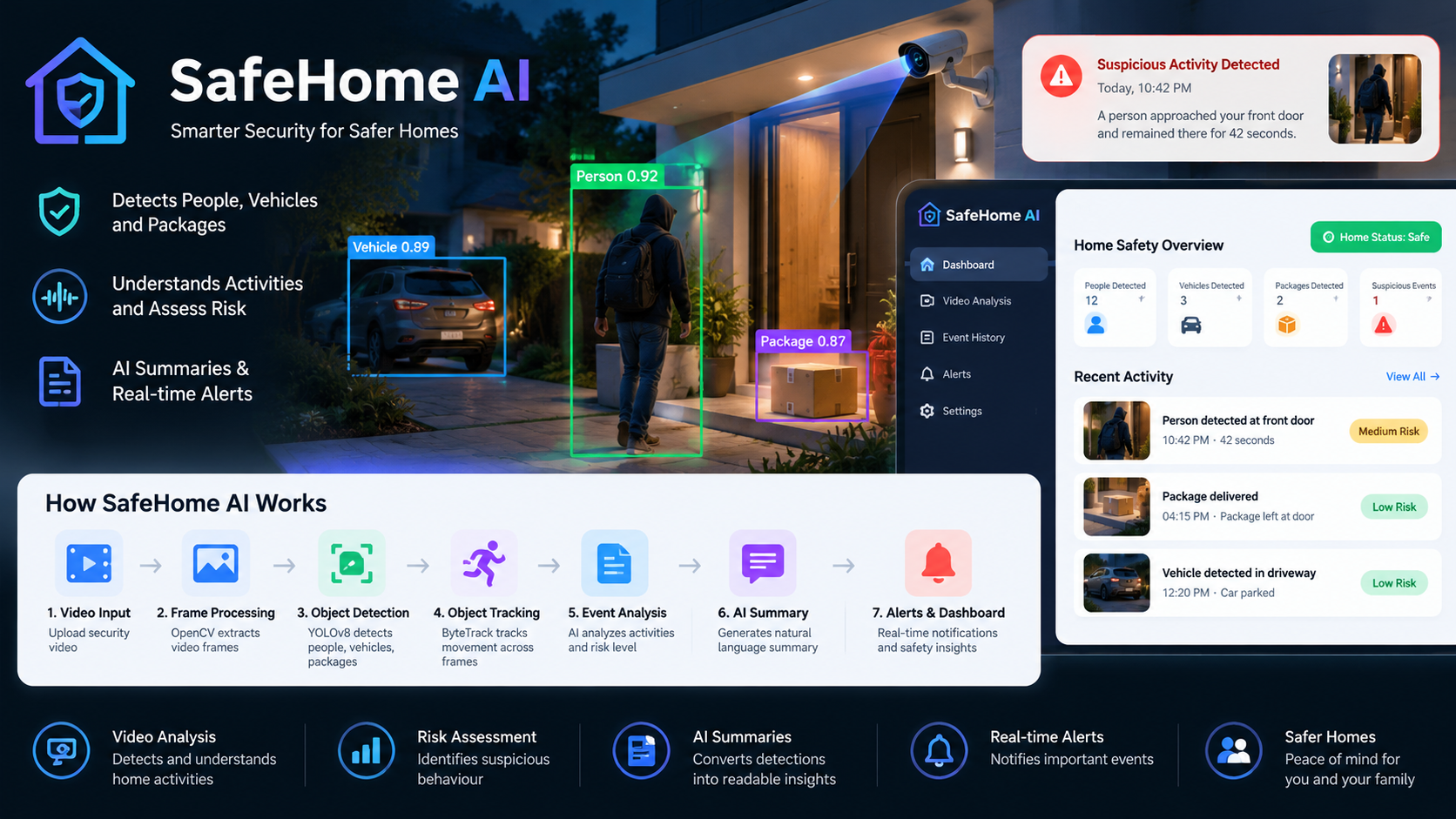
Home safety is a major concern for families, especially when they are away from home or unable to monitor security cameras continuously. Traditional surveillance systems record hours of footage, leaving people to manually identify important events. We wanted to build a smarter solution that helps people understand what is happening around their homes instead of simply recording videos. This inspired us to develop SafeHome AI, an AI-powered home safety monitoring system that aims to turn security footage into meaningful events, risk insights, and easy-to-understand alerts.
What We Built
SafeHome AI is designed to analyze uploaded security videos, identify relevant objects and activities, and present useful information through an intuitive dashboard. Our goal is to reduce the effort required to review surveillance footage and help users focus on events that may need attention.
How We Built It
We designed the system around a modular AI pipeline. OpenCV is used for video processing and frame extraction, while a YOLO-based object detection model can identify supported objects such as people and vehicles. Object tracking can help associate detections across consecutive frames. A Python-based event analysis engine interprets the detection results and applies predefined rules to estimate event risk. A language model can then transform structured event information into concise, readable summaries. The backend coordinates the processing pipeline, while the frontend presents event information and safety insights to users.
Challenges We Faced
One of our main challenges was connecting video processing, AI detection, event analysis, and the user interface into a coherent workflow. Object detection alone does not explain what happened in a video, so we needed to consider timestamps, tracking information, and contextual rules to generate meaningful events. We also had to consider processing efficiency, detection reliability, and the risk of incorrectly classifying ordinary activities as suspicious. These challenges encouraged us to design the system as separate components that can be tested and improved independently.
What We Learned
Through SafeHome AI, we explored how computer vision, object detection, tracking, backend development, and language models can work together to solve a practical problem. We learned that building a useful AI application requires more than selecting a model: it also requires reliable data processing, thoughtful event interpretation, clear explanations, and responsible handling of uncertainty.
What's Next
We aim to improve activity recognition, event summarization, notification capabilities, and the overall reliability of risk assessment. Future improvements could include real-time camera integration, customizable monitoring zones, and a more comprehensive event history. Our long-term vision is to make home monitoring more accessible and understandable by helping people focus on relevant safety events rather than hours of raw footage.
Built With
- amazon-web-services
- artificial
- computer
- detection
- fastapi
- geniai
- home
- home-energy-saver
- machine
- object
- opencv
- python
- react
- sagemaker
- security
- smart
- vision
- yolo

Log in or sign up for Devpost to join the conversation.