Inspiration
The project was inspired by the need for an AI-powered solution to enhance hemoglobinopathy diagnosis using advanced analytics. Leveraging recent breakthroughs in natural language processing and retrieval-augmented generation (RAG) systems, the team aimed to create an intelligent platform that not only processes medical test data but also provides contextually enriched analysis of hemoglobinopathies.
What it does
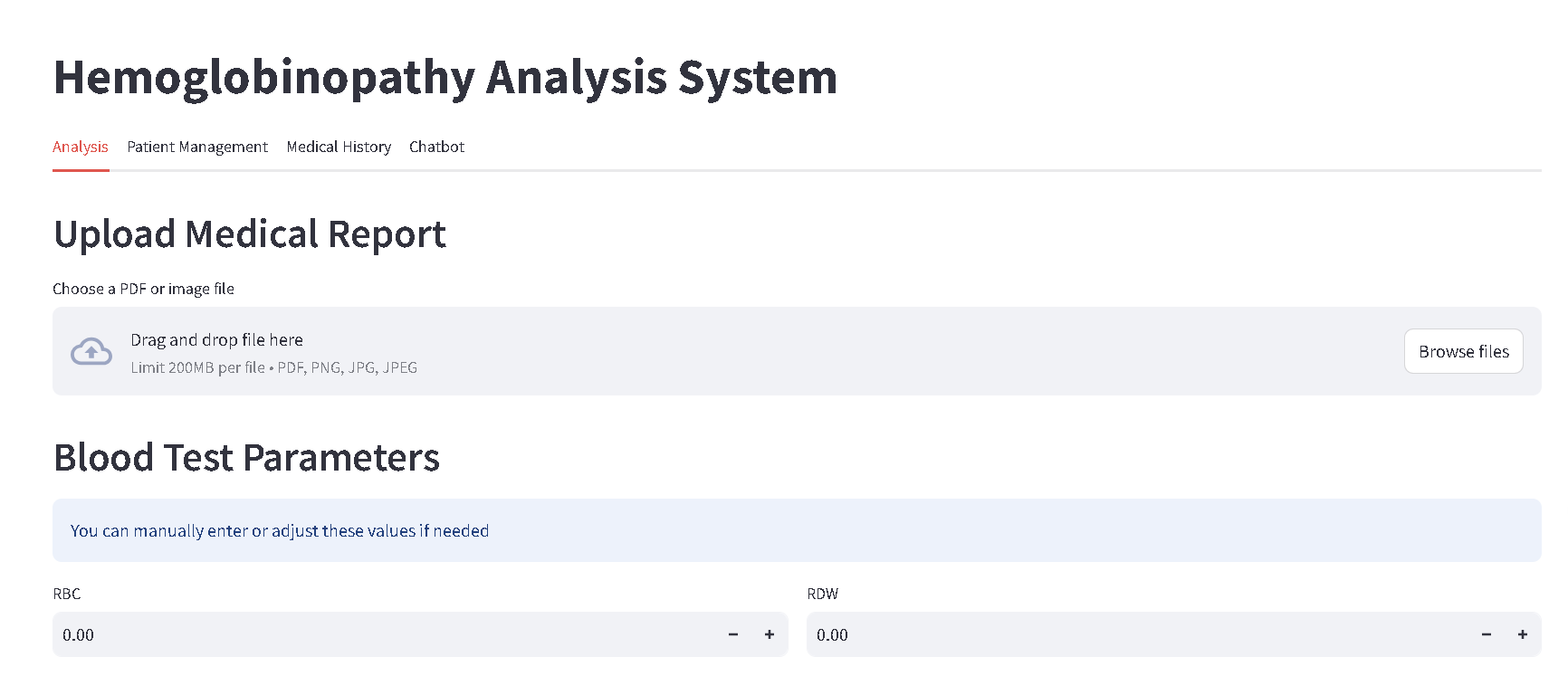
The system serves a dual purpose. The first component performs real-time analysis of blood test metrics to differentiate between various hemoglobinopathy conditions—such as Sickle Cell Disease, Thalassemias, and normal findings—by synthesizing medical test results and leveraging LLMs for clinical interpretation. The second component is a knowledge base that uses a RAG system to retrieve and present relevant information from a set of curated PDF documents and medical texts. Together, these features offer an end-to-end solution for diagnosis assistance and medical knowledge validation.
How we built it
The platform is built using Python, Docker, and Azure Container Apps. The core logic is implemented across multiple repositories:
- The microsoft-ai-app repository contains the web application, LLM integration (using GPT-4o), and analytic routines.
- The rag_hemoglobinopathies repository handles document processing, retrieval pipelines, and model interfacing with APIs (e.g., Hugging Face and SambaNova).
- Docker images are configured for easy deployment and scaling, with the image hosted on Docker Hub.
Challenges we ran into
Key challenges included:
- Integration of RAG systems with multiple API providers and reconciling response formats.
- Managing Docker credentials on Windows, which led to setup issues during push/pull operations.
- Optimizing memory utilization, especially during document indexing and model queries, to ensure fast and reliable processing.
- Aligning deployment configurations for both local and cloud-based environments (Azure Container Apps and Replit).
Accomplishments that we're proud of
- Successfully integrating advanced AI and retrieval pipelines to analyze and classify hemoglobinopathy test results.
- Building a modular and deployable system that spans from containerized applications to cloud-based deployments.
- Overcoming Windows-specific Docker credential challenges and ensuring robust API interactions between multiple services.
- Creating an open-source, comprehensive medical analysis platform that supports both clinical assessments and educational insights.
What we learned
This project reinforced the importance of modular design and comprehensive logging to quickly address integration issues across different parts of the system (LLM analysis, retrieval pipelines, API interactions). We also learned to effectively troubleshoot and resolve Docker credential challenges on Windows and optimize application performance during high-memory operations.
What's next for AI-Powered Hemoglobinopathy Diagnosis and Knowledge Base
Future directions include:
- Enhancing the contextual intelligence of the RAG system to further minimize irrelevant document retrieval.
- Expanding support for additional medical conditions and integrating more comprehensive data sources.
- Implementing finer-grained performance optimizations and scaling strategies leveraging Azure Container Apps.
- Increasing community collaboration through additional documentation and open-source contributions.
For more details, visit the Docker image on Docker Hub and see the source code on GitHub.

Log in or sign up for Devpost to join the conversation.