-
-
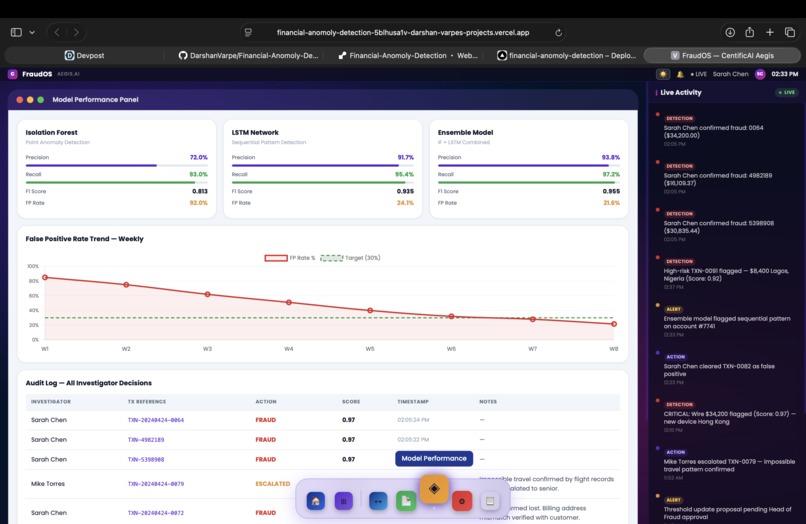
Model Performance
-
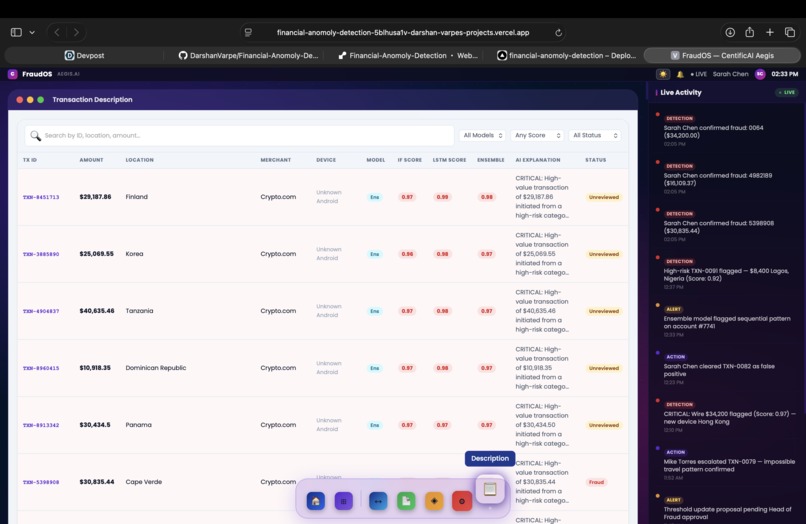
Description
-
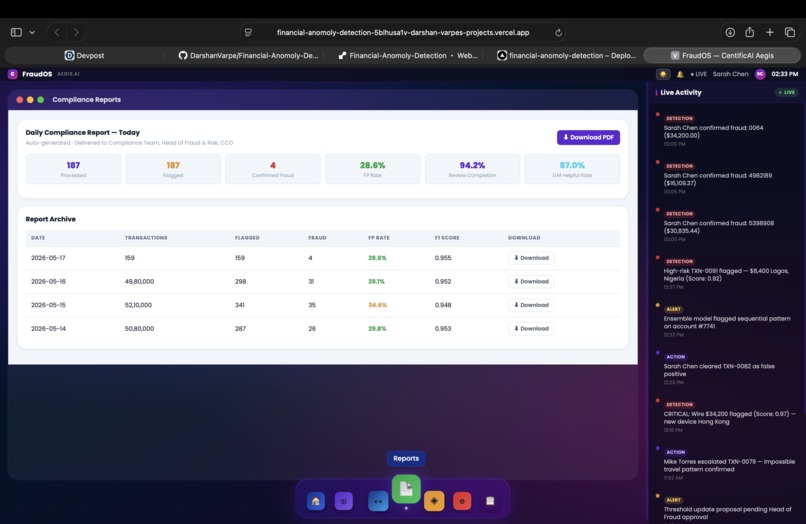
Report
-
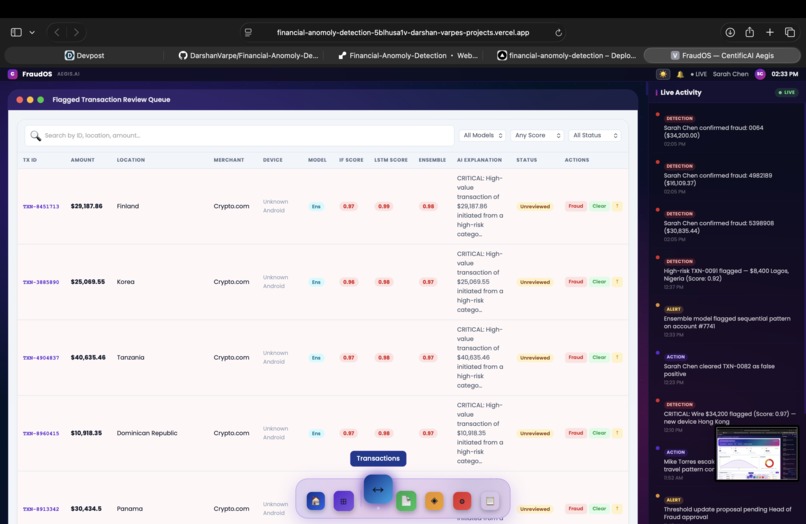
Transactions
-
Thresholds
-
Dashboard
-
Desktop

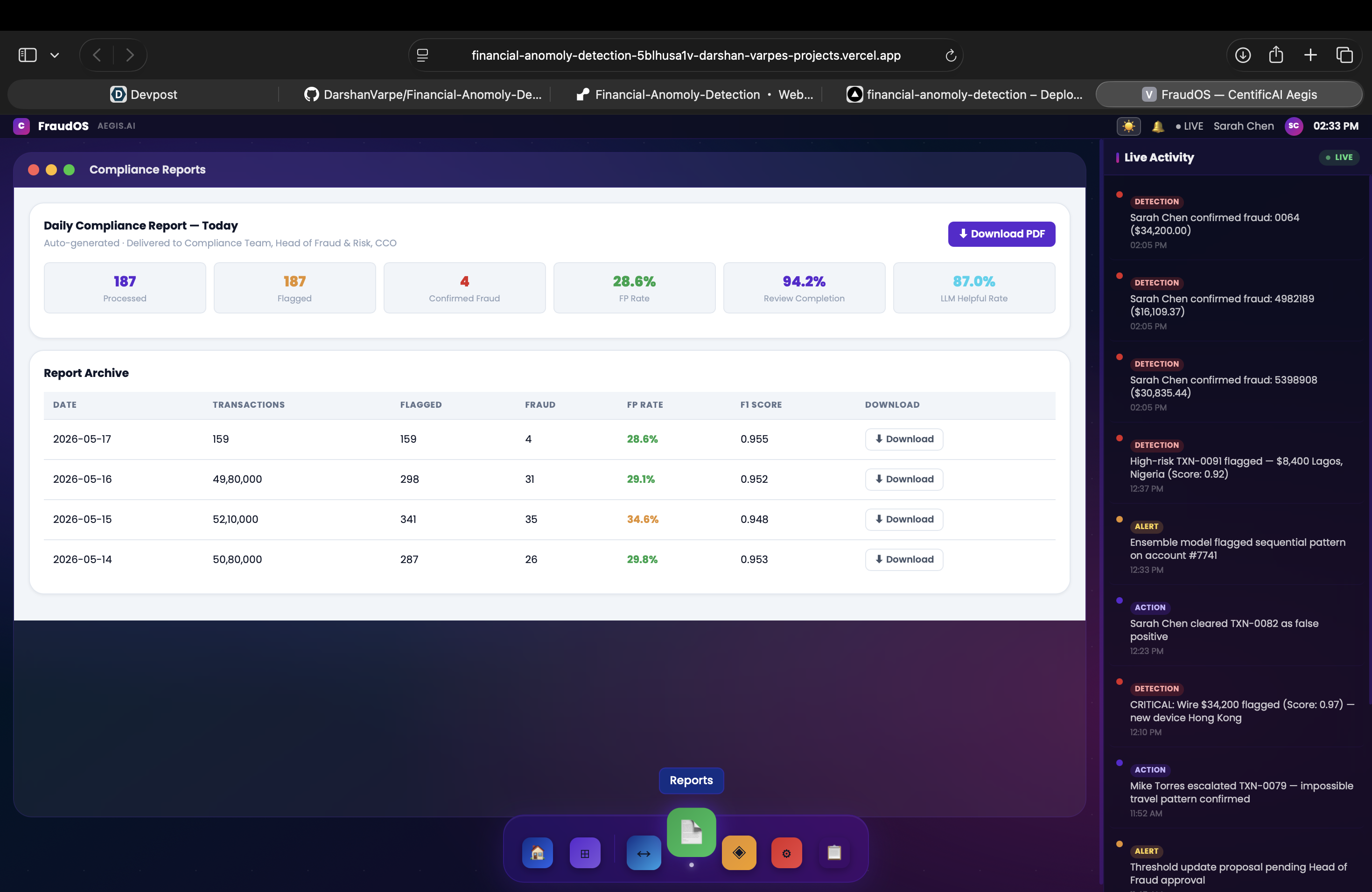
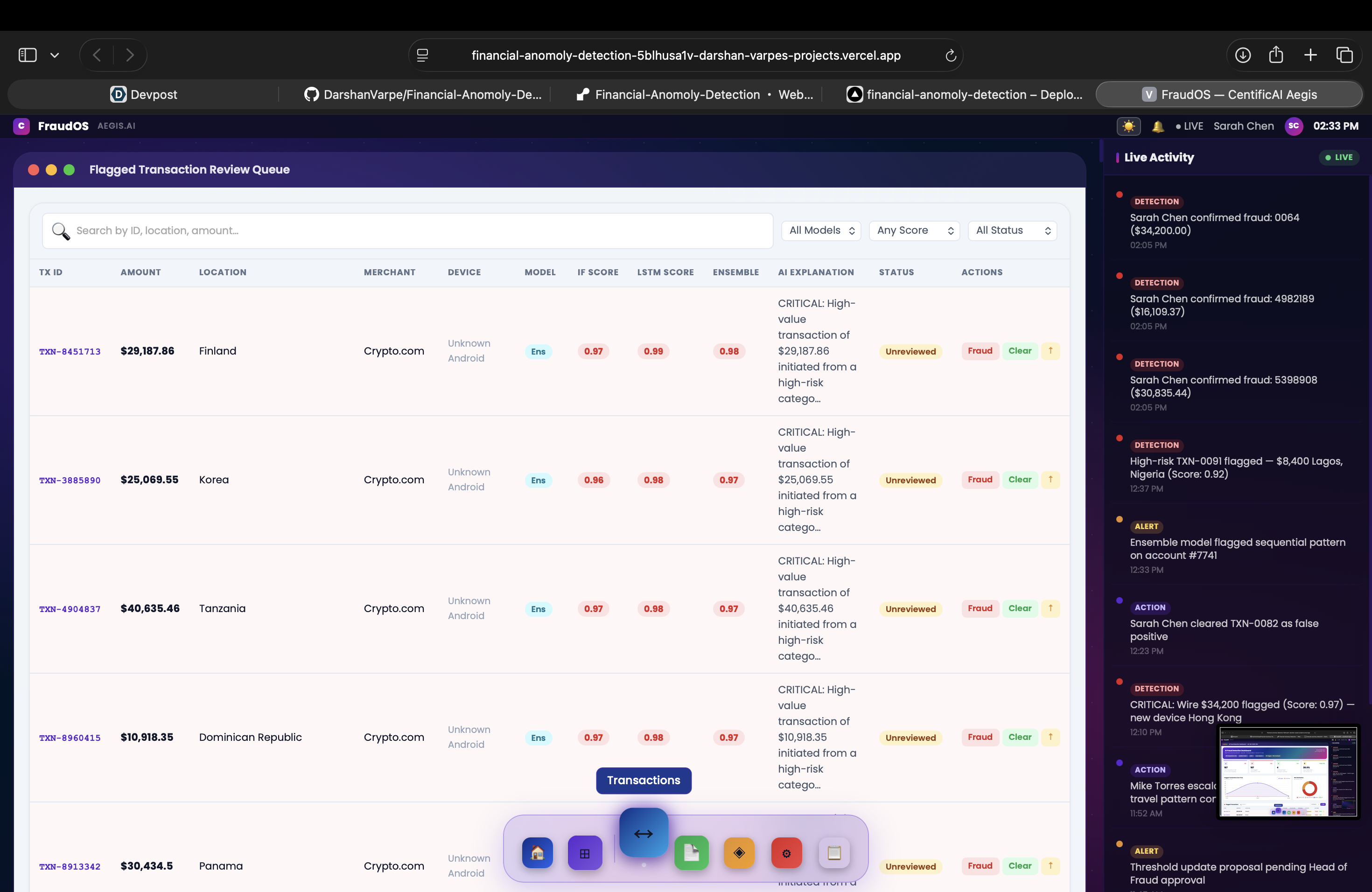
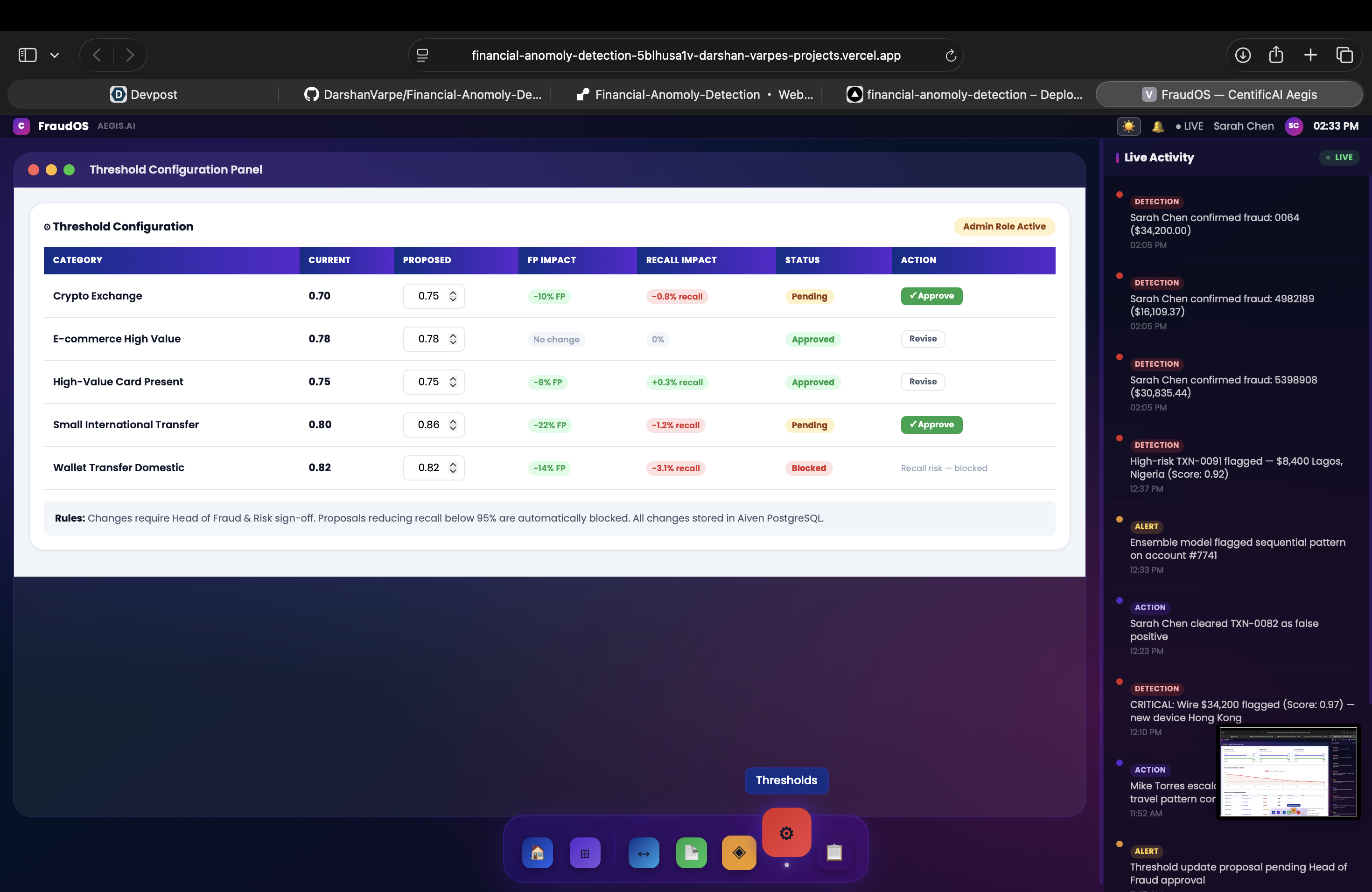
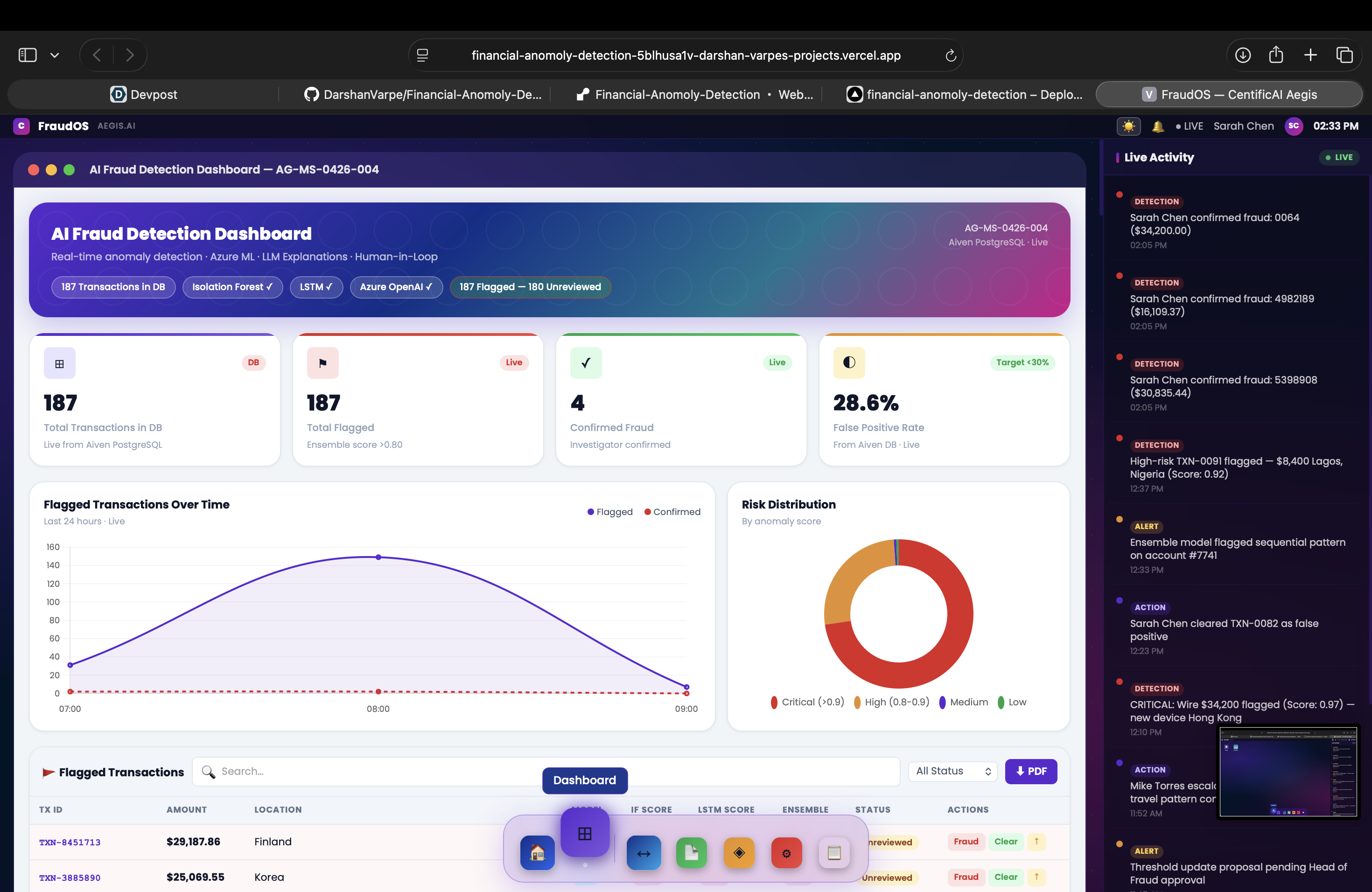
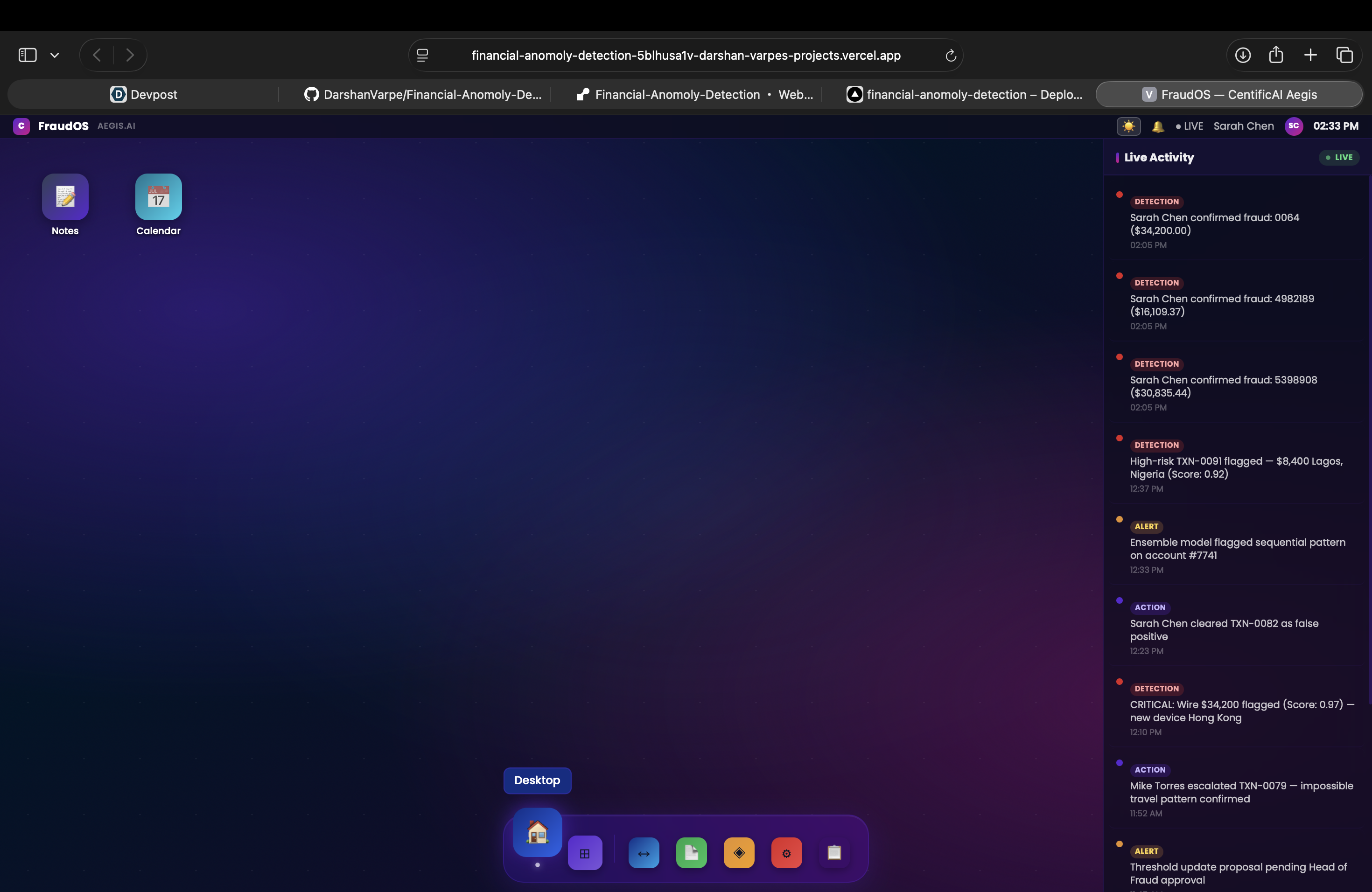
FraudOS (AEGIS.AI)
Inspiration
Today, financial fraud detection pipelines flag transactions at an average 92% false-positive rate. This means that out of every 100 transactions an investigator manually reviews, 92 are legitimate customers being inconvenienced, and only 8 are actual fraud cases.
This creates a massively noisy queue, leading to:
- Investigator fatigue
- Missed fraudulent activity
- Frustrated customers
- Slower operational response times
We were inspired to solve this problem of “alert fatigue” by building a system that not only detects fraud more accurately, but also explains why the AI flagged a transaction — eliminating the traditional “black box” problem in financial machine learning systems.
What it does
FraudOS (AEGIS.AI) is an end-to-end fraud investigation operating system powered by our virtual AI agent, “Rahul.”
🔍 Hybrid AI Detection
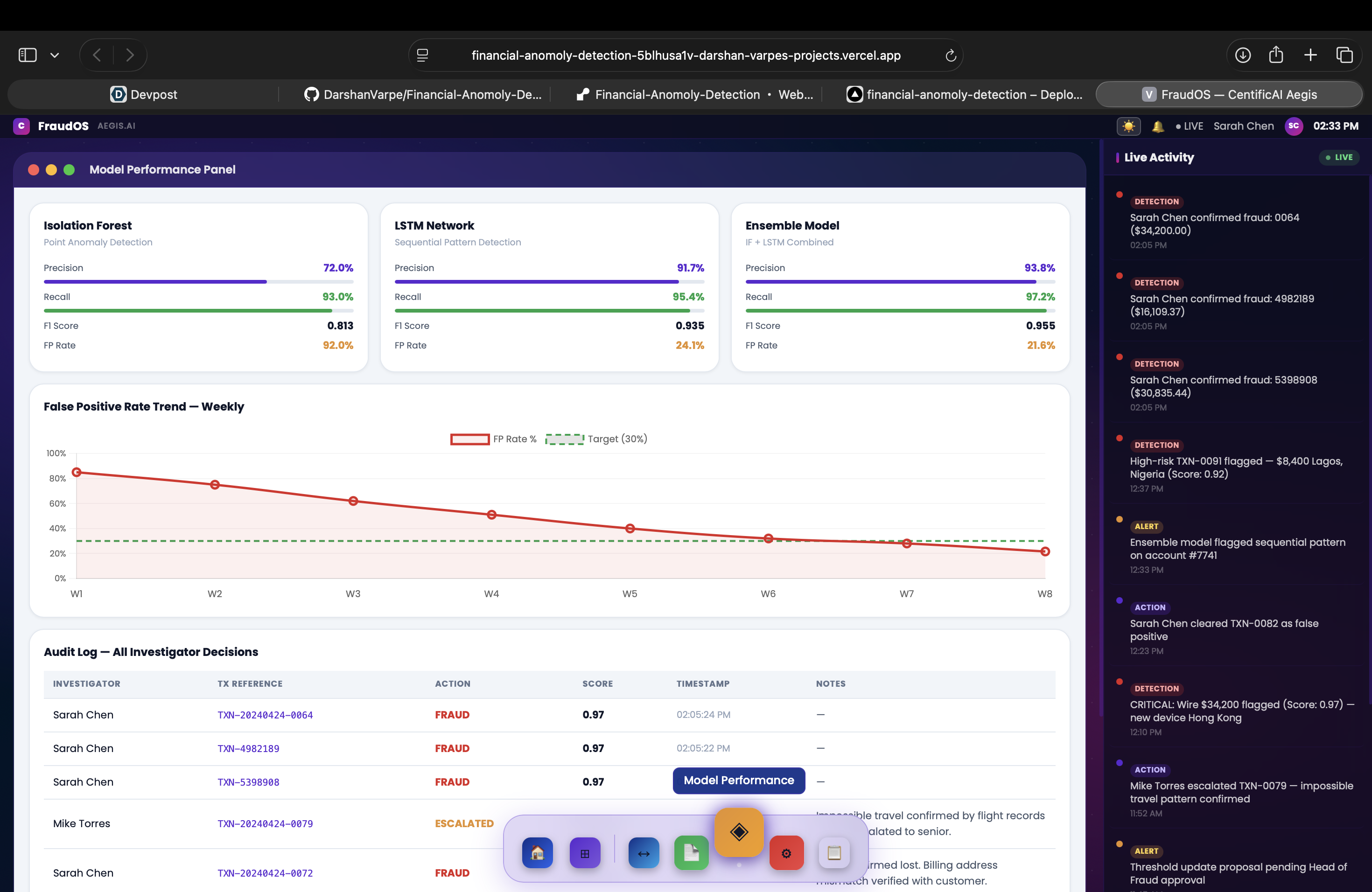
The platform ingests live transaction data and scores activity using an Ensemble AI Model that combines:
- Isolation Forest → detects point anomalies
- LSTM Networks → detects sequential and velocity-based fraud patterns
This hybrid approach improves fraud detection accuracy while reducing false positives.
🧠 Explainable AI (XAI)
When a transaction crosses the anomaly threshold (for example, > 0.80), Agent Rahul generates a plain-English explanation for investigators.
Example:
CRITICAL: High-value wire transfer of $34,200 initiated from a new device in Hong Kong.
This removes the black-box nature of AI and allows investigators to quickly understand the reasoning behind each alert.
👨💼 Human-in-the-loop Governance
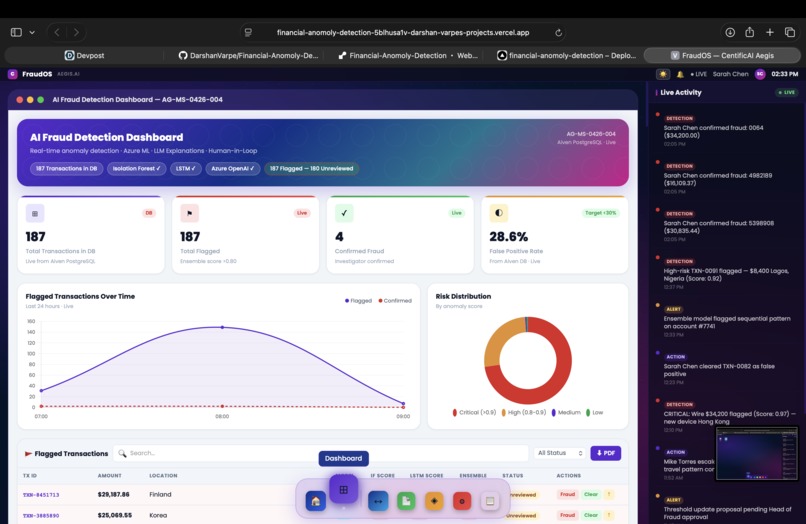
Investigators interact with a premium desktop-like web interface where they can:
- Review flagged transactions
- Confirm fraud
- Clear legitimate activity
- Monitor compliance metrics
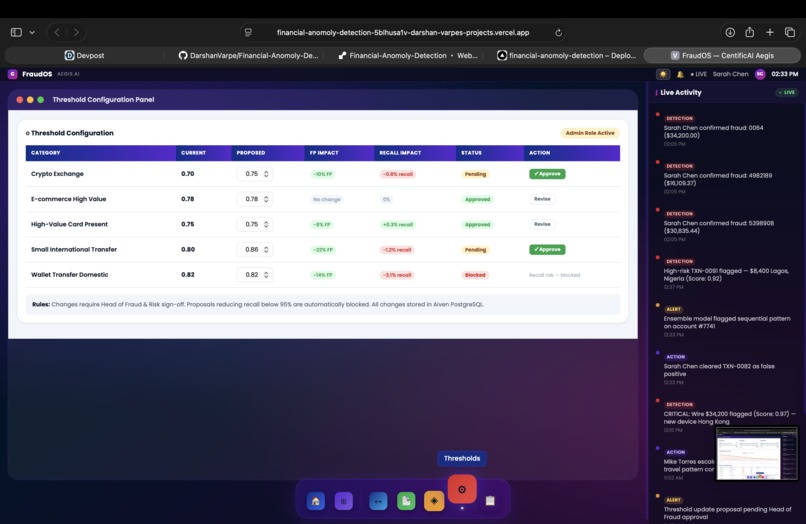
The platform also enforces regulatory compliance by automatically blocking any model threshold changes that would reduce fraud recall below 95%.
📡 Live Data Injection
FraudOS includes a real-time Python AI Data Agent that continuously simulates realistic transaction activity and injects it directly into the cloud database for live monitoring and testing.
How we built it
🎨 Frontend (UI/UX)
Built using React + Vite and deployed on Vercel.
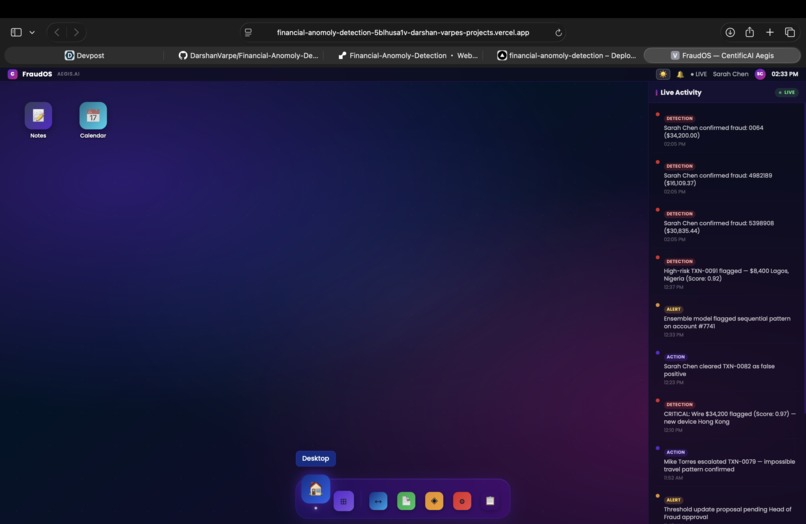
We designed a highly immersive glassmorphic Web Operating System featuring:
- macOS-style dock
- Draggable application windows
- Smooth micro-interactions
- Real-time toast notifications
- Interactive fraud investigation workspace
The goal was to make enterprise fraud analysis feel modern, intuitive, and visually premium.
⚙️ Backend (FastAPI)
A fully containerized Python FastAPI backend, deployed on Render, powers:
- Business logic
- Fraud scoring APIs
- Compliance workflows
- Real-time metrics
- Automated PDF compliance report generation
🗄️ Database (PostgreSQL)
We migrated from local storage to a cloud-hosted Supabase PostgreSQL database to support:
- Persistent live state
- Instant audit logging
- Scalable cloud infrastructure
- Reliable multi-service synchronization
🤖 AI Data Agent
We developed a custom Python worker script (ai_data_agent.py) using:
scikit-learnFaker
The agent continuously injects realistic synthetic transaction data into Supabase, enabling a constantly active fraud monitoring environment.
Challenges we ran into
One of the biggest technical hurdles was managing asynchronous communication between:
- The live AI data injector
- The cloud database
- The frontend dashboard
Ensuring that the Live Activity Feed updated accurately whenever the Python worker injected new transactions required careful handling of:
- Database connection pooling
asyncpgoptimization- Supabase free-tier connection limitations
We also had to properly configure CORS across separate Vercel and Render deployments to ensure secure cross-origin communication.
Accomplishments that we're proud of
✨ Exceptional UI/UX
We didn’t build a traditional dashboard — we created a fully interactive Web Operating System with premium animations, glassmorphism, and enterprise-grade usability.
☁️ True Full-Stack Cloud Deployment
Successfully deploying and integrating:
- Vercel
- Render
- Supabase
- Containerized FastAPI services
was a major milestone for the team.
🛡️ Regulatory-First Design
FraudOS actively enforces compliance by:
- Blocking unsafe model threshold modifications
- Maintaining minimum fraud recall guarantees
- Automatically generating compliance PDFs and audit logs
What we learned
We learned that even a highly accurate ML model is ineffective in finance if human investigators cannot understand why decisions are being made.
The most valuable insight was realizing that:
Explainability is just as important as accuracy in enterprise AI systems.
Bridging machine learning with human-centered UX through plain-English AI explanations became the defining strength of FraudOS.
What's next for FraudOS (AEGIS.AI)
⚡ Real-time WebSocket Integration
We plan to move from REST API polling to live WebSocket architecture so investigators receive updates instantly the moment suspicious activity is detected.
🧩 Custom Agent Personas
Future versions of Agent Rahul will support specialized personas tailored to different fraud domains, such as:
- Crypto Fraud Specialist
- Domestic Retail Fraud Analyst
- International Wire Transfer Expert
- Regional Compliance Specialist
This will allow financial institutions to customize the AI investigator experience based on operational needs.
Tech Stack
Frontend  : React, Vite, TailwindCSS
Backend   : FastAPI, Python
Database  : Supabase PostgreSQL
AI/ML     : Isolation Forest, LSTM, scikit-learn
Cloud     : Vercel, Render
Utilities : Faker, asyncpg
Final Vision
FraudOS (AEGIS.AI) is more than a fraud dashboard — it is an intelligent fraud investigation operating system designed to combine:
- AI-powered detection
- Human-centered explainability
- Regulatory governance
- Real-time operational workflows
Our mission is to dramatically reduce alert fatigue while empowering investigators with transparent, trustworthy AI.
Built With
- asyncpg
- docker
- fastapi
- postgresql
- python
- react
- render
- scikit-learn
- supabase
- tailwind
- vercel
- vite


Log in or sign up for Devpost to join the conversation.