The Problem:
During an emergency, every minute matters. However, emergency response can become slow when ambulances, hospitals, and emergency priorities are not coordinated.
An ambulance may be sent to the nearest hospital even when it has no available ICU beds or does not have the required medical specialization. At the same time, emergency teams may not have enough information to decide which case should be handled first.
This inspired us to build a system that helps make emergency resource allocation faster, smarter, and more data-driven.
Our Solution:
AI-Powered Emergency Resource Allocation System is a smart emergency response platform that helps emergency teams make better decisions.
The system focuses on three key tasks:
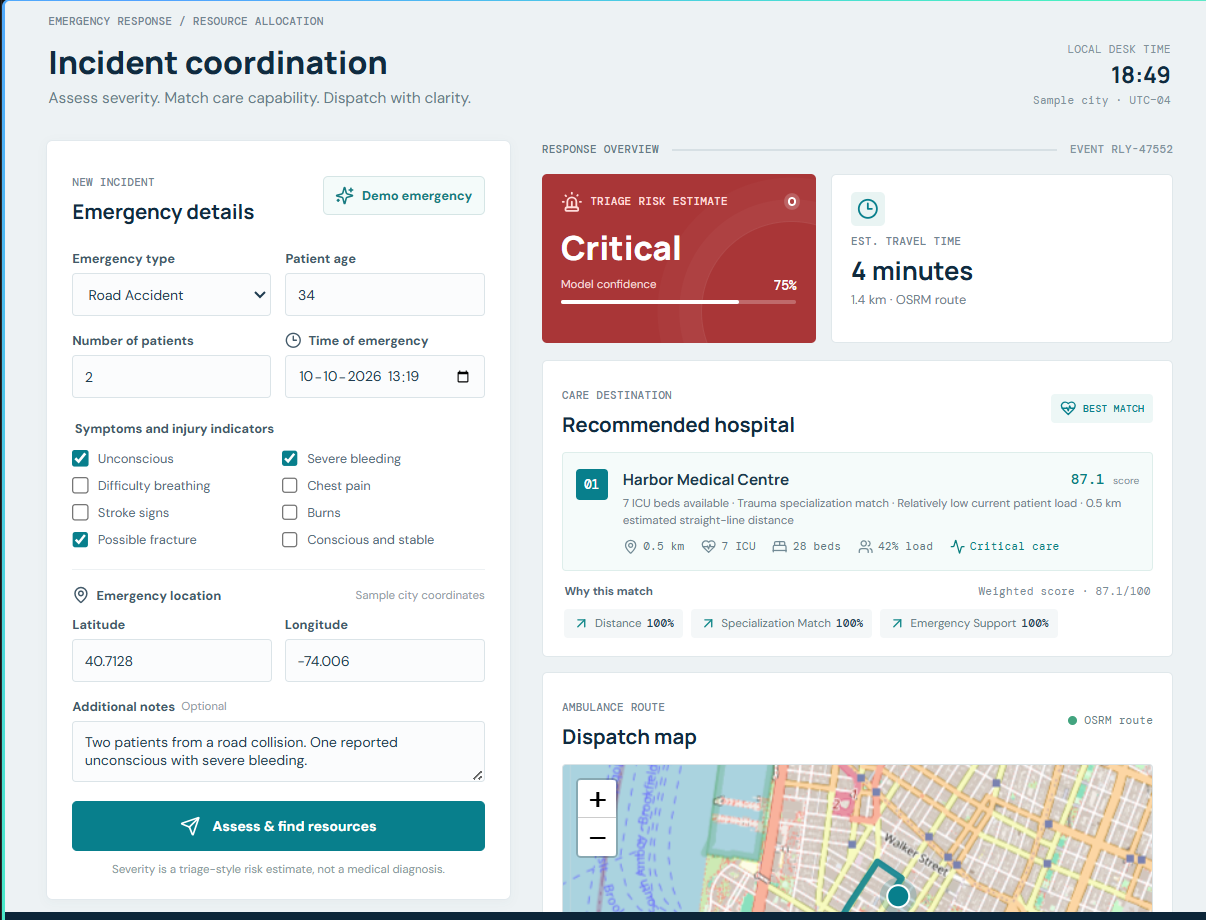
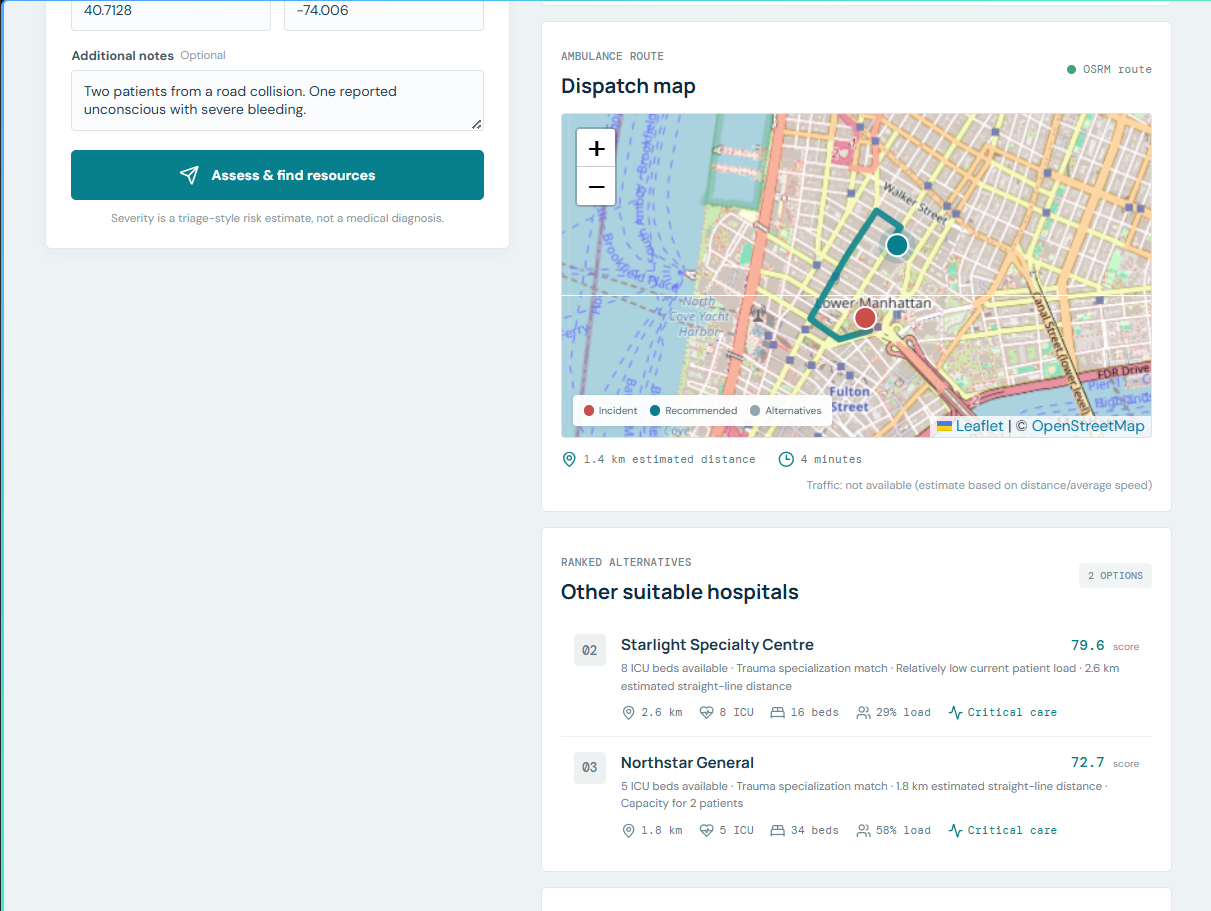
Severity Prediction – Classifies an emergency as Critical, High, or Medium to help prioritize cases. Smart Hospital Selection – Recommends a suitable hospital based on factors such as available beds, ICU availability, hospital specialization, and current patient load. Ambulance Routing – Finds a faster route to reduce the time taken to reach the selected hospital.
Instead of looking at only one factor, our system combines multiple emergency conditions to recommend a better response.
How It Works:
Emergency Occurs → Collect Information → Predict Severity → Select Suitable Hospital → Find Fastest Route → Reach Care Faster
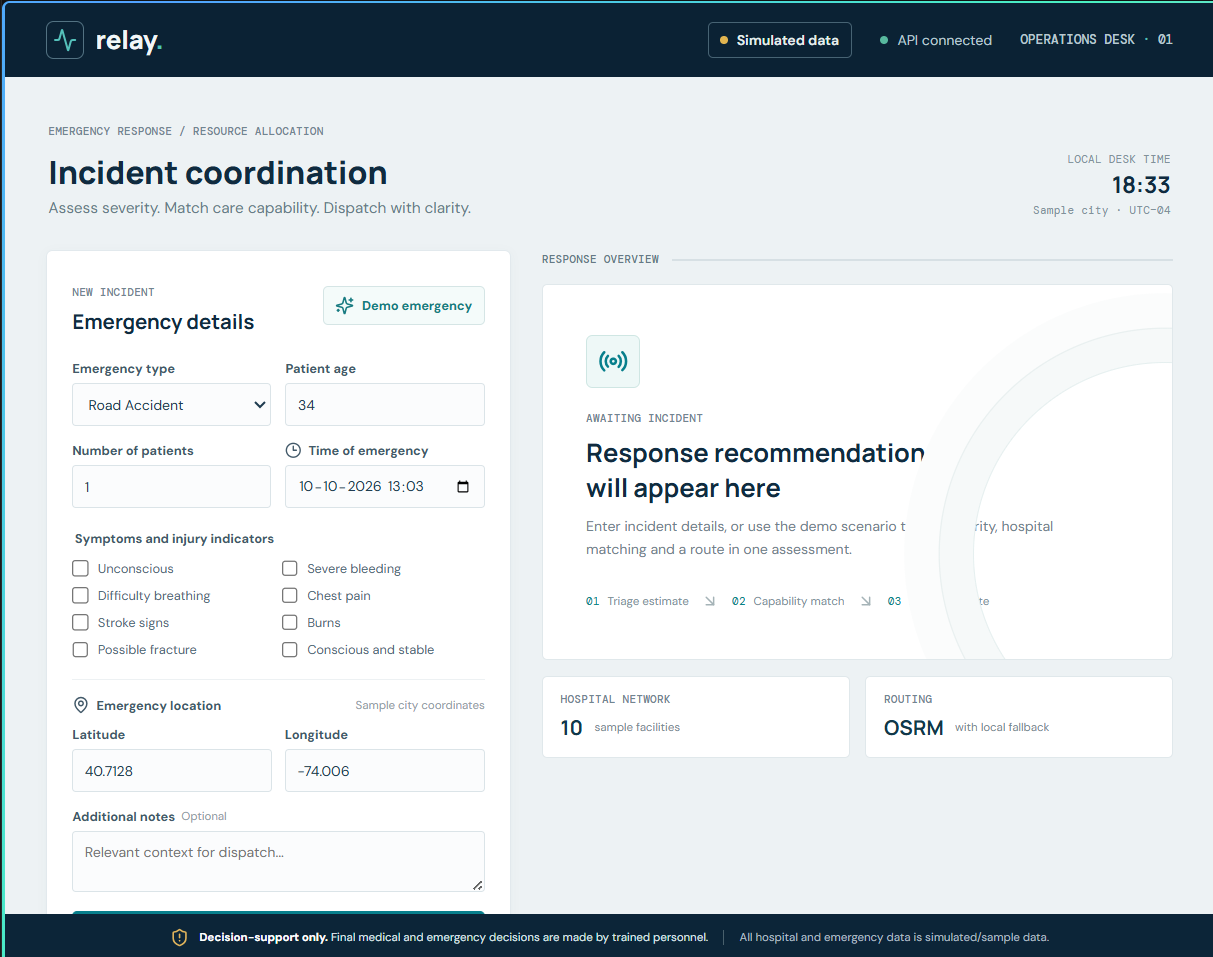
The system considers information such as the emergency location, type of emergency, time, hospital availability, and patient load.
How We Built It:
We designed the project as an AI-assisted decision-support system.
The main components are:
Emergency Data Processing – Collects and processes emergency-related information. AI Severity Prediction – Uses emergency information to classify the severity level. Hospital Recommendation – Compares hospital conditions and identifies the most suitable option. Route Optimization – Determines a faster ambulance route based on available route information. Emergency Dashboard – Presents the recommendations in a simple format for emergency teams.
The system is designed to assist emergency personnel, not replace their final decision.
What We Learned:
While developing this project, we learned how AI can be applied to real-world emergency management. We also explored how multiple factors such as severity, hospital capacity, specialization, and route information can work together instead of being handled separately.
We gained experience in AI-based prediction, data processing, decision support, system design, and emergency resource optimization.
Challenges We Faced:
One of the main challenges was deciding how to combine different emergency factors into one useful recommendation.
For example, the nearest hospital is not always the best hospital. A hospital may be closer but have no ICU availability, while another hospital slightly farther away may be better equipped for the emergency.
Another challenge was designing the system so that AI provides useful recommendations while keeping the final decision with trained emergency personnel.
Future Scope:
In the future, the system can be enhanced with:
Live hospital bed and ICU availability Real-time traffic and route data Integration with emergency services such as 108 / 112 City-level emergency monitoring dashboards More accurate AI models trained using real emergency datasets Real-time hospital and ambulance coordination
Our Vision:
Our vision is to make emergency response smarter, faster, and more reliable by using technology to help the right resources reach the right place at the right time.
Built With
- ai
- api
- data
- fastapi
- learning
- machine
- postgresql
- processing
- python
- react
- rest
- route


Log in or sign up for Devpost to join the conversation.