-
-
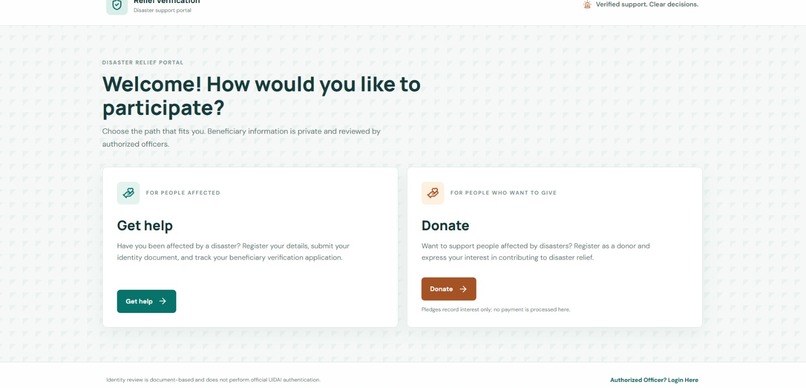
Login Page
-
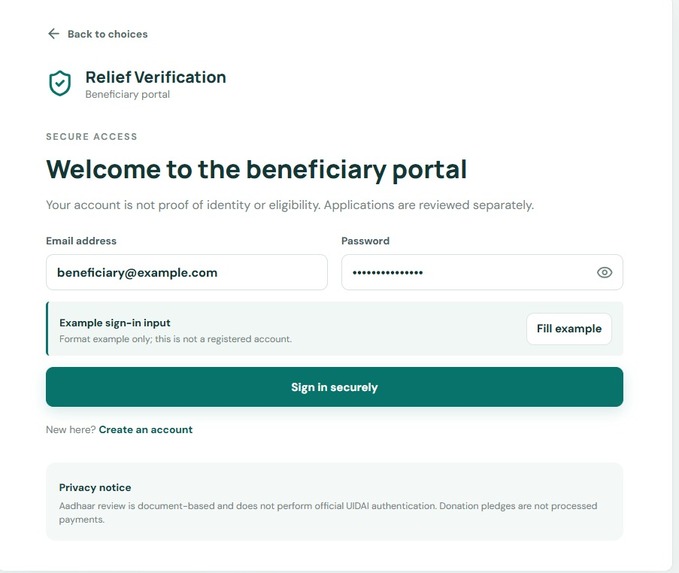
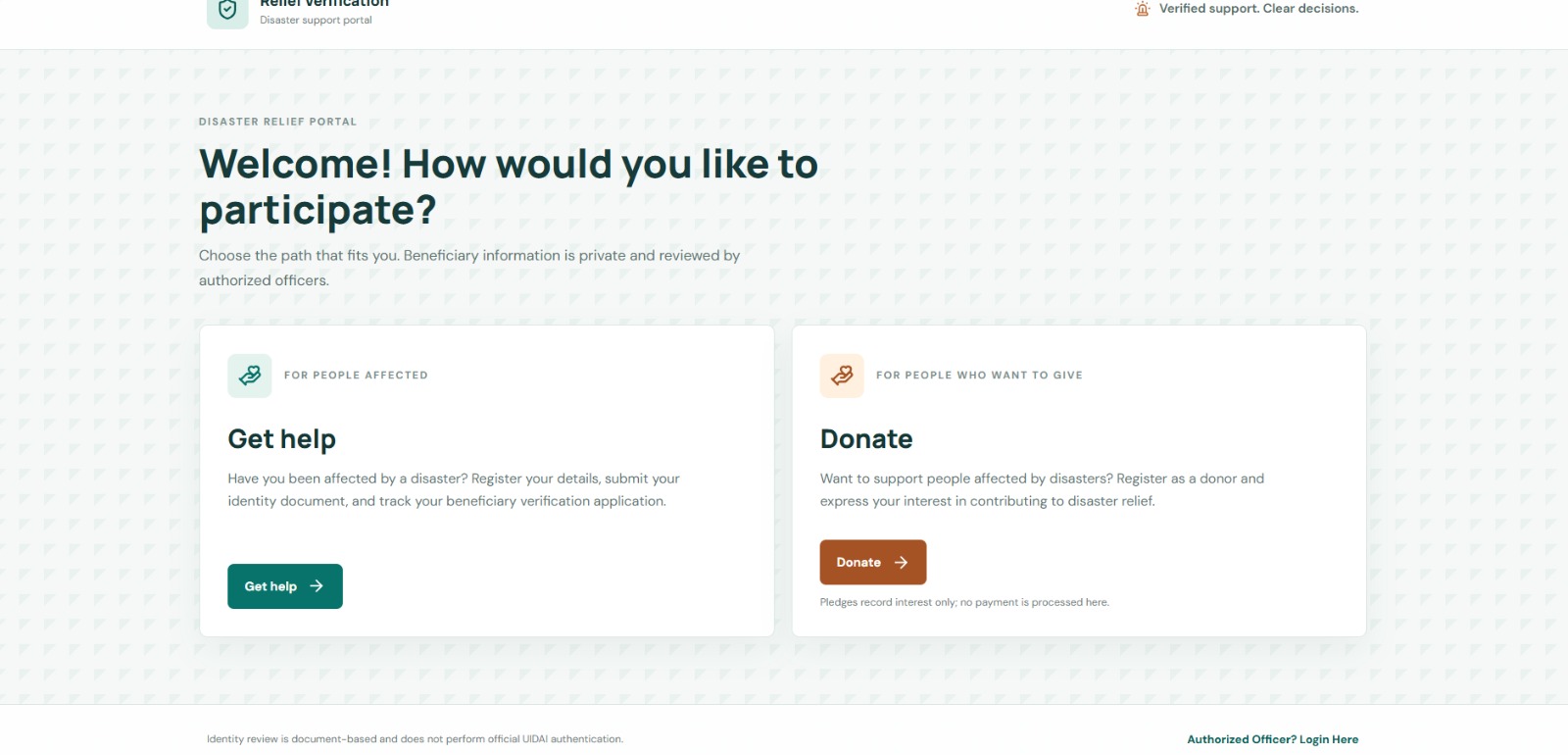
Help Page
-
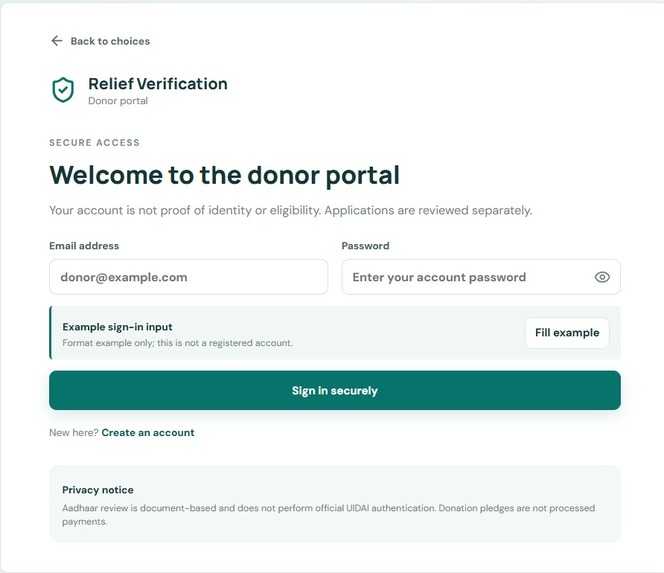
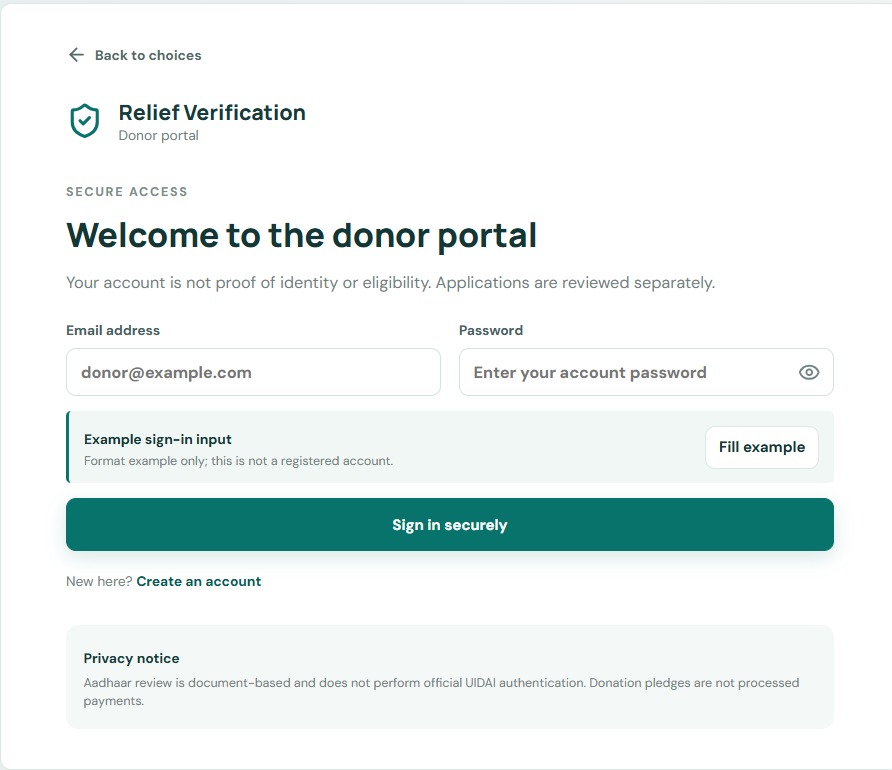
Donor Page
-
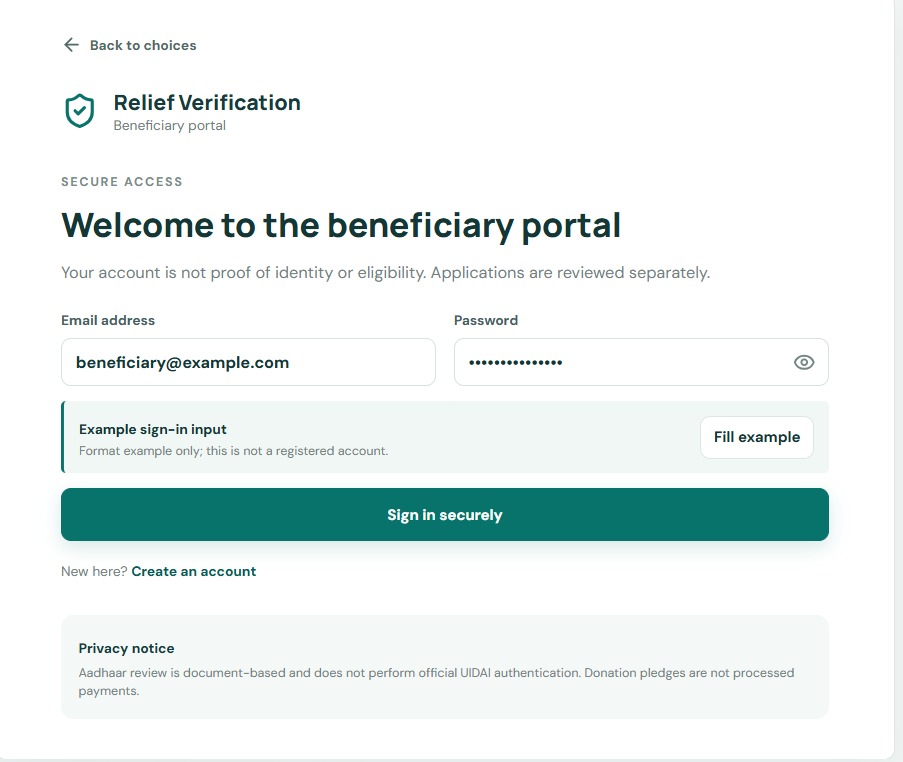
Beneficiary Page
-
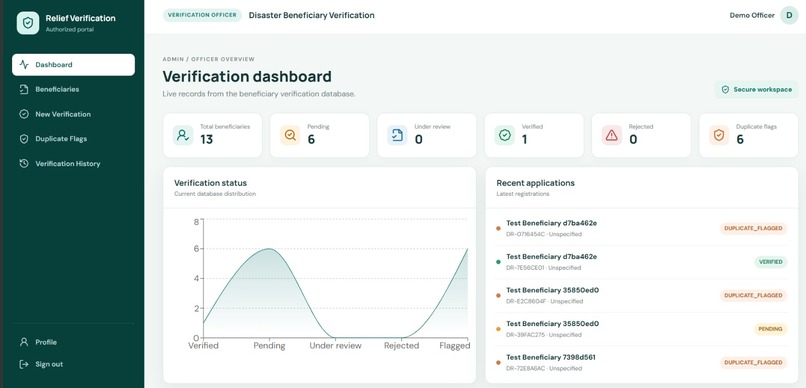
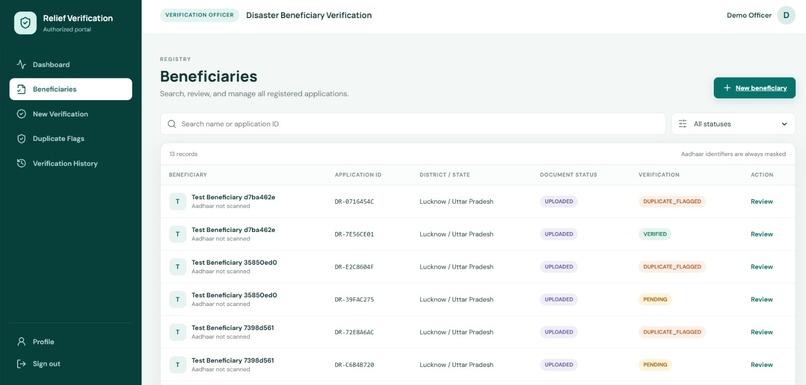
Verification Dashboard Page
AI-Powered Disaster Relief Verification & Aid Platform
Inspiration
During disasters such as floods, a large number of people require immediate relief assistance. Managing beneficiaries and aid requests manually can lead to duplicate registrations, repeated aid requests, delayed verification, and difficulty identifying people who need urgent support.
This inspired us to develop a platform that focuses not only on registering beneficiaries, but also on verifying beneficiaries and their aid requests before assistance is approved. Our goal was to make disaster relief operations more transparent, data-driven, and efficient.
What We Built
We developed an AI-powered web platform that manages the complete relief verification workflow:
Beneficiary Registration → Six-Point Verification → Eligibility Assessment → Aid Request → Duplicate Aid Detection → Aid Verification → Approval → Fulfillment
The platform provides:
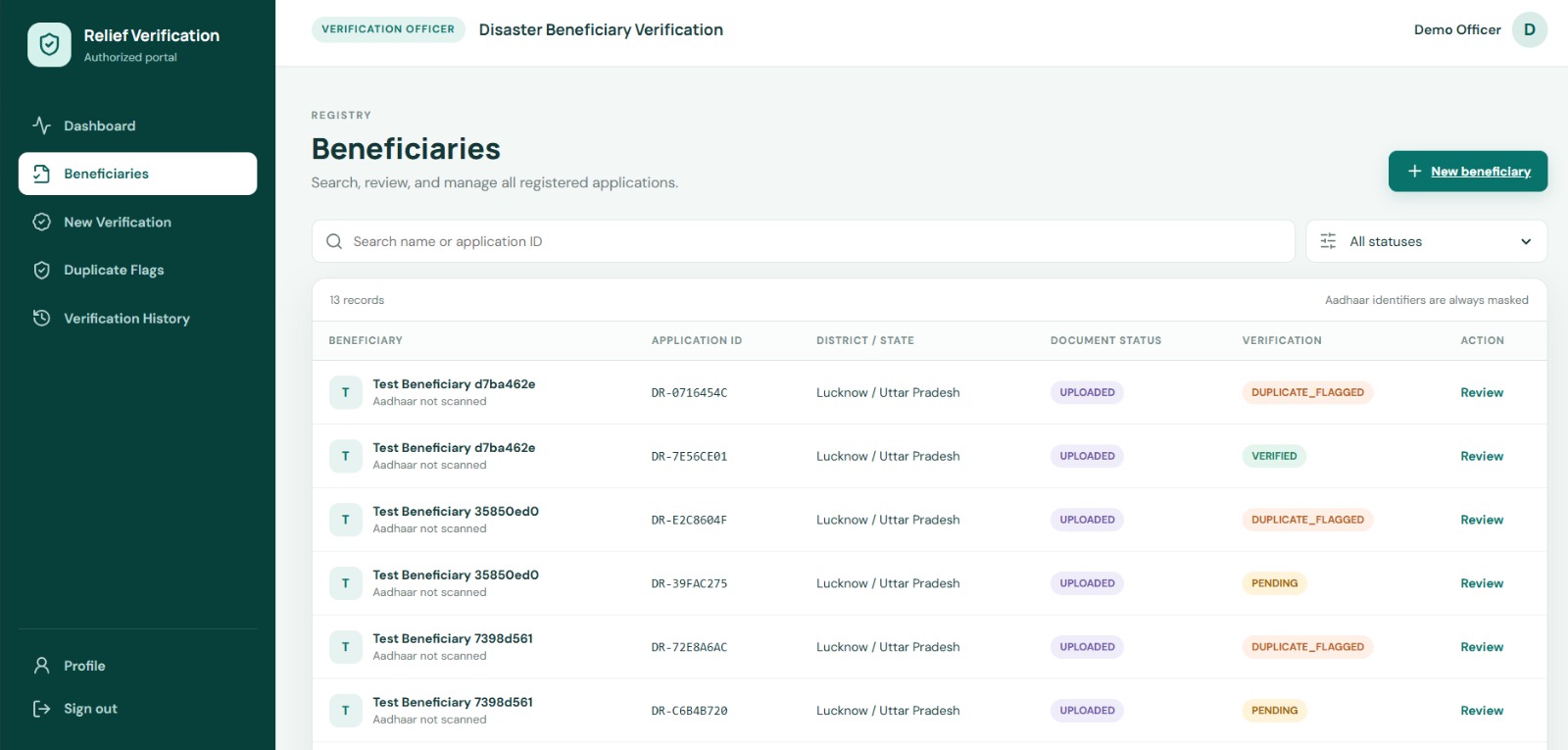
- Six-point beneficiary verification to validate beneficiary information and identify suspicious or duplicate records.
- Aadhaar format validation and local duplicate checking without claiming official UIDAI authentication.
- Aid verification based on beneficiary eligibility, previous aid history, duplicate requests, and resource availability.
- Duplicate aid detection to identify repeated or suspicious requests for manual review.
- Random Forest for predicting beneficiary priority as Low, Medium, or High.
- K-Means Clustering to group beneficiaries based on their needs and characteristics.
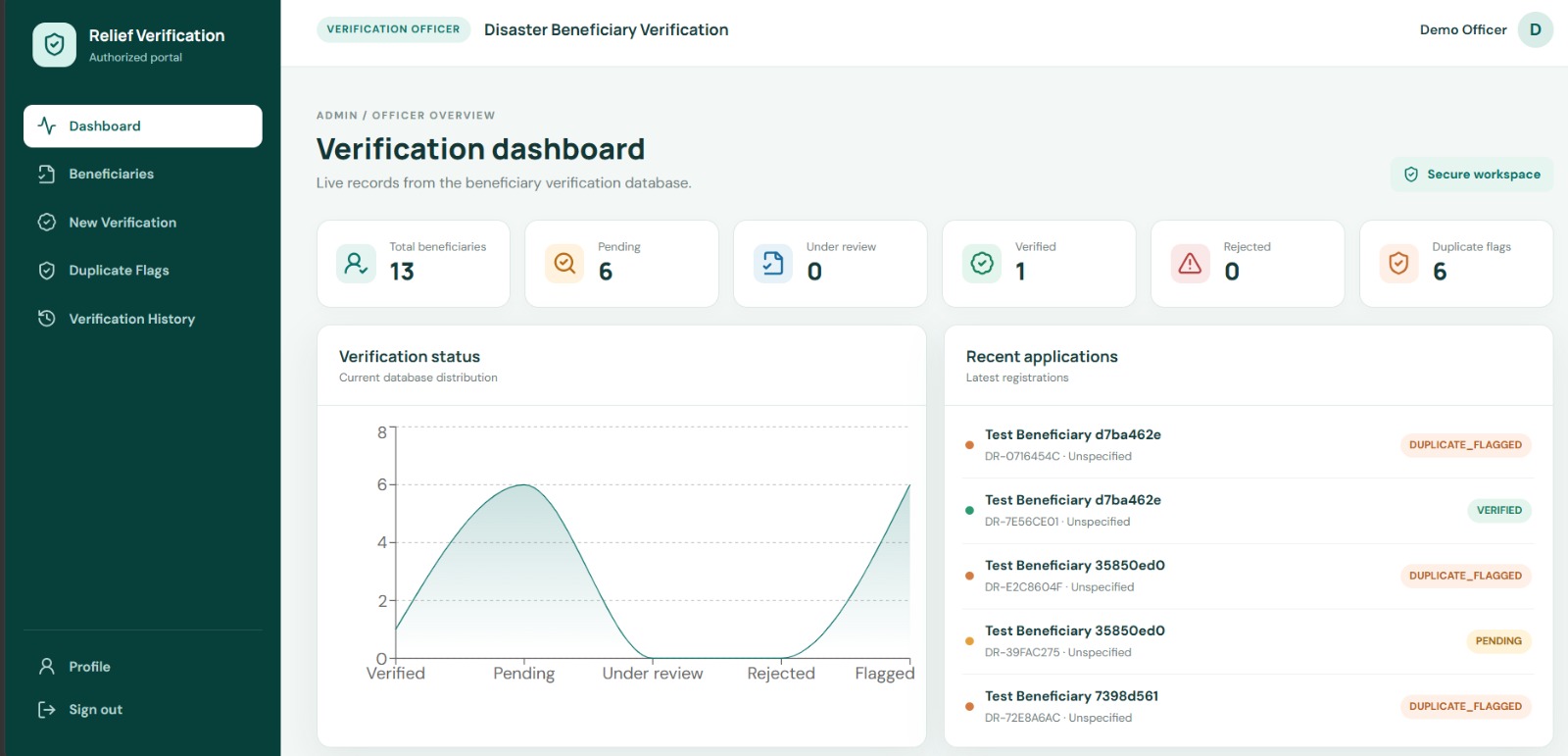
- Real-time dashboard and AI insights for monitoring beneficiaries, aid requests, resources, emergencies, and priority cases.
- Camp, resource, emergency, and report management for centralized relief operations.
How We Built It
The frontend was developed using React.js, JavaScript, CSS, React Icons, and Recharts. The backend was developed using Python and Flask, with REST APIs connecting the application to a MySQL database.
For AI/ML, we used Pandas, NumPy, and Scikit-learn. Random Forest is used for beneficiary priority prediction, while K-Means is used for need-based beneficiary clustering.
We designed the system so that verification results and dashboard information are generated from actual database records and model outputs, rather than hard-coded values.
What We Learned
Through this project, we learned how to:
- Integrate AI/ML with a real-world web application.
- Build and connect React, Flask, and MySQL.
- Design verification workflows with multiple decision stages.
- Perform data preprocessing and feature engineering for ML models.
- Apply Random Forest and K-Means to a practical problem.
- Design APIs and maintain consistent frontend-backend communication.
- Handle database relationships, validation, and transaction-based resource updates.
- Understand the importance of human review when AI predictions are uncertain.
Challenges We Faced
One of our main challenges was designing a verification process that could distinguish between genuine repeated assistance and potentially duplicate aid requests. A person affected by a disaster may legitimately need the same type of aid multiple times, so simply rejecting repeated requests would not be appropriate. We therefore designed the system to flag suspicious cases for manual review.
Another challenge was integrating the ML models with live application data while ensuring that the predictions were meaningful and not just decorative AI features.
We also faced challenges in maintaining consistency between the frontend, Flask APIs, MySQL database, and AI modules, especially when beneficiary verification, aid approval, and resource updates had to happen together.
Impact
Our platform aims to help relief teams verify beneficiaries faster, identify potential duplicate aid requests, prioritize urgent cases, and monitor relief operations from a centralized dashboard.
Instead of replacing human decision-making, our approach uses AI as a decision-support tool, helping authorized relief staff make more informed and transparent decisions.
Smarter Verification. Faster Relief. Better Decisions.

Log in or sign up for Devpost to join the conversation.