-
-
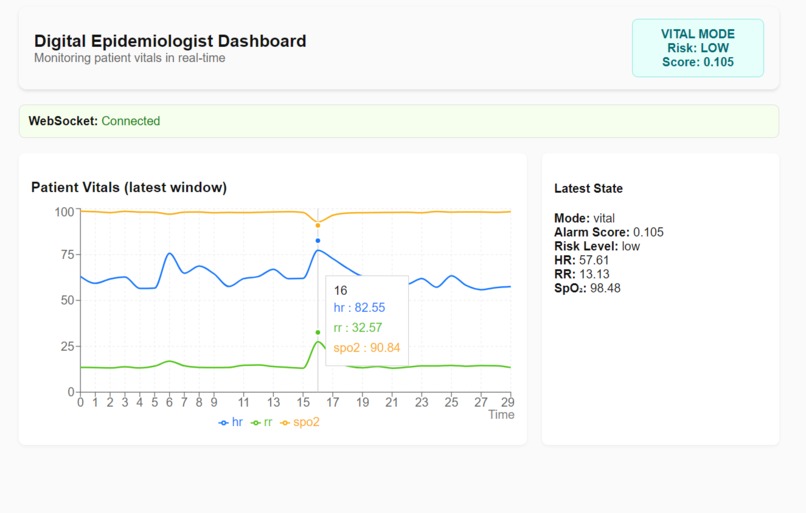
Front Page
-
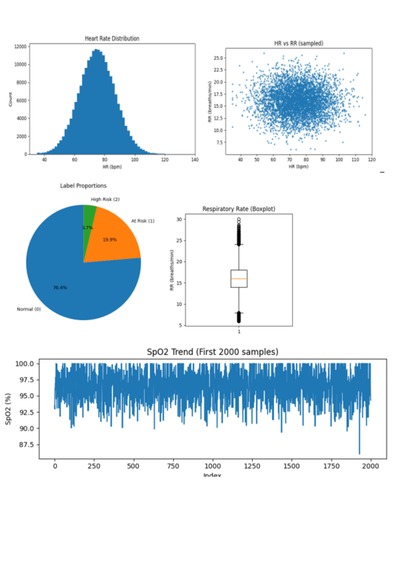
Visualisation
-
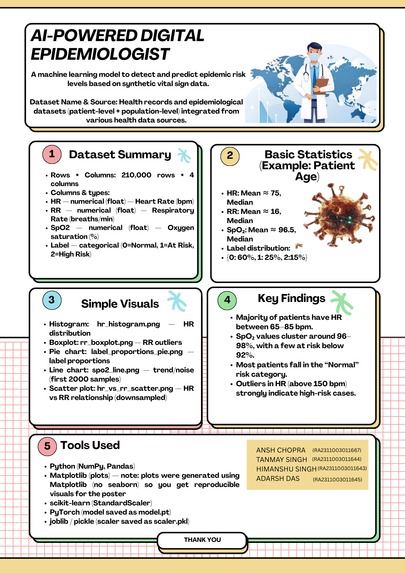
Poster


About the project
Inspiration
The COVID-19 pandemic and other global outbreaks revealed the critical need for advanced tools that can predict and analyze the spread of epidemics in real-time. Traditional epidemiological models often rely on static data and lack adaptability to rapidly changing conditions. This inspired me to build an AI-powered digital epidemiologist that uses synthetic health data, machine learning, and natural language processing (NLP) to simulate, monitor, and analyze epidemic dynamics dynamically. The goal was to empower researchers and health officials with actionable insights, enabling faster, more informed decisions to contain outbreaks.
What it does
This project is an intelligent tool that:
- Simulates epidemic spread patterns using synthetic population health data.
- Applies AI models to predict future infection rates and hotspots.
- Leverages NLP to extract and analyze relevant information from health reports, news, and research articles.
- Provides interactive dashboards with real-time visualizations of epidemic trends.
- Helps researchers understand disease dynamics and evaluate intervention strategies.
How I built it
- Data Simulation: I created synthetic datasets simulating population demographics and infection transmission using agent-based modeling techniques.
- AI Modeling: Implemented machine learning models such as SEIR (Susceptible-Exposed-Infectious-Recovered) extensions, trained on simulated data, using Python libraries like TensorFlow and Scikit-learn.
- NLP Pipeline: Used spaCy and HuggingFace Transformers to extract key insights from textual health data sources, enabling semantic understanding of outbreak-related content.
- Visualization: Built an interactive dashboard using Plotly Dash and React.js to visualize epidemic curves, heatmaps, and predictive analytics.
- Deployment: Containerized the application with Docker and deployed it on AWS to ensure scalability and accessibility.
Challenges I ran into
- Data Scarcity: Real epidemic data is often incomplete or delayed, so generating realistic synthetic data required careful calibration of simulation parameters.
- Model Complexity: Balancing model accuracy and computational efficiency was difficult, especially when extending classical epidemiological models with AI components.
- NLP Integration: Extracting meaningful information from unstructured text sources posed challenges related to noise, ambiguity, and domain-specific terminology.
- Real-time Visualization: Ensuring the dashboard updates smoothly with new predictions without performance lag required optimization of both backend APIs and frontend rendering.
Accomplishments that I'm proud of
- Successfully combined classical epidemiological models with modern AI and NLP techniques into a unified tool.
- Developed a modular pipeline that can be extended to new diseases or adapted for different geographic regions.
- Created visually compelling dashboards that clearly communicate complex data to diverse audiences.
- Demonstrated the ability of synthetic data-driven AI models to provide useful epidemic forecasts in the absence of complete real-world data.
What I learned
- The importance of synthetic data and simulation in overcoming real-world data limitations.
- How to integrate multi-disciplinary techniques including epidemiology, machine learning, and natural language processing.
- Best practices for designing interactive, real-time data visualizations that support decision-making.
- The challenges and nuances of deploying AI systems in sensitive domains like public health.
What's next for AI Powered Digital Epidemiologist
- Incorporate real-time data feeds from health agencies and IoT devices to improve prediction accuracy.
- Enhance NLP capabilities with domain-adapted language models specialized in epidemiology.
- Expand the tool to support multi-disease modeling and co-infection scenarios.
- Develop mobile applications for health workers to collect data and receive outbreak alerts in the field.
- Collaborate with public health institutions to validate and refine models using real outbreak data.

Log in or sign up for Devpost to join the conversation.