-
-
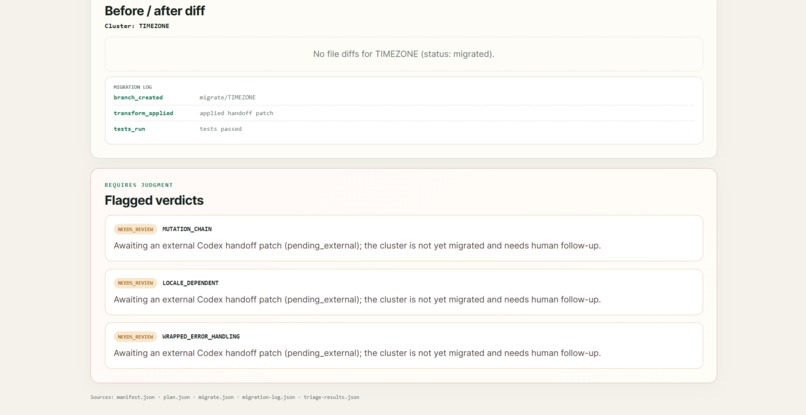
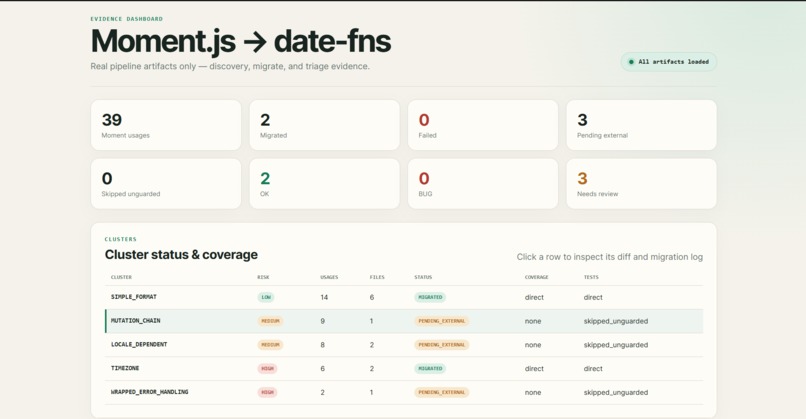
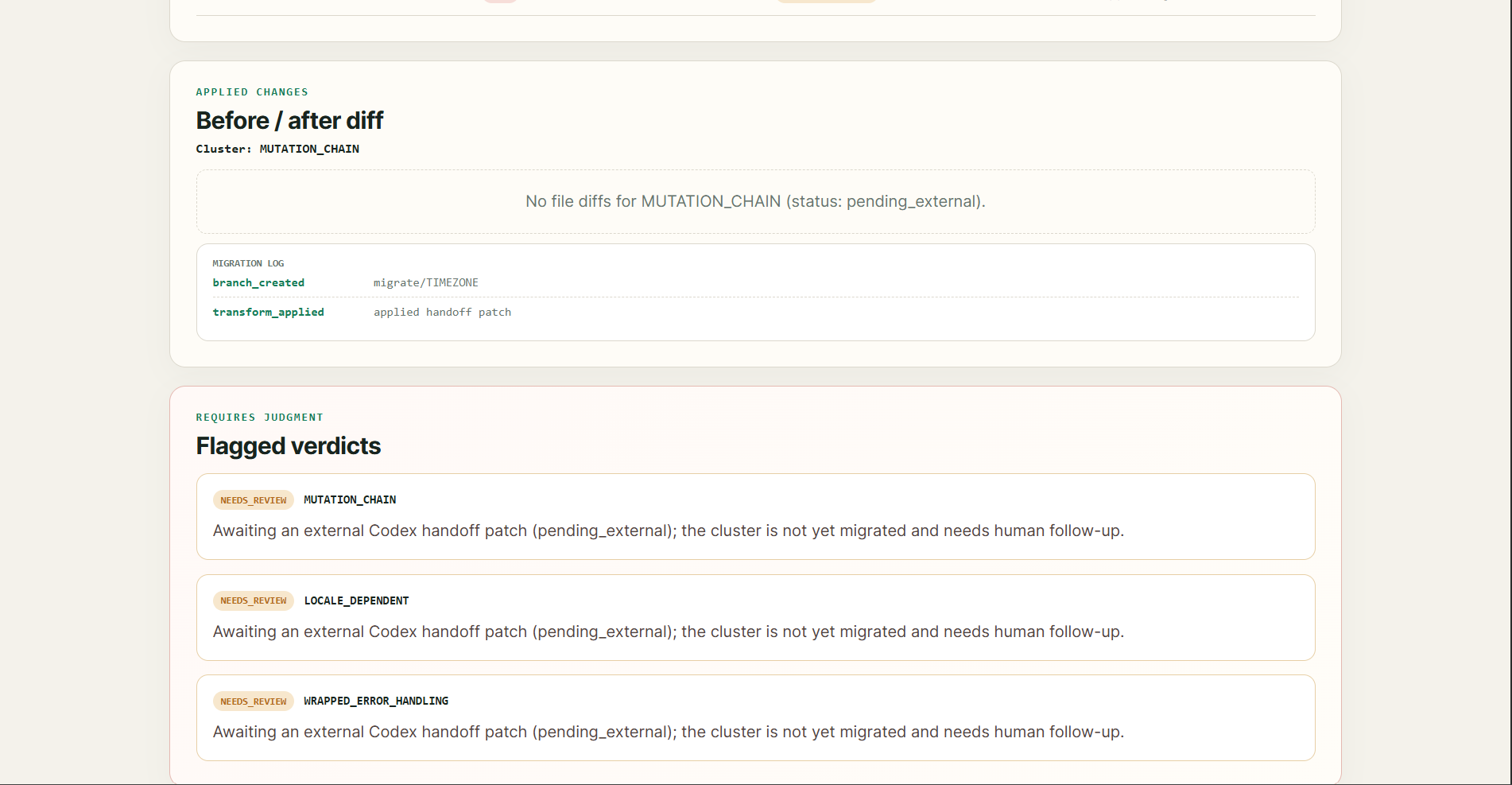
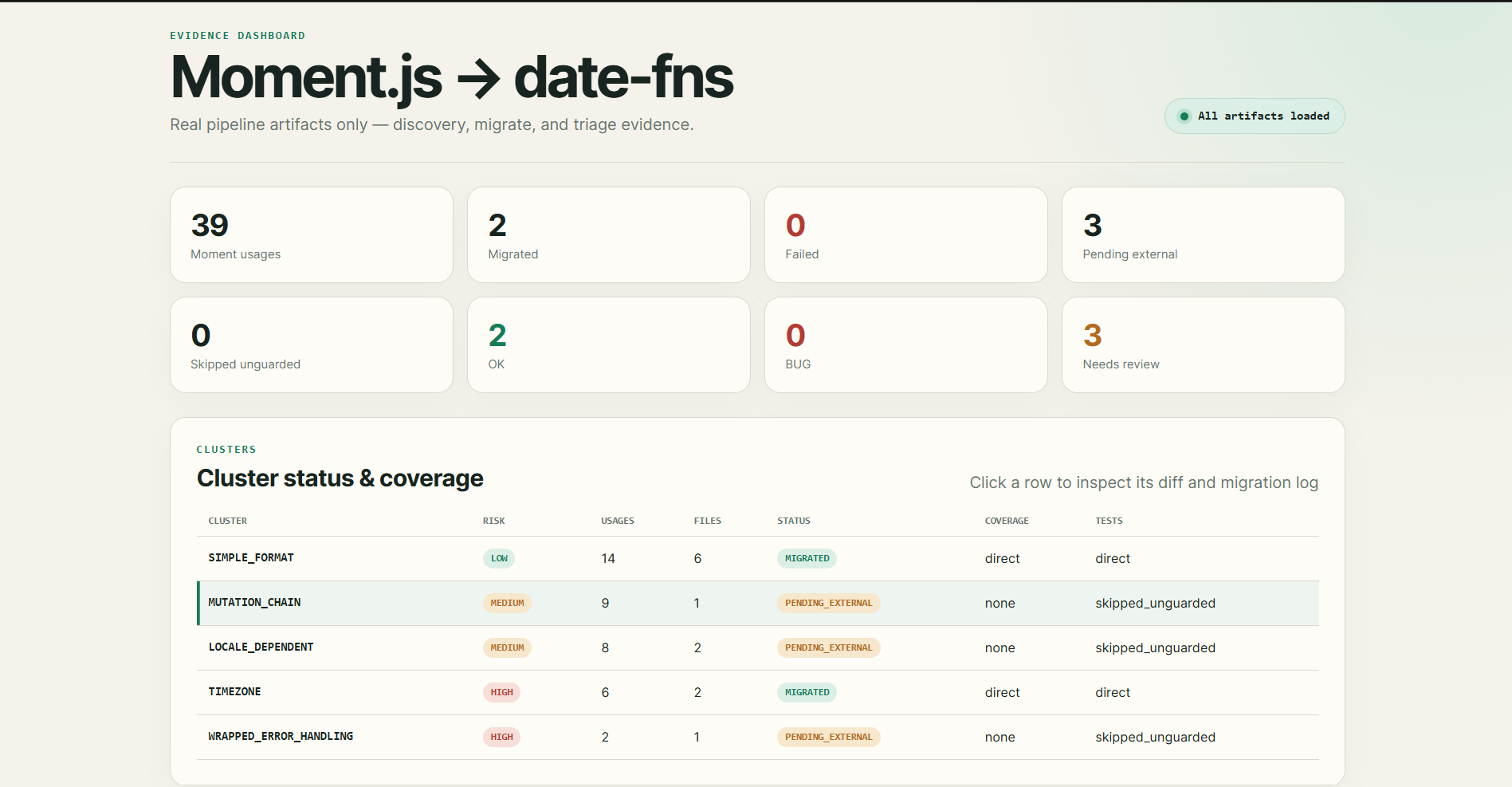
MUTATION_CHAIN Selected
-

MUTATION_CHAIN Details & Flagged Verdicts
-
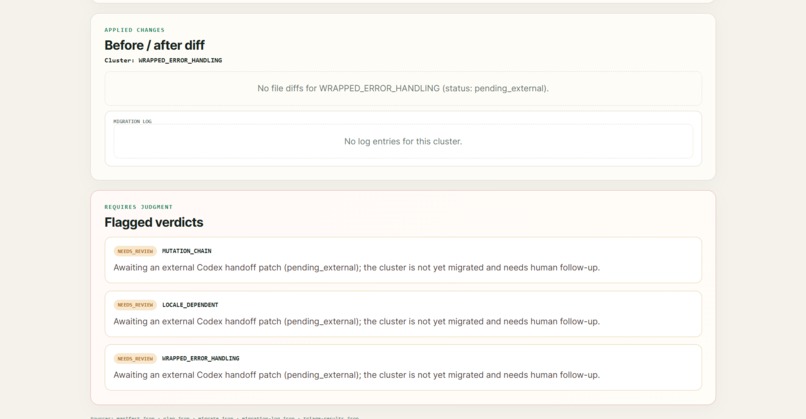
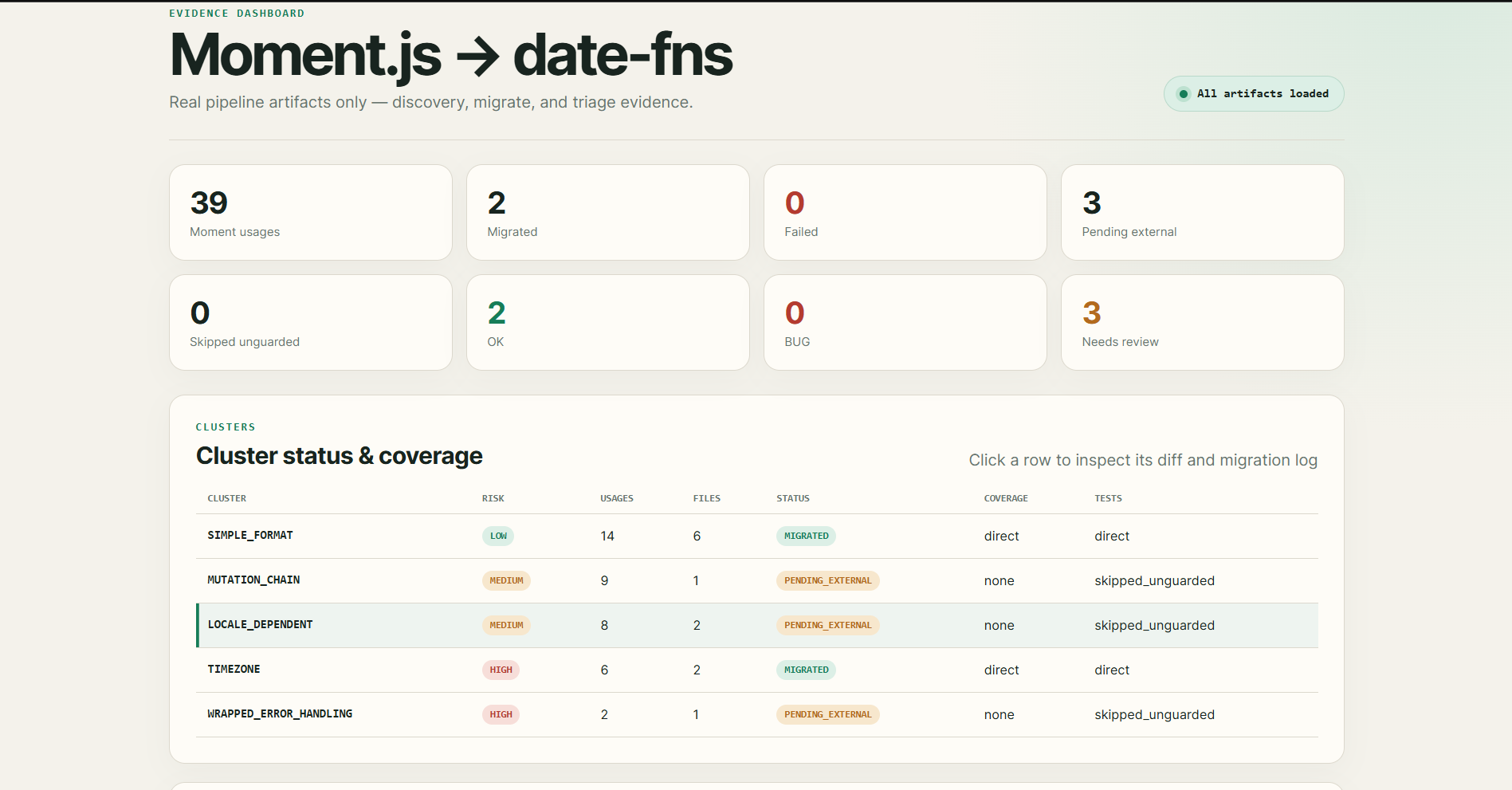
Overview Dashboard & Cluster Table
-
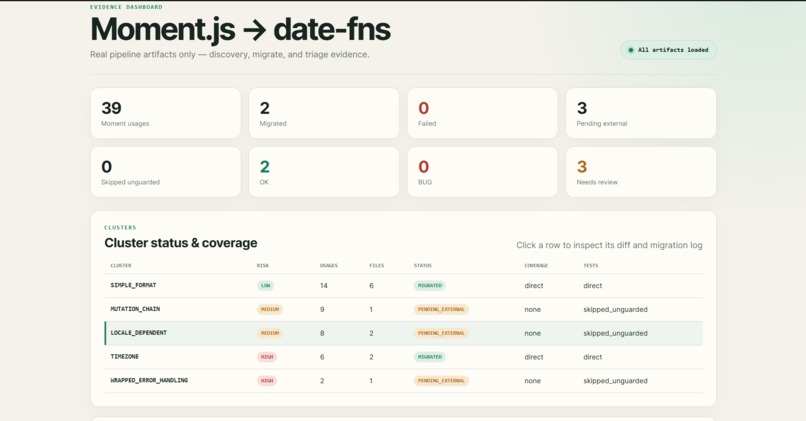
Overview Dashboard & Cluster Table
-
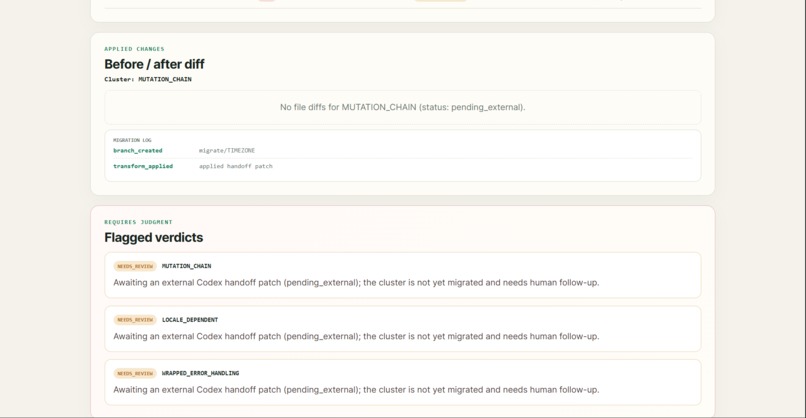
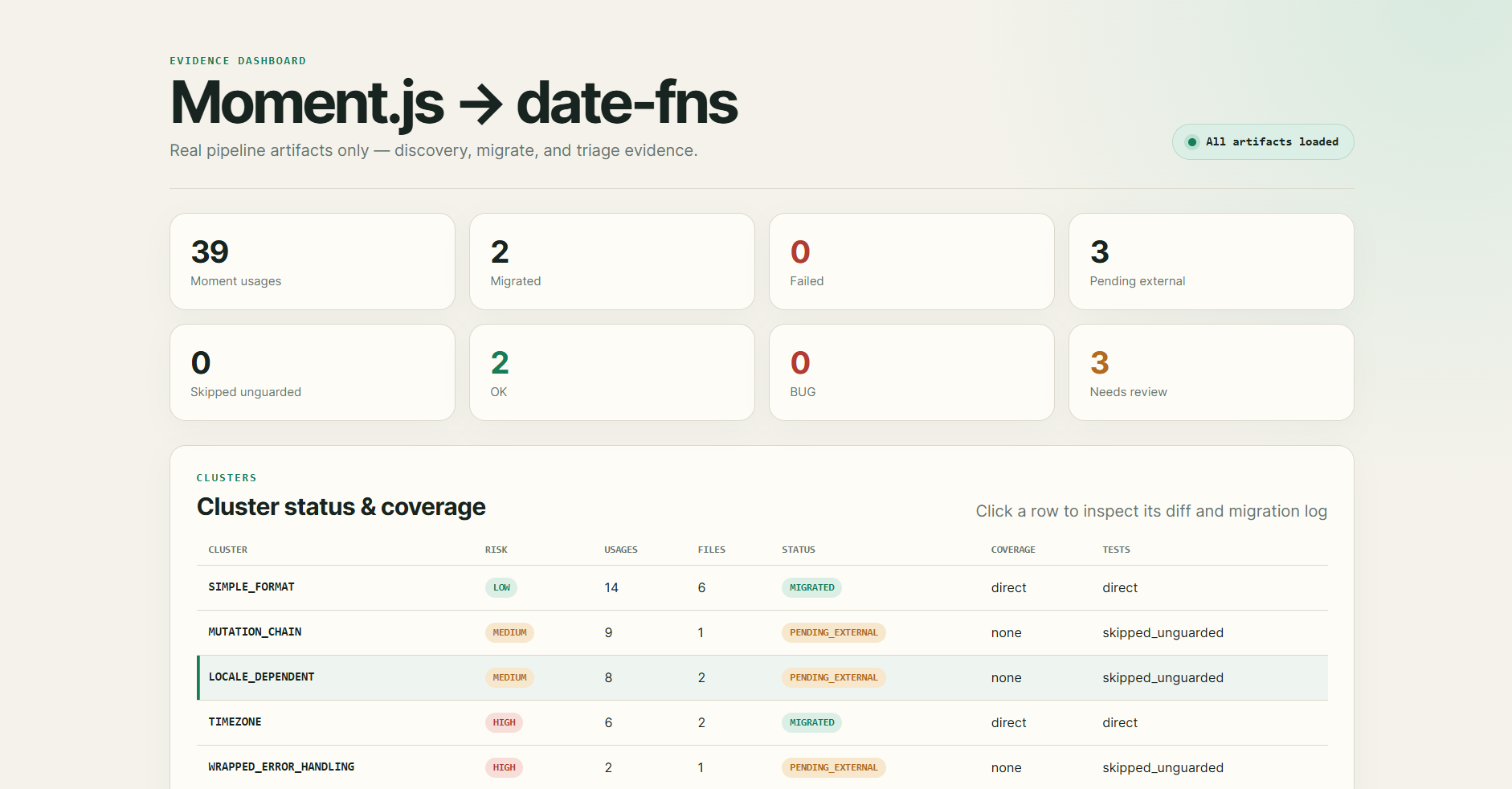
LOCALE_DEPENDENT Selected
-
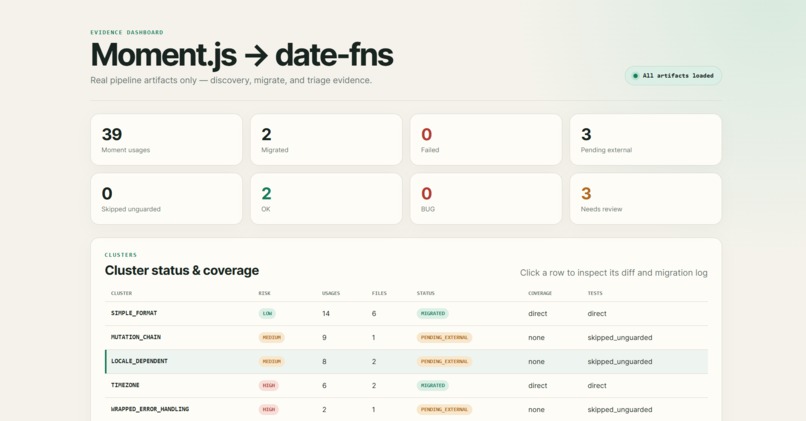
LOCALE_DEPENDENT Details & Flagged Verdicts
-
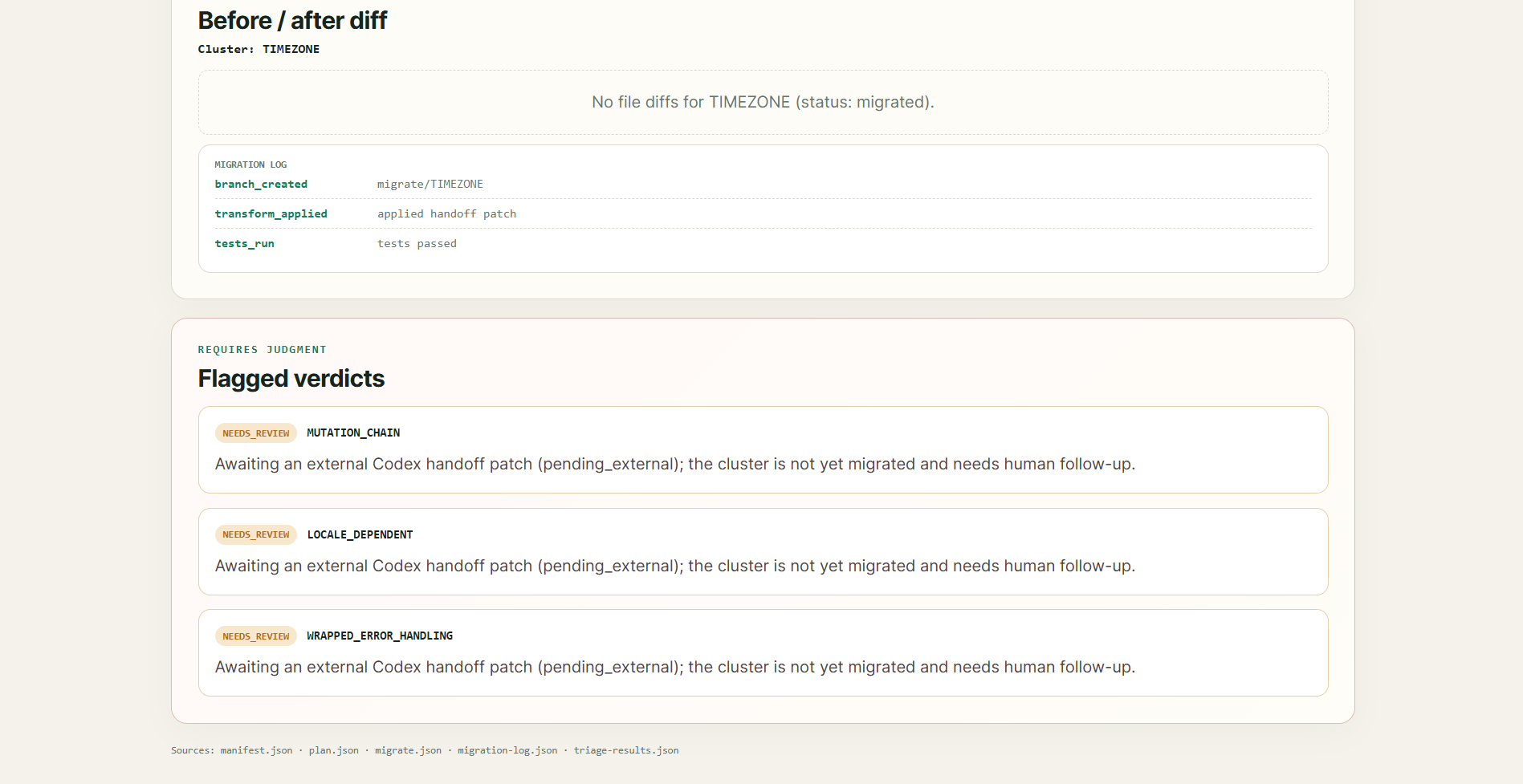
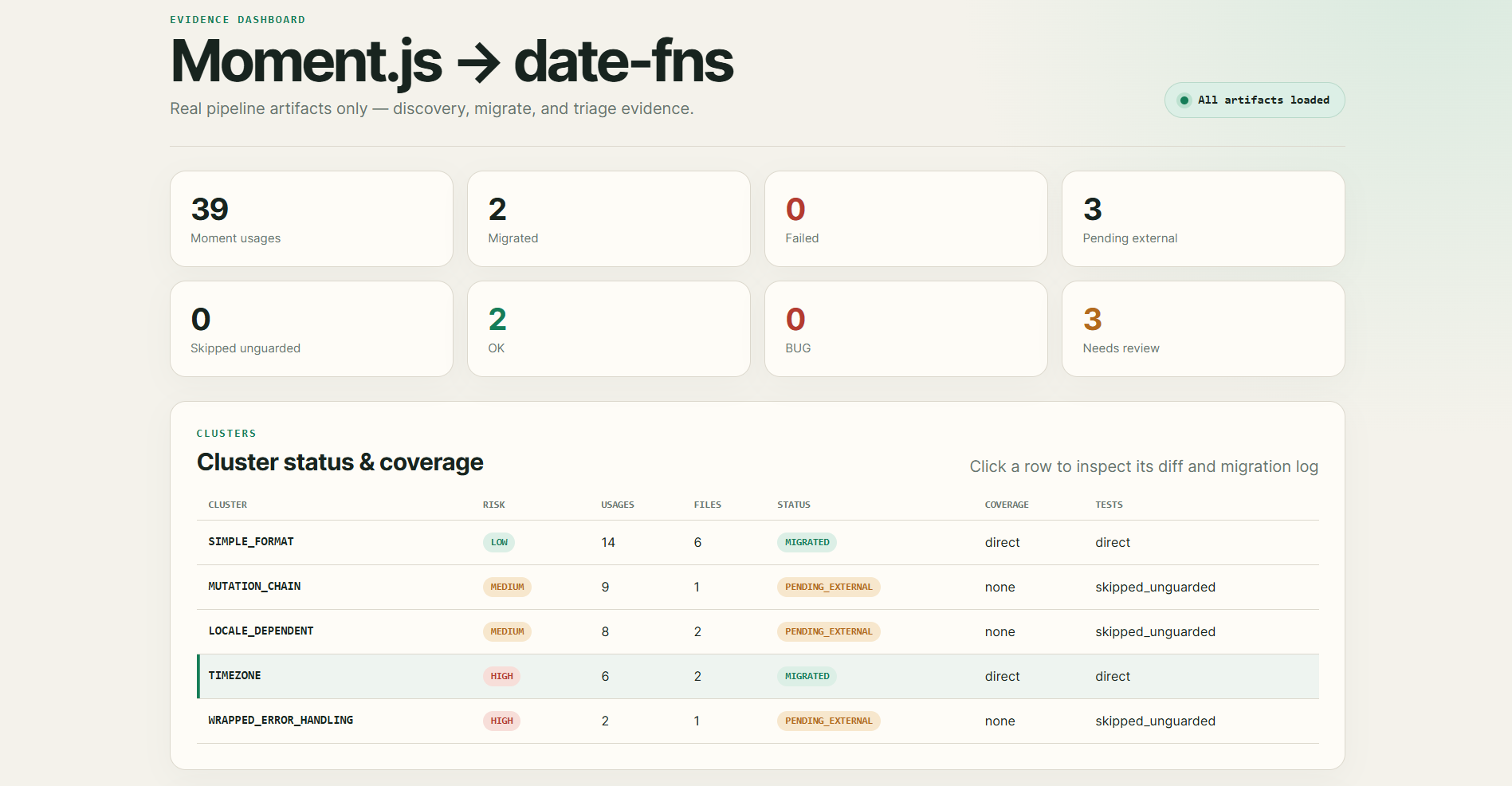
TIMEZONE Selected
-
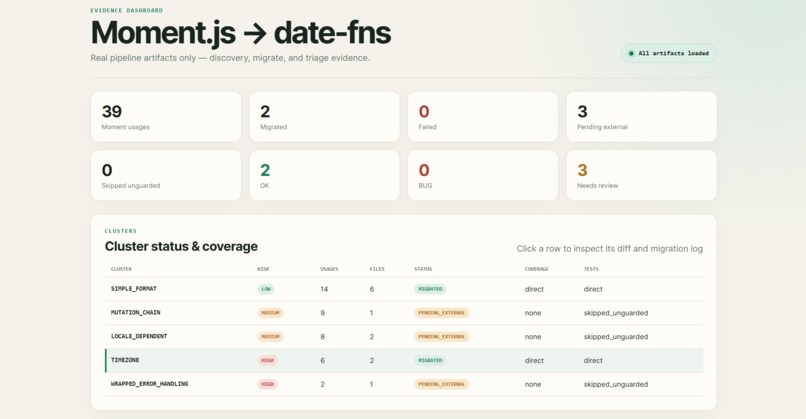
TIMEZONE Details & Test Logs
-
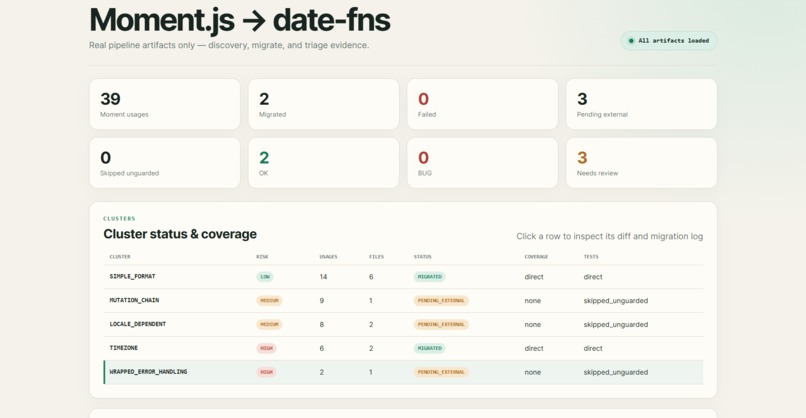
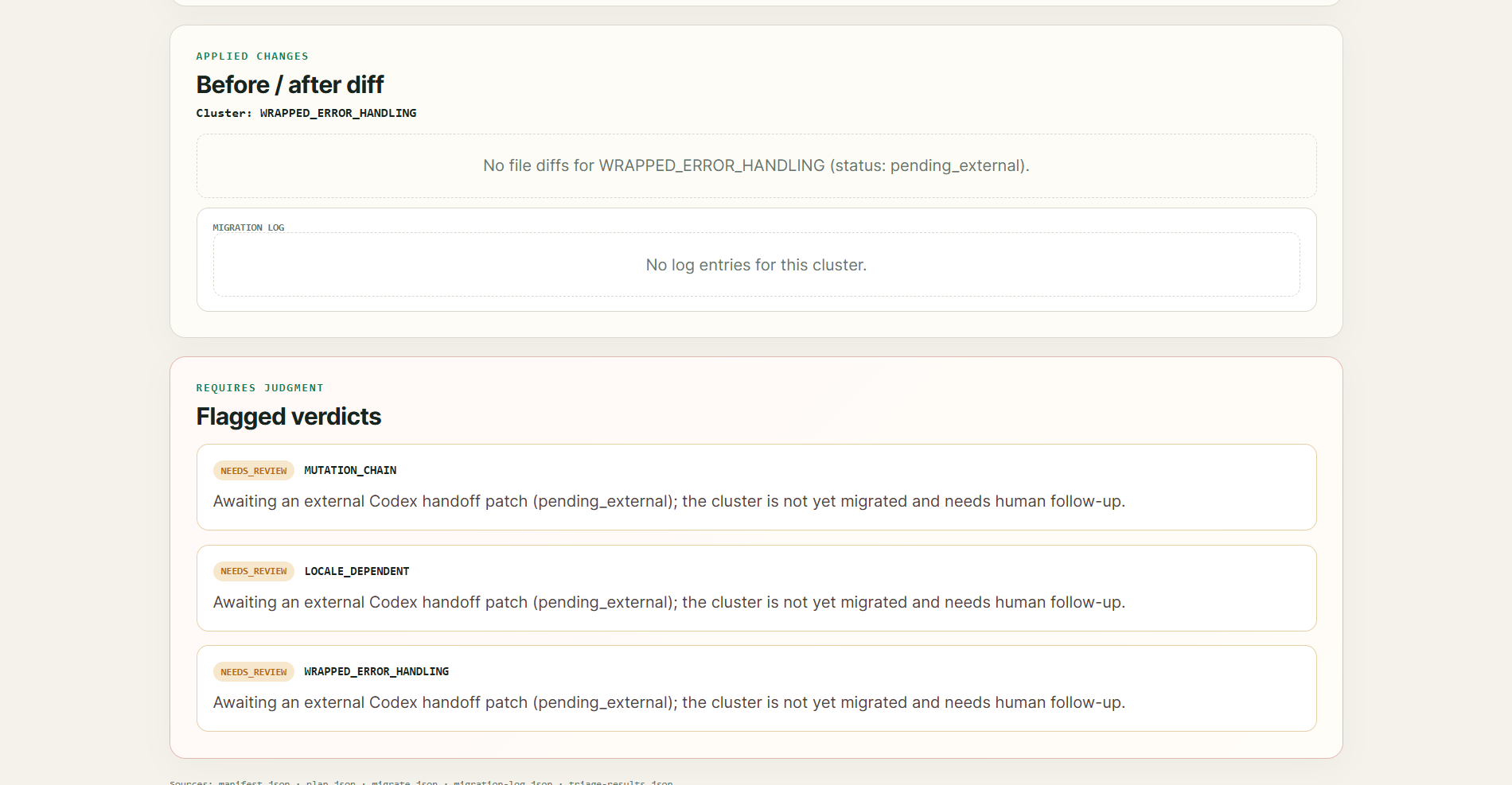
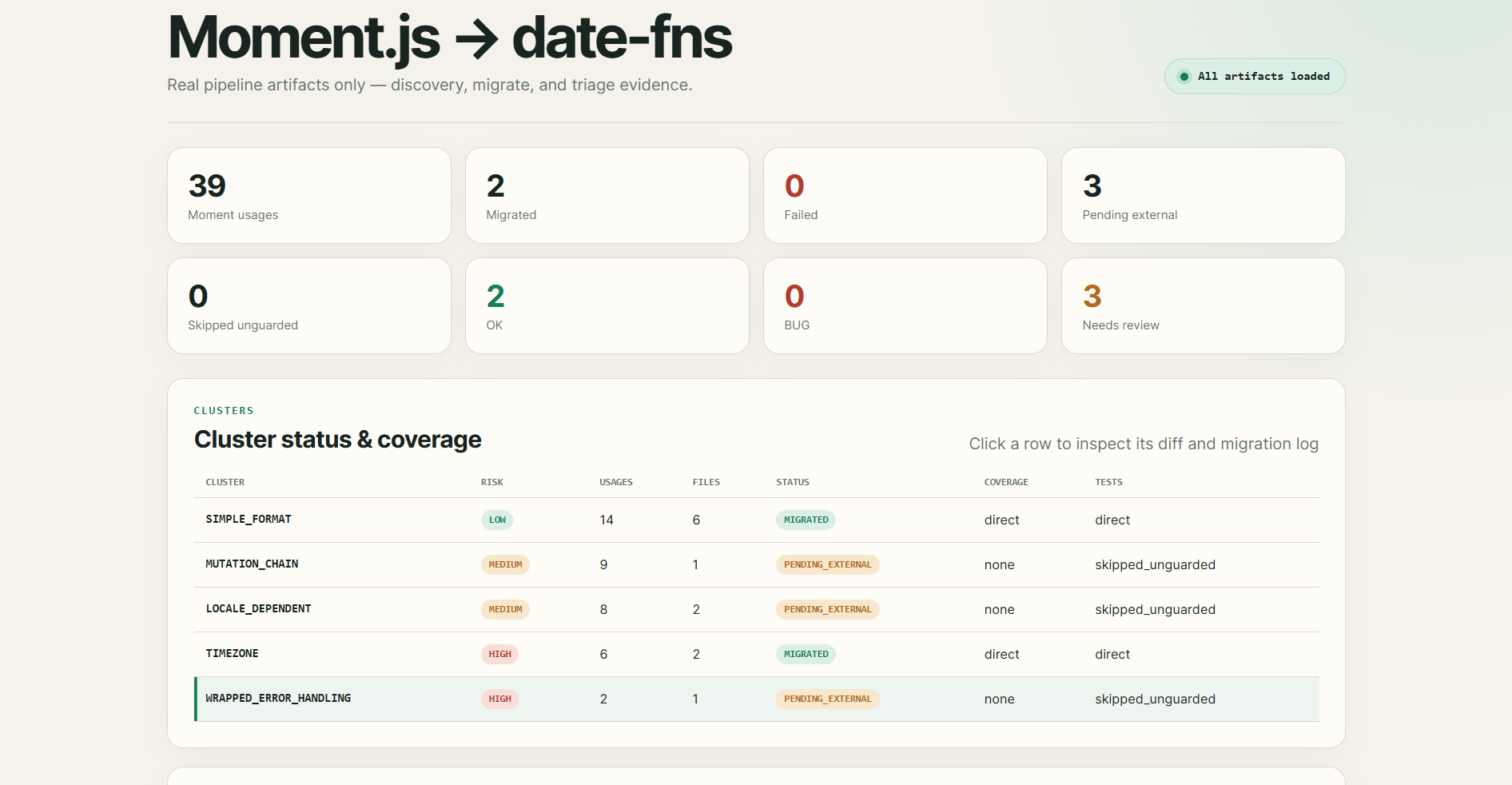
WRAPPED_ERROR_HANDLING Selected

Inspiration
Engineers spend an inordinate amount of time fighting tech debt. Updating outdated frameworks, refactoring fragile error handling, and converting synchronous legacy patterns into modern asynchronous standards are necessary tasks—yet they are manually exhausting and prone to human error.
The idea behind Legacy Migration Agent was born from a simple question: What if we could automate the heavy lifting of codebase refactoring with compiler-level precision? Instead of relying on risky search-and-replace scripts or tedious manual updates, we set out to build an intelligent system capable of parsing legacy code structures and safely transforming them into clean, modern, production-ready standards
What it does
What it does Legacy Migration Agent is an automated code modernization tool that safely refactors outdated codebases using compiler-level precision. Rather than relying on fragile text searches or manual rewrites, it analyzes Abstract Syntax Trees (ASTs) to execute deterministic, safe code transformations.
AST-Powered Refactoring: Parses legacy JavaScript and TypeScript codebases into syntax trees to perform accurate, scope-aware code transformations without altering business logic or breaking runtime contracts.
Targeted Migration Passes: Runs automated, modular refactoring passes to modernize specific patterns:
Error Handling: Wraps floating promises, unhandled rejections, and unsafe synchronous expressions in robust error-handling logic.
Timezone & Locale Standardization: Converts rigid, localized date/time routines into global, timezone-aware standards.
Code Simplification: Modernizes outdated module imports, eliminates redundant mutation chains, and updates legacy syntax.
Mathematical Complexity Verification: Calculates Cyclomatic Complexity (C=E−N+2P) before and after transformations to mathematically verify that refactoring passes actively reduce technical debt (ΔC>0).
Developer-Friendly Output: Generates clean, idiomatic, and human-readable code that aligns with modern engineering standards and can be directly committed to production repositories.
How we built it
The Legacy Migration Agent was built as an automated transformation engine capable of analyzing and mutating Abstract Syntax Trees (ASTs).
AST Parsing & Transformation: Built on a Node.js architecture utilizing modern parser tools (@babel/parser, @babel/traverse, and @babel/generator) to inspect legacy JavaScript/TypeScript code at the syntax node level.
Targeted Migration Passes: Designed modular migration pipelines that execute sequential pass transformations, addressing specific refactoring categories:
Error Wrapping: Wrapping floating promise calls and unsafe expressions in robust error handlers.
Timezone & Locale Standardization: Converting localized date handling routines to global, timezone-aware standards.
Code Simplification & Formatting: Eliminating redundant mutation chains and standardizing module imports.
Automated Verification: Integrated with testing workflows to guarantee that code mutations maintain functional equivalence before and after transformation.
Challenges we ran into
Preserving Runtime SemanticsManipulating AST nodes directly carries the risk of altering code execution order or scope bindings. A major challenge was ensuring that automated refactoring didn't introduce subtle side effects into business logic.Complex AST Edge CasesCodebases evolve organically and often contain non-standard syntax patterns. We had to build AST visitors capable of handling nested conditional branches and unwieldy error handling structures gracefully.Quantifying Complexity & RiskWe modeled code complexity to evaluate whether a proposed AST refactoring actually simplified the codebase. We used Cyclomatic Complexity ($C$) to measure structural improvement across control flow nodes ($E$ edges, $N$ nodes, and $P$ connected components):$$C = E - N + 2P$$Ensuring that $\Delta C = C_{\text{legacy}} - C_{\text{modern}} > 0$ allowed us to mathematically verify that our refactoring passes reduced overall code complexity without breaking runtime contracts.
Accomplishments that we're proud of
Compiler-Level Precision: Successfully implemented an Abstract Syntax Tree (AST) mutation engine using @babel/traverse that safely refactors code at the syntax level rather than relying on brittle, regex-based text replacements.Multi-Pass Migration Pipeline: Built a modular architecture capable of running isolated, deterministic refactoring passes—including automatic error wrapping, timezone standardization, and mutation chain simplification—without corrupting scope or runtime contracts.Mathematical Complexity Verification: Established an automated evaluation model based on Cyclomatic Complexity ($C = E - N + 2P$) to mathematically verify that every migration pass genuinely reduces technical debt ($\Delta C > 0$).Developer-Friendly Output: Configured high-fidelity AST generation (@babel/generator) to output clean, idiomatic JavaScript/TypeScript that developers can inspect, understand, and trust in production
What we learned
Deep AST & Scope Mechanics: Mastered AST node manipulation, binding tracking, and reference rewriting, learning how subtle changes to parent-child node structures impact execution flow.
Atomic Refactoring Strategy: Realized that breaking complex code migrations down into small, deterministic, single-responsibility transformation passes is far safer than attempting monolithic single-pass rewrites.
Trust Through Readability: Learned that automated code generation is only effective if the output matches team coding standards and maintains human readability.
What's next for AI-Powered Dependency Analyzer
Multi-Language AST Support: Expand the parsing and transformation pipeline beyond JavaScript and TypeScript to support legacy Python, Java, and C# codebases.
LLM & AST Hybrid Engine: Pair deterministic AST transformations with Large Language Models to intelligently resolve ambiguous logic, legacy framework API changes, and complex control flow rewrites.
CI/CD & GitHub Action Integration: Build automated PR reviewers and GitHub Actions that scan incoming pull requests, identify legacy technical debt, and offer automated one-click fix suggestions.
Zero-Breakage Test Generation: Automatically construct unit and integration test suites prior to executing migrations to guarantee 100% functional equivalence before and after refactoring.
Built With
- ast
- babel
- babel-generator
- babel-parser
- babel-traverse
- babel-types
- code-analysis
- code-modernization
- git
- javascript
- jest
- latex
- markdown
- node.js
- npm
- refactoring-tool
- static-analysis
- typescript


Log in or sign up for Devpost to join the conversation.