-
-
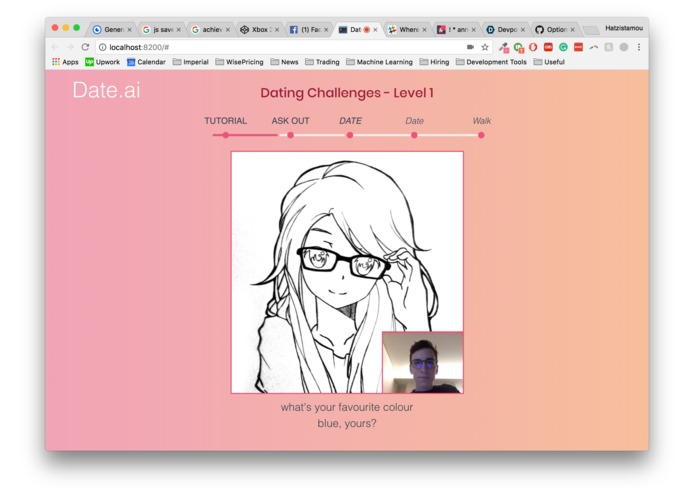
Live Conversation Screen
-
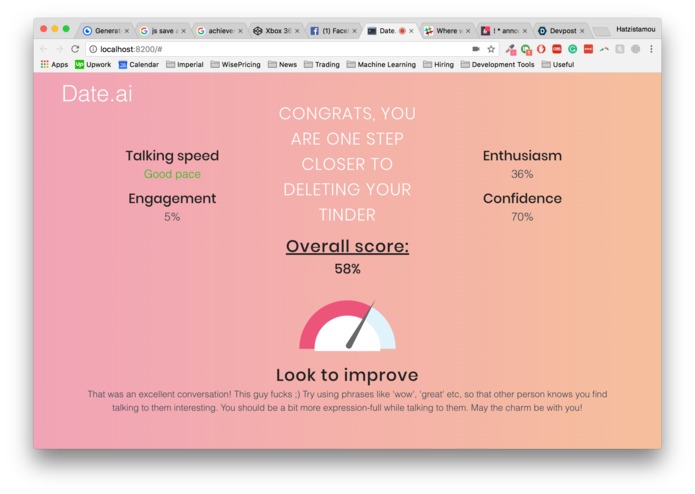
Analysis Screen

Digitilization of dating with tinder, bumble etc is killing real life romance. Men and women suffer from approach anxiety, gynephobia and general lack of confidence when it comes to approaching the opposite gender.
Being Imperial students and computer science nerds, we could relate to this problem as much as anyone. And we wanted to help others just as much as we wanted to help ourselves here.
Our team consists of a first year Electronic and Electrical Engineering student and two MSc Computing (Machine Learning) students. Our team was formed through the #teamforming channel set up by the brilliant ICHack team on Slack.
After brainstorming many ideas, we settled on a Web platform to allow people to overcome approach anxiety and fast-track into the sheets. We call it the "AI Powered Date Simulator."
The inputs we are using are audio and video from the laptop/mobile webcam and microphone. By integrating with a modified version of the Cleverbot api, and then using Microsoft Cognitive Services for textual and visual analysis, we were able to engage with the user and have a simulated conversation. This simulation best tries to represent various scenarios that you would often encounter when approaching the opposite gender in real life.
Once the conversation is over, we blend the Microsoft Cognitive Services API with our own custom machine learning models to analyse video and audio feed and provide feedback to the user. The video feed is converted to series of images to which we apply emotion recognition. The audio feed is converted to text to which we apply text based sentiment analysis.
Using these output, we are able to provide a extensive feedback to the user not limited to (limited for the time being):
- Speed - We count the words per minute and let the user know if they are talking too fast or slow.
- Filler words - We alert the user when they are using filler words such as "umm", "like" etc.
- Engagingness - We use the video feed to run emotional recognition and let the user know how engaging they are being.
- Enthusiasm - Based on words that user is speaking (textual analysis), we determine if he would strike as enthusiastic/disinerested listener
- Confidence - We determine from the screenshots captured from the user whether they are feeling nervous.
Using all the quantitative features above, a score and feedback advice is generated which helps the user to better prepare for 'tindeavours' in life.
Built With
- bing-tts
- cleverbot-api
- emotion-recognition
- flask
- html
- javascript
- microphone
- microsoft-cognitive-services
- microsoft-cognitive-services-(emotion-recognition
- python
- speech-recognition
- text-based-sentiment-analysis
- text-based-sentiment-analysis-and-speech-recognition)
- webcam


Log in or sign up for Devpost to join the conversation.