-
-
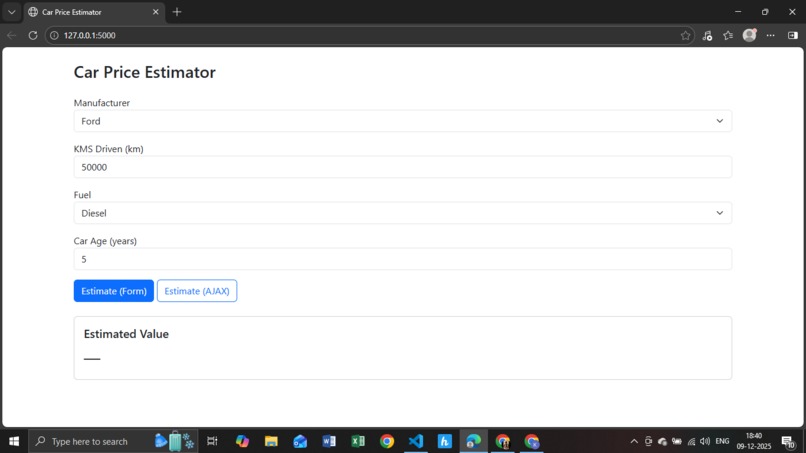
Car Price Estimator – User Input Interface
-
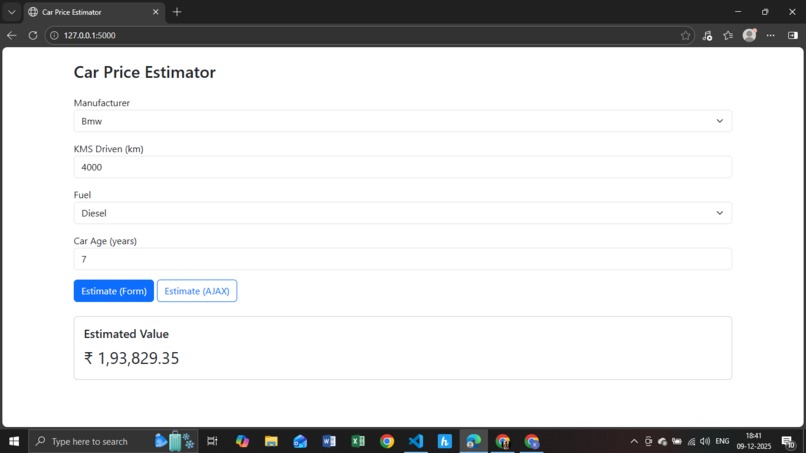
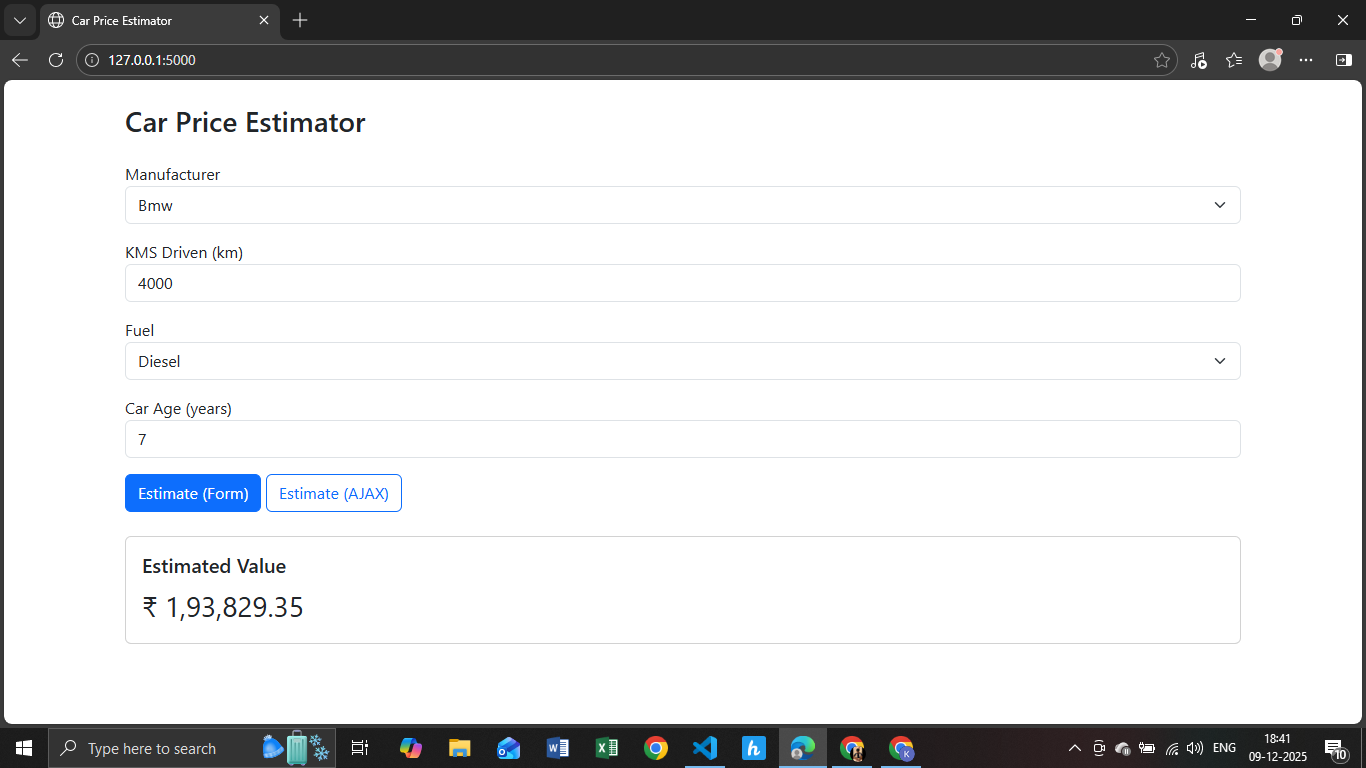
Real-Time Price Prediction Output
-
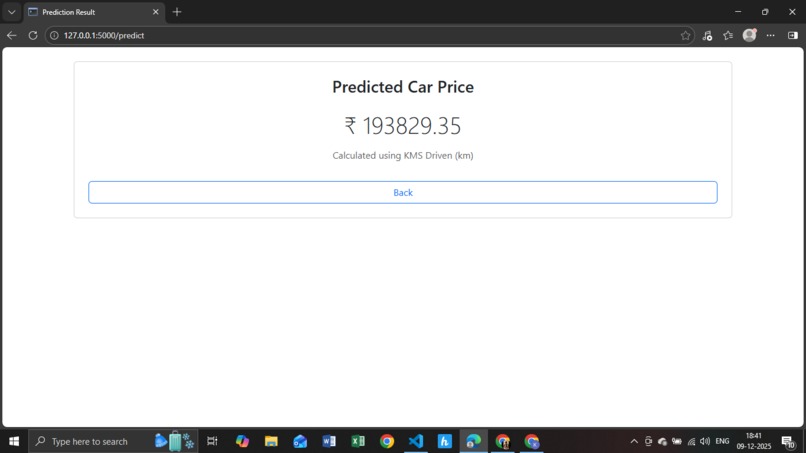
Prediction Result Page


Inspiration
Buying or selling a used car often involves uncertainty, subjective judgments, and inconsistent pricing across platforms. During our research, we observed that many buyers overpay due to lack of price transparency, while sellers struggle to determine a fair market value. This motivated us to build an AI-driven system that can estimate car prices objectively using historical data and machine learning, making the decision-making process more data-driven and reliable.
What it does
The AI-Powered Car Price Prediction Web App predicts the estimated market price of a used car based on essential vehicle attributes such as brand, model year, fuel type, transmission type, and kilometers driven. Users input car details through a simple web interface, and the application instantly returns a predicted price generated by a trained machine learning model.
How we built it
We started by collecting and cleaning a real-world used car dataset. Data preprocessing included handling missing values, encoding categorical variables, and scaling numerical features. We trained and evaluated multiple regression models and selected the most accurate one based on performance metrics.
The final model was serialized using pickle and integrated into a Flask-based backend. A clean HTML/CSS frontend was developed to collect user inputs and display predictions. The complete pipeline—from data preprocessing to deployment—was implemented as a single end-to-end web application.
Challenges we ran into
One of the main challenges was handling categorical features such as car brand and fuel type while maintaining model accuracy. Ensuring consistency between training-time preprocessing and real-time user inputs was another critical challenge. Additionally, balancing prediction accuracy with simplicity and interpretability required careful model selection and tuning.
Accomplishments that we're proud of
Built a complete end-to-end machine learning web application
Achieved reliable price predictions using real-world data
Successfully deployed the model into a user-friendly Flask web app
Published research work based on this project, validating its academic value
What we learned
This project strengthened our understanding of machine learning pipelines, feature engineering, and model deployment. We gained hands-on experience in integrating ML models into production-ready web applications and learned the importance of clean data and consistent preprocessing for real-world AI systems.
What's next for AI-Powered Car Price Prediction Web App
Future improvements include integrating real-time car listing data, adding advanced ensemble models, improving UI/UX, and extending the system to compare predicted prices with listings across multiple platforms. We also plan to enhance explainability to show users which features influence the price prediction the most.

Log in or sign up for Devpost to join the conversation.