AI-Powered Bid & Proposal Response Engine
A working prototype for CUST Hackathon 2026 — Procurement, Sourcing & Contract Management track.
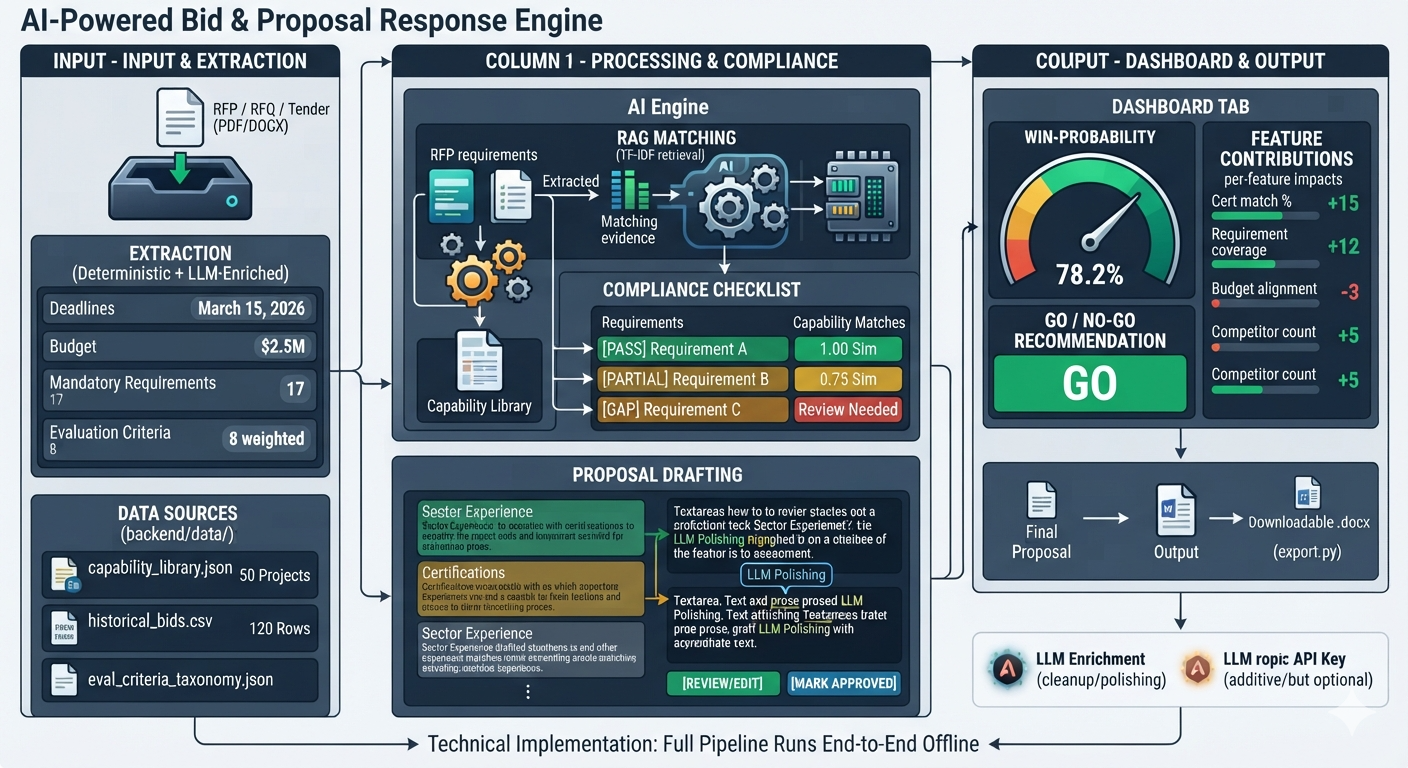
Ingests an RFP/RFQ/Tender (PDF/DOCX), extracts mandatory requirements, deadlines, budget and evaluation criteria, matches them against a Company Capability Library via RAG, drafts a structured proposal response, flags compliance gaps, and scores the opportunity's win-probability with a GO / NO-GO recommendation.
Quick start
cd backend
pip install -r requirements.txt --break-system-packages   # if needed
uvicorn app:app --reload --port 8000
Open http://localhost:8000 in a browser. A demo workspace ("PITB ICMS - District Case Management") is already loaded with the included sample RFP so you can explore the full pipeline immediately -- or click New RFP workspace and upload your own PDF/DOCX.
Optional: enable LLM enrichment
Set ANTHROPIC_API_KEY before starting the server to turn on:
- LLM-based cleanup / labeling of extracted requirements
- LLM-polished proposal draft prose
export ANTHROPIC_API_KEY=sk-ant-...
uvicorn app:app --reload --port 8000
Without a key, everything still works end-to-end using the deterministic rule-based extraction, TF-IDF RAG matching, and template-based drafting -- the demo never breaks due to missing connectivity.
Architecture
sample RFP (PDF/DOCX)
        |
        v
 extraction.py   --  regex/NER-lite: deadlines, budget, mandatory
        |             requirements, evaluation criteria, Q&A sections
        |             (+ optional Claude enrichment)
        v
   rag.py        --  TF-IDF retrieval over capability_library.json
        |             -> compliance checklist (pass / partial / gap)
        v
 analysis.py     --  derives win-probability model features
        |             (cert match %, requirement coverage,
        |              budget alignment, competitor count, ...)
        v
 scoring.py      --  logistic regression trained on historical_bids.csv
        |             (120 past bids) -> win probability + GO/NO-GO
        v
 proposal.py     --  drafts each Q&A section using matched evidence
        |             (+ optional Claude polishing)
        v
   export.py     --  assembles everything into a downloadable .docx
        |
        v
   app.py (FastAPI) + frontend/ (vanilla HTML/CSS/JS SPA)
Data (backend/data/)
| File | Description |
|---|---|
capability_library.json |
50 past-project records (sector, certs, contract value, client type) |
historical_bids.csv |
120 rows x 18 cols of win/loss outcomes used to train the scoring model |
eval_criteria_taxonomy.json |
15 common RFP evaluation criteria by sector |
generate_data.py / generate_sample_rfp.py |
regenerate the sample datasets / sample RFP |
Sample RFP
sample_rfps/PITB_ICMS_RFP_2026.docx -- a realistic IT-services tender
(17 mandatory requirements, 8 weighted evaluation criteria, 5 Q&A
sections, deadlines and budget figures) used to demo the full pipeline.
Mapping to deliverables
- Working prototype accepting a sample RFP -> structured draft response --
proposal.py+ Draft tab - Separate workspace per RFP/RFQ/Tender --
storage.py(one JSON record per workspace) - Auto-generated compliance checklist with pass/fail mapping --
rag.py-> Checklist tab - Win-probability dashboard --
scoring.py-> Dashboard tab, with explainable per-feature contributions - GO / NO-GO decision --
scoring.go_no_go_decision() - Review/edit/approve UI before export -- editable draft textareas + "Mark approved" + .docx export
Mapping to rubric
- Technical implementation -- full pipeline runs end-to-end offline (no external dependency required for the core demo); LLM enrichment is additive, not load-bearing.
- Validation & reliability -- the scoring model reports its own training accuracy (87.5%) and base win rate (63.3%) directly in the UI; the compliance checklist shows similarity scores for every match.
- Innovation -- combines rule-based NER, TF-IDF RAG, and an explainable logistic-regression scoring model with optional LLM enrichment -- degrades gracefully at every layer.
- Feasibility -- entirely Python/FastAPI + vanilla JS, runs on a laptop with no GPU and no mandatory API key.

Log in or sign up for Devpost to join the conversation.