Inspiration
This project was inspired by how invisible problems can cause enormous climate and financial damage. While researching energy efficiency, I discovered that air leaks in both homes and in industrial compressed air systems are responsible for vast amounts of wasted energy, yet they are rarely monitored continuously.
Industries rely heavily on compressed air, but leaks often go unnoticed for months. Similarly, in homes, heating and cooling losses quietly increase energy bills and carbon emissions. What struck me most was that the technology to detect these leaks already exists, but it is typically used manually, infrequently, and only by specialists. This gap between available technology and real-world usage motivated me to explore how AI could make leak detection continuous, accessible, and proactive.
Accomplishments that we're proud of
Through this project, I learned how interdisciplinary effective climate solutions must be. I explored:
- Compressed air systems and why they are extremely energy-intensive
- Ultrasonic acoustics, particularly why air leaks emit sound in the 20–40 kHz range
- Thermal imaging and how temperature anomalies reveal invisible air movement
- How computer vision can be applied to non-RGB data, such as thermal images
- The role of machine learning in anomaly detection and predictive maintenance
I also learned how to translate technical engineering concepts into clear, user-focused solutions, especially when designing for both industrial users and households.
What it does
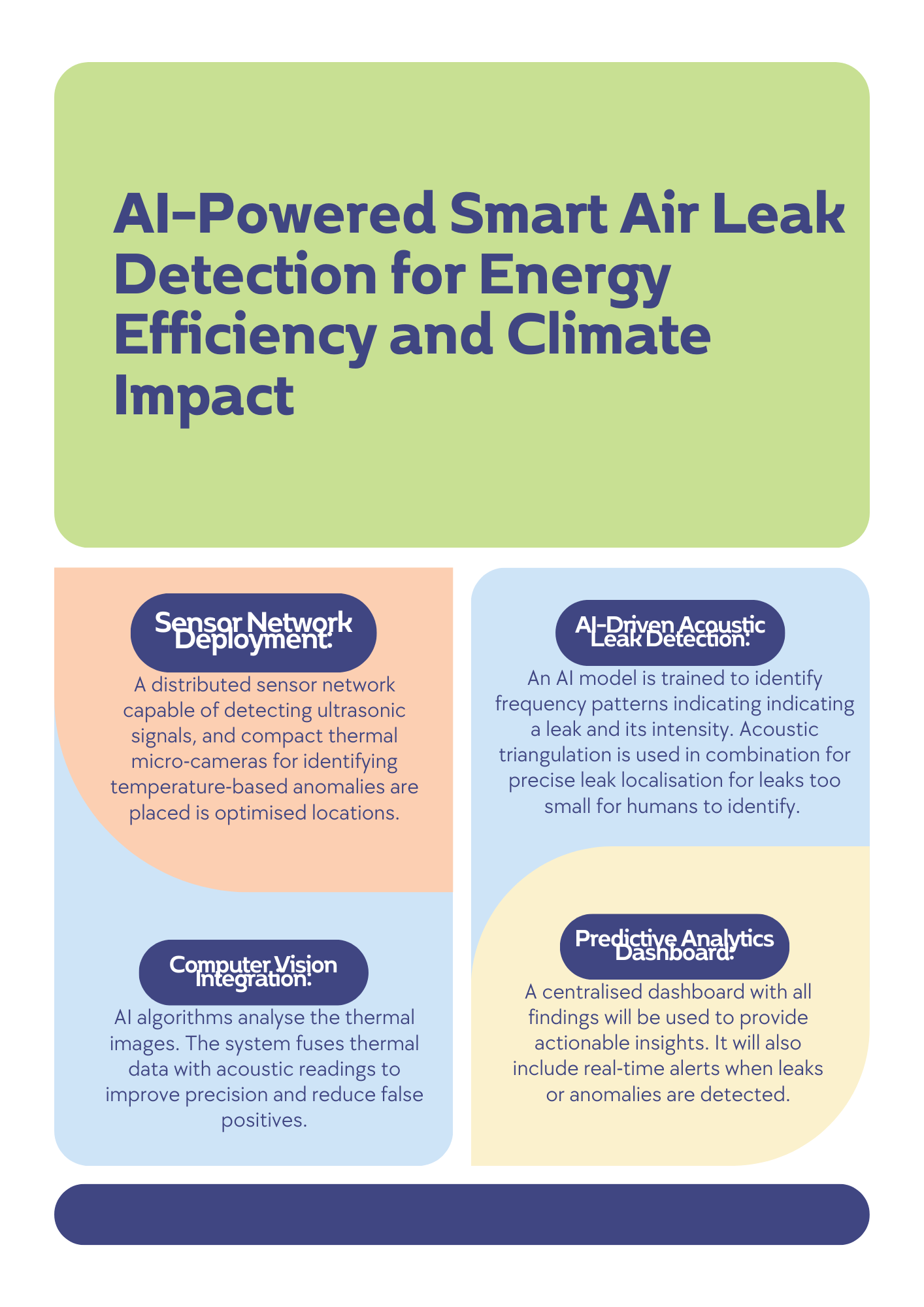
The project was designed as a smart, AI-driven detection ecosystem, rather than a single device.
Sensor Layer
I based the system on existing technologies: ultrasonic acoustic sensors and thermal micro-cameras. These sensors capture sound and temperature data from high-risk leak areas.AI & Data Processing
Machine-learning models analyse:- Ultrasonic frequency patterns
- Temperature anomalies
- Abnormal pressure or flow behaviour
The AI learns baseline system behaviour and flags deviations as potential leaks.
Computer Vision Integration
Thermal images are processed using computer vision techniques to detect heat loss, cold air infiltration, insulation failures, and faulty seals.Analytics & Reporting
A central dashboard translates raw data into insights:- Real-time alerts
- Estimated financial loss per leak
- Carbon impact reduction metrics
- Predictive maintenance recommendations
- Real-time alerts
The system estimates energy loss by calculating the volume of compressed air lost through leaks and multiplying it by the typical energy required to generate compressed air. This enables accurate estimates of financial cost and carbon emissions.”
Challenges we ran into
One of the main challenges was balancing technical accuracy with accessibility. Many reliable sources describe compressed air inefficiencies differently, so I had to be careful not to overstate claims and ensure all figures were defensible.
Another challenge was integrating multiple sensing modalities—acoustic and thermal—into a coherent AI workflow. Each data type behaves differently, and designing a system that fuses them logically required careful reasoning rather than simply stacking technologies.
What we learned
This project showed me how AI can be applied to practical, scalable climate solutions. By targeting inefficiencies that already exist, this system demonstrates how small technological interventions can lead to significant energy savings and emissions reductions.
Built With
- opencv
- python
- scikit-learn
- tensorflow
