-
-
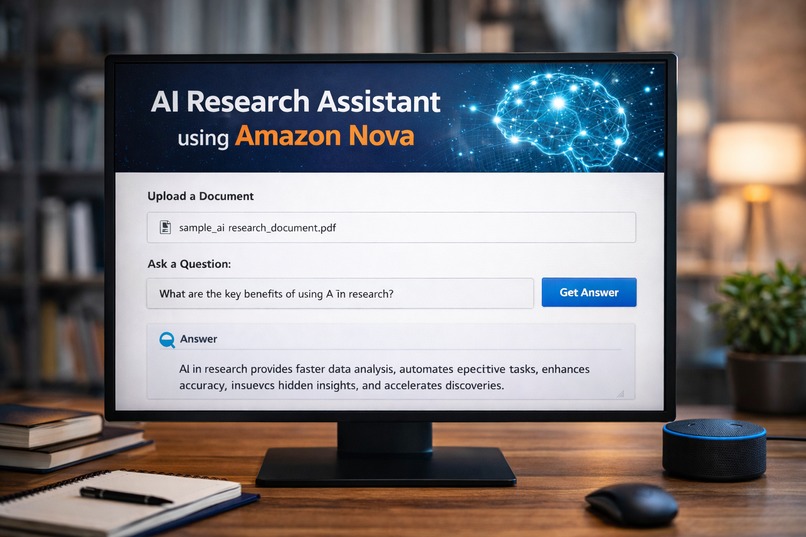
AI Research Assistant using Amazon Nova
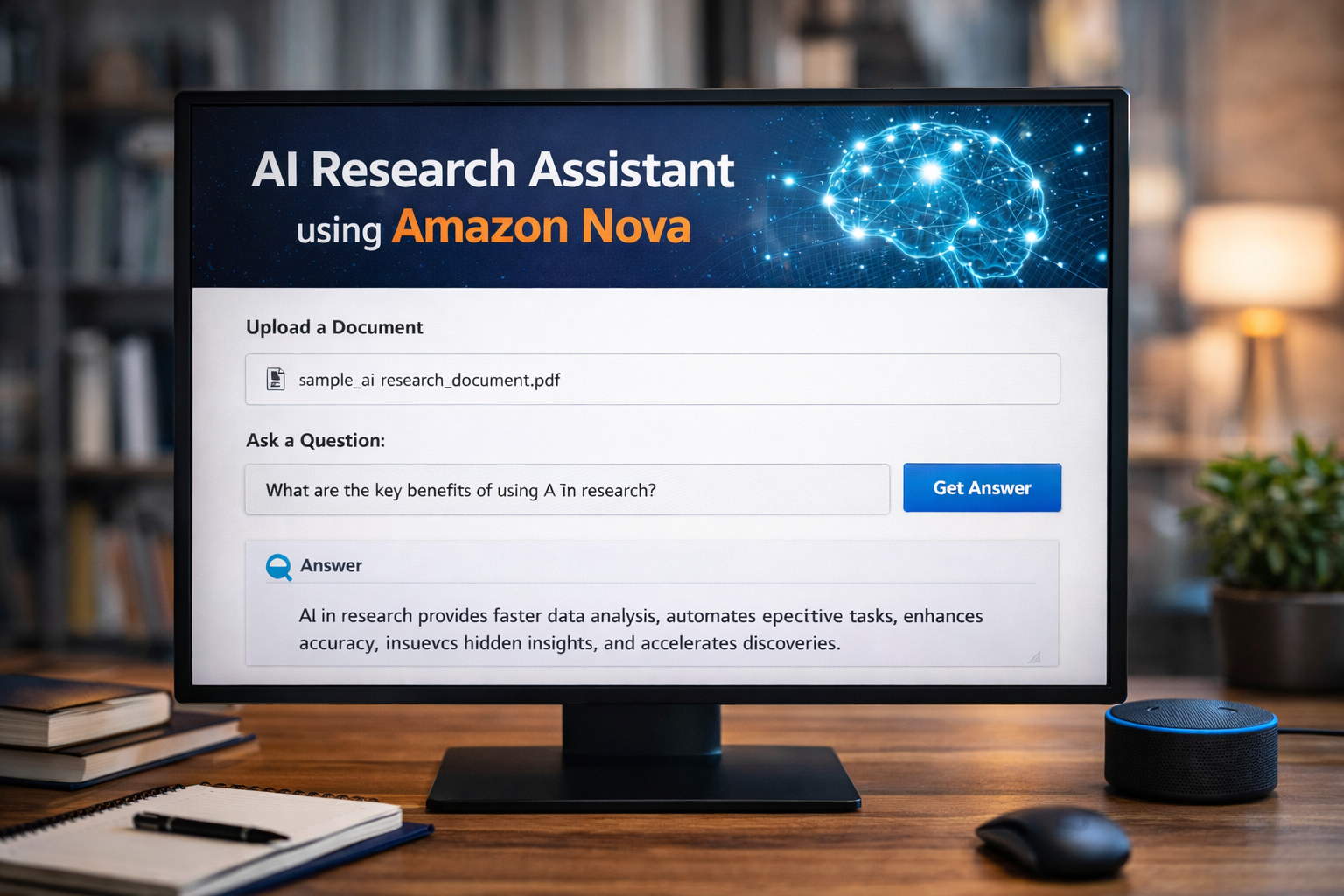
This project was inspired by a common challenge I experienced while working with large amounts of information as a Data Scientist. Many organizations store important knowledge in documents such as research papers, technical manuals, reports, and internal guidelines. However, finding specific information inside these documents can take a lot of time and effort. To address this problem, I built an AI Research Assistant powered by Amazon Nova that allows users to ask questions in natural language and receive clear, context-based answers directly from the documents. The idea behind the project was to make knowledge retrieval faster, easier, and more interactive.
While working on this project, I learned several important concepts related to modern generative AI systems. One of the key concepts was Retrieval-Augmented Generation (RAG), which combines document retrieval with large language models to generate accurate answers based on real data. I also gained hands-on experience with embeddings and semantic search, where documents are converted into vector representations so that the system can understand the meaning of text rather than relying only on keyword matching. This helped me understand how AI systems can retrieve the most relevant pieces of information from a large dataset before generating a response.
To build the system, I designed an end-to-end pipeline that processes documents, generates embeddings, stores them in a vector database, and retrieves relevant information when a user asks a question. First, documents are divided into smaller chunks to improve retrieval accuracy. These chunks are then converted into embeddings using Amazon Nova’s embedding model. The embeddings are stored in a vector database, which allows the system to quickly find the most relevant sections of the documents. When a user submits a query, the system converts the query into an embedding, retrieves the most relevant document chunks, and sends them as context to the Amazon Nova model. The model then generates a response based on this retrieved information.
During development, I faced several challenges. One of the main challenges was deciding the right chunk size for documents because large chunks reduced search accuracy while smaller chunks sometimes removed important context. I addressed this by experimenting with overlapping chunks to maintain context while improving retrieval quality. Another challenge was ensuring the model did not generate incorrect or unsupported answers. To solve this, I used structured prompts that instructed the model to rely only on the retrieved document content. I also had to experiment with retrieval parameters and embedding strategies to improve the relevance of search results.
Overall, this project demonstrates how generative AI can transform the way users interact with large knowledge bases. Instead of manually reading through long documents, users can simply ask questions and receive accurate answers within seconds. This type of system can be useful in many industries such as healthcare, legal services, enterprise knowledge management, and technical support. Building this project helped me strengthen my understanding of generative AI systems, vector search, and AI-powered knowledge retrieval using Amazon Nova.

Log in or sign up for Devpost to join the conversation.