-
-
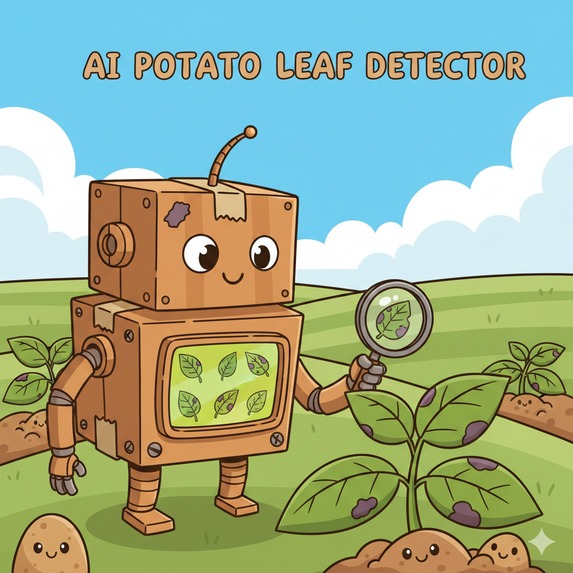
deep learning patato leaf
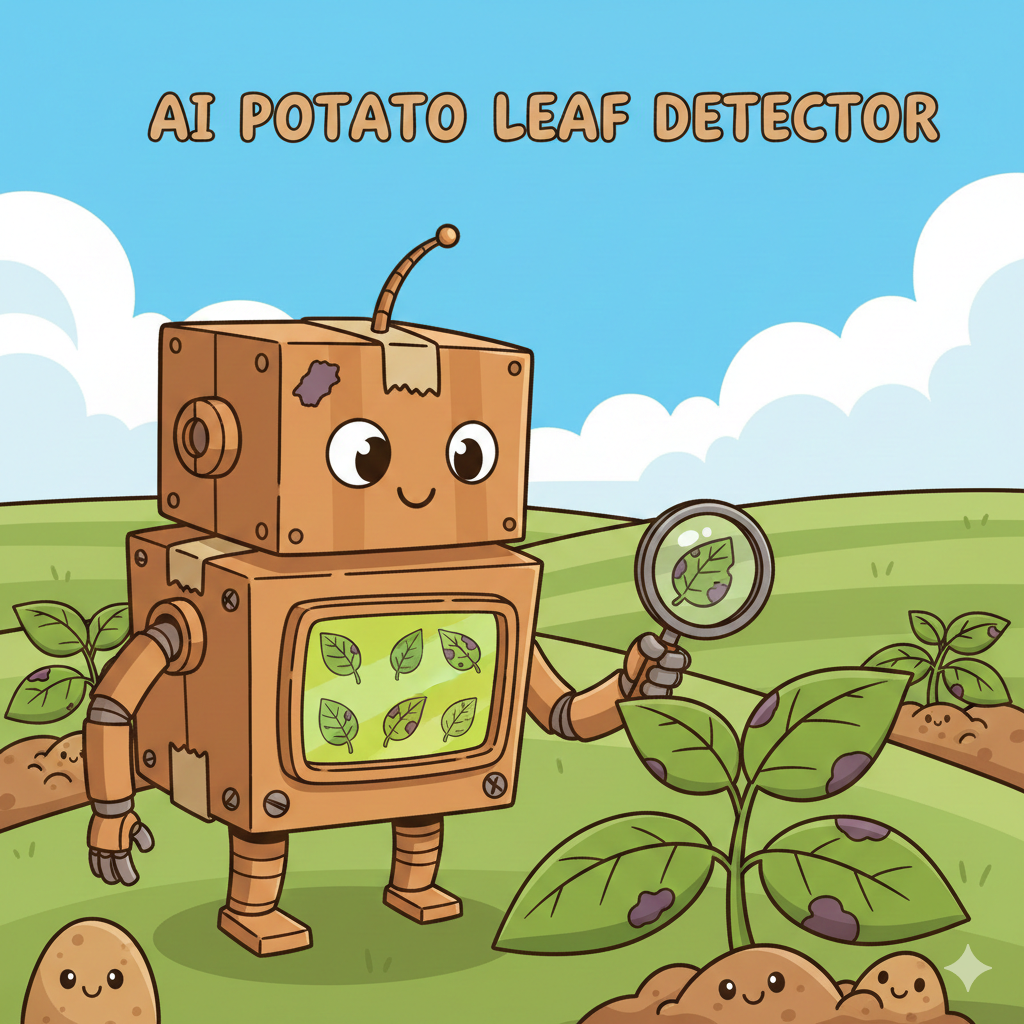
InspirationPotato is one of the most important food crops in many countries, including Pakistan, where small-scale farmers heavily depend on it for their livelihood. During my studies and personal observation, I noticed that many farmers still rely on manual inspection to identify plant diseases. This often leads to late detection, incorrect diagnosis, and significant crop loss.
I was inspired to build a solution that uses Artificial Intelligence to assist farmers and students in identifying potato leaf diseases early, accurately, and affordably, using nothing more than an image.
🧠 What I Learned
This project helped me deepen my understanding of:
Deep Learning & Computer Vision
Convolutional Neural Networks (CNNs)
Image preprocessing and augmentation
Model evaluation and overfitting control
Deploying ML models into real-world usable applications
Bridging the gap between AI research and practical impact
I also learned how to design an AI system with end users (non-technical farmers) in mind.
🛠️ How I Built the Project
The project follows a clear end-to-end deep learning pipeline:
Dataset Preparation
Collected labeled images of potato leaves
Categories include Healthy, Early Blight, and Late Blight
Applied image resizing and normalization
Model Development
Built a Convolutional Neural Network (CNN)
Used multiple convolutional and pooling layers to extract visual features
Trained the model to classify leaf images into disease categories
Training & Evaluation
Split data into training and validation sets
Used categorical cross-entropy loss and accuracy metrics
Tuned hyperparameters to improve performance
Deployment
Integrated the trained model into a simple user interface
Users can upload an image and instantly get disease predictions
Mathematically, the model learns a function
𝑓 ( 𝑥
)
arg max 𝑐 𝑃 ( 𝑐 ∣ 𝑥 ) f(x)=arg c max
P(c∣x)
where 𝑥 x is the input image and 𝑐 c represents the disease class.
⚙️ Technologies Used
Python
TensorFlow / Keras
NumPy
OpenCV
Streamlit (for user interface)
CNN-based Deep Learning Models
🚧 Challenges Faced
Dataset quality and balance: Some disease classes had fewer images.
Overfitting: Required careful tuning and data augmentation.
Generalization: Ensuring the model performs well on real-world images.
Deployment simplicity: Designing a UI usable by non-technical users.
Each challenge helped me improve both my technical skills and problem-solving mindset.
🌍 Impact & Future Scope
This project can help:
Farmers detect diseases early
Reduce unnecessary pesticide use
Improve crop yield and food security
Future improvements may include:
Mobile app integration
Multi-crop disease detection
Offline inference for rural areas
Severity estimation and treatment recommendations
If you want, I can also:
Shorten this for judge-friendly reading
Add a “Why this stands out” section
Tailor it exactly to Nexora Hacks judging criteria
Just tell me 👍
What it does
How we built it
Challenges we ran into
Accomplishments that we're proud of
What we learned
What's next for AI Potato Disease Detection
Built With
- cnn
- cv
- datacleaning
- javascript
- matplot
- tensorflow

Log in or sign up for Devpost to join the conversation.