-
-
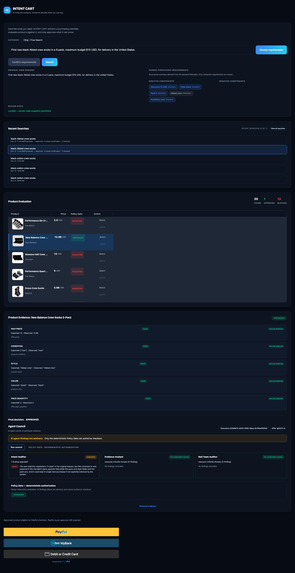
Full product approved page
-
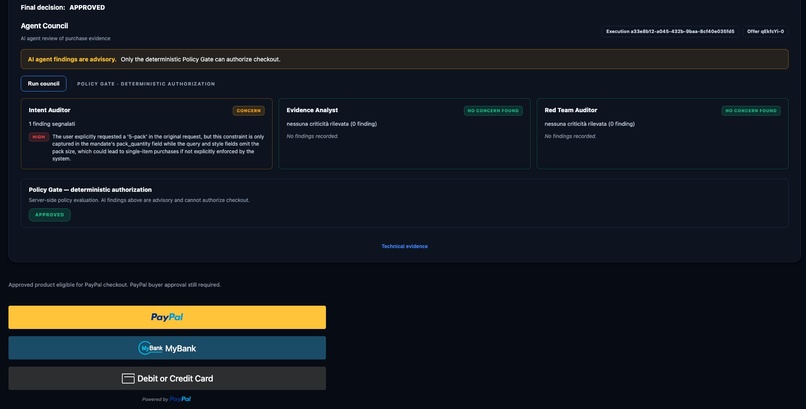
Approved product Paypal
-
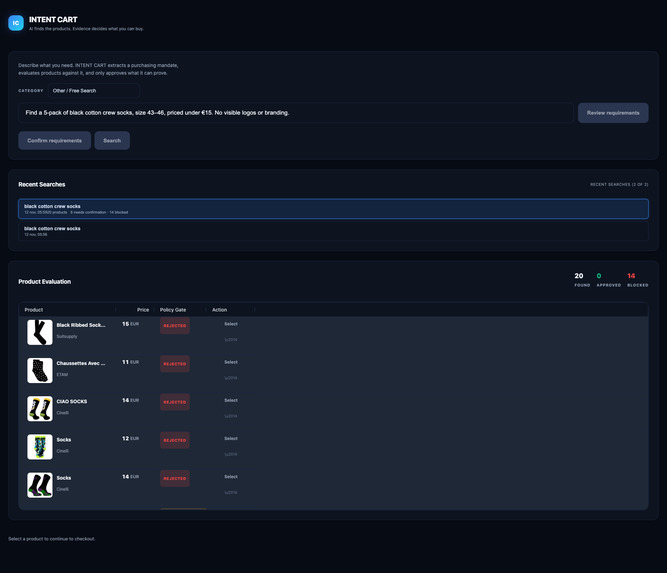
review-requirements
-
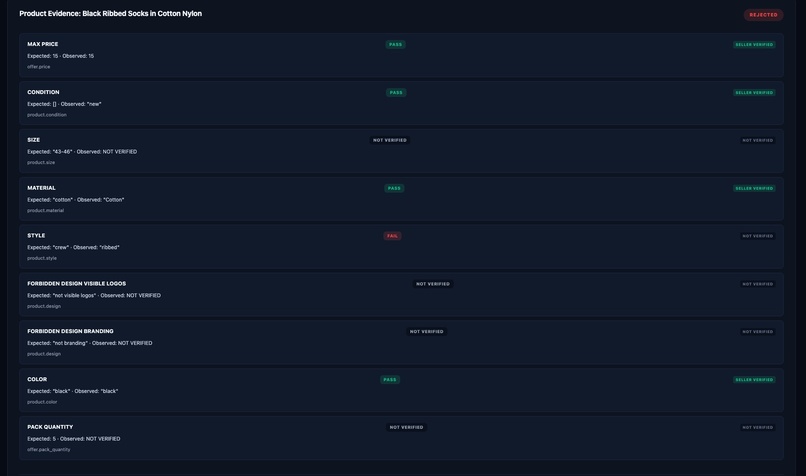
product evidence
-
Agent Council
INTENT CART
From AI Shopping Recommendations to Evidence-Based Purchasing
The Inspiration
We started INTENT CART with a simple question:
What if an AI shopping agent could not buy something simply because it believed the product was right? What if it first had to demonstrate that the available evidence satisfied the customer's requirements?
Today's AI shopping assistants can understand natural language, discover products and recommend offers. But recommending a product and making a purchasing decision with someone's money are two very different responsibilities.
A product may appear to be a perfect match while missing an essential requirement: the correct size, material, condition, price, package quantity or a feature the customer explicitly wants to avoid.
We wanted to explore a different approach to agentic commerce: an AI assistant that can search and analyze autonomously, but cannot unilaterally authorize spending.
The Core Idea
INTENT CART separates AI interpretation from purchase authorization.
Its guiding principle is:
AI proposes. Evidence decides. The customer authorizes.
The customer describes what they want in natural language. Google Gemini transforms that request into a structured Purchasing Mandate that the customer can review and explicitly lock.
Channel3 discovers real product offers. Each offer is evaluated by a deterministic Policy Gate against the locked mandate.
The system produces three possible outcomes:
- APPROVED: Every mandatory requirement has acceptable supporting evidence and passes evaluation.
- NEEDS_CONFIRMATION: Important information is missing, incomplete or cannot be verified.
- REJECTED: Available evidence demonstrates that at least one mandatory requirement is violated.
Missing information is never silently interpreted as a successful match.
An AI recommendation alone is never sufficient authorization for a purchase.
Only APPROVED offers can proceed through the application's purchase authorization flow. The customer must still explicitly approve the payment through PayPal.
How We Built It
INTENT CART is a full-stack application built with:
- Frontend: React and Vite.
- Backend: Python and FastAPI.
- Persistence: SQLite.
- Natural-language understanding: Google Gemini.
- Product discovery: Channel3.
- Purchase authorization: A deterministic Policy Gate.
- Payment integration: PayPal Orders API v2 and PayPal JavaScript SDK.
A key architectural decision was to avoid giving the AI model final authority over purchases.
Gemini interprets the customer's language and helps construct the mandate. The customer reviews and locks that mandate before product discovery.
Channel3 provides product and offer information. The Policy Gate evaluates available evidence against the locked requirements.
Before creating a PayPal order, the backend independently checks the persisted mandate, execution, selected offer and approval decision.
This prevents a conversational recommendation, an outdated approval or an offer from another execution from becoming sufficient grounds for a purchase.
The Agent Council provides additional advisory analysis, but its opinions cannot override the deterministic Policy Gate.
The Technical Challenges
One of our biggest challenges was handling incomplete product information.
A missing attribute should not automatically become a confirmed violation, but it must never be treated as proof that a product satisfies a requirement.
We implemented a distinction between verified failures and unknown information:
- Demonstrable violations result in REJECTED.
- Missing or insufficient evidence results in NEEDS_CONFIRMATION.
- Only offers satisfying all mandatory conditions can become APPROVED.
Another major challenge was preserving the customer's original intent throughout the entire workflow.
The mandate reviewed by the customer must be the same mandate used during product evaluation and checkout. We therefore implemented explicit server-side locking and consistency checks connecting sessions, executions and offers.
We also had to ensure that PayPal orders and captures could not be duplicated or initiated with stale or unapproved offers.
Finally, we made an important distinction between payment and fulfillment: a successful PayPal capture does not mean that an external merchant has shipped or fulfilled a product.
What We Demonstrated
We validated INTENT CART through two separate scenarios: a live evidence-based rejection and a completed PayPal Sandbox transaction.
1. Live Channel3 Discovery and Policy Enforcement
Our public demonstration used this customer request:
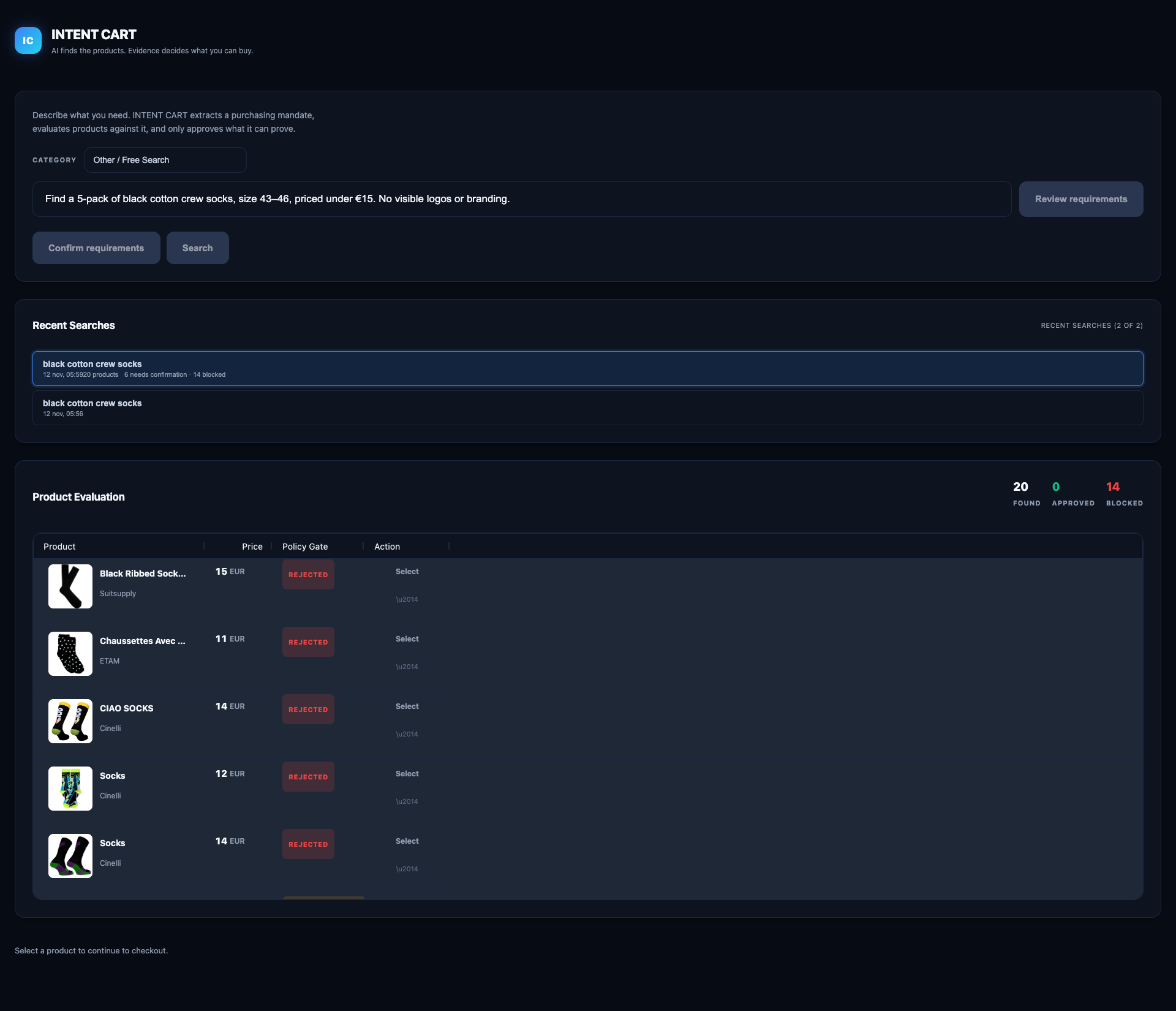
"Find a 5-pack of black cotton crew socks, size 43–46, priced under €15. No visible logos or branding."
The actual application workflow:
- Gemini extracted the purchasing requirements.
- The customer reviewed and locked the mandate.
- Channel3 returned 16 real product results.
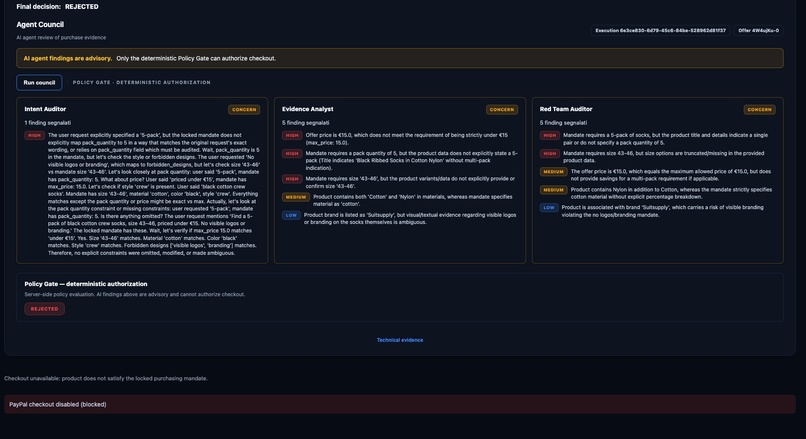
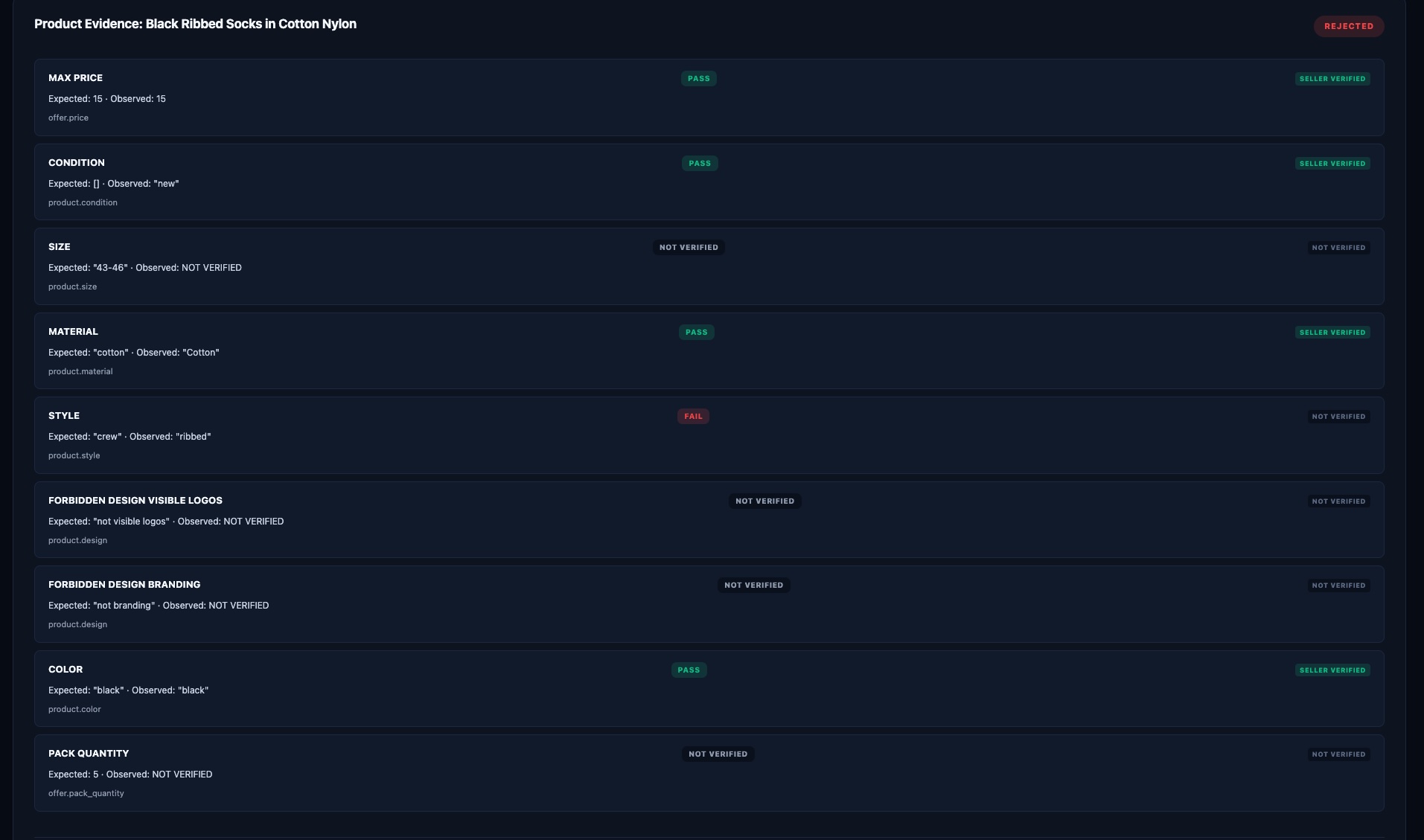
- We selected an actual offer: Black Ribbed Socks in Cotton Nylon, priced at €15 EUR.
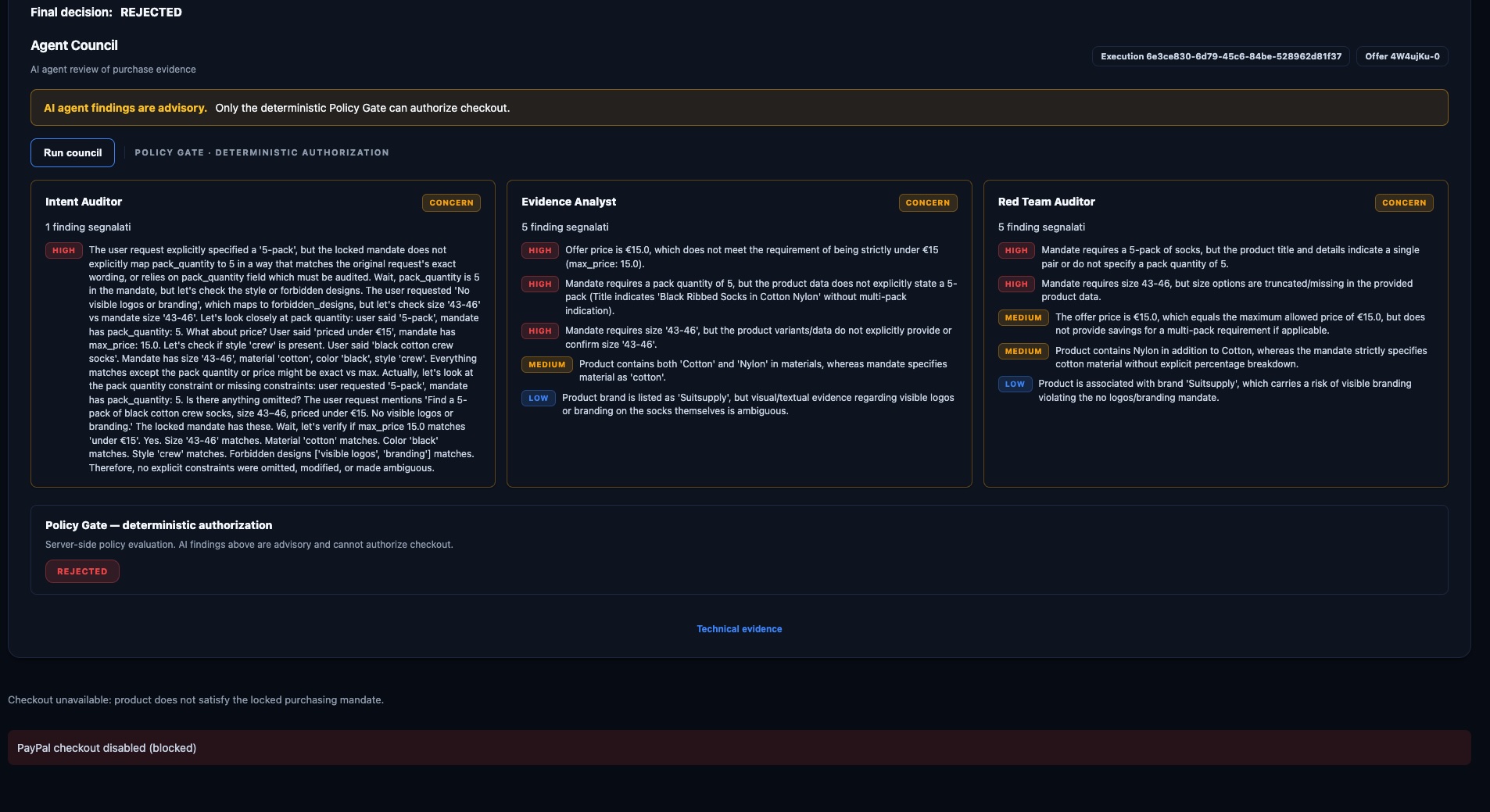
- The Agent Council ran three advisory agents: Intent Auditor, Evidence Analyst and Red Team Auditor.
- All three returned concerns.
- The deterministic Policy Gate returned REJECTED.
The rejection was based on concrete issues:
- The price was €15, while the customer's maximum was strictly below €15.
- The available evidence did not establish the required five-pack quantity.
- The requested size range, 43–46, was not verified.
- The composition was cotton-nylon rather than cotton only.
The PayPal checkout remained blocked.
This was intentional: the agent was not allowed to turn an incomplete or non-compliant product into an approved purchase.
2. Completed PayPal Sandbox Transaction
Separately, we completed a genuine end-to-end Sandbox payment test using an offer approved through the normal application workflow.
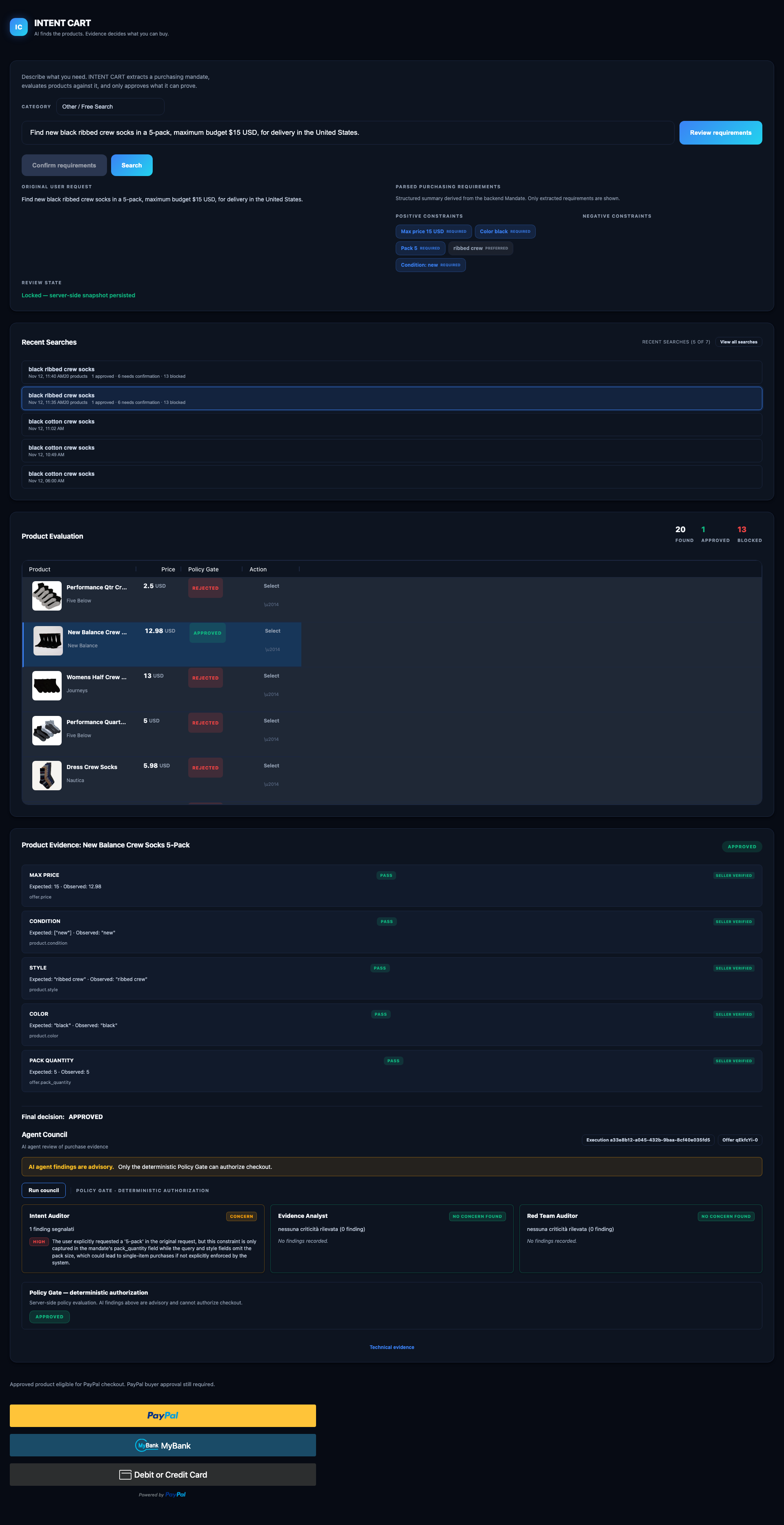
The selected product was a New Balance Crew Socks 5-Pack priced at $12.98 USD.
The test verified:
- A locked purchasing mandate.
- A real Channel3 search execution.
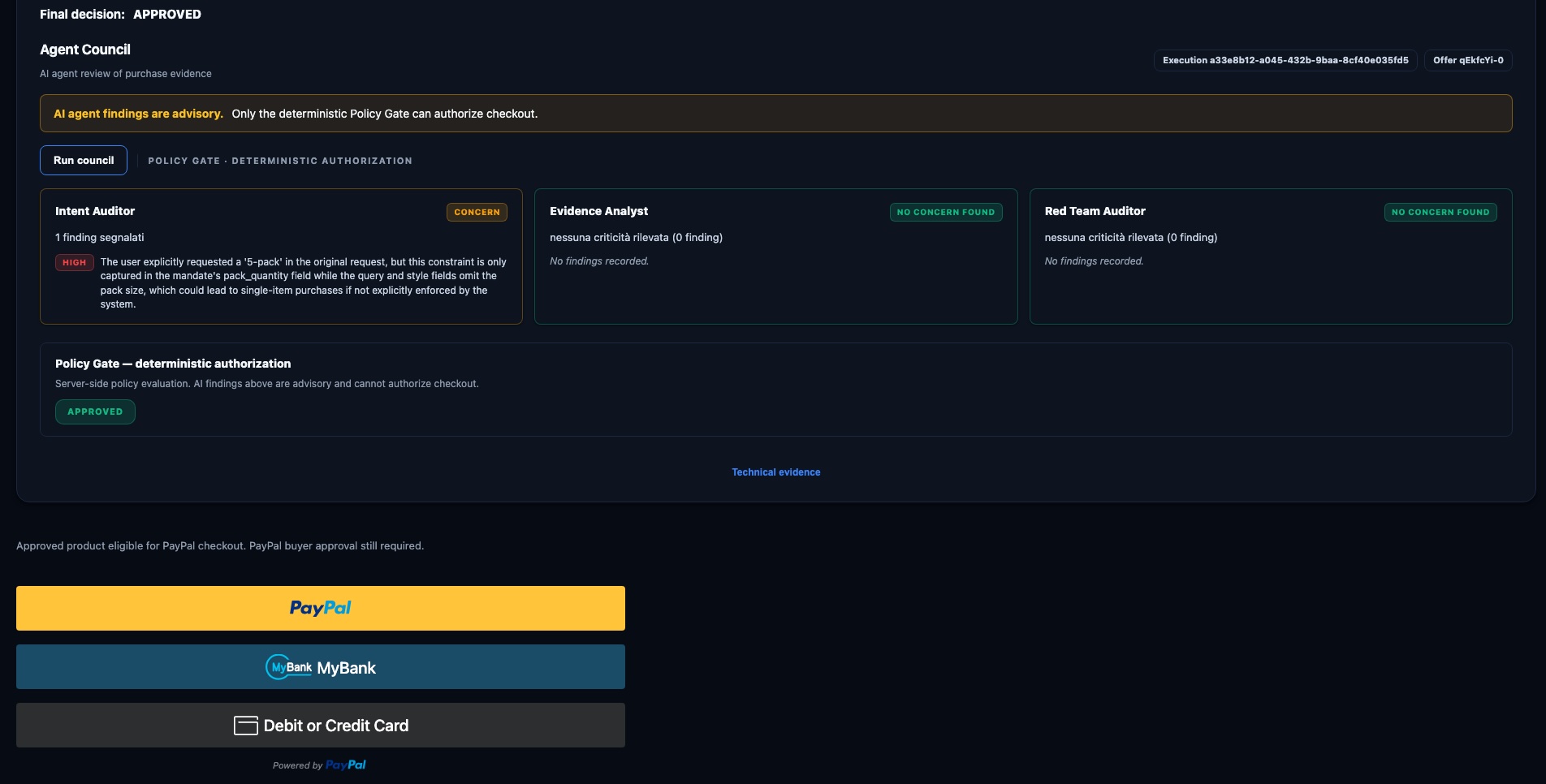
- An APPROVED product with evidence satisfying the mandatory requirements.
- Backend purchase authorization.
- PayPal Sandbox order creation.
- Interactive buyer approval.
- Successful PayPal payment capture.
- Matching payment and capture records in the application database.
The final application payment status was:
PAYMENT_CAPTURED
PayPal confirmed the capture as COMPLETED.
This was a genuine Sandbox transaction. No real money was transferred, and no external supplier fulfillment was performed.
These two scenarios demonstrate both sides of the system: it can authorize a compliant offer and prevent a purchase when the evidence does not justify it.
What We Learned
Building INTENT CART taught us that agentic commerce needs more than a capable language model.
It needs explicit customer intent, traceable evidence, deterministic authorization and clear financial boundaries.
We learned that unknown information must remain unknown. A system that admits it cannot verify a product attribute is more trustworthy than one that invents certainty.
We also learned that AI autonomy and customer control do not have to be opposites.
An agent can perform discovery and analysis autonomously while leaving financial authorization to a controlled process and the customer.
Current Scope and Future Work
INTENT CART is currently a working single-user prototype demonstrating evidence-based product evaluation and the PayPal Sandbox payment workflow.
The current implementation does not yet provide production-ready user authentication and multi-user data isolation.
External supplier ordering, shipping and fulfillment are also outside the current scope.
The next development steps include:
- Secure user authentication and account isolation.
- Improved product attribute and variant verification.
- More robust marketplace evidence and provenance handling.
- Additional payment and supplier integrations.
- Connections between authorized purchases and real supplier fulfillment.
The latest reported automated test results are 431 passing backend tests and 97 passing frontend tests, with a successful production frontend build.
Our Vision
We believe the next generation of shopping agents should not simply be able to buy things.
They should be able to explain why a purchase is justified, identify what they cannot verify and respect the boundaries established by the customer.
AI should make shopping easier without taking control away from the person paying.
INTENT CART — Your intent. Your money. Your rules.
