Inspiration
Photographs capture moments, but they don't always tell the full story behind them.
We often have hundreds of photos from childhood, school, college, trips, friendships, and important milestones. Turning those photos into a meaningful story usually requires manually selecting images, arranging them, writing captions, choosing music, and editing a video.
We wanted to change that.
The idea behind AI Photo Storyteller was simple:
What if AI could look at our photographs, understand the memories they represent, and turn them into a cinematic story automatically?
Instead of treating photos as individual images, our project treats them as pieces of a larger personal narrative.
What it does
The project follows a multimodal AI pipeline:
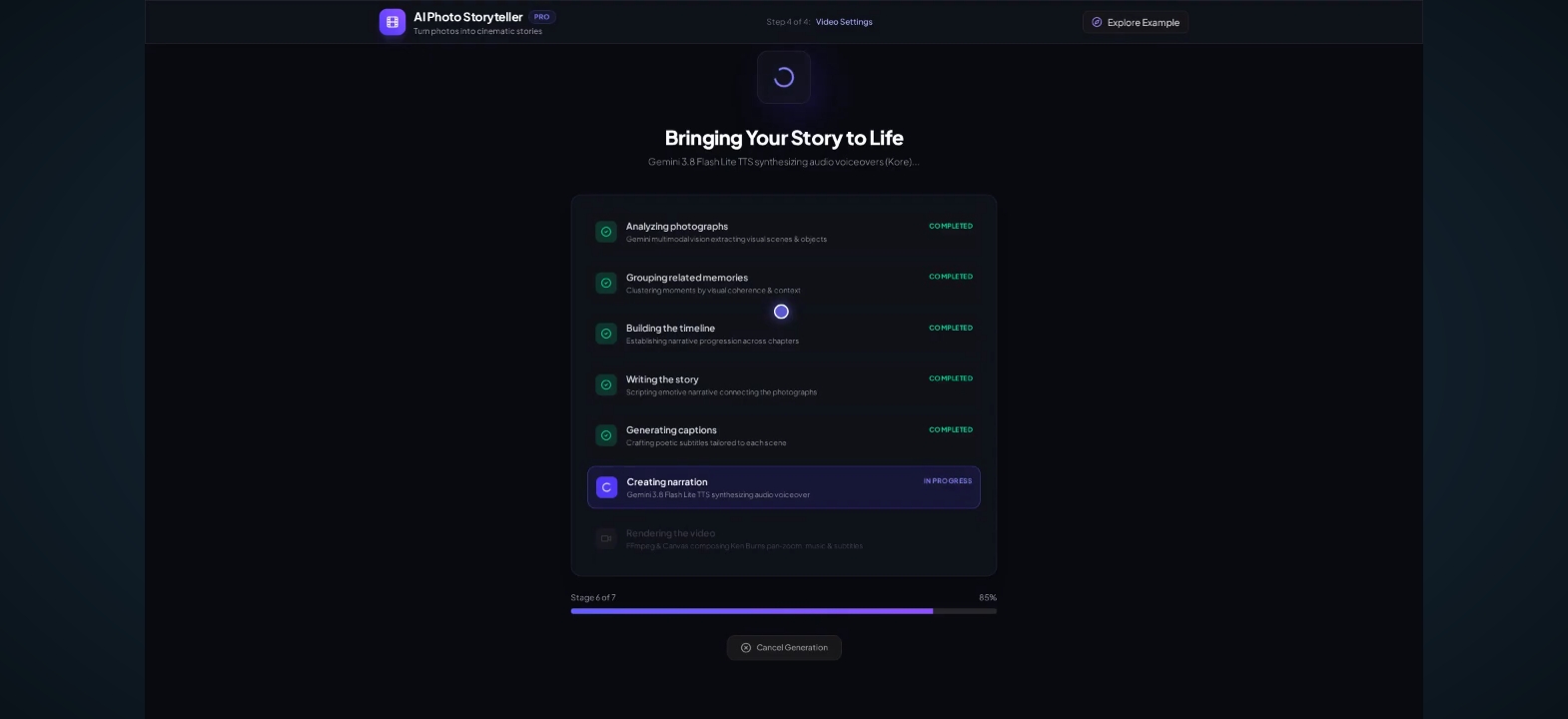
Photos ↓ Computer Vision / Vision AI ↓ Image Understanding ↓ Photo Clustering ↓ Timeline & Story Ordering ↓ Generative AI ↓ Story + Captions ↓ Text-to-Speech ↓ Narration ↓ Video Generation ↓ Cinematic Memory Story
- Image Understanding
When photographs are uploaded, the AI analyzes each image to understand its visual content, including people, objects, scenes, and activities.
The system generates structured information about each photograph that can be used by the storytelling pipeline.
- Photo Organization
Instead of blindly using the upload order, the system attempts to group related photographs into meaningful sections.
For example:
Photos 1–4 → Childhood Photos 5–8 → School Photos 9–13 → College Photos 14–17 → Friends Photos 18–20 → Graduation
This gives the final story a more natural flow.
- Story Generation
The structured information from the images is passed to a generative AI model.
The AI creates a narrative connecting the different moments together rather than generating unrelated descriptions for every photograph.
- Caption Generation
Each photograph receives a short caption that matches the overall story and selected storytelling style.
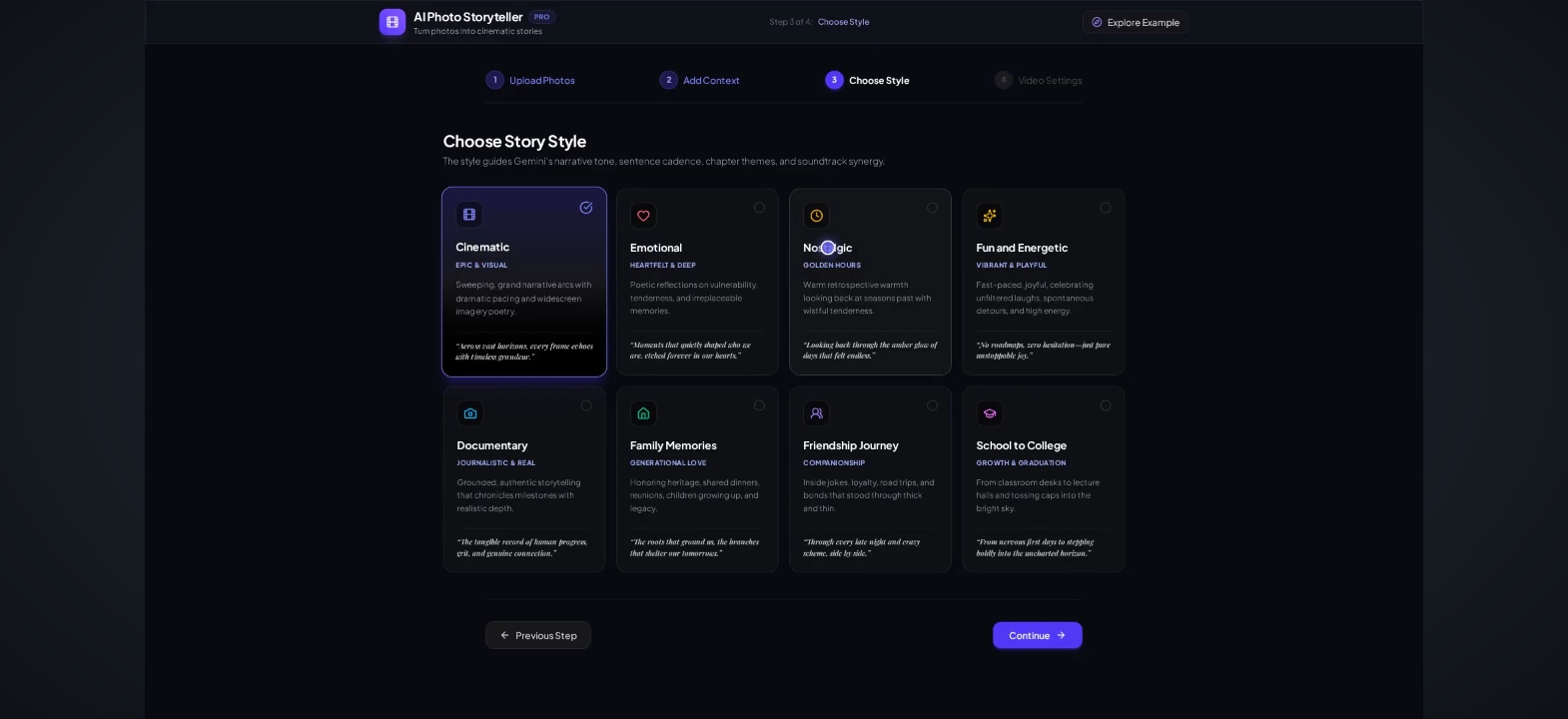
Users can choose styles such as:
Cinematic
Emotional
Nostalgic
Fun
Documentary
- Narration
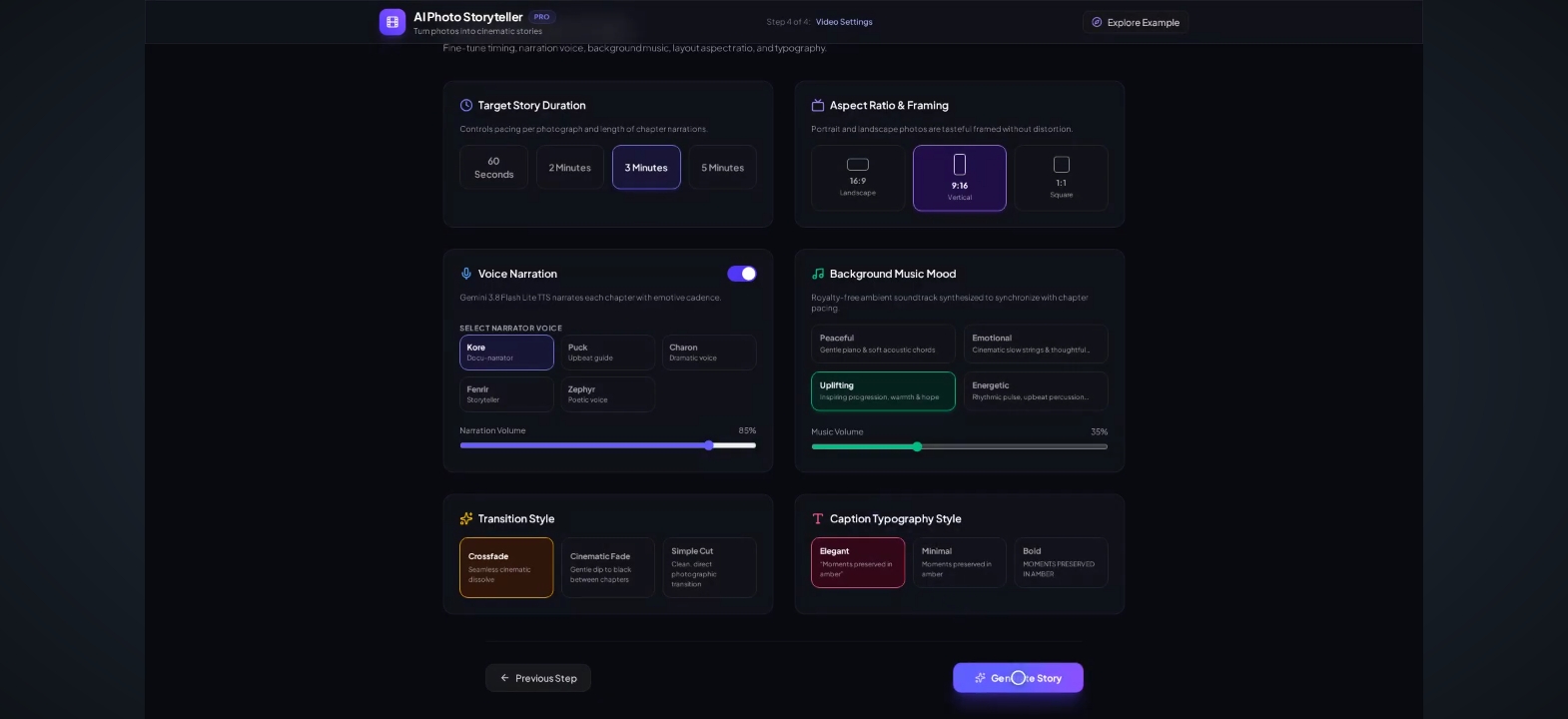
The generated story can be converted into speech using text-to-speech technology.
This creates the feeling of watching a narrated personal documentary.
- Video Generation
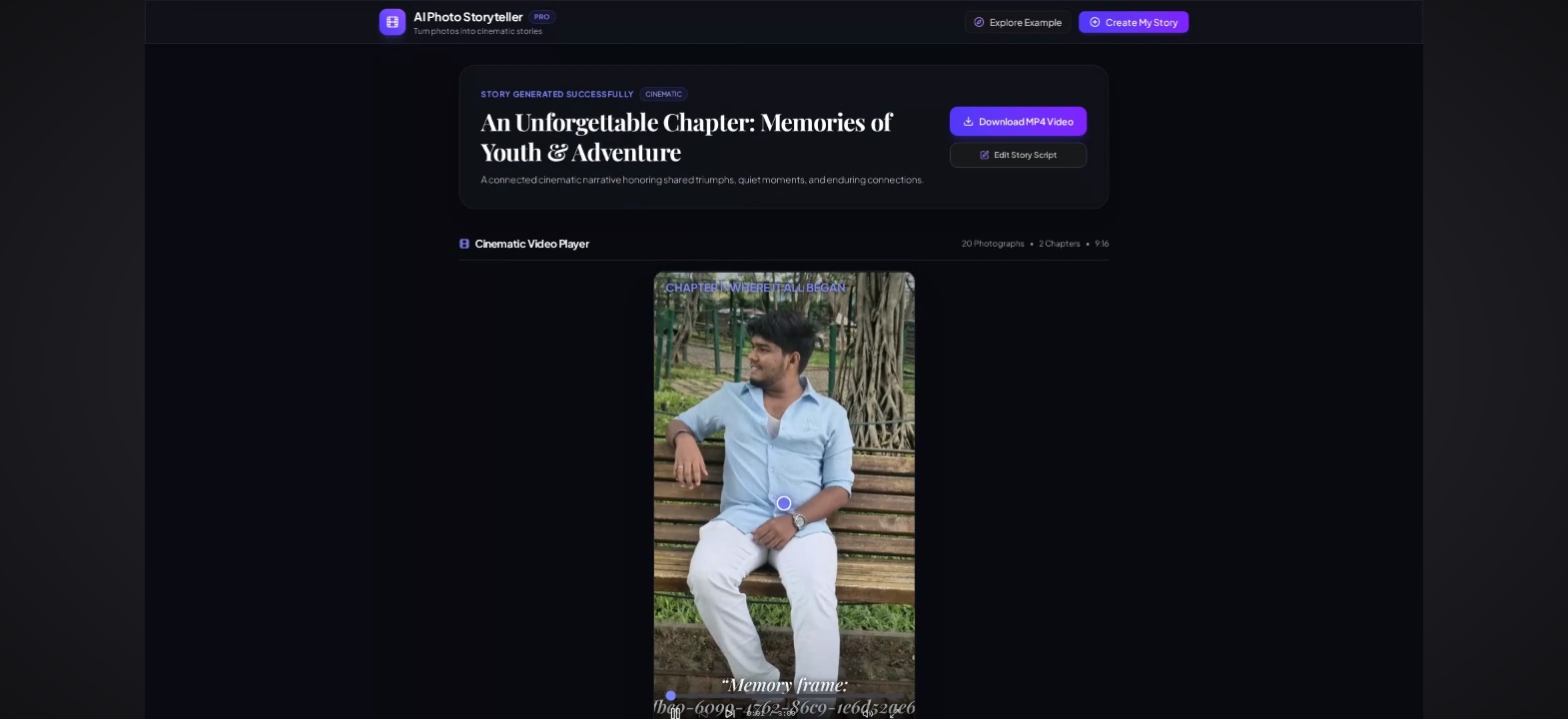
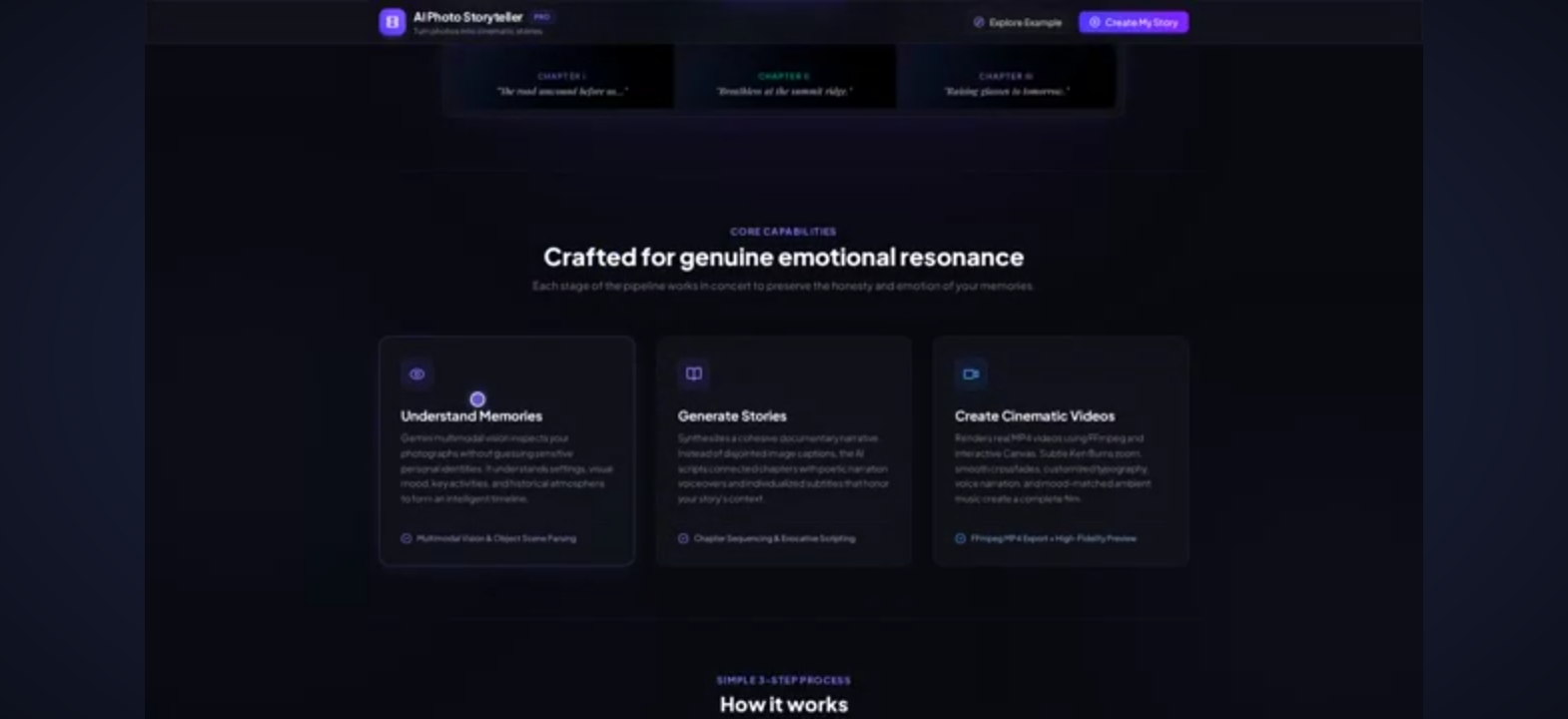
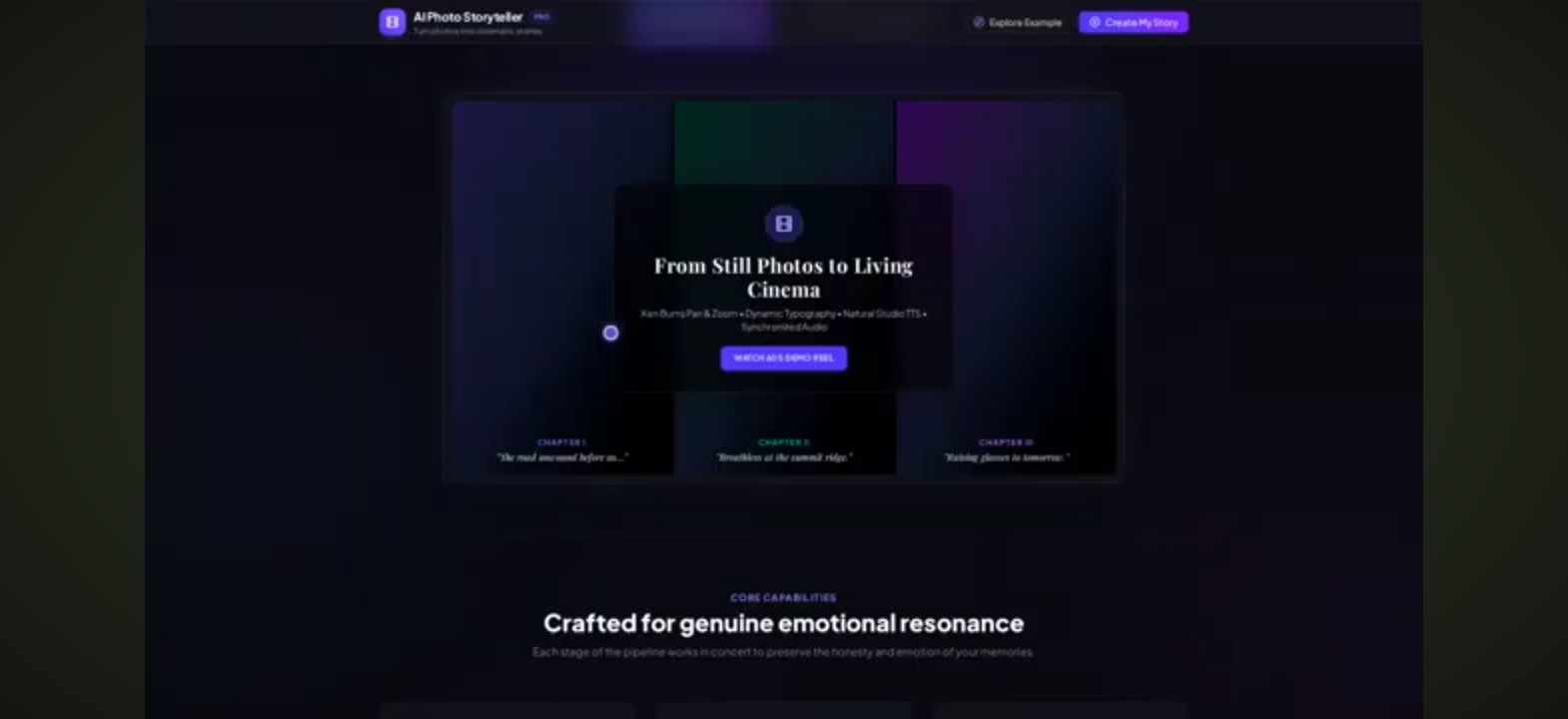
Finally, the photographs, captions, narration, music, and transitions are combined into a cinematic video.
The result is a complete story generated from a collection of ordinary photographs.
How we built it
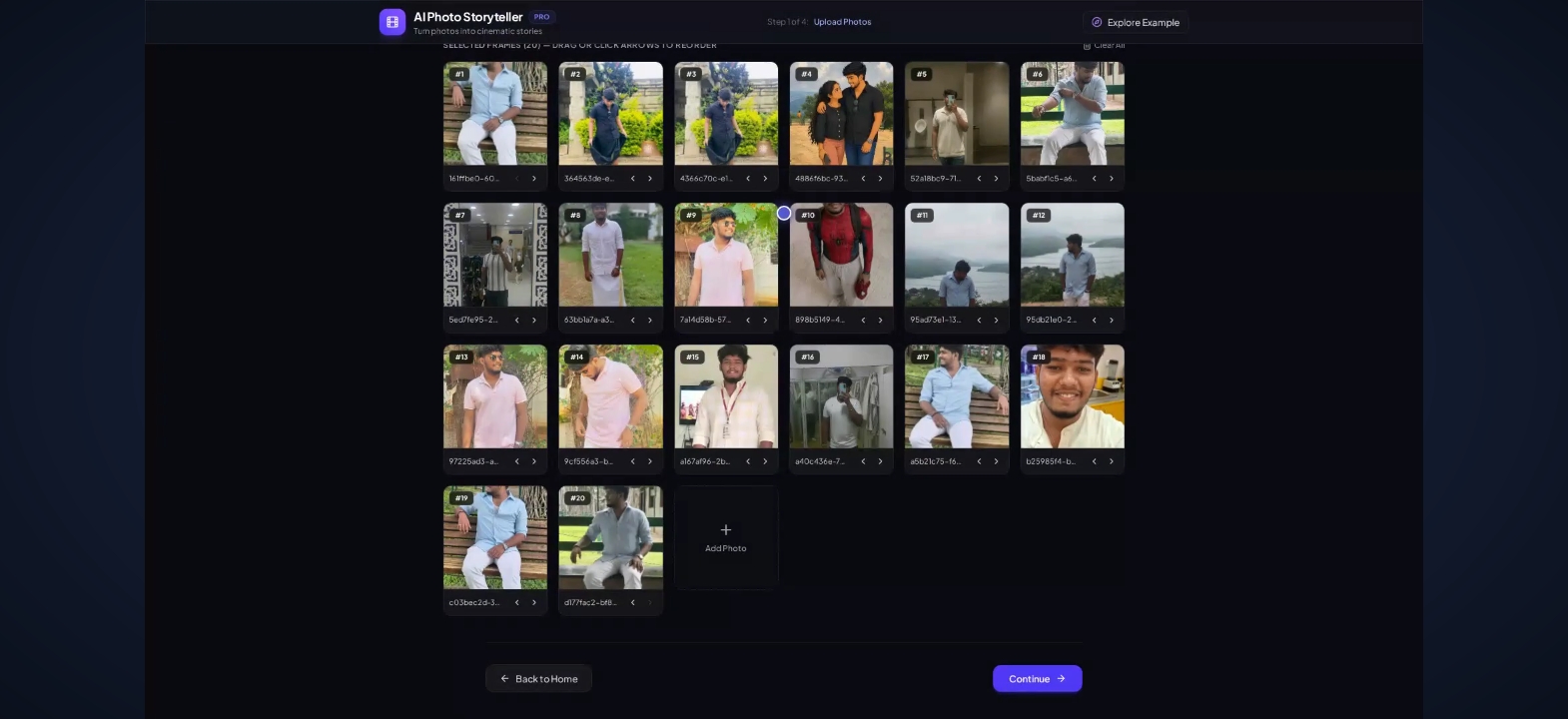
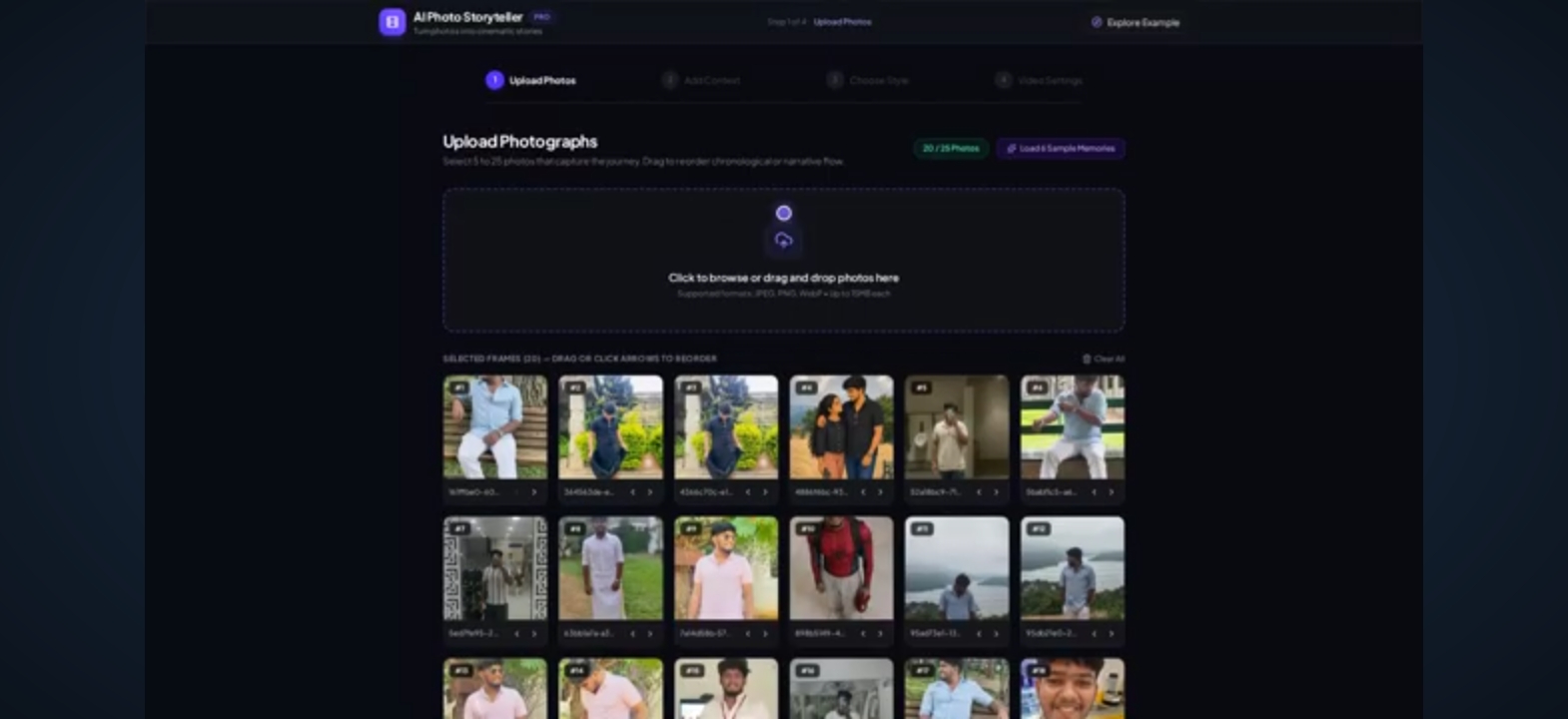
AI Photo Storyteller allows users to upload 5–20 photographs and automatically transforms them into a structured visual story.
The system analyzes the uploaded images and generates:
- Photo descriptions
*AI-generated story
Personalized captions
Timeline and story chapters
AI narration
Background music
Cinematic transitions
*Photo animations and effects
- Final story video
For example, a collection of photographs could be transformed into:
Childhood ↓ School ↓ Friends ↓ College ↓ Achievements ↓ Graduation
The goal is not simply to create a slideshow, but to create a narrative from visual memories.
Challenges we ran into
- Understanding Context From Individual Photos
A single photograph rarely tells us exactly when or where it was taken.
The AI has to work with incomplete information and infer relationships between photographs without inventing facts.
This taught us the importance of designing prompts that encourage the model to distinguish between observations and assumptions.
- Creating a Coherent Story
Generating individual captions was relatively straightforward.
The harder problem was connecting multiple photographs into one continuous narrative.
We had to design the system so that the AI considers the collection as a whole instead of treating every image independently.
- Ordering Photographs
Users may upload photographs in completely random order.
Creating a meaningful sequence required combining available signals such as visual similarity, metadata when available, and AI-generated descriptions.
- Video Generation
Combining images, captions, narration, music, and transitions into a polished video introduced another layer of complexity.
We had to carefully manage:
Image duration
Audio synchronization
Transitions
Aspect ratios
Video rendering
Output quality
- Avoiding Hallucinated Memories
This was one of the most important challenges.
If an image shows a group of people, the AI should not invent their names or claim an event happened when there is no evidence.
We designed the storytelling process to stay grounded in information available from the photographs and user-provided context.
Accomplishments that we're proud of
Built an end-to-end AI storytelling pipeline that transforms a collection of photographs into a structured and meaningful story.
Combined multiple AI capabilities — image understanding, generative storytelling, caption generation, and text-to-speech — into a single creative experience.
Created automatic story organization, allowing the system to group related photographs and arrange them into meaningful chapters such as childhood, school, college, friends, and achievements.
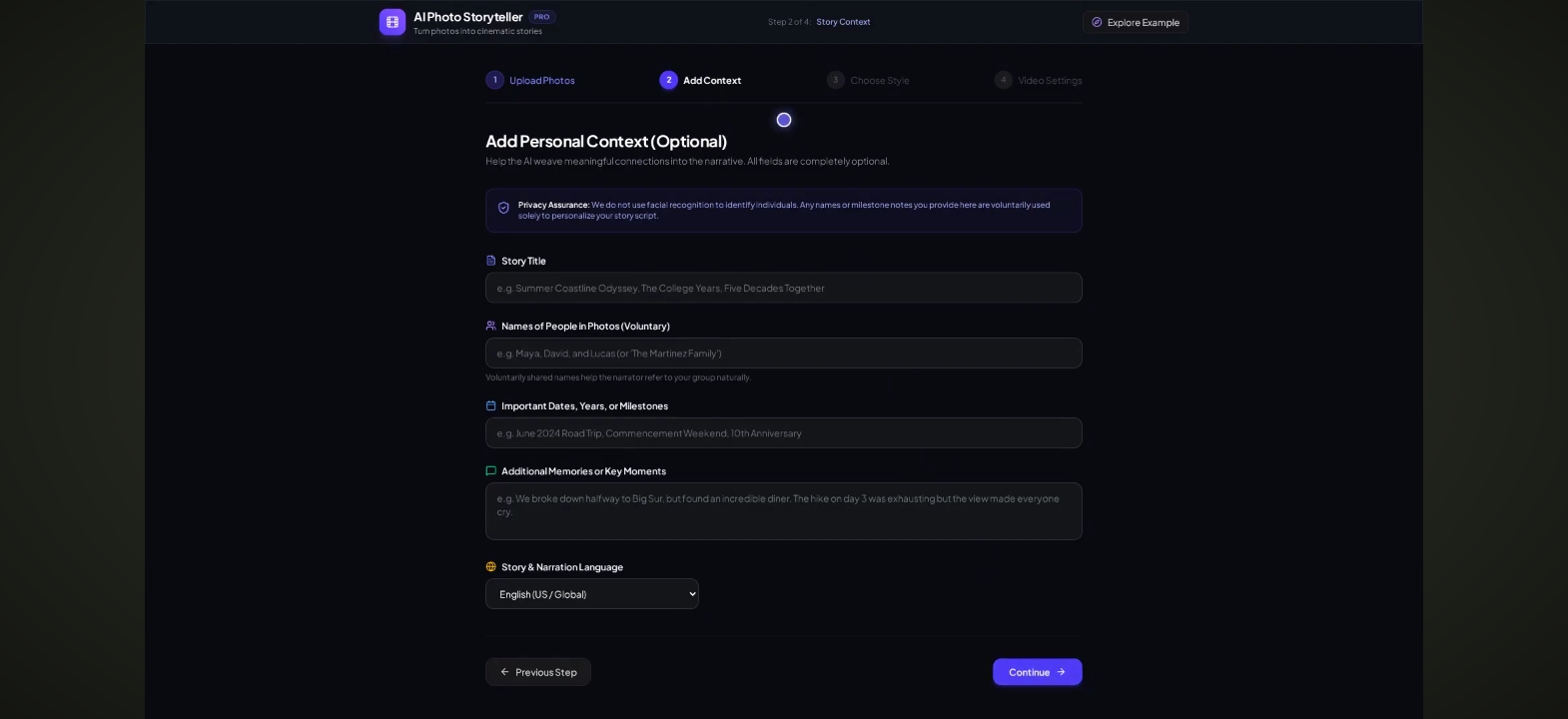
Made the experience highly personalized by allowing users to choose different storytelling styles such as cinematic, emotional, nostalgic, and fun.
Connected AI-generated content with multimedia generation, turning the generated story, captions, narration, images, music, and transitions into a cinematic final experience.
Focused on responsible storytelling, designing the system to avoid unnecessarily inventing personal details that cannot be determined from the photographs.
Built the project around a real-world creative problem, demonstrating how AI can be used not only for prediction and automation, but also as a creative collaborator for preserving and presenting memories.
Most importantly, we are proud that we turned a simple collection of photographs into something that feels like a personal story rather than just a slideshow.
What we learned
One of the biggest things we learned was that building an AI application is not just about calling an AI API.
We had to think about the entire pipeline:
Input → Understanding → Reasoning → Generation → Presentation
We learned how multimodal AI can combine visual information with language generation.
We also learned about:
Computer vision and image understanding
Prompt engineering
Image embeddings and similarity
Photo clustering
Generative AI
Text-to-speech systems
Multimedia processing
Video generation with FFmpeg
API integration
Cloud storage
Building an interactive frontend
Designing an AI-powered user experience
Most importantly, we learned how to transform unstructured visual data into something meaningful and human-readable.
What's next for AI Photo Storytelle
There are several directions we would like to explore:
Automatic face recognition with user-approved names
Better chronological reconstruction using EXIF metadata
More advanced emotion and scene analysis
Personalized music selection
Multi-language storytelling and narration
Voice cloning with explicit user consent
Automatic subtitle generation
Different cinematic themes
Photo restoration and enhancement
Interactive AI-generated memory timelines
Sharing stories through a private link
Creating long-form personal documentaries from larger photo collections

Log in or sign up for Devpost to join the conversation.