-
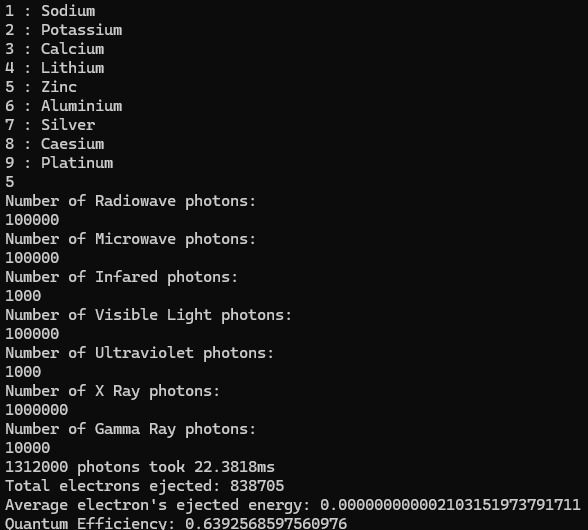
Baseline Simulation
-

Generating Data set
-
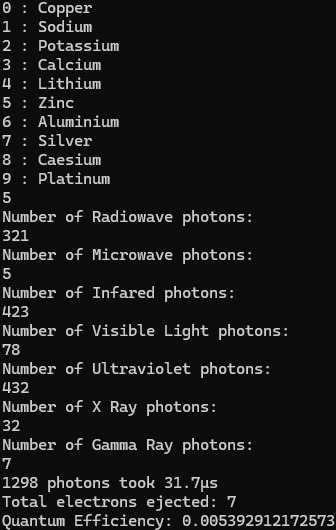
Inference Model
-
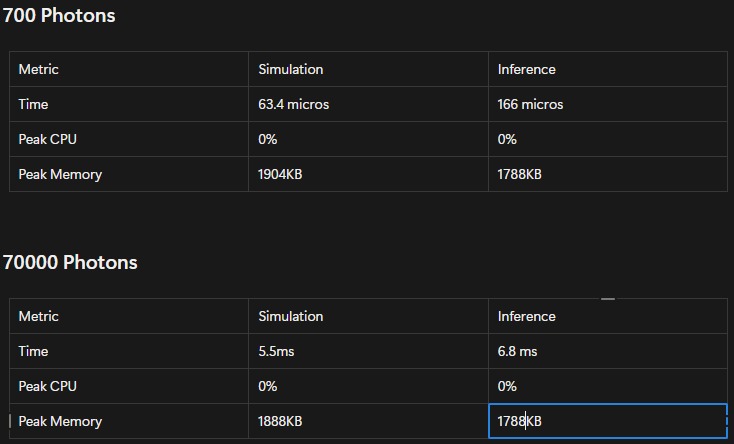
Comparing workload scalability
-
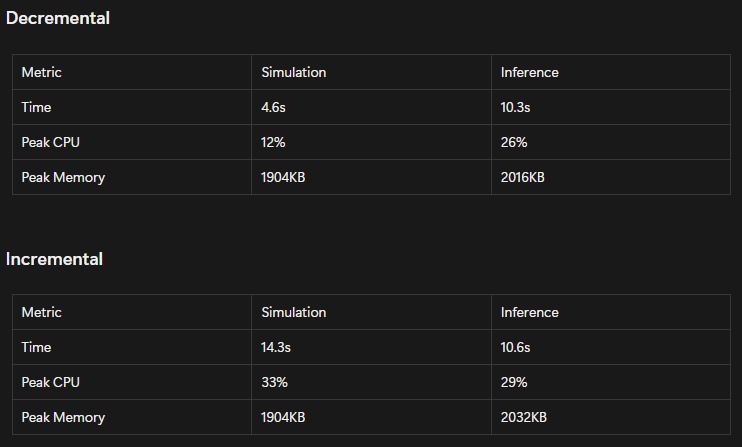
Comparing photon distributions

Inspiration
Educational tools including Colorado PhET simulations have aided me in conceptual understandings of quantum mechanics. Effective quantum mechanic simulations present computation bottlenecks for low-power hardware. I decided to focus on the Monte Carlo probabilistic layer as a physical phenomenon to simulate and then optimise using Machine Learning to turn a resource-intensive simulation into an optimised program that can efficiently run on ARM devices. This means the project will fit the Physical AI track.
What it does
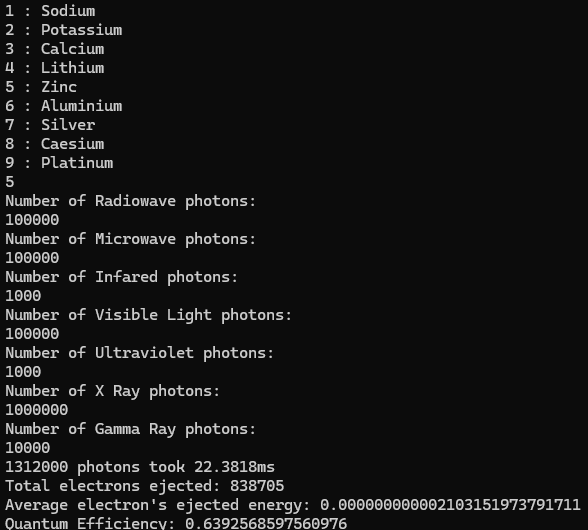
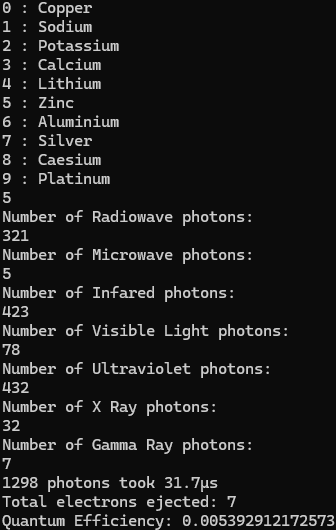
Using a self-made Rust binary to simulate the photoelectric effect (incorporating deterministic threshold and the Monte Carlo pipeline to track key data), I generated a training dataset for a Logistic Regression model to bypass physical computations and reduce CPU and RAM usage and CPU time.
How we built it
I opted to use Rust due to its strict type safety, low-cost abstractions and modular architecture. The photoelectric simulation generates a dataset with thousands of photon permutations. Using Python and scikit-learrn, I trained a Logistic Regression model against that data set to capture the quantum efficiency curves. I then exported the raw mathematical weights, wrote the matrix-vector dot products and sigmoid calculations and then cross compiled both the model and simulation on a Raspberry Pi 4 alongside a custom tracking utility for RAM and CPU usage for benchmarking.
Challenges we ran into
A Logistic Regression model operates using continuous sigmoid curves; the photoelectric effect is defined by a harsh mathematical step due to work function thresholds. As a linear classifier is incapable of natively fitting a discontinous boundary, the model experienced a local drop in accuracy near the threshold boundary. This prompted me to make a trade-off, accepting accuracy loss for light-weight real-time processing.
Accomplishments that we're proud of
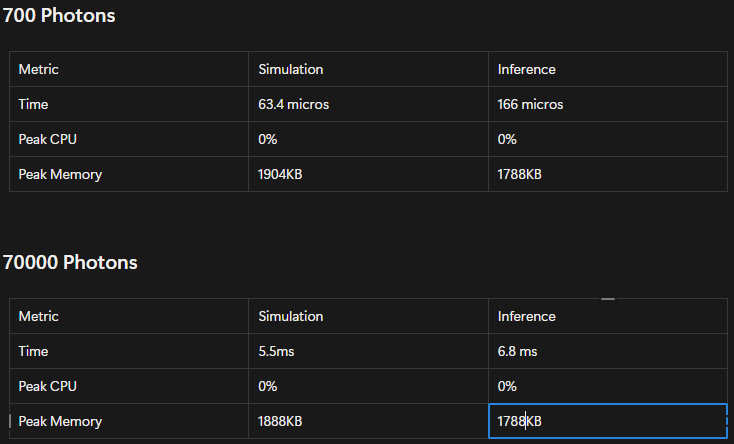
I am proud to have achieved a perfect constant space complexity. As I implemented a data pipeline where loops dropped photon structures as they were individually processed, this prevented an accumulating data heap meaning physical memory usage remains separate from workload size. This is evident when scaling my input factors of over 1000x to a distribution of over 111 million total photons per spectrum section as the peak memory usage remained static at around 1.85MB.
What we learned
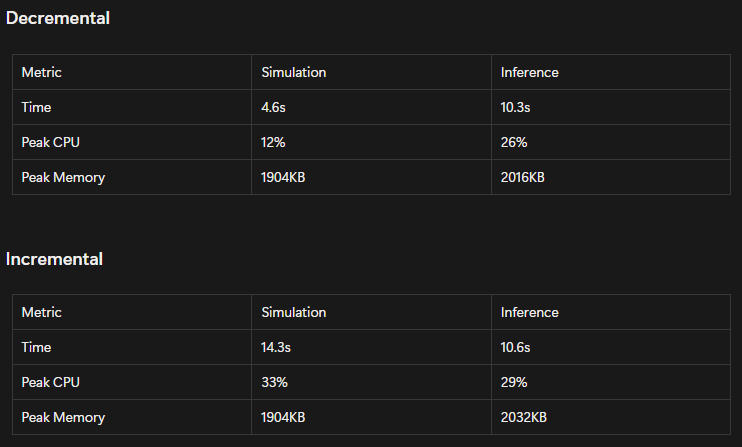
I gained useful insight into how data composition can directly impact performance statistics. When testing my simulation with a decreasing and increasing photon concentration, the decreasing photon concentration resulted in most photons not exceeding the work function threshold, allowing the simulation to skip the Monte Carlo probabilistic layer, the increasing photon concentration presented the exact opposite effect as the photons were run against the layer much more often.
What's next for AI Optimised Quantum Physics Simulation
Rather than continuing the development of this application, I will utilize the lessons it taught me of low-level systems engineering, compilation pipelines and math optimization frameworks to build a standalone Machine Learning framework entirely from scratch.

Log in or sign up for Devpost to join the conversation.