-
-
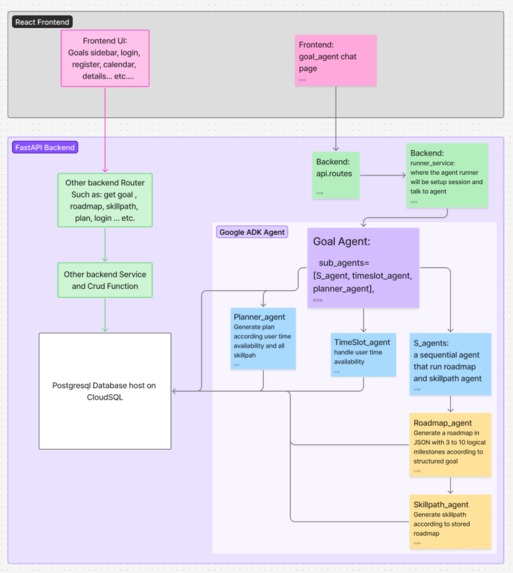
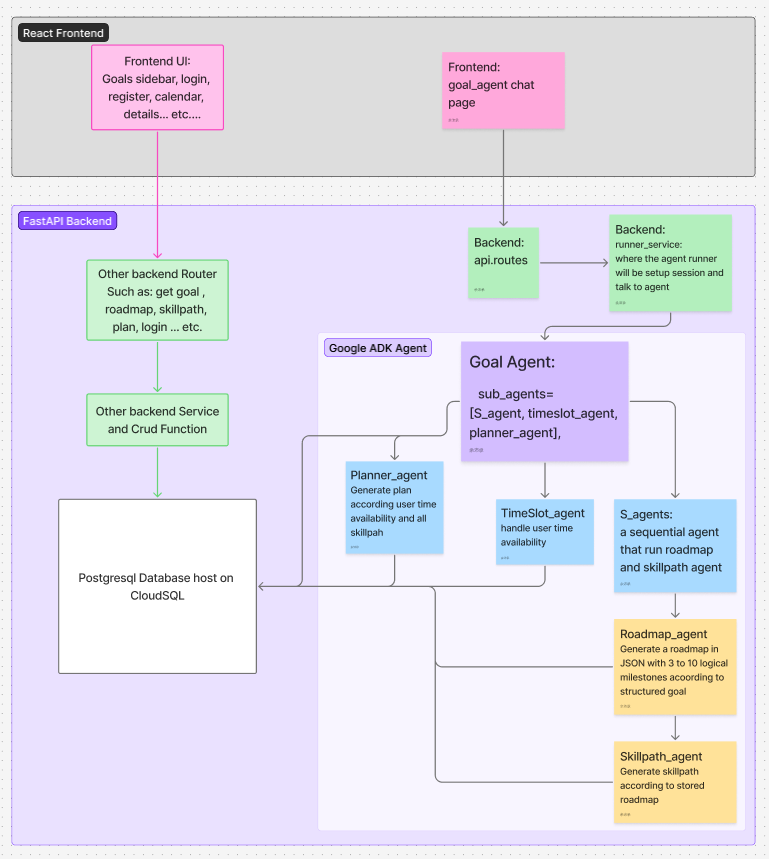
Architecture diagram of the project and ADK agent
Inspiration
Every time someone starts a new learning goal or project — whether it's "Learn French", "Start a YouTube channel", or "Build a website" — they’re often full of motivation but face the same challenge:
👉 The goal feels vague, and the path forward is unclear.
Most people don’t know what the roadmap looks like, how long it will take, what to learn first, or how to fit it into their already busy schedule. These problems lead to procrastination or even abandonment.
We wanted to solve that.
Our inspiration was to create an AI Personal Planner — a system that helps users:
- Refine their goals into structured milestones and tasks
- Find useful resources to start learning right away
- Automatically schedule learning based on their actual availability
By turning uncertainty into clear, actionable steps — with time slots and deadlines — our system empowers users to move forward with confidence and momentum.
What it does
AI Personal Planner is a multi-agent system that:
- Helps users define goals (like “Learn French” or “Build a portfolio website”)
- Automatically generates step-by-step learning paths or project plans
- Collects and stores weekly availability and exceptions
- Schedules all tasks using intelligent daily planning
- Displays the final personalized schedule in a calendar interface
Each user ends up with a tailored action plan — balanced across goals, organized by milestone, and optimized for their free time.
How we built it
We used Google's ADK (Agent Development Kit) to build a chain of specialized AI agents:
GoalAgent: captures and structures user goalsRoadmapAgent: breaks goals into roadmap milestonesSkillPathAgent: creates learning steps under each milestoneTimeSlotAgent: builds a weekly availability calendarPlannerAgent: assigns tasks to actual time slots day-by-day
All agents interact via ADK’s session and tool context system, and we persist state in a centralized PostgreSQL database.
We used:
- FastAPI for the backend API
- React + Tailwind CSS for the frontend
- FullCalendar to display the user's personalized schedule
The backend is deployed on Google Cloud Run, while the PostgreSQL database is hosted on Google Cloud SQL, providing scalable and serverless infrastructure that supports real-time interaction between agents and users.
Challenges we ran into
Building an AI-based multi-agent system sounds clean in theory — but in practice, it brought many unexpected challenges:
Agents didn’t always behave as expected.
Sometimes they skipped steps, misunderstood the prompt, or triggered tools in the wrong order. Especially when workflows got complex, the LLM behind each agent would misinterpret the task or call tools at the wrong time. Debugging these behaviors required a lot of prompt tuning and tool logic adjustments.Dividing complex workflows into manageable substeps.
It wasn’t obvious at first how much responsibility to give each agent. If an agent was assigned too broad a task (e.g., parse user input and plan steps and schedule time), it would often fail or go off track. We had to re-architect our system to break the workflow into smaller, more focused pieces that each agent could handle reliably.Deploying to Google Cloud Run + Cloud SQL.
Containerizing the FastAPI backend, configuring environment variables securely, setting up Cloud SQL connections, and managing CORS policies were all necessary to get the system running end-to-end in production. These took trial and error, especially with auth and database access.Synchronizing state across agents and backend services.
Since multiple agents interact asynchronously and rely on a shared session state, keeping everything in sync — including what’s stored in the database — was a real challenge. Any mismatch between in-memory session state and persistent storage could lead to broken plans or missing data.
Despite these hurdles, solving each one gave us clearer architecture and more confidence in handling LLM-based systems at scale.
Accomplishments that we're proud of
Successfully generated dynamic roadmaps and tasks from any user goal.
Whether it’s “Learn French”, “Start a podcast”, or even something abstract like “Be more creative”, our system can break it down into structured milestones, learning steps, and scheduled actions. Supporting such a wide range of goal topics was a major achievement.Fully editable and flexible output.
Users can view the plan on a calendar, and we designed the system to allow updates, changes, and re-planning. The roadmap and tasks are not rigid — they can adapt as the user's progress or availability changes.Handled everything end-to-end — from backend to frontend.
This was my first time building a full-stack application completely on my own:- Designing the data flow
- Building the backend logic and deploying it on Google Cloud Run
- Managing the database with Cloud SQL
- Creating a smooth, interactive UI with React + Tailwind + FullCalendar
It was both challenging and empowering to take ownership of the entire stack.
- Designing the data flow
Built a system that actually feels helpful.
Beyond the tech, we’re proud that this planner genuinely reduces friction between ideas and execution — helping users go from vague intentions to concrete, scheduled action.
What we learned
Gained a deeper understanding of full-stack development.
Building both the backend and frontend helped clarify how data flows through the entire system — from user input to database to visual output. It also taught us the importance of clean architecture and modular design.Developed an appreciation for UI/UX design.
While creating the frontend, we learned how impactful thoughtful UX is. We realized that even small interface tweaks — like accordion layouts, tag displays, or clearer navigation — can significantly improve user experience.Learned more about building AI systems using agent orchestration.
Through Google ADK, we got hands-on experience with creating multi-agent pipelines: breaking tasks into sub-agents, using tool functions, and carefully guiding agent behavior through prompt design.Explored the broader ecosystem of AI coordination.
Although we didn’t implement MCP (Multi-Agent Collaboration Protocol), we became aware of how it enables better coordination and communication between different AI systems. It inspired us to think about future scalability — how our planner could one day interact with other intelligent agents in a shared environment.
This project not only improved our technical skills, but also deepened our perspective on what it takes to build helpful, human-centered AI systems.
What's next for AI Personal Planner
Improving agent reliability and predictability.
The first priority is making each agent more stable and consistent. We want to reduce unexpected behavior and make the entire system more robust, even when handling complex or unusual goals.Expanding to more personal services.
Once the core planning experience is solid, we aim to extend the system into other areas — like trip planning, habit tracking, or daily routines — to make the planner even more useful in everyday life.Exploring multi-agent collaboration (MCP).
In the future, we want to explore implementing MCP (Multi-Agent Collaboration Protocol) to enable more advanced coordination between agents. This could allow our system to interoperate with other AI services, share context, and work as part of a larger intelligent ecosystem.Connecting with external AI services.
Long term, we envision our planner connecting with services like Google Calendar, Notion, or even AI tools like ChatGPT plugins or Gemini extensions, so users can plan and act across platforms seamlessly.
Our goal is to turn AI Personal Planner into a truly adaptive assistant — one that grows smarter, more helpful, and more connected over time.
Built With
- fastapi
- fullcalendar
- google-adk
- google-cloud-run
- google-could-sql
- javascript
- python
- react
- vite

Log in or sign up for Devpost to join the conversation.