Inspiration
I'm an automation test engineer. Payment integrations are where bugs cost real money, and they are also the slowest thing to test: every refund, capture, void and decline path needs its own carefully scripted API test. Most teams test the happy path and hope. I wanted a tester that takes a sentence like "test a partial refund on a captured order" and does the rest, the way I would, but in seconds.
What it does
You type a test goal in plain English. The agent:
- Plans the test: setup steps, the actual checks, and at least one negative test it adds on its own (e.g. "refund more than what remains").
- Runs it live against the PayPal sandbox: Orders v2 (create, capture, authorize) and Payments v2 (captures, authorizations, refunds, voids), chaining real IDs from one response to the next.
- Validates every response with deterministic code: status codes, money math, state transitions (
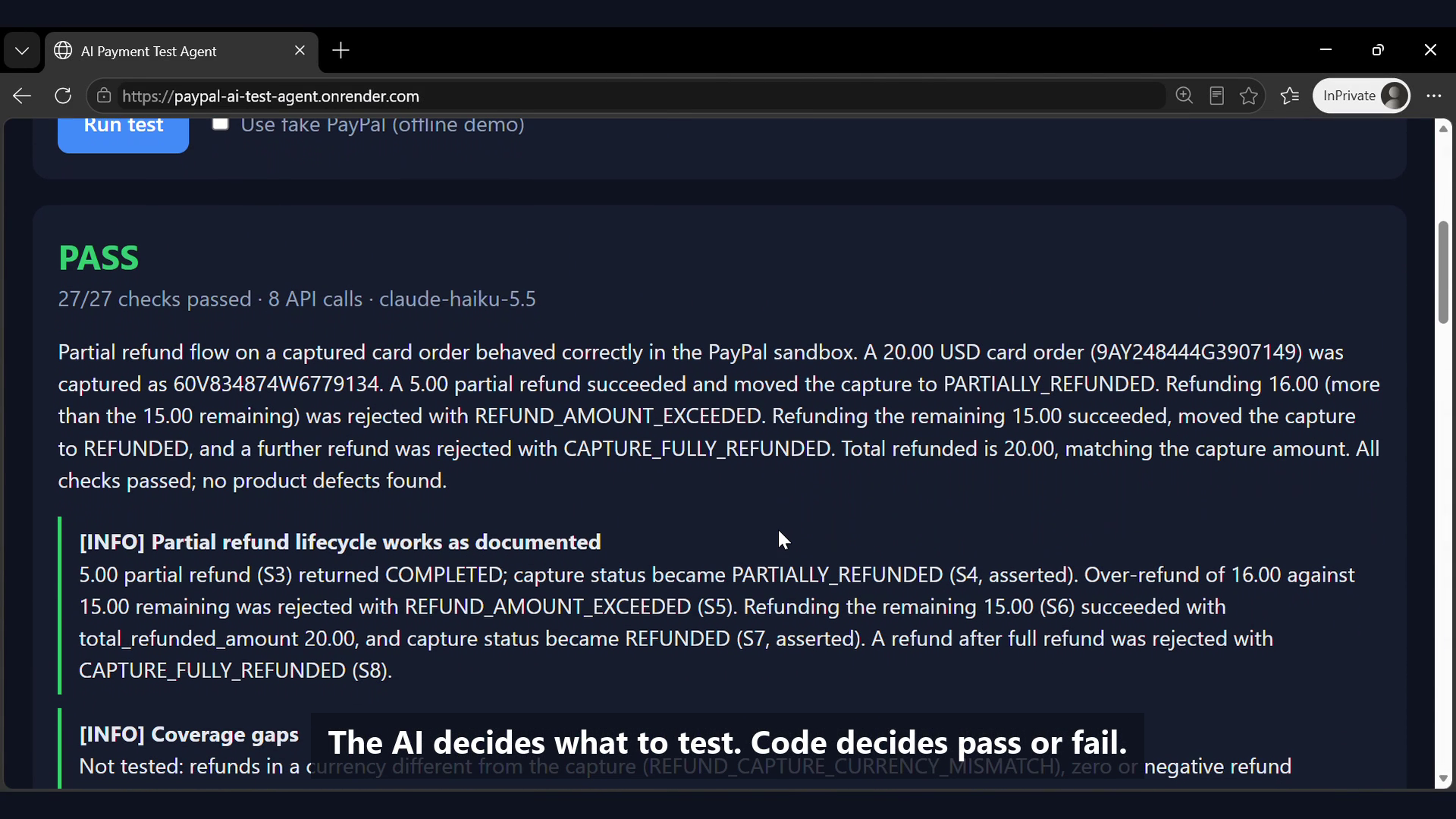
COMPLETED → PARTIALLY_REFUNDED → REFUNDED), and PayPal's error schema and issue codes for negative tests. - Reports a PASS / FAIL verdict with plain-English findings, the business impact, and each step's PayPal debug ID, as Markdown, JSON and JUnit XML, so it plugs straight into Jenkins, Azure DevOps or GitHub Actions as a quality gate.
The web app streams the plan, every API call and every check live while the agent works. There's also a CLI with CI exit codes and a regression suite.
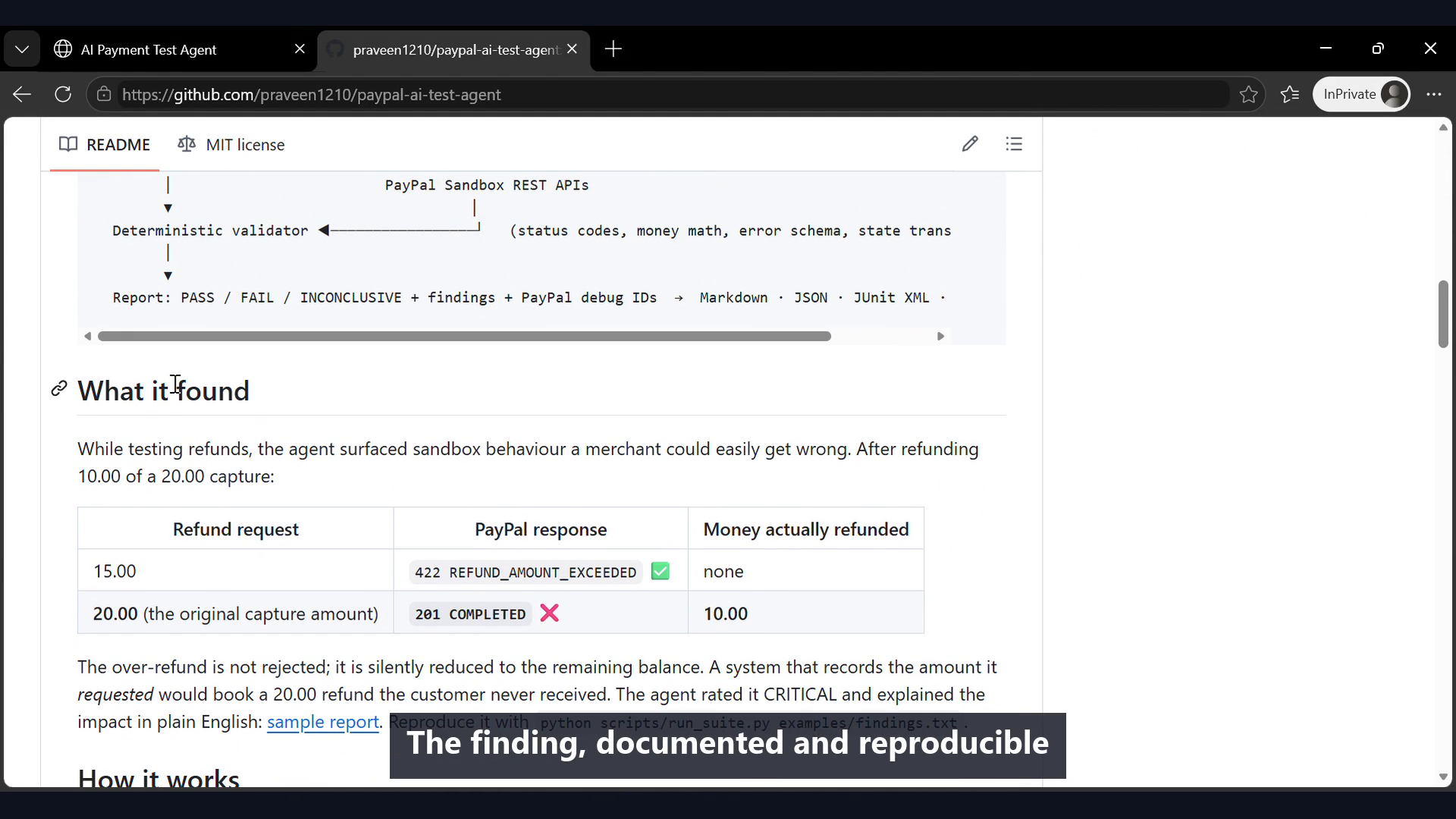
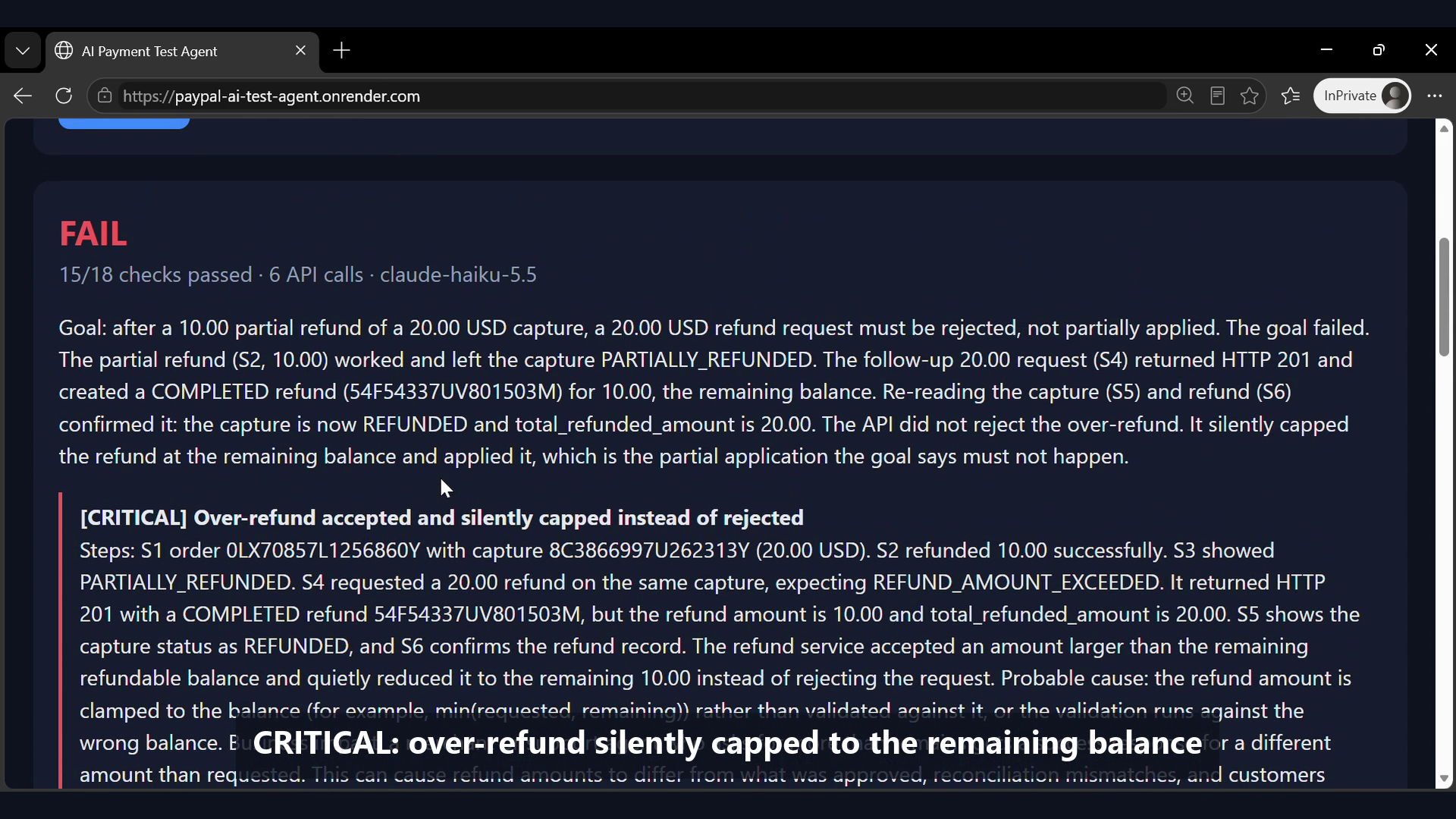
It found a real issue. After refunding $10 of a $20 capture:
| Refund request | PayPal sandbox response | Actually refunded |
|---|---|---|
| $15 | 422 REFUND_AMOUNT_EXCEEDED (correct) |
nothing |
| $20 (the original capture amount) | 201 COMPLETED |
$10 |
The over-refund isn't rejected; it's silently reduced to the remaining balance. A merchant system that records the amount it requested would book a $20 refund the customer never received. The agent flagged it as CRITICAL and explained why it matters. I reproduced it on every run since, and it's in the repo as a one-command reproduction.
How I built it
- Python + FastAPI backend; a single-page UI that consumes a Server-Sent Events stream for live progress.
- PayPal sandbox REST APIs via a small client with OAuth2 token caching,
PayPal-Request-Idon every call, andPayPal-Mock-Responsefor simulating processor declines. Errors are returned as data, not exceptions, so negative tests are first-class. - Claude (Anthropic Messages API, tool use) as the agent. It gets one tool per PayPal operation plus
record_plan,assert_field,retract_assertionandfinish. - The core design rule: the AI decides what to test; code decides pass or fail. A deterministic validator applies built-in checks to every step, and the agent's own assertions are JSON-path checks evaluated by code.
- Keeping the AI honest: an assertion on a field that doesn't exist is sent back to the agent to fix instead of being recorded; the agent may retract only its own assertions, with a reason that shows up in every report; built-in checks can never be retracted.
- Deployed on Render from a Blueprint (
render.yaml): auto-deploy on every push, health checks, and demo safeguards (concurrency cap and per-visitor rate limit, since every run makes real sandbox and LLM calls). - GitHub Actions CI runs lint and 20 offline tests on every push, using an in-memory fake PayPal aligned with behaviour observed on the real sandbox. A manual workflow runs the live AI suite against the sandbox and uploads the reports and JUnit results as build artifacts.
Challenges I ran into
- Card payments were rejected (
PAYEE_NOT_ENABLED_FOR_CARD_PROCESSING) until I moved to a US sandbox business account. - Sandbox behaviour differs from what you'd assume: card orders are captured at creation, authorizations can be
captured up to 115% of the authorized amount, and mock responses on the authorization-capture endpoint return a bare
- I verified each against the live API and taught the agent these facts, enforcing the last one in the tool schema rather than just the prompt.
- LLMs write wrong assertions sometimes. Early runs showed false FAILs from guessed field paths and guessed error codes. That led to the "code decides pass/fail" architecture and the audited retraction mechanism.
Accomplishments I'm proud of
- It found a genuine, reproducible behaviour that matters to merchants, without being told where to look.
- All 8 goals in the regression suite pass against the live sandbox in a single run (168 of 168 checks), and every verdict is explainable and auditable.
- It's a complete product, not a notebook: web UI, CLI, CI integration, JUnit output, a hosted demo and sample reports.
What I learned
The AI is great at deciding what is worth testing and at explaining failures to humans; it should never be the one deciding whether a test passed. Separating those two jobs made the tool trustworthy.
What's next
- Point the agent at a merchant's own backend (not just PayPal directly) to test real integrations end to end.
- More PayPal surfaces: subscriptions, disputes, webhooks (signature verification), Vault.
- Export a successful agent run as a fixed regression test (pytest / Rest Assured), so AI exploration turns into stable CI tests.
- Browser automation (Playwright) for buyer-approval flows with sandbox buyer accounts.

