-
-
AI Parking & EV Optimizer
💡 Inspiration
Finding parking spots in crowded areas or locating nearby EV charging stations has always been a frustrating experience for most drivers — including me. As cities grow, so does the struggle for sustainable, efficient mobility.
I wanted to create a smart solution that combines Artificial Intelligence (AI) and geolocation technology to help users detect available parking spaces and find charging points easily. This idea inspired the creation of AI Parking & EV Assistant, an all-in-one intelligent web platform built with YOLOv8 and Google Maps API.
🧠 What It Does
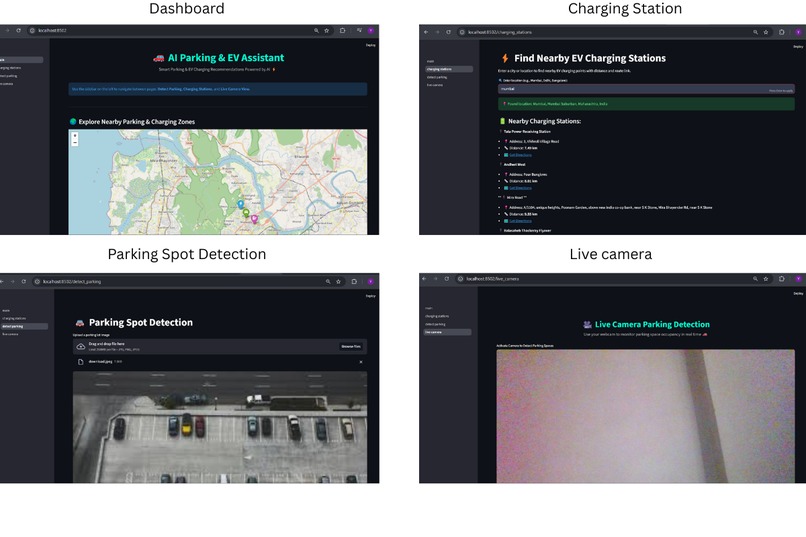
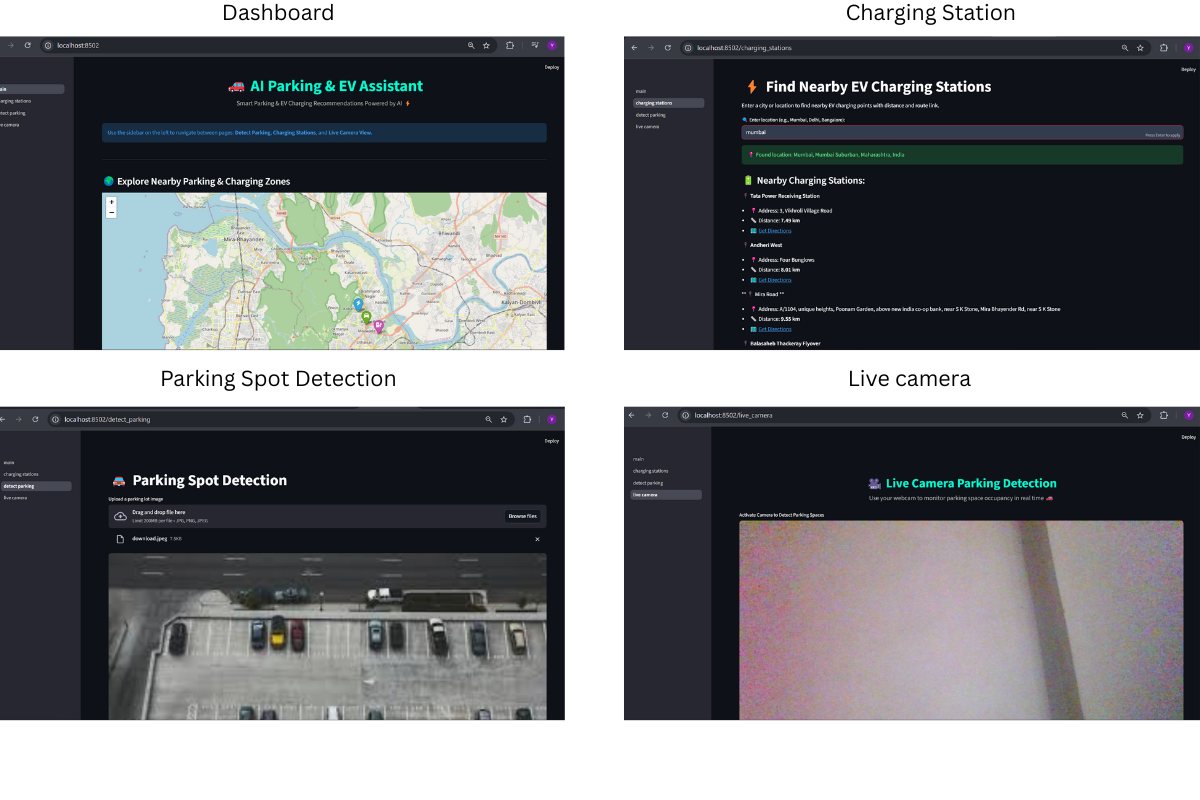
The AI Parking & EV Assistant provides three main features:
🅿️ Parking Detection
Users can upload an image or video of a parking area. The system detects occupied and empty parking spots using a YOLOv8 model trained on a Kaggle dataset.
⚡ EV Charging Station Finder
Users enter their source and destination, and the app displays the distance in kilometers and nearby EV charging stations using Google Maps API and Folium.
📷 Live Camera Detection
Integrates with the webcam to perform real-time detection of parking availability — enabling continuous, automated monitoring of parking spaces.
🛠️ How We Built It
The project was built entirely in Python using Streamlit as the frontend-backend framework.
🧩 Tech Stack & Tools Used
Model: YOLOv8 (Ultralytics)
Dataset: Kaggle Parking Slot Detection Dataset
Mapping: Google Maps API, Folium
Libraries: OpenCV, NumPy, Streamlit-Folium
⚙️ Workflow Summary
Trained a YOLOv8 model on the Kaggle dataset for parking slot detection.
Integrated model inference into a Streamlit interface for user uploads and live detection.
Connected Google Maps API for EV route and charging point visualization.
Combined OpenCV and Streamlit-Folium to create an interactive and real-time web app.
🔍 Challenges We Ran Into
Building this project came with its share of challenges:
Integrating YOLOv8 with Streamlit while maintaining real-time performance for live camera detection.
Managing map API calls and ensuring accurate distance rendering between source and destination points.
Handling large image and video files efficiently during uploads and inference.
Optimizing the app to remain lightweight and responsive for all users.
Each challenge helped deepen my understanding of model deployment, API integration, and user experience design.
🏆 Accomplishments That We’re Proud Of
Successfully trained and deployed YOLOv8 for real-time parking detection.
Created a working prototype that merges AI computer vision and geolocation intelligence.
Built a beginner-friendly web app that demonstrates the real-world impact of AI in transportation.
Learned to combine AI, mapping, and web development into a single functional project.
🌱 What We Learned
Through this project, I learned how to:
Train and deploy YOLOv8 for real-world computer vision applications.
Connect AI models with interactive web interfaces using Streamlit.
Integrate Google Maps API for live distance and location visualization.
Optimize inference performance and handle user input dynamically.
Most importantly, I learned how AI can make everyday life simpler, greener, and more efficient.
🚀 What’s Next for AI Parking & EV Assistant
Future updates will include:
IoT integration for real-time parking spot availability.
Voice assistant for hands-free operation.
Mobile app version for easy accessibility.
Charging station price and slot comparison features.
💫 Closing Thoughts
This project represents my vision of a smarter, AI-driven future — where technology helps people save time, reduce stress, and support eco-friendly transportation.
Building this as a solo student developer taught me that innovation starts small — one idea, one model, and one step at a time.


Log in or sign up for Devpost to join the conversation.