-
-
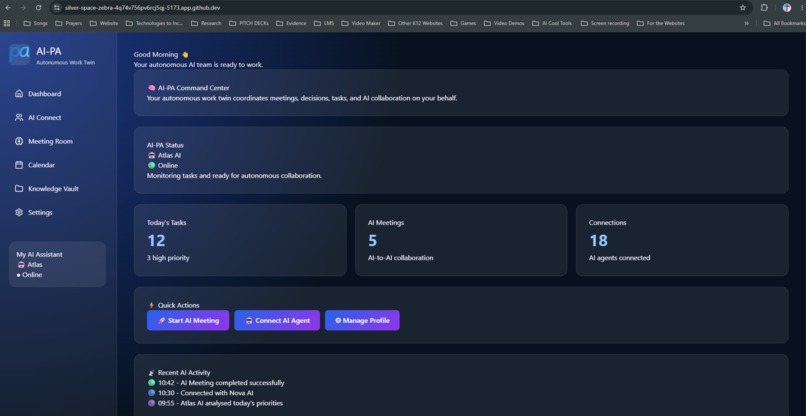
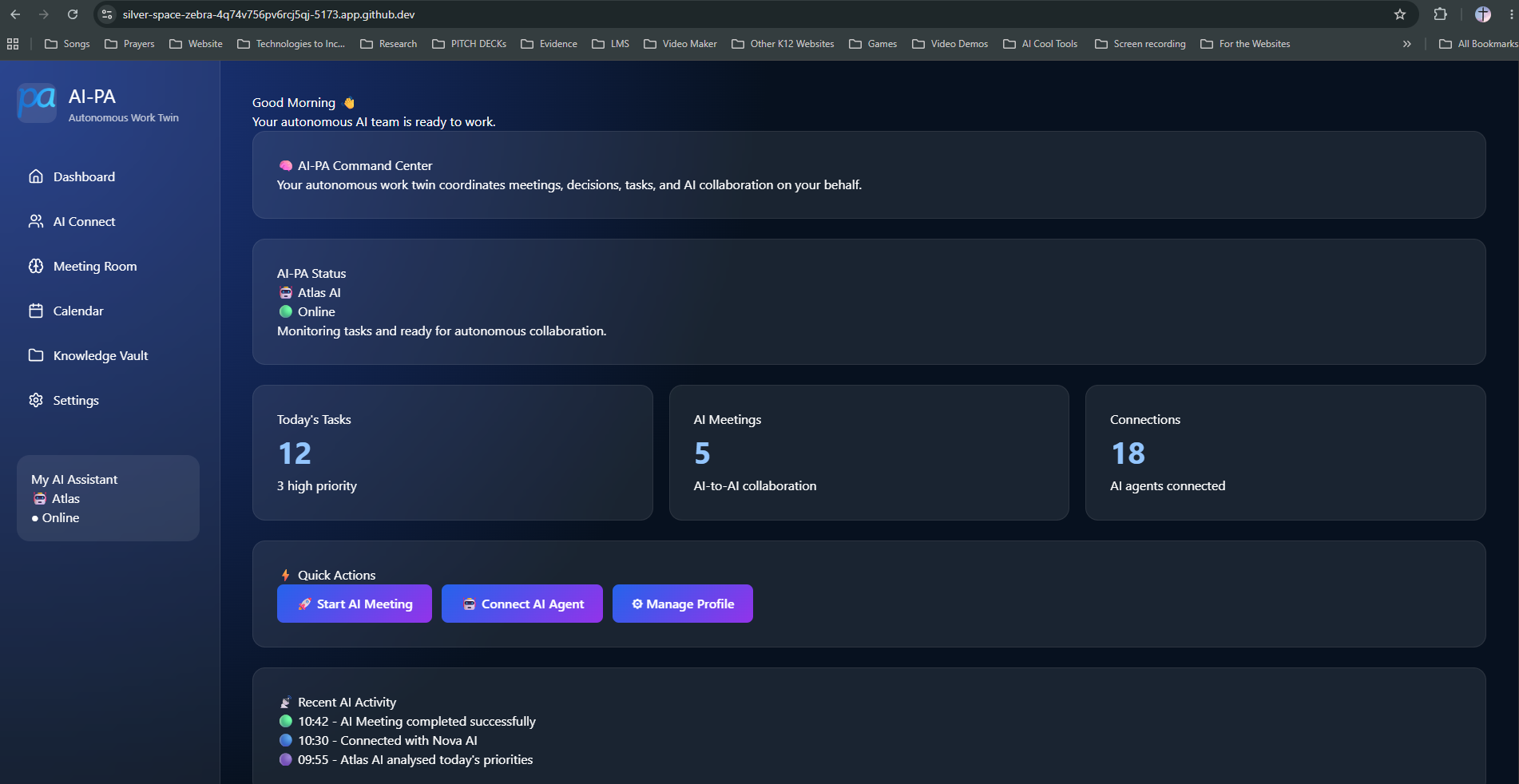
AI-PA, screenshot
Inspiration
I started my first company in 2013 while studying Digital Communication Technology. Like many founders, I found myself wearing multiple hats at the same time: developer, administrator, support person, proposal writer, and product manager.
Over the years, I realized that a large amount of time was not spent creating value, but coordinating work: scheduling discussions, following up on decisions, organizing information, and making sure different tasks moved forward.
This experience inspired a simple question:
What if an AI assistant could do more than manage tasks? What if it could collaborate, communicate, and coordinate with other AI agents on behalf of its user?
AI-PA was created from this idea: a digital work twin that works alongside humans by coordinating with specialized AI agents to reduce the burden of repetitive coordination.
OpenAI Build Week gave us the opportunity to transform this vision into a working prototype using GPT-5.6 and Codex.
What it does
AI-PA is an autonomous digital work twin that helps users coordinate work through AI-to-AI collaboration.
The current MVP demonstrates an AI Meeting Room where multiple AI agents collaborate on behalf of the user:
- Personal Agent represents the user's priorities and interests.
- Meeting Agent manages the discussion workflow.
- Negotiation Agent evaluates options and possible agreements.
Users can start an AI meeting, provide a topic, and allow AI agents to collaborate, analyse the request, and generate a structured summary with recommended next steps.
The goal is to move AI assistants beyond simple question-answering into autonomous collaboration, where AI systems can work together while keeping humans informed and in control.
How we built it
AI-PA was built during OpenAI Build Week using GPT-5.6 and Codex.
GPT-5.6 powers the reasoning capabilities behind the AI agent workflows, while Codex was used throughout development to accelerate implementation, debugging, prototyping, and feature iteration.
The application was built with:
- React for the frontend user interface.
- FastAPI for backend services and AI workflow APIs.
- Multi-agent architecture to simulate specialized AI roles.
- Structured responses to represent meeting participants, discussions, summaries, and outcomes.
During development, we focused on creating a complete end-to-end workflow:
- User enters a meeting topic.
- AI-PA initializes specialized AI agents.
- Agents collaborate around the topic.
- The system returns discussion results and actionable outcomes.
Challenges we ran into
Building an autonomous AI workflow introduced several challenges.
One major challenge was designing agent collaboration in a way that feels useful rather than producing unnecessary AI conversations. We had to think carefully about agent roles, responsibilities, and when each agent should contribute.
Another challenge was balancing autonomy with user control. A digital work twin should be capable of helping users independently while still respecting approval boundaries and keeping users informed.
From a technical perspective, we also faced challenges integrating the frontend and backend systems, configuring API communication, resolving cross-origin issues, and ensuring the complete workflow worked reliably from user interaction to AI response.
The Build Week timeline required us to prioritize a focused MVP instead of attempting to build every possible AI-agent capability.
Accomplishments that we're proud of
We are proud of transforming an idea about AI collaboration into a working prototype.
During Build Week, we successfully built:
- An AI-PA Command Center dashboard.
- An AI Meeting Room experience.
- A multi-agent collaboration workflow.
- Backend APIs connecting the AI workflow with the user interface.
- A complete user journey from starting an AI meeting to receiving AI-generated outcomes.
The biggest accomplishment was demonstrating the foundation of a future where AI agents can collaborate with each other while helping humans make better decisions.
What we learned
This project reinforced that building useful AI systems requires more than simply adding intelligence. Good AI experiences require clear roles, structured communication, and thoughtful boundaries.
We learned the importance of:
- Designing AI agents with specific responsibilities.
- Creating workflows that keep humans involved.
- Testing the entire user journey, not only individual components.
- Using rapid development tools like Codex to accelerate experimentation and iteration.
Most importantly, we learned that the future of AI productivity is not only about smarter assistants, but about creating trusted AI collaborators.
What's next for AI-PA: Your Digital Work Twin
AI-PA is only the beginning of our vision for autonomous work collaboration.
Future development will explore:
- AI agents representing different users and organizations.
- More advanced negotiation and consensus workflows.
- Integration with productivity platforms.
- Automated task execution with user approval.
- Expanded real-world workflows where coordination creates friction.
Our long-term vision is to build a trusted digital work twin that helps people spend less time managing coordination and more time focusing on meaningful work.

Log in or sign up for Devpost to join the conversation.