AI Ops Guardian — Project Story 🔹 About the Project
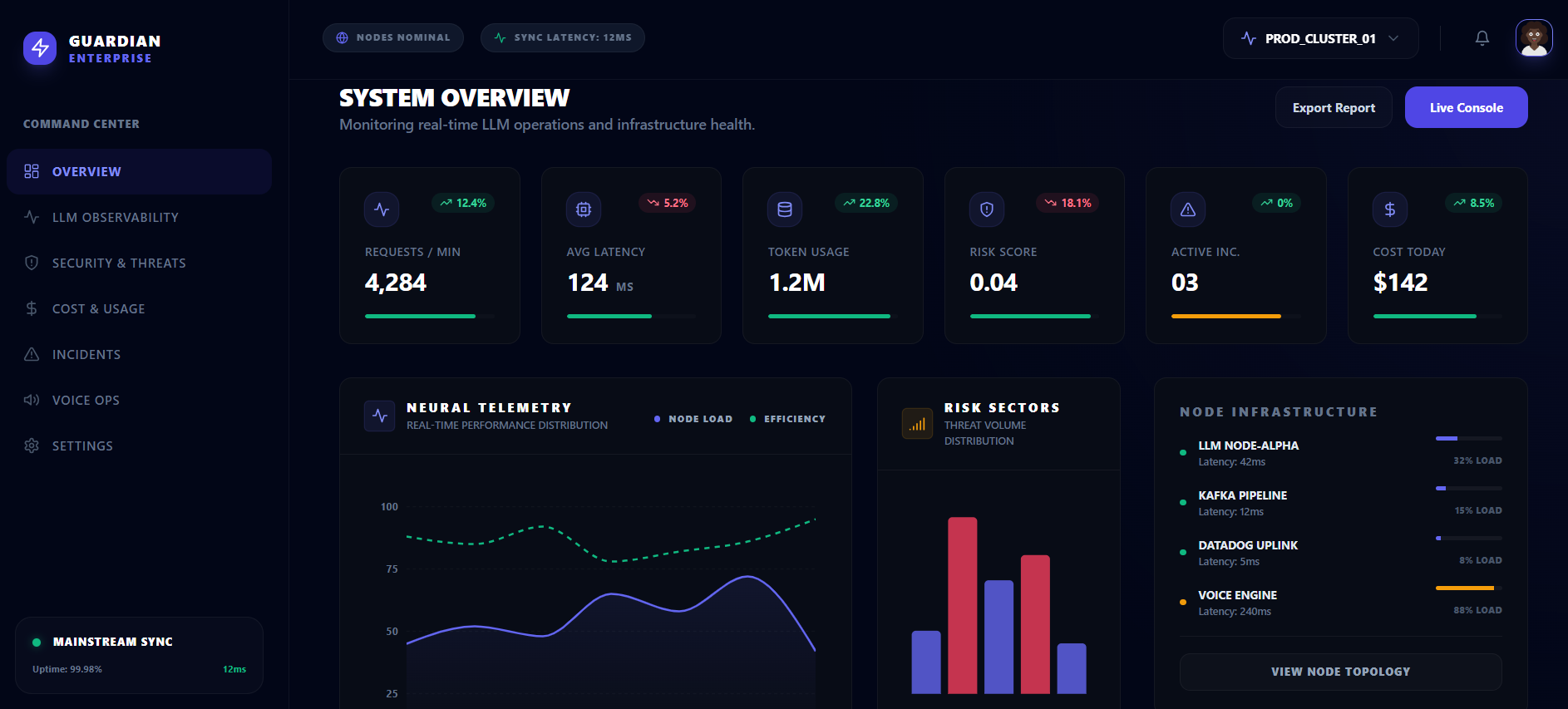
AI Ops Guardian is a real-time observability and security platform for Large Language Model (LLM) applications. It treats AI behavior as data-in-motion, continuously streaming prompts, responses, and runtime signals to detect risks, performance issues, and security threats as they happen.
Modern teams are rapidly deploying LLMs into production, but once deployed, these systems become hard to observe and control. Traditional monitoring tools focus on infrastructure, not AI behavior. AI Ops Guardian fills this gap by providing deep visibility into how LLMs actually behave in real-world usage — and by making incidents understandable through dashboards and voice explanations.
💡 What Inspired Us
The idea came from a simple realization:
Authenticating AI systems is not enough — we must also observe and govern their behavior in production.
While working on secure AI systems and agent-based architectures, we noticed a recurring problem:
LLMs hallucinate silently
Prompt injection attacks go unnoticed
Token usage explodes without warning
Engineers only find issues after users complain
AI systems were running in production with no behavioral guardrails.
This inspired us to build a platform that answers one critical question:
“What is my AI actually doing right now — and is it safe?”
🏗️ How We Built It
AI Ops Guardian was designed as a modular, event-driven platform, using best-in-class cloud and AI tools.
Core Architecture
Google Cloud Vertex AI / Gemini Used to power the LLM and generate AI-based explanations and remediation suggestions.
Confluent Kafka Streams LLM prompts, responses, latency, token usage, and security signals in real time.
Datadog Acts as the observability and action engine — dashboards, detection rules, alerts, and incidents.
ElevenLabs Provides voice-based alerts and conversational incident explanations.
Custom Telemetry Middleware Captures and enriches AI-specific signals that traditional monitoring tools miss.
Every LLM interaction is treated as an event:
AI Interaction → Telemetry Event → Stream → Detection → Action AI Interaction→Telemetry Event→Stream→Detection→Action 🔍 What the Platform Does
AI Ops Guardian monitors:
Prompt and response behavior
Latency and reliability
Token usage and cost anomalies
Prompt injection attempts
Hallucination risk indicators
When a detection rule is triggered:
Datadog creates an actionable incident
Gemini explains what went wrong and why
ElevenLabs delivers a voice alert for critical issues
Engineers receive clear, contextual guidance — not raw logs
🚧 Challenges We Faced
- Observing AI Is Not Like Observing Servers
LLM behavior is probabilistic, not deterministic. Designing meaningful signals (like hallucination risk) required combining heuristics with AI-based reasoning instead of fixed rules.
- Avoiding Alert Noise
We focused on actionable detection, not flooding dashboards with metrics. Each alert had to answer:
“Can an engineer act on this right now?”
- Keeping the Scope Hackathon-Ready
This platform could easily become very large. We deliberately scoped the MVP to:
One LLM app
Clear detection rules
One clean end-to-end demo path
📚 What We Learned
AI observability is fundamentally different from traditional monitoring
Streaming data is essential for trustworthy AI systems
Voice interfaces dramatically improve incident response clarity
Engineers need explanations, not just alerts
Most importantly, we learned that trust in AI systems comes from visibility, not just accuracy.
🚀 What’s Next
Future extensions include:
Agent-to-agent behavior monitoring
Compliance reporting (GDPR / PDPL / AI governance)
SDKs for easy integration into existing AI apps
Deeper cost optimization and AI performance benchmarking
🎯 Final Thought
AI Ops Guardian is not just a monitoring tool — it’s a runtime trust layer for AI systems.
As AI moves into critical workflows, platforms like this will be essential to make AI:
Observable
Secure
Accountable
And reliable in production
Built With
- backend:
- built-with:-languages:-typescript
- communication:
- coolify
- javascript-frontend-framework:-react-18-(vite)-styling-&-ui:-tailwind-css
- lucide-icons-infrastructure:-docker
- nginx
- node.js
- real-time
- shadcn/ui-(radix-ui)-visuals:-recharts
- telemetry)
- websockets

Log in or sign up for Devpost to join the conversation.