Inspiration
I run an AI consulting business for local service companies, and the same two problems come up in every first conversation: missed calls quietly leak revenue, and businesses with a thin web presence never get recommended when someone asks an AI assistant for a plumber or a roofer. Owners can feel something is off but have no number attached to it. I wanted a tool that turns a business name into that number in about two minutes.
What it does
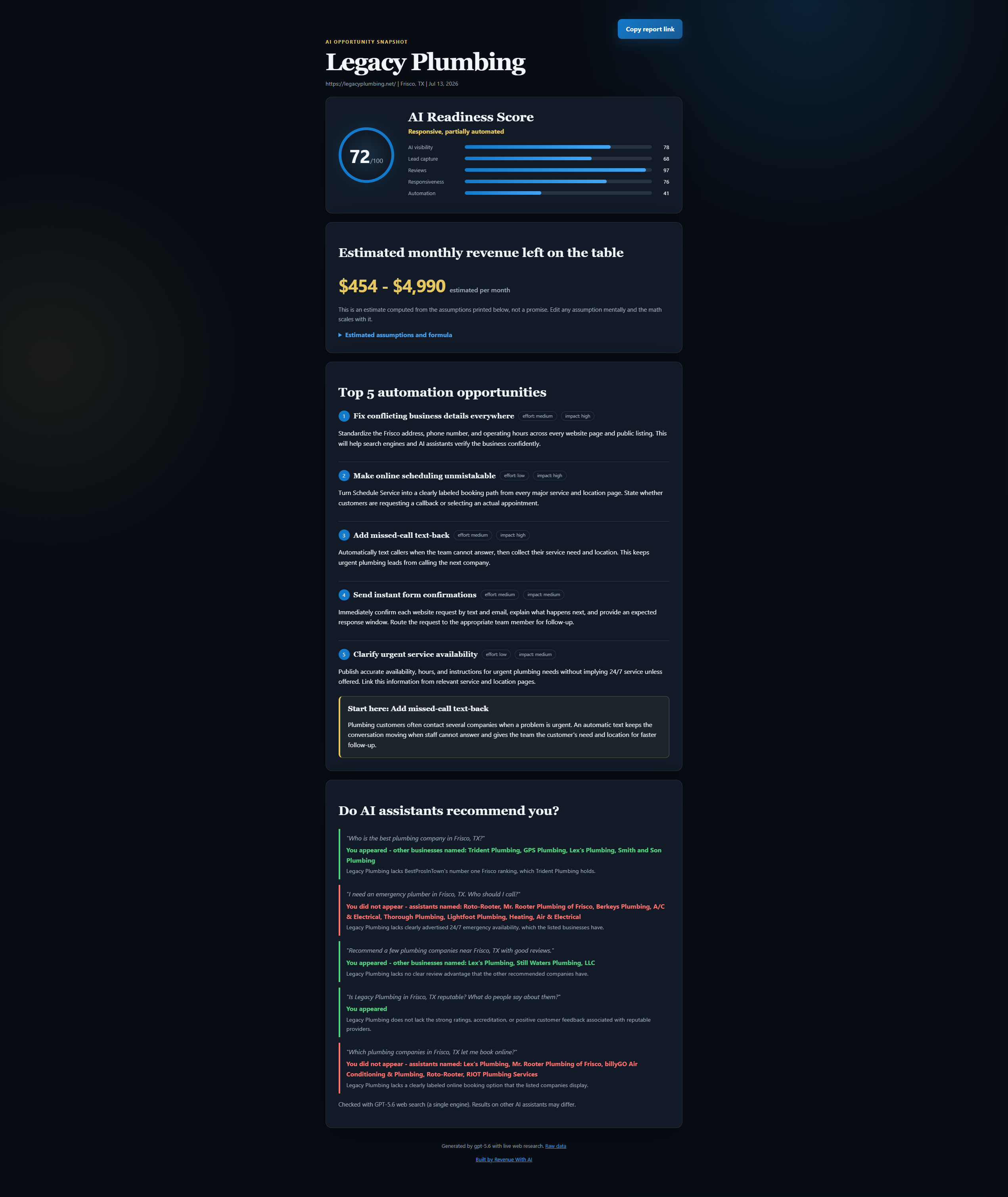
Enter a local service business and AI Opportunity Snapshot researches it live, then returns a shareable report with:
- An opportunity score with a plain-language band (for example "Findable but manual")
- An estimated monthly revenue-left-on-the-table range, with every assumption printed on the report
- The first automation to build for that specific business, with reasoning
- An AI visibility check: can assistants actually find and recommend this business today?
Every report gets a permanent shareable link plus raw JSON. Try it live, no login: https://opportunity-snapshot.airevenuestack-jason.workers.dev
How I built it
The entire project was built in Codex, in one primary session, on GPT-5.6. Codex wrote the Astro 6 SSR application, the Cloudflare Worker deployment, the scoring engine, the deterministic ROI math, and the test suite (61 unit tests, all passing).
GPT-5.6 also powers the product at runtime through the Responses API in two passes: web search to research the business (site, hours, booking options, reviews, AI visibility), then a strict structured-output call that returns typed JSON the report is rendered from. One deliberate design rule: the model never produces dollar amounts. All estimates are computed deterministically in code from the printed assumptions table, so the numbers are explainable and reproducible.
Challenges I ran into
- Model-backed runs take one to two minutes, which is longer than Cloudflare's detached-work window. Keeping the request connected while KV-backed status polling drives the UI took real iteration.
- Score stability: a report is only credible if rerunning the same business lands in the same band. I verified this with golden runs across strong, average, and thin web presences, including a rerun that scored 59 against an original 60.
- Copy safeguards: tests enforce that user-facing copy stays clean and that no invented figures slip through.
Accomplishments I'm proud of
Registered, specced, built, tested, and deployed to production inside Build Week, solo. 61/61 tests, a fresh-clone verified README, and three verified golden reports spanning the scoring range.
What I learned
Pairing GPT-5.6's research strengths with deterministic code for anything numeric is the right split: the model finds and structures facts, the code owns the math. And Codex is genuinely capable of carrying a full production build when the spec is written first.
What's next
Lead capture on report pages, PDF export for consultants, and richer visibility checks across more AI assistants.
Built With
- astro
- cloudflare-workers
- codex
- couldflare-kv
- gpt-5.6
- openai
- typescript
- vitest

Log in or sign up for Devpost to join the conversation.