

Inspiration
Businesses already have dashboards that tell teams when something goes wrong, but they often still depend on people to investigate the cause, decide what to do, execute the fix, and verify the result.
We wanted to build something that goes beyond monitoring and turns operational data into actionable, coordinated AI-driven resolution.
This inspired us to create AI Operations Command Center, a multi-agent AI system that works like an AI operations team.
What We Built
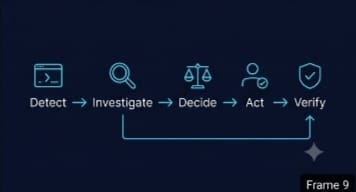
AI Operations Command Center follows a closed-loop workflow:
Detect → Investigate → Decide → Act → Verify
The system uses specialized AI agents:
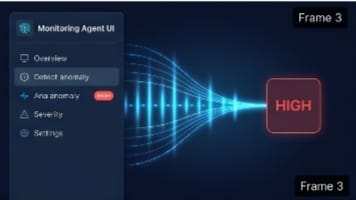
- Monitoring Agent — detects unusual changes in business metrics.
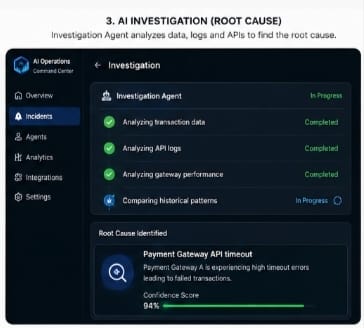
- Investigation Agent — analyzes data, logs, and APIs to identify the root cause.
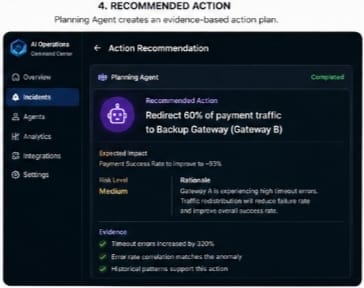
- Planning Agent — creates an evidence-based corrective action.
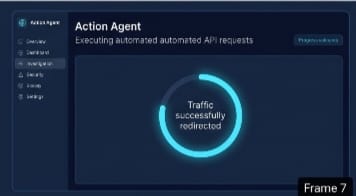
- Action Agent — executes approved actions through tools or APIs.
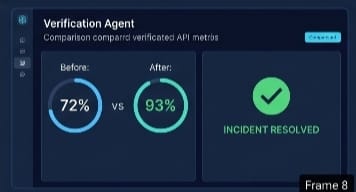
- Verification Agent — checks whether the action actually resolved the problem.
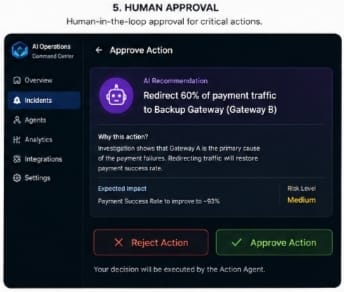
Sensitive operations include a human-in-the-loop approval step, keeping people in control of high-impact decisions.
How It Works
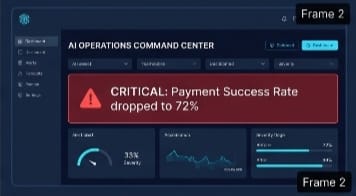
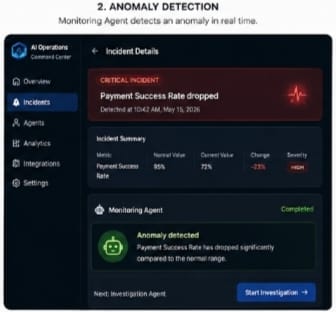
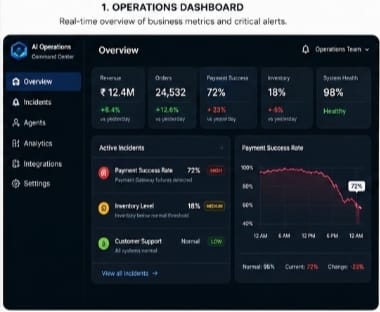
For example, imagine an e-commerce company where payment success suddenly falls from 95% to 72%.
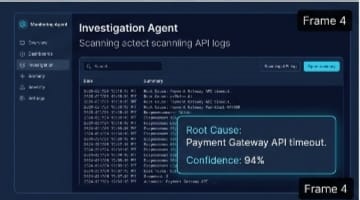
The Monitoring Agent detects the anomaly and triggers an investigation. The Investigation Agent analyzes transaction data and API logs and identifies a payment gateway timeout as the likely root cause.
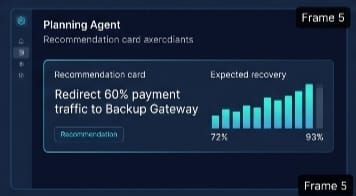
The Planning Agent then recommends switching a portion of traffic to a backup gateway. Instead of executing a sensitive action automatically, the system presents the recommendation to an operator for approval.
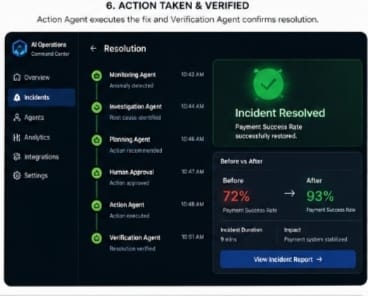
After approval, the Action Agent executes the operation and the Verification Agent checks the resulting metrics.
The workflow ends with:
Payment Success: 72% → 93%
and the incident is marked as resolved.
How We Built It
The project is designed as a multi-agent enterprise application with a web-based operations dashboard.
Technology Stack
- Frontend: React, Vite, Tailwind CSS
- Backend: Python, FastAPI
- AI: LLM-powered specialized agents
- Database: PostgreSQL / MySQL
- Integration: REST APIs and tool-based agent interactions
- Development: GitHub and VS Code
The architecture separates responsibilities between agents so that each agent has a focused role instead of relying on a single general-purpose chatbot.
What We Learned
Building an agentic system taught us that creating reliable AI agents involves much more than generating good responses.
We focused on:
- Designing clear responsibilities for individual agents
- Managing information between multiple agents
- Making tool and API interactions reliable
- Adding human approval for sensitive actions
- Providing explanations and confidence levels
- Verifying the result after an action is taken
One of our biggest learnings was that an effective enterprise agent should not just answer questions. It should be able to reason about a problem, use tools, coordinate with other agents, take appropriate actions, and verify the outcome.
Challenges
One of the major challenges was maintaining reliable context across multiple agents. Each agent needs enough information from previous steps without creating unnecessary complexity.
We also faced challenges around:
- Multi-agent orchestration
- Reliable API and tool execution
- Handling unexpected agent outputs
- Preventing hallucinated conclusions
- Designing safe autonomous actions
- Knowing when to involve a human
- Verifying that an action actually solved the problem
We addressed these challenges by giving each agent a clearly defined responsibility, introducing structured workflow states, and adding a human approval layer before sensitive actions.
What Makes It Different
Traditional monitoring systems mainly answer:
"What went wrong?"
AI Operations Command Center aims to answer:
"What went wrong, why did it happen, what should we do, can we safely act on it, and did the action actually work?"
Our goal is to move enterprise operations from reactive monitoring to proactive, AI-driven resolution.
Future Improvements
If extended beyond the hackathon, we would add:
- More enterprise system integrations
- MCP-based tool connectivity
- Real-time event streaming
- More specialized agents
- Advanced anomaly detection
- Role-based access control
- Detailed audit trails
- Continuous learning from previous incidents
- Support for multiple simultaneous incidents
Final Vision
We envision AI Operations Command Center becoming an intelligent operations layer that works alongside enterprise teams — continuously monitoring systems, investigating problems, coordinating specialized agents, and helping humans resolve incidents faster while keeping critical decisions under human control.
Built With
- agentic-ai
- artificial-intelligence
- automation
- enterprise
- fastapi
- generative-ai
- llm
- mcp
- multi-agent-systems
- postgresql
- python
- react
- rest-api

Log in or sign up for Devpost to join the conversation.