-
-
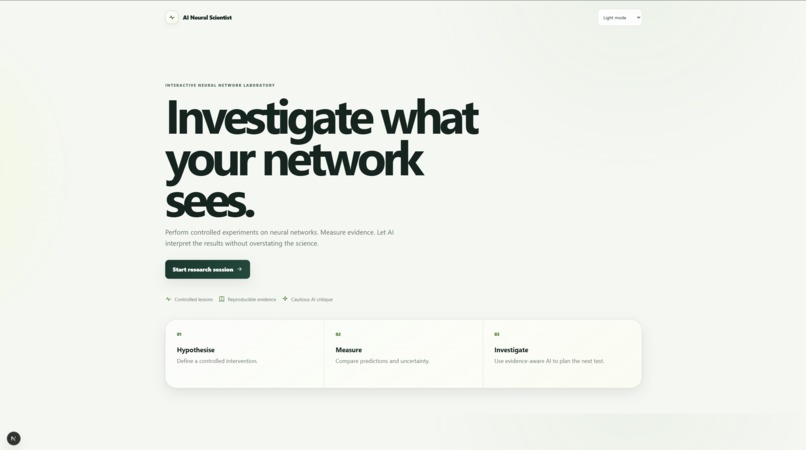
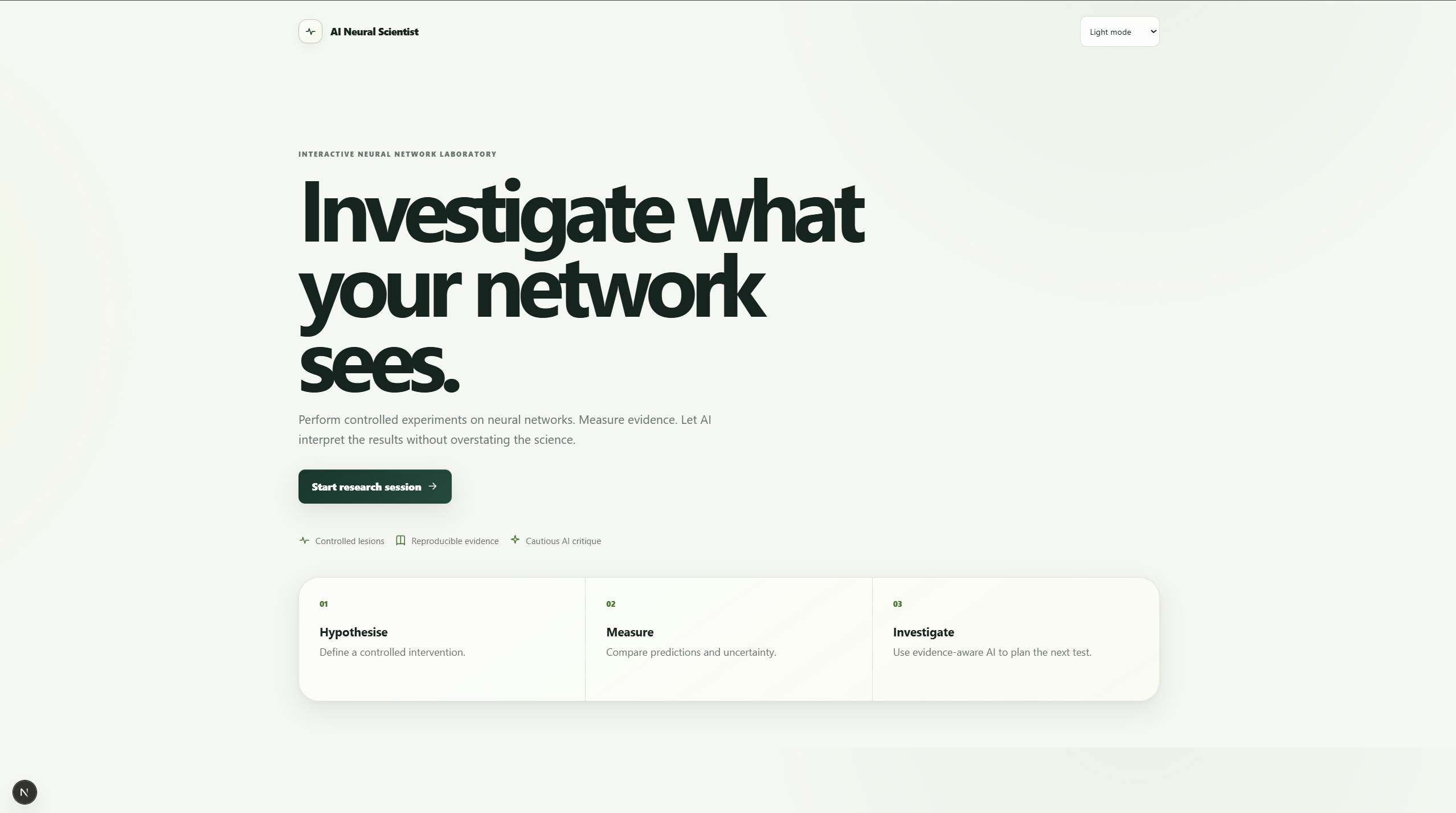
AI Neural Scientist Landing Home Page
-
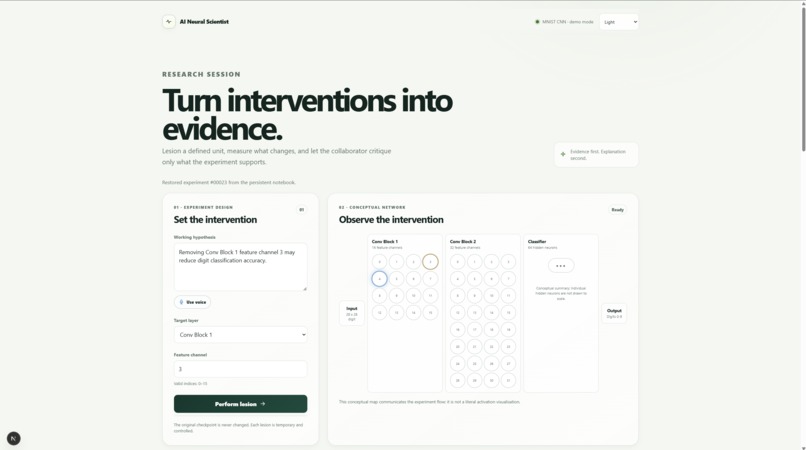
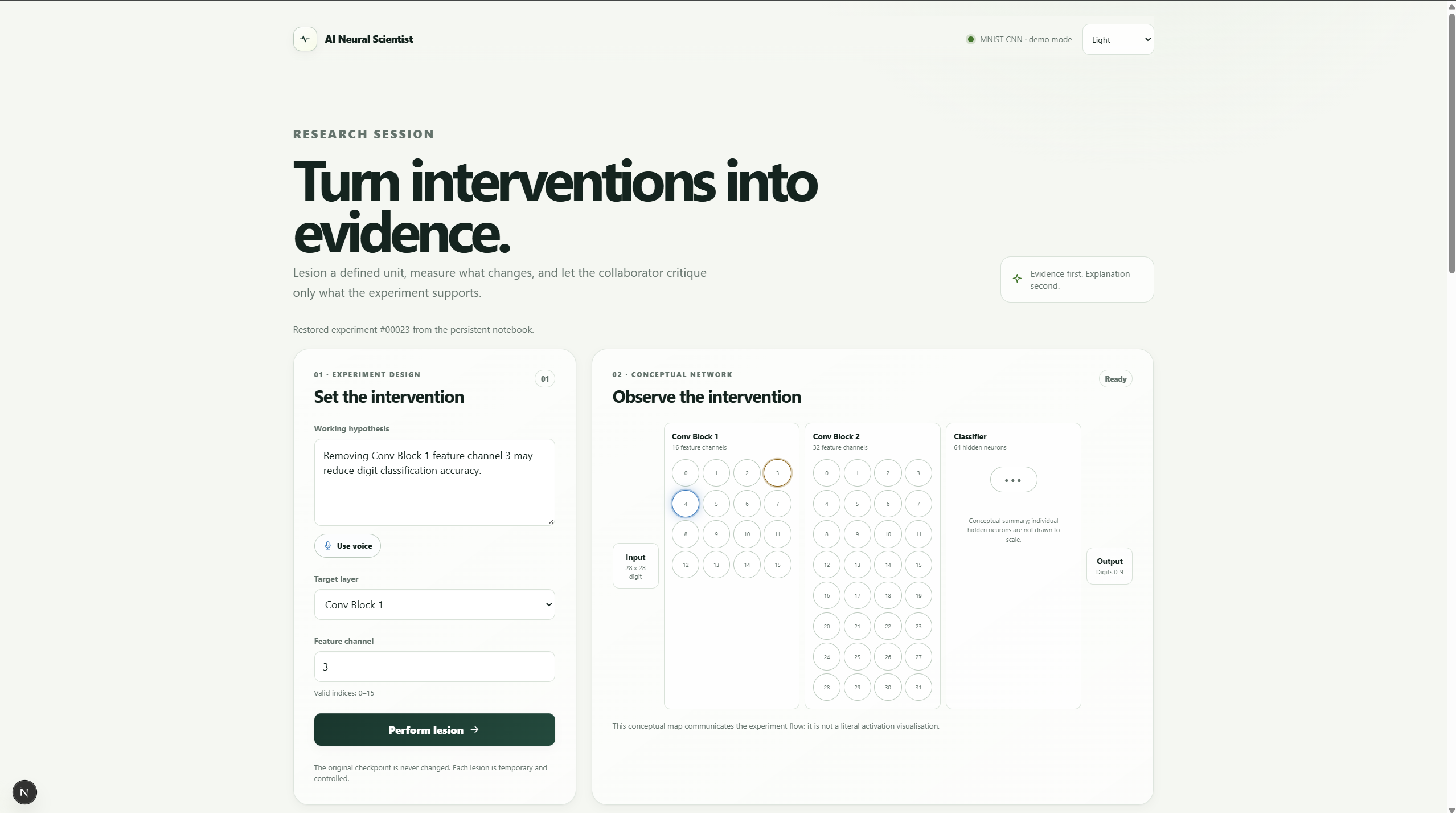
AI Neural Scientist Main Page view
-
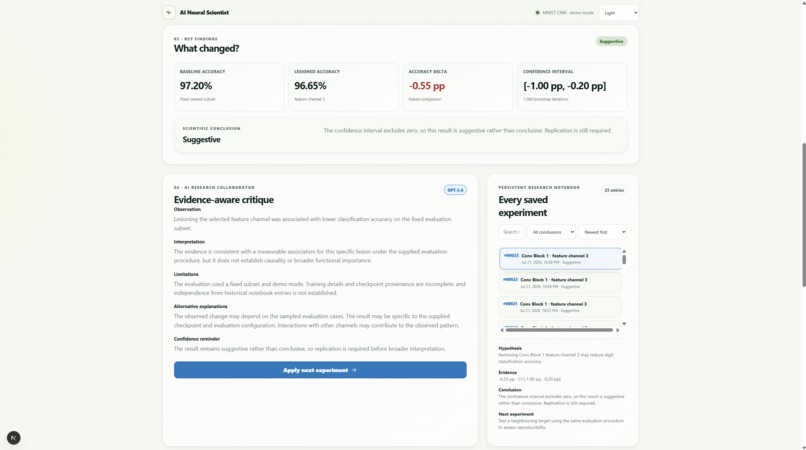
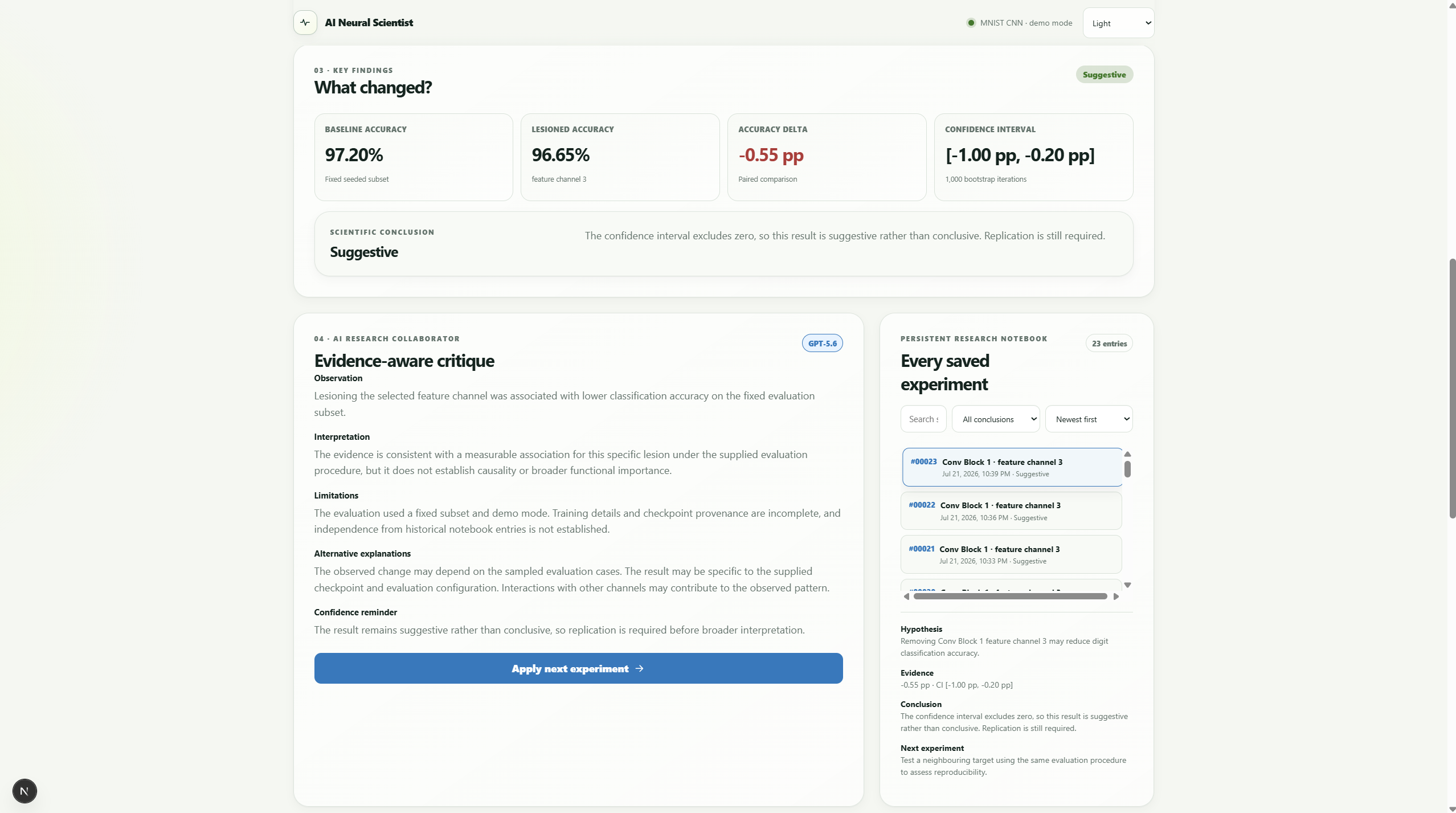
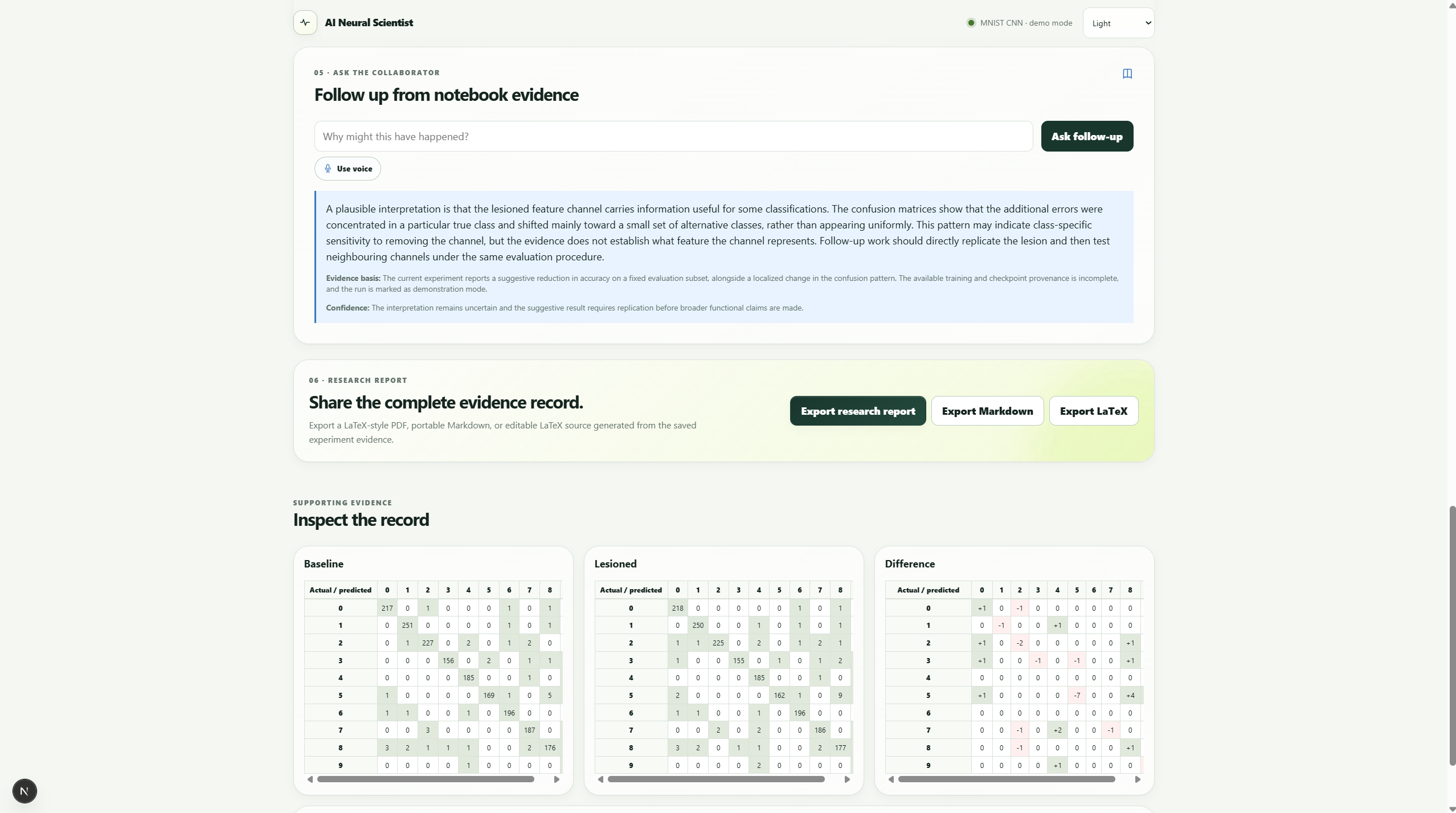
AI Neural Scientist Research Collaborator
-
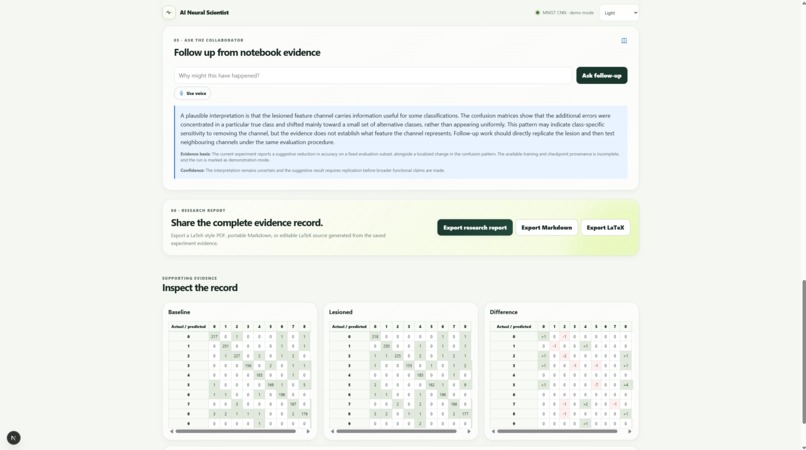
AI Neural Scientist Research Collaborator 1
-
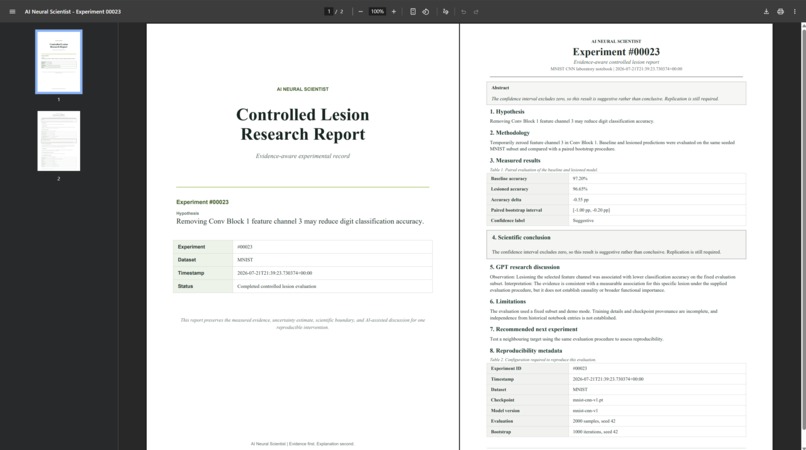
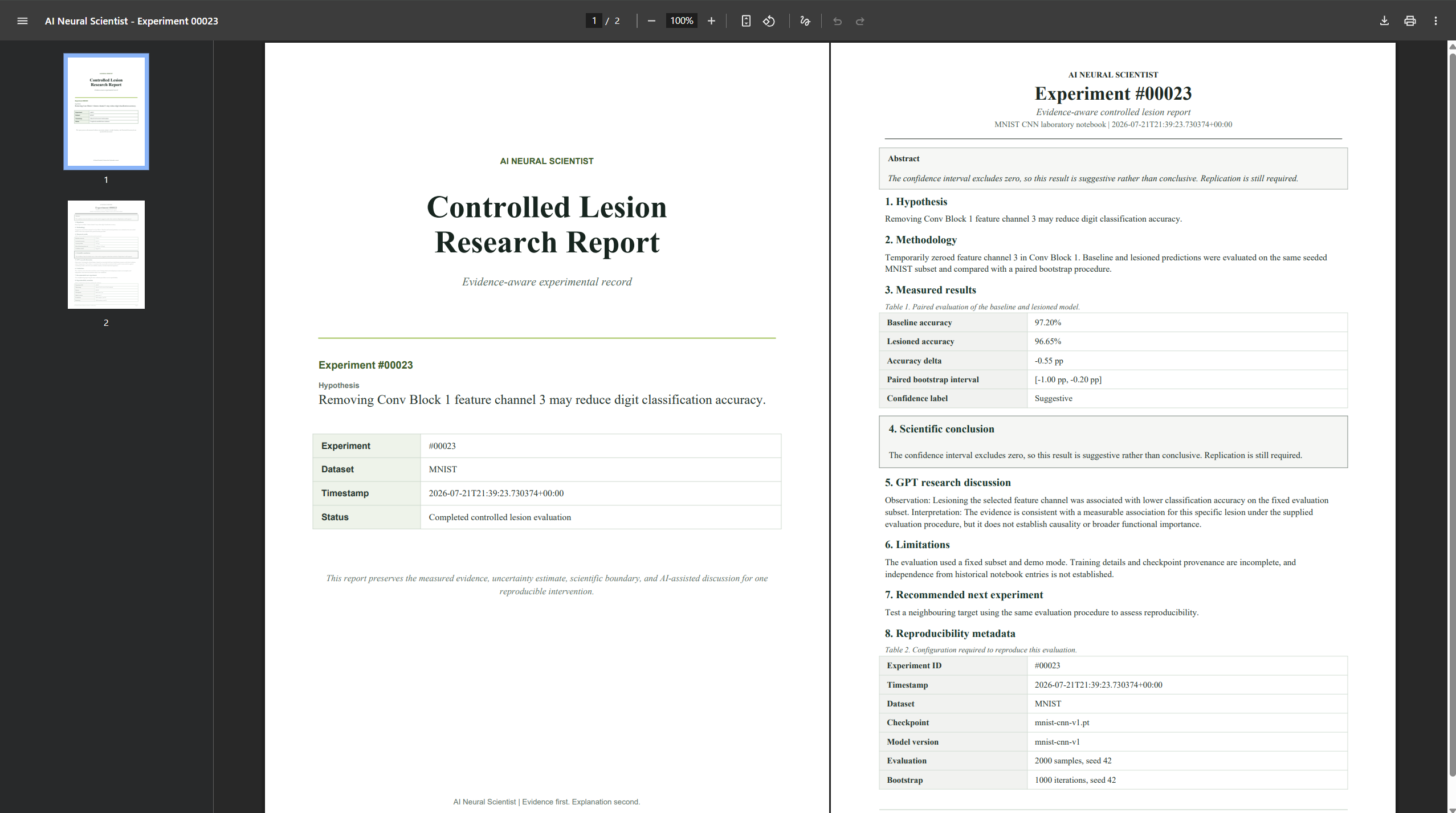
AI Neural Scientist Exported Research Report
AI Neural Scientist
Inspiration
When I was in my first year of Computer Science undergraduate degree learning about Neural Networks it was taught as black boxes. Students would often train a model, then observe how accurate they were and then move on without understanding why the model actually behaves like it does.
I wanted to enter the OpenAI Build Week 2026 and enter the education category as I want to build a tool that encourages experimentation rather than just observation. I was inspired by Neuralink and how neuroscientists study the human brain. Here AI Neural Scientist lets the users perform controlled "lesions" on a virtual neural network where they can measure the behavioural impact and work with OpenAI GPT-5.6 as a caution research collaborator together in a virtual laboratory. Rather than presenting the AI as a so called magic interaction, the AI Neural Scientist teaches that the underlying scientific understanding comes from carefully designed valid experiments, measured evidence and replication of these experiments.
What it does
AI Neural Scientist transforms a trained MNIST CNN (convolutional neural network) into an interactive research laboratory. Users can:
- formulate a research hypothesis
- temporarily lesion (disable) an individual feature channel or a hidden neuron
- compare baseline performance and lesioned performance on the same deterministic evaluation subset
- inspect accuracy changes, confusion matrices, paired bootstrap confidence intervals
- ability to distinguish suggestive results from inclusive results
- receive tailored evidence-aware feedback analysis from GPT-5.6
- ask follow-up questions with context-aware responses from GPT-5.6
- save experiments to a research notebook
- export experiments as PDFs, Markdown scripts and LaTeX research reports
How we built it
AI Neural Scientist is a full-stack research platform tool. Its Frontend consists of:
- Next.js
- React
- TypeScript. This frontend provides a modern research dashboard UI featuring:
- light/dark/system themes
- conceptual neural-network visualisation
- responsible layouts
- modern glass-inspired UI
- mobile support
- reduced-motion accessibility
- PDF and report export
The backed is built using PyTorch and FastAPI. The backend provides:
- the lesion engine
- deterministic evaluation
- GPT-5.6 integration
- paired bootstrap confidence intervals
- SQLite persistence
- report generation
How GPT-5.6 was used
GPT-5.6 acts in the AI Neural Scientist as a research collaborator and not a source of truth. For every experiment, the backend provides GPT-5.6 wish a structured packet containing:
- the hypothesis
- intervention
- measured statistics
- confidence interval
- confusion matrices
- scientific conclusion
- previous notebook context
Then GPT-5.6 uses this to:
- critique the experiment
- discuss limitations
- suggest alternative explanations
- recommend follow-up experiments However it cannot alter measured statistics or override the deterministic conclusions produces by the experiment engine due to the in-built safeguards built into the AI Neural Scientist. Also, if GPT is unavailable, then it falls back to the backup rule-based scientific guidance.
How Codex accelerated the development
Codex acted as an AI engineering collaborator throughout the project. It accelerated architecture design, implementation, debugging, testing, release reviews and documentation while every major engineering decision and scientific claim was reviewed and validated before being incorporated into the project.
It helped me to:
- design the overall architecture
- implement the lesion engine
- help build the FastAPI backend
- develop the research notebook
- help to refine the GPT evidence pipeline
- integrate the report export system
- review the repo for release readiness Every major engineering decision was still reviewed and validated before being incorporate into the project.
Challenges we ran into
One of the main challenges was making sure that the project remained scientifically responsible. This is because it would have been easy for GPT-5.6 to overstate conclusions from a single experiment which is why guardrails was implemented in order to prevent unsupported claims and ensure the deterministic experiment engine remained scientifically responsible.
Another challenge was making sure that it was also usable to a broad range of users especially learners and students. I wanted the interface to feel like a modern research application while remaining understandable to students who are learning about neural networks and machine learning for the first time.
Accomplishments that we're proud of
I'm quite proud that the AI Neural Scientist is far more than just a chatbot or even a chatbot extension attached to a machine learning mode. Every experiment is driven by a real PyTorch lesion engine with deterministic evaluation, paired bootstrap confidence and an evidence-first workflow.
Some of the accomplishments that I'm proud of are:
- Building a complete full-stack application using Next.js, FastAPI, PyTorch and SQLite.
- Creating a research notebook that persists experiments and allows users to reopen and export previous work
- Designing GPT-5.6 to behave as a cautious research collaborator instead of an authoritative answer engine
- Implementing scientific guardrails so GPT-5.6 cannot invent statistics or overstate experimental conclusions
- Producing professional PDF, Markdown and LaTeX research reports directly from completed experiments
- Creating a polished research-laboratory interface with modern glass-inspired visuals, accessibility support and responsive layouts
The current final application of AI Neural Scientist feels like an actual educational research tool that people will actually use often rather that a simple machine learning demo.
What we learned
This project taught me how difficult it is to be project manager and technical co-founder building with the most cutting-edge technologies using OpenAI Codex and GPT-5.6. In addition it taught me far more than how to build another AI application.
One of the biggest lessons I learned was that building trustworthy is just as much as about interface design and scientific communication as it is about machine learning models. I also learned how important it is to separate measured evidence from AI generated interpretation. The GPT-5.6 model became significantly more useful especially when it was constrained to critique structured experimental evidence rather than to go about freely generating explanations. In addition, I also gained experience gained experience designing reproducible experiments using deterministic evaluation, bootstrap confidence intervals and careful metadata tracking. Throughout development I found myself thinking much more like researchers than software developer which is what I aspire to be.
What's next for AI Neural Scientist
Although the current release for AI Neural Scientist focuses on the MNIST datataset, the underlying architecture was designed to grow into a more broader educational neuroscience lab for artificial neural networks.
Some future directions include:
- Support for additional datasets such as FashionMNIST and CIFAR-10.
- Comparing multiple trained models and checkpoints.
- Feature visualisation and attribution methods such as Grad-CAM and Captum.
- Progressive neuron death and recovery through retraining.
- Experiment comparison across multiple research sessions.
- More advanced statistical analysis and reproducibility tools.
- Cloud deployment with optional multi-user collaboration.
- Integration with larger modern neural-network architectures for explainability education.
The long-term vision is to create an educational platform where students can learn neural-network interpretability through experimentation rather than memorisation.
Built With
- ai
- codex
- deep
- education
- explainable
- fastapi
- gpt-5.6
- javascript
- machine-learning
- mnist
- neuroscience
- next.js
- openai
- python
- pytorch
- react
- reportlab
- research
- sqlite
- torchvision
- trustworthy
- typescript

Log in or sign up for Devpost to join the conversation.